
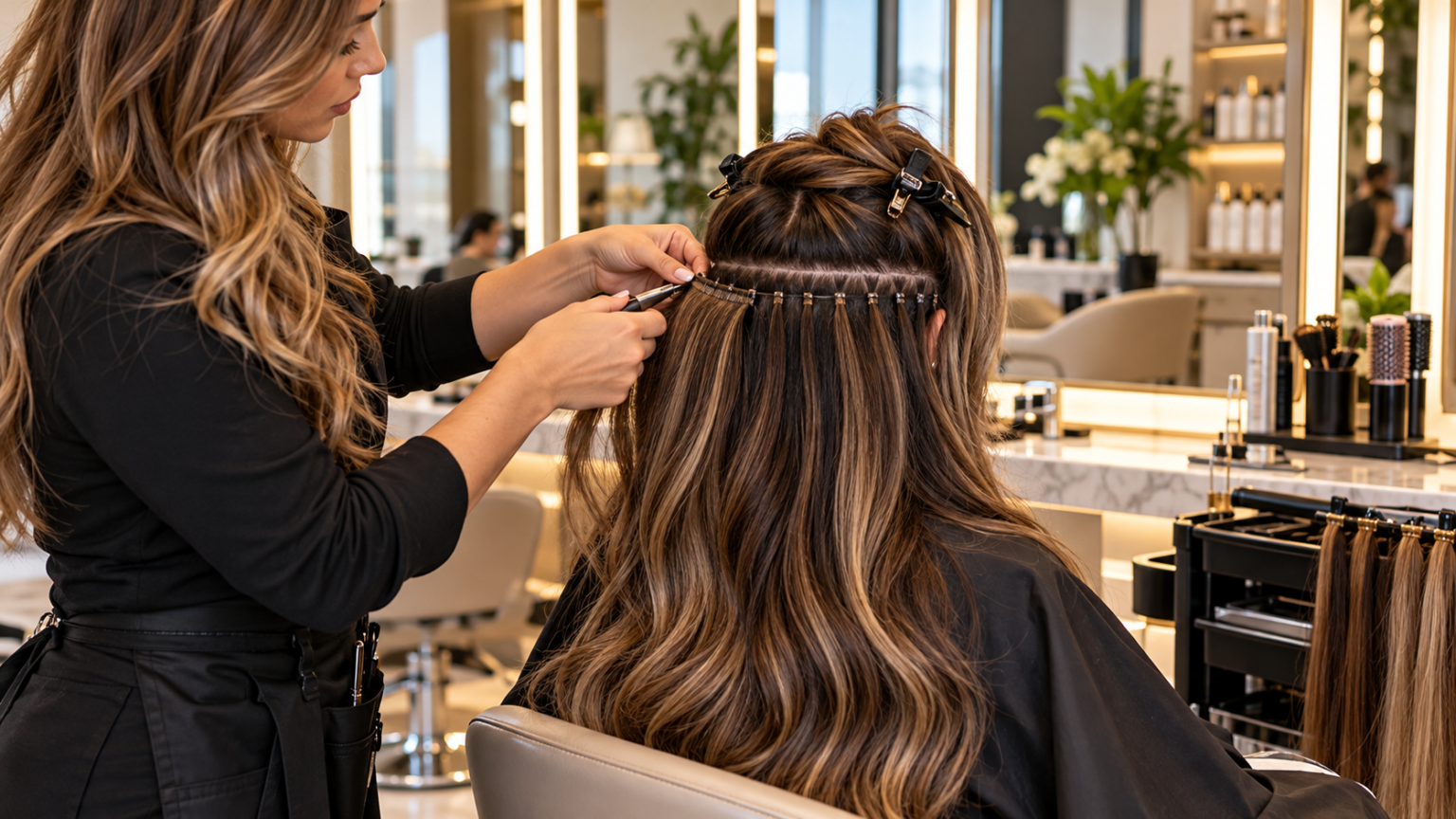
Hair extensions can transform the appearance of your hair by adding fullness, length, and movement. Whether you want to improve the thickness of your ends, achieve longer hairstyles, or create a more balanced look, choosing the right installation is essential. One of the most common questions people ask before booking an appointment is how many rows of extensions you need to achieve a beautiful result without placing unnecessary weight or tension on your natural hair.
The answer is more personal than many people expect. One person may achieve their desired fullness with a single row of extensions, while another may need two rows for noticeable length. Someone with a short, blunt haircut or very thick natural hair might require a more detailed blending arrangement involving three rows.
However, more rows do not automatically mean better results.
The correct number depends on the density of your natural hair, its current length, the desired transformation, the weight of the extensions, and the health of your scalp.
Placement also matters. Even high-quality extensions can feel uncomfortable or become visible when installed incorrectly.
A professional stylist considers all these factors before recommending a suitable installation plan.
This guide explains how beaded row extensions work, what one, two, or three rows can achieve, and the seven important factors that influence how many rows are appropriate for your hair.
What Are Rows of Hair Extensions?
A row is a horizontal attachment foundation used to secure hair-extension wefts to natural hair.
In a beaded row installation, a stylist creates a carefully positioned line of small beads that help support the wefts.
The extension hair is attached along this foundation using an appropriate professional installation technique.
The goal is to create added length or volume while keeping the attachment points concealed beneath natural hair.
Understanding Hand-Tied Wefts
A weft is a strip of extension hair joined together along a narrow edge.
Hand-tied wefts are constructed using a fine seam that allows them to lie relatively flat when installed correctly.
A stylist may attach one or more wefts to an individual row, depending on the required fullness and the amount of weight the natural hair can safely support.
This is an important distinction.
The number of rows is not necessarily the same as the number of wefts.
Rows Versus Wefts
Think of a row as the foundation and a weft as the hair attached to it.
One row can sometimes support multiple appropriately selected wefts.
A two-row installation spreads the selected wefts across two separate foundations.
The exact arrangement depends on the stylist’s method, the client’s hair characteristics, and the manufacturer’s guidance.
Adding another row should not be treated as permission to add unlimited hair.
Every attachment must remain suitable for the natural hair supporting it.
Why Installation Placement Matters
Rows are generally placed in areas where the natural hair can conceal the attachments.
A stylist must consider the crown, sides, hairline, and the way the hair moves during everyday styling.
Poor placement may make a row visible when the hair is parted or tied up.
It may also create uncomfortable tension.
Good extension planning balances appearance, comfort, and the condition of the existing hair.
How Many Rows of Extensions Do You Need? A Simple Breakdown
For many people considering beaded row extensions, the initial discussion involves one, two, or three rows.
These categories can provide a useful starting point, but they are not universal prescriptions.
One Row of Extensions: Best for Subtle Fullness
One row is commonly considered when the main goal is adding thickness.
It may help fill in ends that look less dense than the hair near the roots.
Someone who already likes their current length may find that one row provides enough additional body.
A single row may also work for certain modest length enhancements.
However, its suitability depends on the existing haircut and the amount of extension hair needed.
Two Rows of Extensions: Best for Noticeable Length and Volume
Two rows are often considered when a person wants a more substantial transformation.
They can provide additional coverage through different areas of the hair.
This may make it easier to blend longer extensions with a naturally shorter haircut.
Portfolio Hair Salon describes two rows as a common choice for meaningful length and fullness, including transformations involving approximately six inches of additional length.
The result still depends on the client’s natural hair.
Three Rows of Extensions: Best for Complex Blending
Three rows may be considered when a haircut presents additional blending challenges.
Examples include shorter, blunt cuts or very dense natural hair.
A stylist may use different placement areas to create a more gradual transition between the client’s existing hair and the extensions.
However, three rows are not appropriate for everyone.
Fine or fragile hair may be unable to support the additional installation.
What About Four or More Rows?
Some specialised extension methods or unusual styling goals may involve other configurations.
However, installing additional rows without evaluating the natural hair can create unnecessary weight and tension.
A high row count should not be viewed as a mark of quality.
The best installation is the one that achieves the desired result with appropriate support and the least unnecessary stress.
1. Your Natural Hair Density Determines How Much Extension Hair You Can Support
Hair density is one of the most important factors in an extension consultation.
Density refers to the amount of hair growing within a given area of the scalp.
It is different from the thickness of an individual strand.
A person can have fine individual strands but relatively dense hair overall.
Extensions for Fine Hair
Fine hair can be more challenging because extension attachment points may be easier to see.
The stylist must also consider how much weight the natural hair can comfortably support.
A lighter installation with one row may be suitable when the goal is subtle fullness.
However, fine hair does not automatically mean one row is the correct choice.
A person with fine hair and significant thinning may be advised to avoid a particular extension method altogether.
Extensions for Medium-Density Hair
Medium-density hair may provide several possible styling options.
One row can add fullness, while two rows may support a greater transformation when appropriate.
The decision depends on the existing haircut and desired final length.
Extensions for Thick Hair
Thick natural hair can create a different blending challenge.
When the existing hair is very dense, a small amount of extension hair may look disconnected from the ends.
Additional hair or carefully arranged rows may be necessary to create a consistent overall shape.
This does not mean thick hair always requires three rows.
A stylist must assess its length, cut, texture, and movement.
Why Hair Density Matters More Than a Fixed Formula
There is no universally correct equation that determines row count from hair density alone.
Two clients may have similar-looking hair but different levels of strength, elasticity, and scalp sensitivity.
A professional examination provides information that photographs cannot fully reveal.
2. Your Desired Hair Length Influences the Number of Rows
Adding length is one of the main reasons people choose professional extensions.
However, the difference between the current hair length and the intended result affects how the extensions must be blended.
Adding a Small Amount of Length
If the goal is only a modest increase, one row may provide an acceptable result for some clients.
The existing haircut should already have enough coverage to conceal the attachment.
A slight length enhancement may require less additional hair than a dramatic transformation.
Adding Four to Six Inches
A more substantial length change can introduce visible differences between natural layers and extension lengths.
A stylist may recommend two rows when additional coverage and blending are needed.
However, the amount of length alone does not establish an automatic row requirement.
Adding Six Inches or More
Large length transformations often require careful blending.
Portfolio Hair Salon identifies two or more rows as a common consideration for clients seeking approximately six inches or more of additional length.
This is a practical salon guideline rather than a guarantee.
The final plan should be based on the client’s density and haircut.
Why Longer Extensions Need Careful Planning
Longer extension hair can have greater weight, depending on its quantity and construction.
Additional length also affects daily brushing, washing, and styling.
The stylist should balance the desired appearance with what the natural hair can reasonably support.
Understanding Extension Length Options
Portfolio Hair Salon advertises hand-tied extension lengths ranging from approximately 14 to 22 inches.
These measurements describe available extension hair lengths rather than a promise that every length will blend naturally on every client.
The finished appearance depends on the client’s proportions, haircut, installation, and styling.
3. Your Existing Haircut Affects Extension Blending
Your haircut can have as much influence on the number of rows as your desired final length.
A soft, layered haircut may blend differently from a short, straight-across bob.
Blunt Haircuts
A blunt haircut has a relatively defined lower edge.
When much longer extension hair is added beneath that line, the transition may become obvious.
A stylist may use additional coverage and professional blending techniques to soften the visual difference.
In some cases, more than one row is useful.
Layered Haircuts
Layers can help create a gradual change in length through the hair.
This may make blending more manageable, depending on the style.
However, very short layers can still be difficult to combine with significantly longer extensions.
Short Hair
Shorter natural hair can make attachment concealment more challenging.
There must be enough coverage above the row for the finished style to look natural.
Portfolio Hair Salon generally identifies chin-length natural hair as a useful starting point for easier blending, although suitability varies.
For some clients, achieving a dramatic transformation from short hair may require more strategic placement.
Others may not be good candidates for the intended method.
Shoulder-Length Hair
Shoulder-length hair can provide a practical starting point for certain length enhancements.
One or two rows may be considered depending on density, the haircut, and the desired result.
Longer Natural Hair
Someone who already has long hair may only want more thickness through the ends.
In that situation, one row may be sufficient.
There is little reason to add additional rows when the desired appearance can be achieved with a lighter installation.
The Role of a Blending Haircut
A stylist may recommend a finishing haircut after installation.
This can help the extension hair transition more naturally into the existing layers.
The aim is not simply to remove length.
It is to create a consistent overall shape.
4. Your Desired Volume Changes the Installation Plan
Length and volume are related, but they are not the same goal.
A client may want noticeably thicker hair without changing its length.
Another may want much longer hair but only moderate additional fullness.
Volume-Only Extensions
Volume-focused installations are designed to increase the appearance of density.
For clients with sufficient natural coverage, a single row may provide the desired result.
This is one reason one-row installations are popular.
Fullness Through the Ends
Some people have relatively full hair near the roots but thinner-looking ends.
A carefully selected extension arrangement can help produce a more balanced shape.
A stylist must decide whether the additional hair can be placed without creating unnecessary bulk.
Maximum Volume Is Not Always the Best Goal
Adding too much extension hair can make the finished style appear unnatural.
It may also increase the weight carried by the client’s own hair.
The best volume enhancement is usually one that looks balanced and remains comfortable.
Matching Volume to Hair Texture
Straight, wavy, and curly hair can look different even when they have similar density.
Texture influences how much fullness is visually apparent.
A stylist should select extension hair that can be blended with the client’s natural texture and everyday styling routine.
Creating a Natural Silhouette
The finished hairstyle should look coherent from the crown through the ends.
If the lower section appears much thicker than the upper layers, additional hair may not improve the result.
Sometimes better placement or shaping provides a more natural appearance than increasing the number of rows.
5. Scalp Health and Hair Strength Should Come Before Row Count
The condition of the natural hair and scalp is a critical part of extension planning.
Extensions add weight and may create tension at the attachment points.
Even carefully installed systems carry some risk of breakage or traction-related hair loss.
Understanding Traction Alopecia
Traction alopecia is hair loss caused by repeated or prolonged pulling on hair follicles.
The American Academy of Dermatology identifies tight hairstyles, extensions, and weaves among possible contributors.
If the tension continues, some cases of hair loss can become permanent.
This is why extension planning should prioritise hair and scalp health.
Extensions Should Not Be Painful
An extension installation should not cause ongoing pain.
Persistent tightness, headaches, tenderness, or irritation may indicate a problem.
The American Academy of Dermatology advises that pain is a warning sign of excessive tension.
If an installation hurts, contact the stylist promptly to have it assessed and loosened or removed as appropriate.
Fine Hair Versus Fragile Hair
Fine hair describes strand diameter.
Fragile hair describes hair that may be vulnerable to breakage.
These are different characteristics.
Someone can have fine but otherwise healthy hair, while another person may have thick-looking hair weakened by chemical processing or damage.
The installation should account for both.
What If You Are Experiencing Hair Loss?
People with unexplained thinning, significant shedding, scalp inflammation, or patchy hair loss should seek medical guidance before adding extensions.
A board-certified dermatologist can assess potential causes and discuss suitable treatment.
Extensions should not be used as a substitute for evaluating an underlying hair or scalp condition.
Why Fewer Rows May Be Better
Sometimes a lighter arrangement is the best option.
In other situations, the safest recommendation may be to postpone installation or choose a different styling approach.
A responsible consultation should address these possibilities.
6. Your Styling Habits Influence Row Placement and Comfort
Hair extensions should fit the way you live.
A beautiful installation that becomes difficult to manage every day may not be a practical choice.
Wearing Your Hair Down
People who usually wear their hair loose may have greater flexibility in certain placement arrangements.
The natural upper layers must still conceal the attachment points.
Ponytails and Updos
If you regularly wear high ponytails or updos, the location of the rows becomes especially important.
Attachment points may become visible when the hair is lifted or parted.
Explain your favourite hairstyles during the consultation.
The stylist can assess whether the chosen method supports them.
Active Lifestyles
Exercise, frequent washing, and physical activities can influence maintenance routines.
Sweat and moisture should be managed according to the stylist’s care instructions.
Extensions need to be cleaned and dried appropriately, including around the attachment areas.
Brushing and Detangling
Extension hair can become tangled when it is not cared for correctly.
Use the brushing method and suitable tools recommended for the specific installation.
Be gentle around attachment points.
Pulling aggressively can stress both the extension hair and the natural hair.
Heat Styling
Heat tools can affect natural and extension hair.
Limit unnecessary heat exposure, use appropriate settings, and avoid applying hot tools directly to beads or attachment materials.
Sleeping With Extensions
A loose, comfortable braid or other stylist-approved arrangement may help reduce tangling while sleeping.
Avoid tight hairstyles that pull on the scalp.
Daily comfort is an important part of a successful extension experience.
7. Maintenance Time and Budget Help Determine the Right Number of Rows
The initial appointment is only part of the commitment involved in professional extensions.
Beaded row systems require maintenance as natural hair grows.
The number of rows, amount of extension hair, and installation complexity can influence ongoing service requirements.
Understanding Move-Up Appointments
As natural hair grows, the attachment points gradually move farther from the scalp.
A move-up appointment allows the stylist to reposition or reinstall the extensions according to the method used.
This helps maintain the intended arrangement and provides an opportunity to inspect the natural hair.
How Often Are Move-Ups Needed?
Portfolio Hair Salon recommends move-up appointments approximately every six to eight weeks for its beaded row extensions.
The appropriate interval can vary with hair growth, installation method, and the condition of the hair.
Do not wait until the extensions become severely tangled or uncomfortable.
More Rows May Mean More Maintenance
Additional rows can require more installation and adjustment work.
The exact appointment time depends on the number of wefts, complexity of placement, and other salon services.
A consultation should explain the expected schedule.
What Affects the Cost?
Hair extension costs commonly depend on the amount of hair needed, its length, colour, quality, and the installation service.
Portfolio Hair Salon states that extension pricing varies according to these factors and the number of rows required.
A client wanting a subtle fullness enhancement may have different costs from someone requesting a substantial length transformation.
Consider the Total Commitment
Before choosing extensions, ask about the initial hair purchase, installation, move-up appointments, maintenance products, and eventual removal.
A realistic budget makes it easier to keep up with professional maintenance.
Prioritise Suitability Over Quantity
Buying more extension hair does not guarantee a better hairstyle.
A carefully designed installation with fewer rows may be more comfortable and appropriate.
The best value comes from matching the service to your hair rather than selecting the highest row count.
One Row vs. Two Rows of Extensions: Which Is Better?
The difference between one and two rows becomes clearer when you consider the intended result.
When One Row Makes Sense
A one-row installation may suit someone who already has enough length but wants thicker-looking ends.
It may also suit a modest transformation where the existing haircut blends easily.
The advantage is a potentially lighter, simpler arrangement.
However, one row must still be compatible with the natural hair and desired style.
When Two Rows Make Sense
Two rows may be considered when additional length creates a larger difference between the natural hair and the extensions.
They allow the stylist to distribute appropriately selected extension hair across two placement areas.
This can help achieve a balanced appearance when the application is suitable.
Is Two Rows Always Better?
No.
Two rows may provide more coverage, but additional weight or attachment points are not beneficial when they are unnecessary.
A person needing only subtle fullness may prefer the result of one carefully designed row.
Can You Start With One Row?
A stylist may recommend starting with a modest installation when the desired result and hair condition allow it.
However, adding more hair later should not be assumed safe without another assessment.
Changes in the amount of extension hair or row placement can affect comfort and tension.
Two Rows vs. Three Rows: When Is the Extra Coverage Necessary?
A third row is sometimes considered for people with challenging haircuts or substantial blending requirements.
However, it should be recommended for a clear reason.
Shorter Blunt Hair
A short, blunt haircut can create a pronounced contrast with longer extension hair.
Additional strategically positioned rows may help soften this transition.
A stylist must confirm that there is enough natural coverage to conceal the attachments.
Very Thick Hair
Dense natural hair may require more extension hair to produce a balanced appearance through the ends.
Some clients may benefit from three rows, but many will not.
The decision depends on the entire haircut.
Dramatic Length Transformations
Large changes in length can require a more complex blending plan.
Even then, the number of rows is only one part of the solution.
Extension colour, length, texture, weft distribution, and finishing techniques also matter.
Avoiding Excessive Weight
A third row should never be installed solely because the client wants the fullest possible result.
The natural hair must be able to support the overall arrangement.
If it cannot, the stylist should recommend a lighter alternative.
How Portfolio Hair Salon Approaches Beaded Row Extensions
Portfolio Hair Salon is a Utah-based salon specialising in premium beaded row extensions and related hair services.
According to its published information, the salon uses 100% Remy hand-tied human hair wefts.
Remy hair refers to human extension hair in which the cuticles are generally maintained in the same direction during collection and processing.
Hair quality also depends on sourcing, manufacturing, processing, and care, so the Remy description alone does not guarantee a particular lifespan.
Customised Row Recommendations
Portfolio explains that clients commonly need between one and three rows.
Its published guidance associates one row with fullness, two rows with noticeable length and volume, and three rows with selected shorter or denser hair types requiring additional blending.
These guidelines provide a useful starting point.
The salon recommends a consultation to determine the appropriate number.
Hair Length and Colour Options
Portfolio advertises extension lengths from approximately 14 to 22 inches and a broad shade selection for customised colour blending.
Choosing the correct shade is important because extension colour that differs noticeably from the natural hair may draw attention to the installation.
Installation and Finishing
The salon describes a process involving consultation, professional installation, blending, and styling.
The final cut and style can help create a smoother transition between natural and extension hair.
Maintenance Expectations
Portfolio recommends regular professional move-ups around every six to eight weeks.
The salon’s maintenance guidance also emphasises gentle brushing, appropriate hair products, and avoiding excessive heat.
These routines are important regardless of how many rows are installed.
The Importance of Personal Consultation
A professional assessment allows the stylist to inspect the natural hair and discuss the client’s expectations.
This is more reliable than choosing a fixed row count from a photograph or online description.
How to Prepare for a Hair Extension Consultation
A consultation is an opportunity to understand the process before committing.
Bring Reference Photographs
Photographs can help communicate the desired length, fullness, and overall style.
Try to select examples that resemble your natural hair texture where possible.
The stylist can explain which elements may be achievable.
Explain Your Hair History
Mention recent chemical services, hair breakage, unusual shedding, or scalp concerns.
This information may affect whether extensions are advisable.
Discuss Your Styling Routine
Explain how often you wear your hair up, use heat tools, exercise, or wash your hair.
The installation should fit your normal habits.
Ask About Extension Weight
The number of rows does not tell the whole story.
Ask how much extension hair will be installed and how the stylist determines a suitable amount.
Understand the Maintenance Schedule
Before booking, ask how often the extensions must be moved up and what happens during those appointments.
Request a Clear Cost Explanation
Discuss the price of the hair, installation, future move-ups, and additional services.
A written estimate may help prevent surprises.
Ask About Discomfort and Removal
Find out what to do if the extensions feel painful, slip, or become tangled.
Professional removal should be part of the long-term care plan.
How to Care for One, Two, or Three Rows of Extensions
The basic care principles are similar regardless of the number of rows.
However, larger installations may require more time for washing, drying, and detangling.
Keep the Scalp Clean
Clean the hair and scalp according to the stylist’s instructions.
Avoid allowing unnecessary product buildup around the attachment areas.
Use Suitable Conditioning Products
Condition the extension lengths according to the hair supplier’s recommendations.
Avoid applying products directly to beads or attachments when the installation instructions advise against it.
Brush Gently
Use an appropriate extension brush or stylist-recommended tool.
Support the hair as needed to avoid excessive pulling.
Dry Attachment Areas Properly
Follow the salon’s recommended drying process.
Do not assume that moisture trapped around an installation is harmless.
Avoid Excessive Heat
Limit unnecessary heat styling and use suitable heat protection where appropriate.
Keep hot tools away from attachment components.
Attend Move-Up Appointments
Regular professional adjustments help keep the installation within its intended operating period.
Do not attempt to reposition beads yourself without the appropriate training.
Watch for Warning Signs
Pain, persistent itching, irritation, breakage, or unusual shedding should not be ignored.
Contact the stylist for an assessment and seek medical advice when hair or scalp symptoms warrant it.
Common Mistakes When Choosing Hair Extension Rows
One common mistake is assuming more rows always produce more attractive hair.
In reality, too much extension hair can make the finished look bulky and uncomfortable.
Another mistake is focusing only on length.
The existing haircut and its ability to blend with the added hair are equally important.
Some people also assume fine hair can never support extensions, while others assume dense hair can support unlimited weight.
Neither assumption is reliable.
A professional assessment is necessary.
Choosing an installation based solely on the lowest initial price can also create problems if maintenance needs are overlooked.
Finally, ignoring pain or tightness can lead to serious consequences for hair health.
The safest long-term approach is to choose a suitable installation, follow aftercare instructions, and respond promptly to signs of excessive tension.
How Many Rows of Extensions You Need: The Final Decision
The most useful starting point is to identify your main goal.
If you primarily want thicker-looking ends, one row may be worth discussing.
If you want a noticeable increase in length and volume, two rows may provide an appropriate starting point.
If you have a shorter blunt haircut or very dense natural hair, a stylist may consider a more complex arrangement involving three rows.
These are only general examples.
A responsible recommendation considers natural hair density, scalp health, haircut shape, desired length, extension weight, attachment placement, and daily maintenance.
The goal is not to maximise the number of rows.
It is to create a balanced look that the natural hair can support comfortably.
Frequently Asked Questions
1. How many rows of extensions do I need for thicker hair?
One row may be enough to add fullness when your natural hair already has sufficient length and coverage. A stylist should confirm the appropriate amount and weight.
2. Are two rows of hair extensions enough for long hair?
Two rows are often considered for noticeable length and volume, including larger transformations, but the correct arrangement depends on natural hair density and blending requirements.
3. Who needs three rows of hand-tied extensions?
Three rows may suit selected clients with short, blunt haircuts, very dense natural hair, or more complex blending needs, provided their hair can safely support the installation.
4. Can fine hair support beaded row extensions?
Some people with fine hair can wear carefully selected extensions, but fine or fragile hair requires particular attention to weight, tension, scalp health, and attachment visibility.
5. How often should beaded row extensions be moved up?
Portfolio Hair Salon recommends professional move-up appointments approximately every six to eight weeks, although individual schedules may vary.
6. Can wearing too many rows damage natural hair?
Yes. Excessive weight or tension can contribute to breakage and traction alopecia. A properly assessed installation should never cause persistent pain or scalp irritation.
Conclusion
Understanding how many rows of extensions you need begins with your natural hair, desired length, and styling goals. One row may provide subtle fullness, two rows may support a more noticeable transformation, and three rows may help with selected complex blending situations. The right installation should also account for hair strength, scalp comfort, maintenance, and professional placement. A personalised consultation remains the most reliable way to achieve natural-looking extensions without unnecessary tension.
