
The rank on your player card is not the number VALORANT actually cares about. Behind that shiny Gold 2 badge sits a second, hidden score the matchmaker trusts far more than the one you see. Learn the gap between those two numbers and the whole climb stops feeling random.
Two Ranks Run at Once: RR and MMR
VALORANT’s competitive mode quietly runs two ratings at once, and only one is public. The visible one is Rank Rating, or RR, the points that fill the bar beneath your rank badge. The hidden one is your Matchmaking Rating, or MMR, Riot’s private estimate of your true skill level. RR is the gamified progress bar. MMR is the real verdict.
That split matters because MMR, not RR, decides who you play against. As esports.gg breaks down, your hidden MMR is the more honest reflection of your ability, and it constantly tugs your visible rank toward where the system thinks you belong. Picture RR as the score on the scoreboard and MMR as the credit rating quietly setting your terms.
One scoping note before the tiers: everything above describes solo/duo competitive queue. VALORANT also runs Premier, a separate team-based competitive mode with scheduled matches, its own standings, and a path toward Challengers. Climbing Premier does not move your competitive rank, so it is worth treating as a different ladder entirely.
The VALORANT Ranks Order, From Iron to Radiant
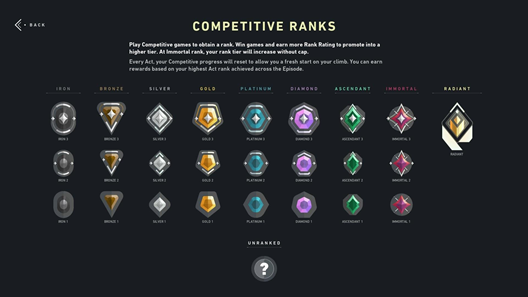
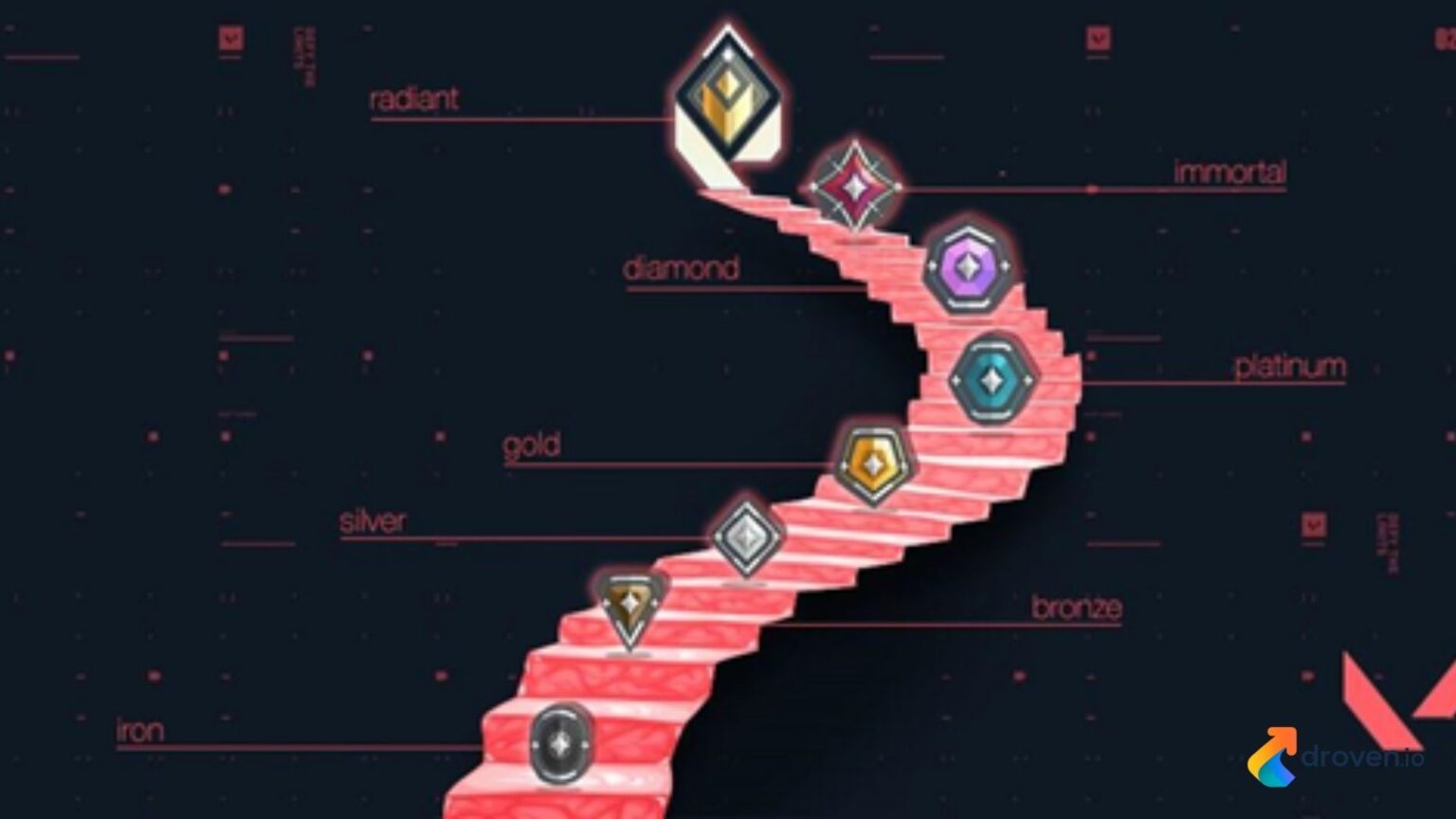
The ladder has nine tiers. From the floor up: Iron, Bronze, Silver, Gold, Platinum, Diamond, Ascendant, Immortal, and Radiant. The first eight each split into three divisions, so Silver runs Silver 1, Silver 2, Silver 3, while Radiant sits alone at the summit with no divisions at all. That makes 25 distinct rungs between a fresh account and the top of your region.
Where players actually sit is lopsided. The current V26 Act 4 rank distribution is a fat bell curve parked in the middle of the ladder, with the median player landing around Silver.
| Rank tier | Divisions | Approx. share of players |
| Iron | 3 | ~5% |
| Bronze | 3 | ~21% |
| Silver | 3 | ~22% |
| Gold | 3 | ~21% |
| Platinum | 3 | ~15% |
| Diamond | 3 | ~9% |
| Ascendant | 3 | ~4% |
| Immortal | 3 | ~0.5% |
| Radiant | None | ~0.03% |
Figures are approximate and shift every act, but the shape holds: if you are stuck in Silver, you are not failing. You are the statistical center of the whole game.
Account Level 20, Then the Placement Matches
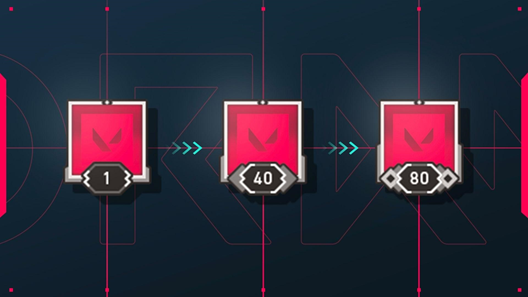
You cannot queue into competitive until you hit account level 20. That grind through the unranked modes is Riot’s built-in tutorial, a way to make sure you have learned the maps and the roster of agents (the game’s playable characters) before your rank means anything.
Then come placements. A brand-new competitive player has to play five placement matches before the system assigns a rank, and no matter how dominant you look, Riot caps how high that first placement can land. Riot runs hard rank resets twice a year, at the start of the season and again at midseason, each requiring another 5 placements. The smaller act-to-act transitions ask for just one, because your previous rank carries over as a soft reset. Your hidden MMR barely moves through any of it, so placements mostly re-attach a visible rank to a memory the system never lost.
How RR Actually Moves Each Game
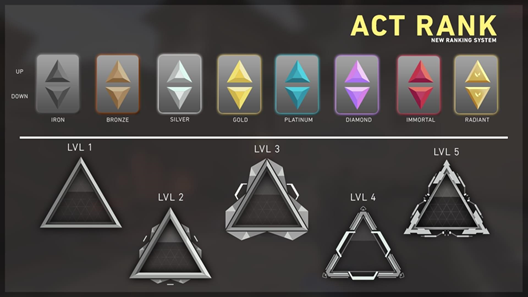
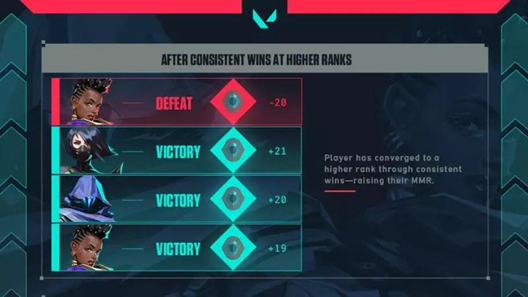
Every division holds 100 RR. Win a competitive match, and you gain roughly 10 to 50 RR; lose one, and you shed 10 to 30. Hit 100, and you promote; drop to 0 and lose again, and you demote. Simple enough on the surface. The interesting part is what sets the size of each swing.
Three forces move the needle. First, your hidden MMR: when the system thinks you are underranked, wins pay bigger, and losses sting less, dragging you up fast. When your MMR sits below your rank, the reverse bites. Second, round differential, because a 13-3 stomp signals more than a 13-11 nailbiter and pays accordingly. Third, individual performance, which nudges gains and losses at the margins, though winning still dominates the math. Queue as a full five-player team with a wide rank spread, and Riot claws back a slice of your RR, 25% in most lobbies, with steep penalties at the very top of the ladder, to protect the integrity of competitive play.
Party size brings its own restrictions. Once you reach Diamond, Riot caps the rank gap allowed inside a party to roughly one tier, so you cannot queue with someone many ranks away. At Immortal and Radiant, the rule tightens further: you can only queue solo, duo, or as a full five-stack. Three-stacks and four-stacks are blocked outright at that level, another way Riot keeps the top of the ladder honest.
Riot keeps tuning the formula. The Patch 13.00 update that opened V26 Act 4 recalculated RR so consistent winners feel less stuck, and tightened matchmaking so each team’s average rank now stays inside a single sub-tier. Keep winning, and your visible rank should finally keep pace.
Act Rank, Rank Decay, and the Grind at the Top
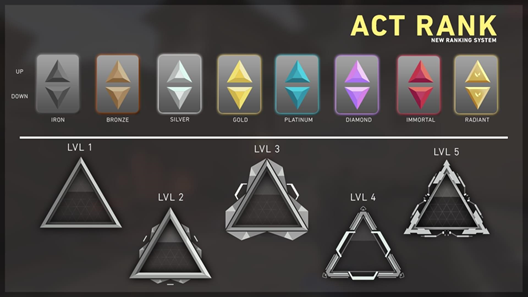
Your climb leaves a paper trail. Each act stamps an Act Rank badge onto your player card showing your peak rank and ranked wins for that stretch, and your best rank of the act decides which gun buddy reward you take home. It is Riot’s receipt for how far you actually pushed.
At the very top, the rules change. Immortal still keeps sub-ranks 1 through 3, but climbing between them runs on continuous RR thresholds instead of the win-loss promotions that move you up through the lower tiers. Radiant sits alone above it with no divisions at all, and reaching it takes both a high RR total and a seat among your region’s elite. Riot’s own thresholds set the floor at 300 RR in North America and Europe, but since Radiant is really just the top sliver of the leaderboard, the practical bar often climbs past 450 or even 700 RR late in an act. Miss about seven days at that level, and you fall off the leaderboard; after two weeks, your badge hides until you queue again.
That wall is why a sliver of the player base treats the last few divisions as a problem to outsource, hiring a Radiant player to boost their rank rather than grinding it solo. Restrictions guard the rest of the ladder: dodge a game at the last second or abandon your team mid-match, and Riot answers with RR penalties and queue bans, a deliberate tax on wrecking a competitive match for nine other people.
Once you see the two numbers for what they are, the ladder stops feeling arbitrary. Win convincingly and win often, and the badge on your card catches up to what the matchmaker already believes. The system is not rigged. It is just keeping a better score than you are.
