
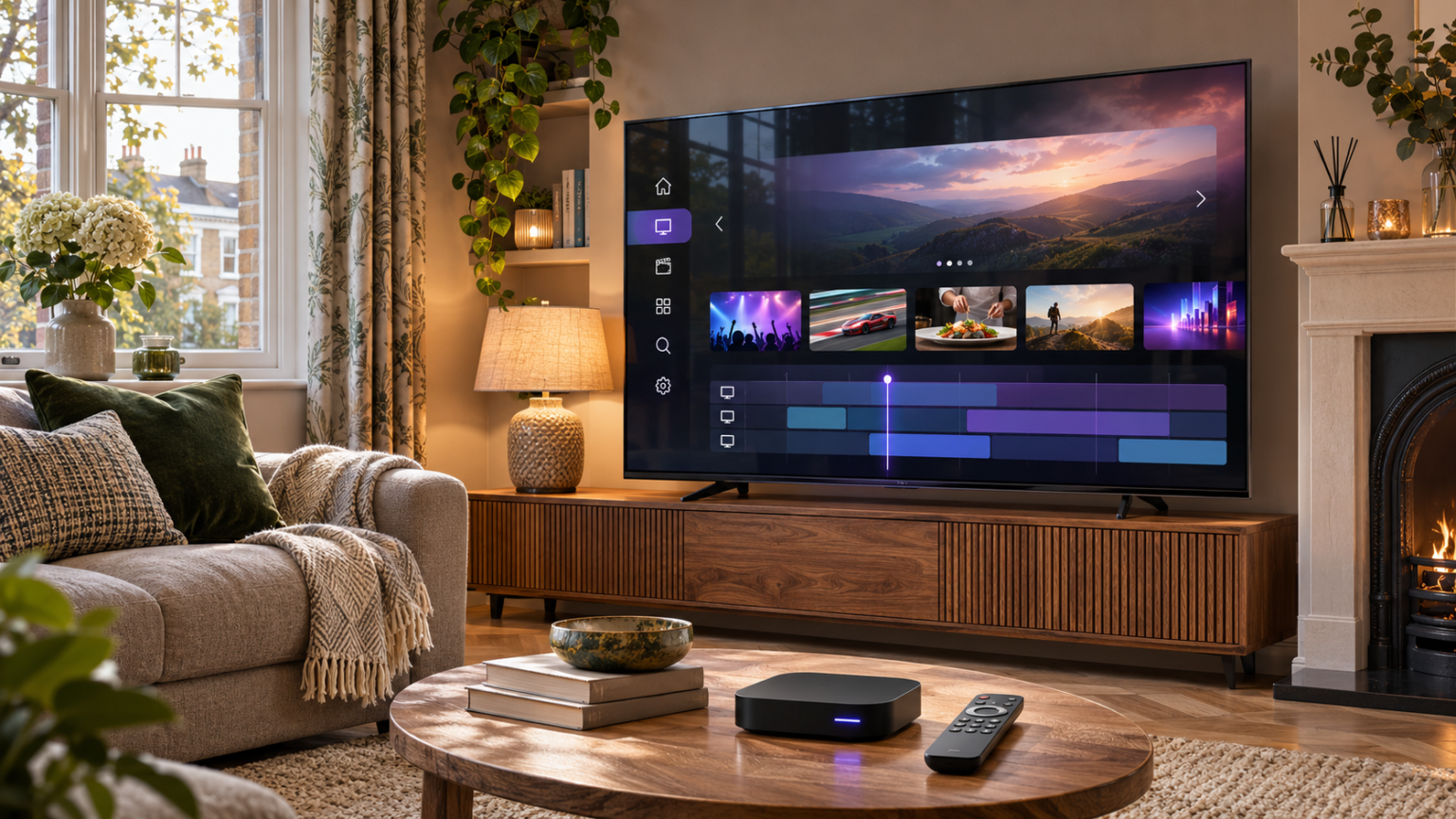
Choosing an IPTV UK service can make home entertainment more flexible, but finding the right provider requires more than comparing subscription prices or counting available channels. British households increasingly use internet connected televisions, streaming applications, and digital media devices to watch programmes whenever and wherever they prefer. However, streaming quality, content licensing, device compatibility, and customer support can vary considerably between services. Understanding these differences helps viewers avoid unreliable subscriptions, unnecessary expenses, and potential legal problems. This guide explains how internet television works, which features deserve attention, and how to evaluate a provider before making a financial commitment.
Understanding How IPTV UK Service Technology Works
Internet Protocol Television, commonly called IPTV, delivers television content through internet networks rather than relying exclusively on traditional aerial, satellite, or cable distribution.
The underlying technology allows video content to reach compatible devices through broadband connections. Depending on the platform, viewers may access scheduled television channels, live broadcasts, recorded programmes, or entertainment libraries.
IPTV is a delivery method rather than a particular brand or subscription package. Importantly, the technology itself is legal. Whether a particular service operates lawfully depends on factors including its content permissions and applicable regulations.
According to Ofcom, internet delivered television is already part of the viewing experience on compatible smart televisions. Different broadcasters and platforms may operate under different regulatory arrangements. www.ofcom.org.uk
How Internet Television Differs From Traditional Broadcasting
Traditional television commonly distributes channels through terrestrial transmitters, satellite networks, or cable infrastructure. Internet television uses network connections to deliver content to the viewer.
This distinction creates several practical differences.
With a suitable connection and compatible equipment, viewers may enjoy:
- Access to television through multiple supported devices.
- Live programmes delivered over broadband.
- On demand entertainment libraries.
- Electronic programme guides for browsing channels.
- Personalised recommendations where supported.
- Flexible subscription options and content packages.
However, these capabilities depend on the particular platform. Not every provider includes recording, catch up programmes, or multiple screen access.
Why IPTV Has Become Relevant to British Households
Many households now combine conventional television services with online entertainment platforms.
Someone may watch news on a smart television, continue a documentary on a tablet, and later access another programme through a streaming application.
Internet television can support these viewing habits without requiring every programme to arrive through the same broadcast infrastructure.
The convenience is particularly relevant to households with different entertainment preferences, although broadband reliability remains a major consideration.
Understanding Live TV and Video on Demand
Live television follows a broadcaster’s transmission schedule. Viewers generally watch programmes as they are being transmitted.
Video on demand allows viewers to select content from an available library and begin playback at a convenient time.
Some internet television platforms combine both formats, while others concentrate exclusively on one.
Understanding this distinction is important when comparing subscriptions because access to live channels does not automatically include a comprehensive on demand catalogue.
Verify the Legitimacy of an IPTV UK Service
The first consideration should be whether a provider has the necessary rights to distribute its advertised content.
A professional website or an attractive streaming application does not automatically demonstrate that a subscription is legitimate.
Confirm Content Licensing and Distribution Rights
Legitimate television distributors require appropriate permissions for the channels, films, sporting events, and other programmes they offer.
Content licensing can differ by country, platform, and distribution agreement.
Before subscribing, examine whether the provider clearly identifies its business, explains its services, and offers reasonable information about the content it is authorised to distribute.
Be particularly cautious when an unfamiliar operator promises access to virtually every premium sports channel and entertainment platform for an unusually low fee.
The UK government’s guidance on illicit streaming explains that devices such as Android TV boxes and streaming sticks are legal when used with authorised content. Problems arise when they are adapted to provide unauthorised access to protected programmes. GOV.UK
Understanding UK TV Licence Requirements
A television subscription does not replace the need for a TV Licence where one is legally required.
In the United Kingdom, a TV Licence is generally required to watch or record live television programmes on any channel or streaming service.
It is also required to watch or download programmes through BBC iPlayer, including its on demand content.
People who exclusively watch on demand content through other services, without watching live television or using BBC iPlayer, generally do not need a TV Licence for that viewing.
These requirements apply regardless of whether content is watched on a television, laptop, tablet, or another supported device. TV Licensing ™
A lawful subscription and compliance with TV Licensing requirements are separate responsibilities. Households should check both before using a service.
Compare Channel Selection Based on Actual Viewing Needs
An extensive channel catalogue may appear attractive, but the number of advertised channels rarely tells the whole story.
A useful IPTV UK service should offer programming that matches the household’s interests, language preferences, and normal viewing schedule.
Prioritise Relevant Entertainment Categories
Different viewers have different expectations.
Some prefer British news, documentaries, and family entertainment. Others are interested in international programming, films, educational content, or specialist channels.
Before subscribing, identify the programmes and categories that matter most.
A practical viewing checklist might include:
- British television and regional programming.
- International news and documentary channels.
- Family entertainment and children’s content.
- Licensed sports coverage.
- Films, series, and specialist entertainment.
- Accessibility features and subtitle availability.
The best package is not necessarily the one with the largest advertised selection. It is the one containing the most useful, properly licensed content.
Examine Sports Coverage Carefully
Sports programming deserves particular attention because broadcasting rights are often restricted by competition, location, platform, and contractual agreement.
A provider offering general entertainment channels may not have permission to distribute premium sports broadcasts.
Likewise, access to one sporting competition does not guarantee coverage of every match.
Check the relevant rights holder or authorised broadcaster when specific competitions are essential to your viewing needs.
Electronic Programme Guide Accuracy
An electronic programme guide, often abbreviated to EPG, displays channel schedules and upcoming programmes.
A useful guide should provide accurate programme names, broadcast times, and clear navigation.
Poorly maintained schedules can make it difficult to find live events, particularly when programmes change or broadcasts run longer than expected.
A well organised interface should make searching and browsing straightforward rather than forcing viewers to navigate hundreds of irrelevant listings.
Assess Streaming Quality and Broadband Performance
Picture quality is another major factor when selecting an IPTV UK service.
Advertising terms such as HD, Full HD, and 4K describe potential video resolutions. They do not guarantee that a particular provider will consistently deliver those resolutions.
Actual performance depends on the video source, network infrastructure, encoding, broadband connection, and playback device.
Understand Broadband Speed Requirements
Streaming requires sufficient and reasonably stable download capacity.
Government research into television distribution notes that major streaming providers commonly recommend approximately 8 Mbps for HD content and 25 Mbps for UHD or 4K viewing. It also identifies 30 Mbps as a useful reference point for reliable IPTV services, although individual requirements vary. GOV.UK
These figures should be treated as guidance rather than universal guarantees.
For example, a household using several televisions simultaneously may need substantially more bandwidth than someone watching a single HD programme.
The speed advertised by an internet provider also may not match the speed available to a television over WiFi.
Why Connection Stability Matters
A high maximum download speed does not automatically provide uninterrupted viewing.
Video playback can still experience problems caused by congestion, wireless interference, temporary packet loss, or inconsistent service infrastructure.
Live events can be particularly sensitive to delays because viewers expect broadcasts to follow real time developments closely.
An overloaded streaming server may cause freezing even when the household’s broadband connection is functioning properly.
Reduce Buffering With Better Home Networking
Several practical adjustments can improve streaming performance.
First, place the broadband router where wireless signals can reach the viewing area without unnecessary obstacles.
Second, keep streaming applications and device software updated.
Third, consider an Ethernet connection for compatible televisions or media devices when WiFi performance is inconsistent.
Fourth, avoid large downloads while testing a struggling connection.
Finally, run broadband speed tests at different times to identify patterns of slower performance.
Ofcom recommends checking connection speeds, device performance, router placement, and local wireless conditions when diagnosing broadband problems. www.ofcom.org.uk
If other applications stream normally but one provider repeatedly fails, investigate the provider’s service before assuming your broadband connection is responsible.
Check Device Compatibility Before Purchasing
A flexible IPTV UK service should work with devices that viewers already own or are prepared to purchase.
However, compatibility can differ significantly across applications and operating systems.
Smart Television Support
Many modern smart televisions include application stores that provide access to legitimate streaming platforms.
Before purchasing a subscription, confirm that the required application is available for the television’s specific operating system and model.
A service that works on one brand of smart television may not support another.
Check whether the provider publishes a compatibility list and explains how customers can install and activate its application.
Avoid assuming that an application will work simply because the television has an internet connection.
Streaming Devices and Media Players
External streaming devices can add functionality to televisions that lack suitable built in applications.
Examples include compatible media players, television streaming boxes, and supported casting devices.
A dedicated media player may provide faster navigation or access to a broader application ecosystem than an older smart television.
Nevertheless, device compatibility, software update support, and content restrictions should be checked individually.
A legitimate application should ideally be obtained from an official application store or another trustworthy source identified by the authorised provider.
Multiple Screens and Household Access
Families often want to watch different programmes at the same time.
Some subscriptions permit simultaneous streams, while others restrict playback to a single active device.
The number of devices registered to an account may also differ from the number permitted to stream simultaneously.
Before purchasing, clarify:
- How many devices can be registered.
- How many streams can run together.
- Whether viewing is restricted to the home.
- Whether additional screens incur charges.
- How devices can be replaced or removed.
These details can have a greater impact on everyday convenience than the total number of channels.
Understand Subscription Pricing and Contract Conditions
Pricing deserves careful analysis because the lowest advertised monthly fee may not represent the best overall value.
A sensible comparison considers the actual content, subscription terms, support arrangements, and any equipment costs.
Compare Total Cost Rather Than Promotional Prices
Some services offer introductory prices that increase after an initial period.
Others require additional payments for premium entertainment, compatible hardware, or extra simultaneous streams.
Before subscribing, calculate the amount payable over the period you intend to use the service.
Check whether the advertised price includes relevant taxes and whether billing is monthly, quarterly, or annual.
For a household testing an unfamiliar platform, a shorter subscription may provide greater flexibility than paying a large amount in advance.
However, longer agreements may be appropriate when the provider is established, the contractual terms are clear, and the household already understands the service.
Read Renewal and Cancellation Policies
Automatic renewal can be convenient, but subscribers should know when the next payment will occur and how cancellation works.
Look for clear information explaining whether payments continue automatically, whether notice is required, and what happens when a subscription expires.
Understand Your Consumer Rights
UK consumer protections may apply to online subscription purchases, but cancellation rights depend on the contract and the nature of the digital service or content.
For certain digital content supplied immediately, consumers may lose the usual cancellation right after giving the required express consent and acknowledgement.
Government guidance explains that streaming providers must communicate relevant cancellation information before supplying digital content. GOV.UK
Consumers should therefore review the applicable terms rather than assume every subscription includes an unconditional refund period.
A reputable provider should make its contractual information accessible before payment.
Evaluate Security, Privacy, and Customer Support
Security is an important consideration when choosing any online entertainment subscription.
Streaming platforms may process personal details, payment information, and account credentials.
The way a provider handles this information can affect customer confidence.
Look for Transparent Business Information
A trustworthy provider should offer enough information for customers to understand who is supplying the service.
Useful indicators include clear company identification, accessible terms, a privacy notice, and genuine support channels.
No single feature proves legitimacy, but an absence of basic business information should encourage further investigation.
Consumers should also distinguish between genuine independent reviews and testimonials published exclusively by the seller.
Protect Your Devices and Payment Information
Use strong, unique passwords for streaming accounts and keep devices updated.
Avoid installing applications from unknown sources unless their legitimacy and security can be established.
Be cautious about requests to disable device protections or grant permissions unrelated to watching television.
The City of London Police has warned that illegal streaming operations can expose users to risks involving malware, fraud, and personal information theft. City of London Police
Using a VPN does not make unauthorised content distribution legal, nor does it replace appropriate security practices.
Warning Signs That Deserve Attention
Certain warning signs justify additional scrutiny:
- The provider cannot explain its content rights.
- Premium channels are offered at implausibly low prices.
- Payment instructions change unexpectedly.
- The seller requests unnecessary personal documents.
- Customer support exists only through anonymous accounts.
- The application requires suspicious device permissions.
- Cancellation and refund terms are missing.
- The seller promises permanent access without credible terms.
A combination of these indicators should be treated as a reason to avoid purchasing until the concerns are resolved.
Test the Responsiveness of Customer Support
Reliable customer assistance matters when activation fails, applications malfunction, or billing questions arise.
Before subscribing, contact the provider with a straightforward question about compatibility or subscription terms.
Consider whether the response is clear, relevant, and consistent with the information advertised.
Support availability should also match your needs. A household that watches live events during evenings may value assistance outside standard business hours.
Test an IPTV UK Service Before Making a Long Commitment
Even a service with appealing features should be evaluated against ordinary household viewing habits.
Where the provider offers a legitimate trial or short subscription, testing can reveal practical limitations that marketing materials do not explain.
Create a Realistic Viewing Test
Use the device and internet connection that will normally deliver the service.
Begin by checking whether the application installs correctly and whether account activation is straightforward.
Then examine the channels or programmes you actually intend to watch.
A practical evaluation should consider picture clarity, navigation speed, loading delays, audio quality, and the availability of subtitles where required.
Testing at different times can help identify performance differences.
Evaluate Everyday Reliability
A short demonstration cannot establish long term reliability, but it can help identify obvious problems.
Observe whether channels load successfully, programme guides provide useful information, and the application remains responsive during normal use.
Try switching between different programmes rather than watching only one channel.
If multiple devices are included in the subscription, verify that simultaneous playback works within the stated limits.
Record Problems Before Contacting Support
If streaming fails, note the time, device, application version, and type of problem.
This information can help distinguish between a local connection issue and a provider problem.
For example, repeated buffering on several devices using different connections may suggest an issue beyond one television’s WiFi signal.
Provide relevant details to customer support and assess whether the proposed solution addresses the problem.
Avoid entering payment information into unfamiliar websites presented through unexpected error messages.
Recognise the Benefits and Limitations of Internet Television
IPTV offers advantages, but its usefulness depends on individual circumstances.
A major benefit is flexibility. Compatible platforms can make television content accessible through different internet connected devices.
Internet delivery can also support interactive features, programme guides, personal preferences, and on demand viewing.
However, these features are not universal.
Some subscriptions provide limited device support, while certain programmes remain subject to distribution rights and geographic restrictions.
Where IPTV Can Be a Practical Choice
Internet delivered television can suit homes with reliable broadband, compatible devices, and a preference for digital entertainment applications.
It may be useful for viewers who want to combine scheduled television with selected on demand programming.
Households should nevertheless compare the total cost against alternatives such as authorised broadcaster applications, established television packages, and dedicated streaming subscriptions.
Situations Where Alternatives May Work Better
For homes with unreliable broadband, traditional broadcast television may provide a more consistent experience for certain channels.
Viewers who require only a small number of programmes might find that individual authorised applications are sufficient.
Likewise, a household primarily interested in films or series may prefer a dedicated on demand service instead of a broad live television package.
The right choice depends on actual viewing requirements rather than a particular technology being universally superior.
Common Mistakes When Choosing Internet Television
Many disappointing streaming purchases begin with assumptions that could have been checked beforehand.
One frequent mistake is equating a large advertised channel catalogue with a high quality service.
Another is assuming that every programme described as 4K will be delivered in that resolution.
Customers may also overlook subscription renewal terms or purchase annual access without confirming device compatibility.
Avoid Choosing Exclusively on Price
A low subscription price has little value if the necessary content is unavailable, streaming continually freezes, or customer assistance is inaccessible.
Compare providers based on verified features and clear contractual conditions.
Be especially cautious about paying an unknown operator a substantial amount in advance.
Do Not Confuse Technology With Content Rights
IPTV technology is legitimate, but the availability of a working video stream does not establish that the distributor has the right to supply it.
Consumers should not assume that a service is lawful simply because its channels play successfully.
Checking the legitimacy of distribution rights is essential, particularly where premium films and sports are advertised.
Avoid Overlooking Accessibility Features
Subtitles, audio description, readable menus, and straightforward navigation can significantly influence the viewing experience.
These features may be especially valuable to older viewers, people with accessibility needs, and households where different languages are spoken.
Confirm availability for the specific programmes and devices concerned rather than relying on general marketing claims.
The Future of IPTV and Digital Television in Britain
Internet delivery is an important part of the United Kingdom’s evolving television landscape.
As broadband infrastructure, connected televisions, and streaming technologies develop, viewers may encounter increasingly integrated entertainment interfaces.
Platforms can potentially combine live television, on demand libraries, personal recommendations, and searchable programming within a single experience.
However, the transition also raises questions about accessibility, reliable broadband coverage, content rights, and support for households that depend on traditional broadcasting.
Why Responsible Providers Will Matter
A successful television platform needs more than modern software.
Consumers benefit from clear subscription conditions, lawful content distribution, dependable infrastructure, and accessible customer assistance.
Services that address these practical expectations are better positioned to provide a consistent viewing experience.
For households comparing options, the central question is not simply whether television can be delivered through the internet. It is whether the chosen service delivers the programmes, reliability, transparency, and support they need.
Frequently Asked Questions
1. What is an IPTV UK service?
An IPTV UK service delivers television programming through internet networks. Depending on the provider, it may offer live channels, scheduled programmes, and on demand entertainment.
2. Is IPTV legal in the United Kingdom?
IPTV technology is legal. However, providers must have appropriate rights to distribute copyrighted content, and viewers must comply with applicable TV Licensing requirements.
3. What internet speed is recommended for IPTV streaming?
Requirements vary by service and resolution. Around 8 Mbps may support HD streaming, while 4K services commonly recommend approximately 25 Mbps, with additional capacity useful for multiple devices.
4. Can I watch IPTV on a smart television?
Many smart televisions support legitimate internet television applications. Compatibility depends on the television model, operating system, and streaming provider.
5. Why does IPTV keep buffering despite fast broadband?
Buffering can result from unstable WiFi, network congestion, overloaded streaming infrastructure, or device performance problems. Testing different applications and connections can help identify the cause.
6. How do I choose a reliable IPTV UK service?
Check content licensing, broadband requirements, device compatibility, subscription terms, security practices, and customer support. Where available, use an authorised trial to evaluate performance before committing.
Conclusion
Choosing an IPTV UK service requires careful consideration of content legality, streaming performance, device support, and overall subscription value. A suitable provider should offer transparent terms, reliable access to properly licensed programming, and dependable customer assistance. By evaluating these factors before purchasing, British households can make informed decisions and enjoy a more convenient, secure, and consistent television experience.
