
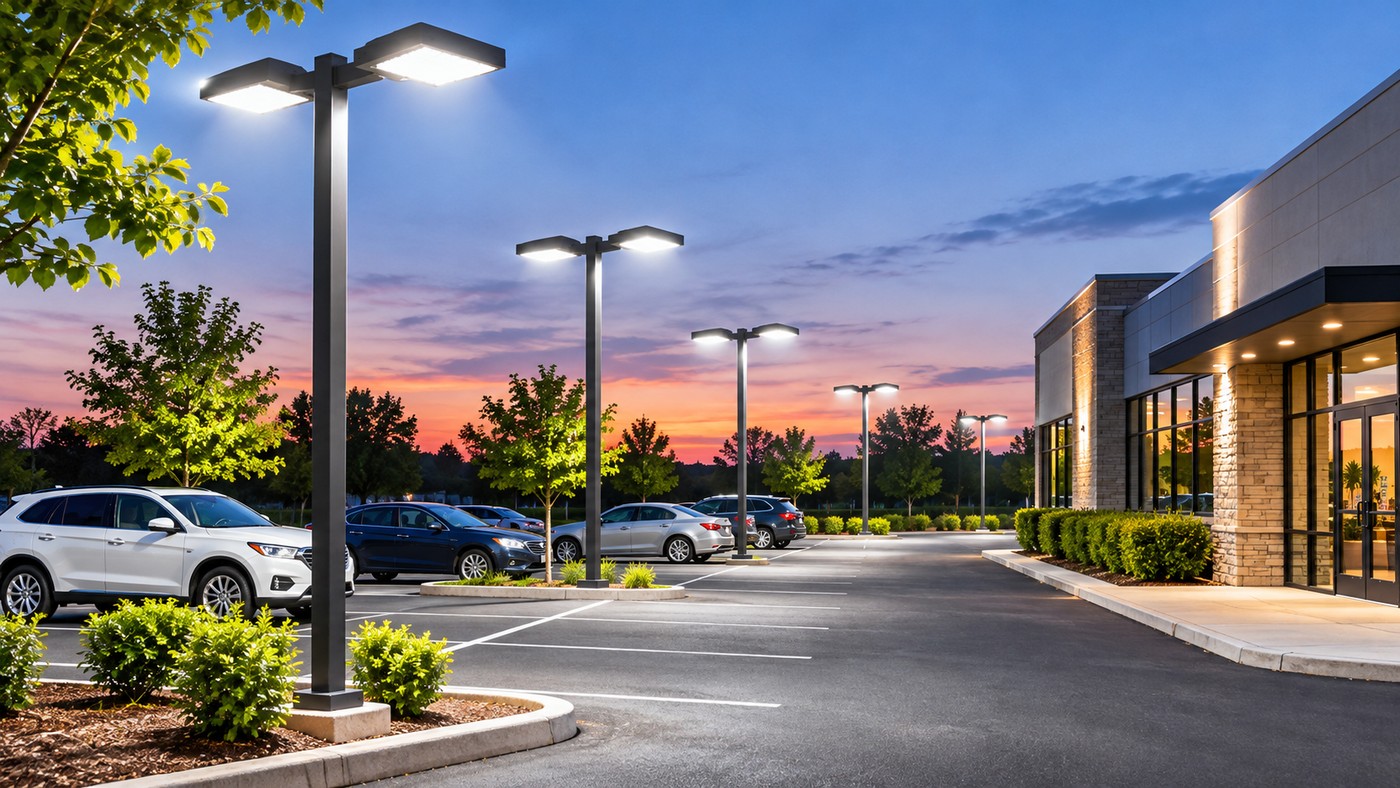
Good parking lot lighting does more than make an outdoor space look bright. It helps drivers see parking spaces, makes walking areas easier to navigate, and improves visibility around buildings and vehicles. For businesses, proper lighting also creates a better experience for customers and employees after dark.
LED parking lot lighting has become a popular choice for commercial properties because it offers lower energy consumption, long operating life, and flexible lighting options. However, choosing the right fixtures involves more than comparing wattages. Pole height, fixture spacing, light distribution, and color temperature all affect the final result.
This guide explains what to consider when choosing LED parking lot lights and how to get better performance from your outdoor lighting system.
What Is LED Parking Lot Lighting?
LED parking lot lighting uses light-emitting diode fixtures to illuminate outdoor parking areas. These fixtures are commonly installed on poles around shopping centers, office buildings, apartment complexes, schools, hotels, and other commercial properties.
Most commercial parking lot fixtures use a shoebox-style design. Their flat housing and optical lenses help direct light toward parking spaces, driveways, and pedestrian areas.
LED fixtures are available in different wattages, lumen outputs, mounting styles, and color temperatures. Some models also include photocells, dimming options, or selectable wattage settings.
The goal is to provide enough light across the entire property without wasting energy or creating uncomfortable glare.
Benefits of LED Parking Lot Lighting
Replacing older outdoor lighting with LED fixtures can improve both operating costs and lighting performance.
1. Lower Energy Consumption
Energy savings are one of the main reasons businesses upgrade to LED parking lot lights. Older metal halide and high-pressure sodium fixtures often consume more electricity while producing less useful light.
For example, a properly selected 150W LED fixture may replace a 400W metal halide fixture in a suitable application. The actual savings depend on the old system’s ballast losses and the new fixture’s performance.
For properties with lights operating throughout the night, even a moderate reduction in power consumption can make a noticeable difference to monthly electricity bills.
2. Longer Operating Life
Commercial LED parking lot lights are commonly rated for more than 50,000 operating hours, although actual performance depends on the fixture, driver, temperature, and installation conditions.
A longer service life means fewer lamp replacements and less maintenance work. This is especially useful for businesses with tall light poles where accessing fixtures requires specialized equipment.
3. Better Visibility
Modern LED fixtures provide consistent light output and different color temperature options. Good lighting helps drivers identify parking spaces, read signs, and notice pedestrians.
The quality of the lighting depends on fixture optics, placement, and aiming. Simply installing brighter fixtures does not guarantee better visibility.
4. Instant-On Performance
Unlike some traditional HID fixtures, LED lights reach full brightness almost immediately. They do not need a warm-up period.
This is useful when lights are controlled by photocells, timers, or motion-based systems.
5. Reduced Maintenance Costs
LED systems generally require fewer replacement components than traditional lighting systems. Businesses can spend less time arranging maintenance visits and replacing lamps or ballasts.
The savings can be particularly valuable for large parking facilities with many fixtures.
Types of LED Parking Lot Light Fixtures
Different parking areas need different fixture styles. Understanding the main options makes it easier to select the right product.
LED Shoebox Lights
LED shoebox lights are among the most common fixtures used for commercial parking lots. They are designed for pole mounting and provide directional light distribution.
They work well for shopping centers, office complexes, retail properties, and large parking areas.
Commercial LED Parking Lot Lights
Commercial LED parking lot lights are designed for regular outdoor operation. They are available in several wattages and lumen outputs to suit different property sizes and mounting heights.
Look for fixtures with suitable weather protection, quality drivers, and appropriate mounting options.
LED Parking Lot Lights With Photocells
Photocells automatically switch outdoor lights on when natural light levels decrease and turn them off when daylight returns.
This removes the need to operate exterior lights manually. It also helps prevent unnecessary daytime energy consumption.
Dimmable LED Parking Lot Lights
Dimmable fixtures allow property owners to adjust light output when full brightness is not required.
For example, a commercial property may use a lower lighting level during quiet hours while maintaining adequate visibility and meeting applicable safety requirements.
How to Choose the Right LED Parking Lot Lighting
Selecting the correct fixtures requires looking at the entire parking area rather than choosing products based on wattage alone.
1. Check Lumens and Wattage
Wattage measures electricity consumption, while lumens measure the amount of light produced.
A higher-wattage fixture does not automatically provide better lighting. Compare lumen output and fixture efficiency before making a purchase.
For example, LED parking lot lights are available in outputs such as 10,000, 20,000, 40,000, and 70,000 lumens. The appropriate output depends on pole height, spacing, optics, and the required light level.
2. Consider Pole Height and Spacing
Pole height affects how light spreads across the ground. Fixtures installed too low may create bright spots directly underneath the poles and leave darker areas between them.
Higher poles can cover wider areas, but they may require fixtures with greater output and suitable optics.
Pole spacing also matters. A well-planned layout provides more uniform illumination across parking spaces and driving lanes.
3. Choose the Correct Beam Distribution
LED parking lot fixtures use different optical distributions to direct light across the property.
Some distributions work better near property boundaries, while others are designed for interior rows or wider parking areas.
The right distribution helps reduce dark patches, wasted light, and glare. A photometric lighting plan can show how fixtures will perform before installation.
4. Select a Suitable Mounting Option
Check the existing pole and fixture connection before ordering replacement lights.
Common mounting options include:
- Slip-fit mount: Fits compatible round pole tenons and allows aiming adjustments.
- Straight arm mount: Provides a direct connection to compatible mounting arms.
- Trunnion or yoke mount: Offers flexibility for wall or other mounting applications.
Always verify dimensions and compatibility with the existing hardware.
Choosing the Right Color Temperature
Color temperature affects how outdoor lighting looks. It is measured in Kelvin (K).
The most common choices for commercial parking lot lighting include:
3000K warm white: Produces a warmer appearance. It can work well around hotels, residential properties, and locations where softer lighting is preferred.
4000K neutral white: Offers a balanced appearance without looking too warm or too cool. It is a practical choice for many offices, schools, and commercial properties.
5000K bright white: Produces a cooler, brighter-looking appearance. It is often selected for retail parking areas, commercial facilities, and locations where a crisp white appearance is preferred.
The best option depends on the property, local lighting requirements, and surrounding buildings.
Replacing Old Metal Halide Parking Lot Lights
Many commercial properties still use older metal halide or high-pressure sodium fixtures.
Replacing these systems with LED parking lot lights can reduce electricity use and maintenance requirements. However, selecting a replacement fixture based only on the old lamp wattage can lead to poor results.
As a starting point, a 150W LED may replace a 400W metal halide fixture, a 300W LED may replace a 1000W metal halide fixture, and a 500W LED may replace a 1500W metal halide fixture in suitable applications.
These are general replacement comparisons, not universal rules. Always check actual lumen output, existing lighting levels, optics, and the proposed LED layout before ordering.
Why Proper Parking Lot Lighting Design Matters
Even high-quality LED fixtures cannot deliver good results if they are installed incorrectly.
A lighting design should consider the dimensions of the parking lot, pole locations, mounting heights, fixture wattage, and optical distribution.
It should also identify areas that need additional attention, such as pedestrian crossings, entrances, driveways, and building access points.
A photometric study helps estimate light levels across the property before installation. It can identify potential dark areas and help avoid unnecessary fixtures or excessive brightness.
Good lighting design improves visibility while controlling glare and wasted light.
Conclusion
Choosing the right LED parking lot lighting system can improve outdoor visibility, reduce electricity consumption, and lower long-term maintenance costs. However, the best results come from matching fixture output, pole height, spacing, mounting style, and light distribution to the property.
Whether you are upgrading old metal halide fixtures or installing a completely new system, take time to evaluate the lighting requirements before purchasing.
Explore the range of LED parking lot lights at LED Light Expert to compare fixture styles, mounting options, and lighting solutions for commercial outdoor spaces.
