
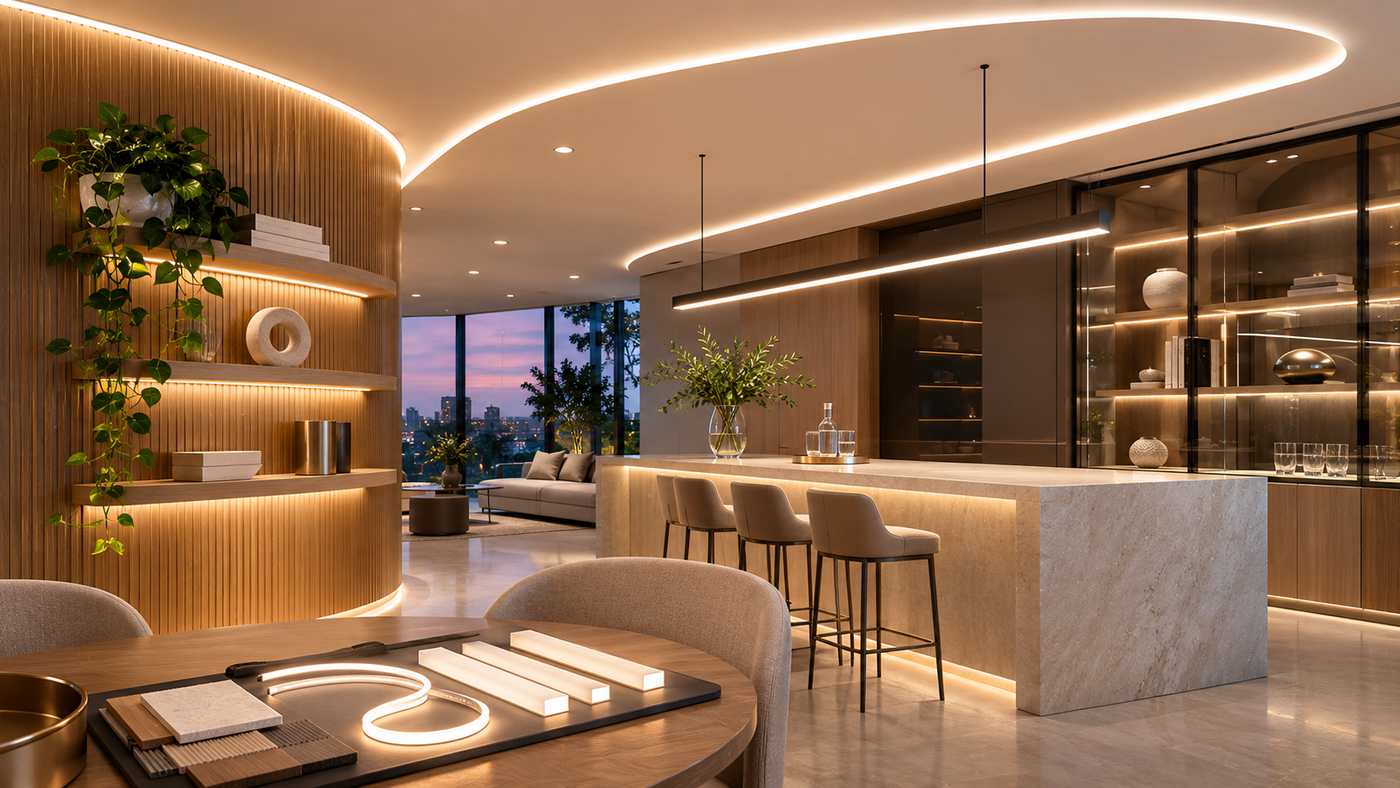
Lighting plays an important role in how people experience buildings, interiors, workplaces, and outdoor environments. A carefully designed lighting system can improve visibility, highlight architectural features, create a comfortable atmosphere, and help organizations manage energy consumption. As LED technology continues to develop, designers have access to increasingly flexible solutions for residential, commercial, and industrial projects.
LEDIA Lighting is a China-based manufacturer specializing in LED strip lights, flexible silicone neon lighting, cabinet illumination, and commercial linear fixtures. Its product portfolio includes lighting solutions designed for decorative installations, architectural applications, retail environments, offices, and industrial facilities.
Modern lighting design requires more than choosing bright fixtures. Architects, electrical contractors, and property owners must consider colour temperature, light output, installation conditions, energy efficiency, product compatibility, and maintenance requirements.
Different environments also demand different solutions. A residential kitchen may benefit from discreet under-cabinet lighting, while a warehouse requires reliable illumination across larger working areas. Retail businesses may prioritize product presentation, whereas architectural designers often focus on continuous light lines and concealed fixtures.
This guide explores LEDIA’s lighting products, the practical advantages of modern LED technology, and seven important ways to create more functional and visually appealing spaces.
What Is LEDIA Lighting?
LEDIA Lighting is a professional LED lighting manufacturer based in Guangzhou, Guangdong Province, China.
According to the company’s published information, its history dates to 2008, when it began developing and manufacturing LED strip lighting technologies.
Over time, the company expanded its product range to include flexible lighting systems, cabinet lights, office fixtures, industrial lighting, and customized solutions for different applications.
Its products are intended for businesses, distributors, contractors, lighting designers, and organizations sourcing lighting equipment for specific projects.
Understanding LEDIA’s Manufacturing Background
The company describes operating more than 20 production lines dedicated to LED strip manufacturing.
Its published manufacturing profile also reports production capacity of approximately 1.5 million metres of LED strips per month, along with separate production facilities for luminaires.
These figures are manufacturer-reported capabilities rather than independently audited production volumes.
LEDIA also describes operating research, development, testing, and quality-control facilities.
Such infrastructure can be relevant to buyers seeking consistent products across large lighting projects.
However, the suitability of any particular product should be evaluated through its current technical specifications, applicable certifications, and actual performance requirements.
What Types of LED Lighting Does the Company Supply?
The manufacturer’s main product categories include:
- Traditional LED strip lights.
- COB LED strip lighting.
- Silicone neon flex.
- Decorative linear lighting.
- LED cabinet and furniture lights.
- Sensor-operated cabinet lights.
- Office linear fixtures.
- High-bay lighting.
- Tri-proof lighting for suitable industrial environments.
- Customized lighting products.
Each category addresses different needs involving appearance, brightness, installation, and operating conditions.
Understanding these differences is essential when planning a lighting installation.
Why LED Lighting Matters for Modern Buildings
LED stands for light-emitting diode.
Unlike conventional incandescent lamps, LEDs produce light through semiconductor technology.
This allows manufacturers to create compact light sources that can be integrated into different shapes and fixture designs.
Energy Efficiency and Electricity Consumption
One advantage of LED technology is its potential to deliver useful illumination with less electrical energy than many older lighting technologies.
However, energy performance varies considerably between products.
The US Department of Energy emphasizes that overall lighting efficiency depends on both the LED source and the complete luminaire, including the driver, optics, and other components.
For this reason, buyers should evaluate the performance of the actual fixture rather than relying only on general LED marketing claims.
Flexible Design Possibilities
LED technology supports compact and adaptable designs.
Flexible strips can follow architectural surfaces, while rigid linear fixtures provide structured illumination.
This versatility allows lighting to become part of the building design rather than merely an accessory installed after construction.
Long-Term Maintenance Considerations
Many LED products can provide extended operating life compared with older lighting technologies.
Nevertheless, lifespan depends on thermal conditions, driver quality, installation, operating hours, and other factors.
A product’s advertised lifetime should not be interpreted as a guarantee that it will operate without maintenance.
Appropriate installation and manufacturer-recommended operating conditions remain important.
7 Smart Ways LEDIA Lighting Can Improve Modern Spaces
Different lighting techniques can achieve different functional and aesthetic results.
The following applications illustrate how LEDIA’s product categories can be considered during lighting design.
1. Create Elegant Architectural Lighting With LED Strips
Architectural lighting uses illumination to emphasize the shape, structure, and visual character of a building.
LED strips are particularly useful because they can be installed in relatively narrow locations.
Designers may integrate them into ceiling recesses, wall details, shelving, stair features, and other architectural elements.
Recessed Ceiling Lighting
Concealed LED strips can create a soft glow around ceiling boundaries.
This technique is often called cove lighting.
The light is directed toward an adjacent surface rather than shining directly into the viewer’s eyes.
When planned correctly, the reflected illumination can help establish a comfortable atmosphere.
For example, a contemporary living room may use warm-white LED strips around a recessed ceiling while relying on separate fixtures for reading and other tasks.
The result is a layered lighting design rather than dependence on one bright ceiling fixture.
Wall and Architectural Accents
LED strips can highlight textured walls, decorative panels, alcoves, and other design features.
For an effective result, designers should consider the distance between the light source and the illuminated surface.
Incorrect positioning may produce uneven illumination or unwanted bright spots.
Why Installation Profiles Matter
Aluminium channels and suitable diffusers can help improve the appearance and installation of LED strips.
An appropriate profile may also support heat dissipation, depending on the product design.
However, installers should confirm compatibility with the specific strip’s dimensions, power requirements, and thermal characteristics.
2. Use Silicone Neon Flex for Continuous Decorative Light
Silicone neon flex is a flexible lighting product designed to create a relatively continuous illuminated surface.
It is often used where designers want the appearance of a luminous line rather than clearly separated individual LEDs.
LEDIA offers several silicone strip and neon flex configurations for different installation requirements.
Achieving Smooth Light Lines
Some conventional LED strips can show individual points of light when viewed directly.
Silicone neon flex uses an enclosing optical structure that helps diffuse illumination.
This can create a smoother visual effect.
Applications may include architectural outlines, decorative features, commercial signage, and hospitality interiors.
Curved and Creative Installations
Flexible lighting allows designers to follow selected curves and contours.
For example, a restaurant might incorporate illuminated curves into a reception counter or decorative wall.
A retail business could use continuous light lines to highlight display areas.
The flexibility of the product does not mean it can be bent without restrictions.
Every model has requirements concerning bending direction, minimum bend radius, cutting intervals, and connections.
Indoor and Outdoor Options
Certain silicone neon products are designed for environments exposed to moisture or dust.
However, environmental protection varies by product.
An outdoor installation should use a configuration with the appropriate protection rating and compatible accessories.
Electrical connections and power supplies must also be protected for the intended environment.
3. Improve Kitchen and Furniture Lighting With Cabinet Fixtures
Cabinet lighting is useful in residential and commercial interiors.
It can improve visibility inside storage areas, illuminate work surfaces, and emphasize furniture design.
LEDIA offers cabinet lighting solutions, including selected products with sensor and adjustable-lighting features.
Under-Cabinet Kitchen Lighting
Kitchen countertops often need dedicated task illumination.
Ceiling fixtures can create shadows when someone stands between the light and the work surface.
An appropriately positioned under-cabinet light can improve visibility during food preparation.
Designers should consider brightness, light distribution, glare, and the location of electrical connections.
Warm or neutral-white lighting may be suitable depending on the kitchen design and intended use.
Wardrobe and Storage Lighting
Cabinet lights can also improve visibility inside wardrobes, cupboards, and storage units.
In some applications, motion or door-activated sensors allow lighting to operate when the storage area is accessed.
This can reduce unnecessary operation and improve convenience.
However, sensor performance depends on installation position, detection range, and environmental conditions.
Decorative Furniture Illumination
Display cabinets and shelving can benefit from subtle lighting.
For example, integrated strips may highlight decorative objects, product collections, or architectural details.
The light should support the presentation without creating distracting reflections.
Glass surfaces and polished materials may require particular attention to fixture positioning.
4. Enhance Retail and Hospitality Environments
Lighting influences how customers experience commercial spaces.
A well-planned retail environment needs sufficient visibility while also creating an appearance consistent with the business’s brand.
Restaurants and hotels may prioritize comfort and atmosphere.
LEDIA’s product range includes strip lights, COB products, and linear fixtures that can be considered for these applications.
Retail Display Lighting
Retailers often use focused lighting to draw attention to selected merchandise.
For example, illuminated shelving can make products easier to examine.
Colour rendering is important when shoppers need to judge the appearance of clothing, furniture, cosmetics, or food.
Products with suitable colour fidelity may help represent merchandise more accurately.
However, brightness alone does not determine presentation quality.
Glare, contrast, fixture placement, and surface reflectance also influence the result.
Hospitality Ambience
Hotels, cafés, and restaurants often use a combination of ambient, task, and decorative lighting.
Warm-white strip lighting can provide a softer appearance in suitable settings.
Colour-changing lighting may be useful for selected decorative applications.
However, complex colour effects should support the design concept rather than interfere with visibility or comfort.
Commercial Lighting Consistency
Businesses with multiple locations may benefit from consistent lighting specifications.
Using clearly defined colour temperatures, output requirements, and fixture designs can help maintain a recognizable visual identity.
For large projects, purchasers should verify colour consistency between production batches and confirm suitable replacement arrangements.
5. Support Professional Workspaces With Linear Fixtures
Offices require lighting that supports visual tasks and comfortable working conditions.
Poorly positioned or unsuitable fixtures may contribute to glare, unwanted screen reflections, and uneven illumination.
LEDIA supplies several office linear lighting product families, including the Kyros, Orbit, and Lyra series.
These products are intended for different commercial design requirements.
Direct and Indirect Lighting
Some office lighting designs combine direct illumination toward work surfaces with indirect light reflected from ceilings or surrounding surfaces.
This can help create a more balanced visual environment.
The appropriate arrangement depends on fixture photometrics, ceiling height, workspace layout, and the activities performed.
Managing Glare
Glare occurs when excessive brightness or unsuitable light distribution creates discomfort or reduces visibility.
For computer-based workplaces, fixture placement should account for monitor positions and viewing angles.
Lighting designers may examine Unified Glare Rating, where applicable, along with other measures of visual comfort.
Selecting Appropriate Colour Temperature
Colour temperature is measured in kelvin.
Lower values generally produce warmer-looking light, while higher values produce cooler-looking illumination.
Common design choices include approximately 3000K for warm-white environments and 4000K for neutral-white applications.
The appropriate selection depends on the intended atmosphere, task, and surrounding materials.
A higher colour temperature does not automatically mean that a light is brighter.
Brightness and colour appearance are separate characteristics.
6. Improve Industrial Lighting With Suitable Linear and Tri-Proof Fixtures
Industrial facilities require lighting systems designed for their operational conditions.
Warehouses, garages, workshops, parking areas, and service corridors may have requirements involving mounting height, dust, moisture, and maintenance access.
LEDIA supplies tri-proof linear fixtures and other commercial lighting products for selected industrial applications.
Understanding Tri-Proof Lighting
The term tri-proof is commonly used in the lighting industry to describe fixtures designed with protective characteristics relevant to challenging environments.
However, it is not a substitute for checking the actual product’s tested ratings.
Buyers should review the stated IP rating, impact protection where applicable, operating temperature range, and other specifications.
Warehouse and Garage Applications
LEDIA’s Tri-proof Light-C Series is marketed for locations including parking areas, garages, warehouses, and underground passages.
The manufacturer describes variants with different power ratings and control options.
Its product information lists selected configurations from 24W to 60W and efficacy claims reaching approximately 130 lumens per watt.
These figures are model-specific and should be confirmed through current technical documentation.
Planning Industrial Illumination
Industrial lighting requires an assessment of the tasks performed.
For example, a warehouse picking area may require different illumination levels from a vehicle parking space.
Lighting design should consider:
- Required illuminance.
- Fixture mounting height.
- Beam distribution.
- Glare control.
- Uniformity.
- Environmental exposure.
- Emergency lighting requirements.
- Maintenance access.
Lighting calculations and applicable standards should guide the final layout.
7. Develop Custom LED Solutions for Specialized Projects
Standard products are suitable for many applications, but some projects require unusual dimensions, electrical characteristics, or mechanical configurations.
Customization can help address these needs.
LEDIA Lighting advertises original equipment manufacturer and original design manufacturer services for selected lighting products.
Understanding OEM and ODM Lighting
OEM generally describes manufacturing products according to defined customer specifications or branding arrangements.
ODM can involve a manufacturer contributing more extensively to product design and development.
The exact responsibilities depend on the commercial agreement.
Customization may involve dimensions, optical characteristics, electrical specifications, packaging, or other approved requirements.
LEDIA’s Customization Process
The company’s website outlines a process involving consultation, design, sample confirmation, mass production, delivery, and after-sales service.
This structure allows buyers to evaluate proposed specifications before committing to a full production order.
However, the availability of particular modifications, development fees, minimum order quantities, and production schedules must be confirmed directly.
When Custom Lighting Makes Sense
Custom solutions may be useful for architectural projects, furniture manufacturing, commercial signage, specialist fixtures, and products requiring particular integration characteristics.
The decision should balance design benefits against development cost, technical complexity, testing, and future replacement requirements.
Understanding Important LED Lighting Specifications
Choosing the right product requires an understanding of several technical measurements.
Marketing descriptions are useful starting points, but a product datasheet provides more reliable information for engineering and procurement.
Lumens and Light Output
Lumens measure luminous flux, or the amount of visible light emitted by a source.
A product with a higher lumen rating generally produces more total visible light, but it does not automatically provide better illumination for a particular task.
Fixture distribution and placement determine where the light reaches.
For workspaces and commercial installations, designers should evaluate actual illuminance at the relevant surfaces.
Lumens per Watt
Luminous efficacy is measured in lumens per watt.
It describes how efficiently electrical power is converted into visible light output.
For example, a lighting product rated at 1,200 lumens while consuming 10 watts has an efficacy of 120 lumens per watt.
This calculation is useful when comparing products under equivalent measurement conditions.
However, overall system performance depends on the actual fixture, driver, and operating environment.
Colour Rendering Index
The Colour Rendering Index, or CRI, describes how faithfully a light source renders certain colours compared with a reference illuminant.
Many general indoor applications use products with a CRI of at least 80.
Higher colour rendering may be desirable for retail displays, interiors, or colour-sensitive tasks.
The US Department of Energy notes that CRI of 90 or above can indicate excellent colour fidelity, although CRI does not describe every aspect of colour quality.
LEDIA’s COB Series includes selected options advertising CRI values above 90.
Buyers should verify the value for their chosen configuration.
Ingress Protection Ratings
IP ratings describe levels of protection against solid objects and water under specified test conditions.
For example, IP20 and IP67 identify very different levels of environmental protection.
However, buyers should not interpret an IP rating as permission to use a product in every wet or hazardous location.
Installation methods, connectors, and electrical equipment must also be suitable.
Input Voltage and Power Supplies
LED strips are manufactured for different electrical inputs.
Some LEDIA products operate using low-voltage DC supplies, while other products have different input requirements.
The correct power supply must match the selected strip’s specifications.
For example, a 24V DC strip should not be connected directly to mains electricity.
Power calculations must account for total strip length, rated consumption, and appropriate driver capacity.
Electrical installation should follow local requirements and manufacturer instructions.
How to Plan an LED Lighting Project Successfully
A well-designed lighting project begins with defining the intended result.
Choosing attractive fixtures before evaluating the space can lead to unnecessary changes or unsuitable performance.
Identify the Purpose of the Lighting
Determine whether the installation is primarily intended for general illumination, task lighting, decoration, or architectural emphasis.
Different purposes may require different products.
For example, concealed ambient strips should not automatically be expected to provide sufficient illumination for detailed workshop tasks.
Review the Physical Environment
Consider available installation space, mounting surfaces, moisture exposure, ventilation, and access for maintenance.
For recessed lighting, account for the dimensions of the strip and any required profile.
Choose an Appropriate Lighting Colour
Colour temperature should support the intended environment.
Warm lighting may suit relaxation areas, while neutral-white lighting can be appropriate for offices or certain workspaces.
Consistency is important when several fixtures operate together.
Calculate Power Requirements
For LED strip lighting, an initial electrical estimate can be made using:
Total Power = Strip Length × Rated Watts per Metre
For example, 8 metres of a strip rated at 10 watts per metre would have a nominal connected load of 80 watts.
The power supply must then be selected according to the manufacturer’s requirements, including suitable capacity and installation conditions.
This calculation does not replace professional electrical design.
Consider Maintenance and Replacement
Before installation, determine how components can be accessed.
Concealed strips may look attractive but become difficult to service if the installation provides no maintenance route.
A practical design balances visual appearance with long-term accessibility.
How LEDIA Lighting Supports Commercial Project Sourcing
Large lighting projects may require consistent specifications across many rooms, facilities, or installations.
Businesses sourcing lighting equipment should consider product availability, documentation, testing, and supplier communication.
Product Range and Standardization
A manufacturer offering multiple lighting categories may help buyers source compatible products for several applications.
For example, a property project may involve decorative strips, office fixtures, cabinet lighting, and garage illumination.
However, availability and product compatibility must be confirmed individually.
Quality and Testing Documentation
LEDIA describes testing facilities covering safety, performance, and electromagnetic compatibility.
The company also reports quality-management and environmental-management certifications, including ISO 9001 and ISO 14001.
Buyers should confirm whether particular certifications are current and apply to the relevant facility or product.
A manufacturer’s general certification claims do not automatically establish regulatory approval for every model.
International Market Requirements
Different countries have different electrical safety and product compliance requirements.
For example, a commercial buyer purchasing lighting for a US project may need documentation relevant to US electrical standards.
Australian and European projects may involve different conformity requirements.
Products should be checked against the regulations applicable to the intended destination and installation.
Sample Evaluation Before Bulk Purchasing
Requesting samples can help buyers evaluate important characteristics.
Useful checks include light colour, brightness, uniformity, electrical compatibility, surface finish, and heat management.
A sample should also be compared with the approved technical specification.
For large orders, buyers may wish to establish procedures for inspecting production consistency.
LEDIA Lighting Products for Residential and Commercial Applications
Different spaces benefit from different lighting combinations.
Modern Residential Interiors
Residential projects may use concealed ceiling strips, under-cabinet lights, wardrobe illumination, and decorative lighting.
The objective is to combine visual comfort with sufficient lighting for daily activities.
Hotels and Restaurants
Hospitality environments often emphasize ambience and architectural character.
Flexible neon products and concealed strips can create subtle lighting effects in selected areas.
General and emergency lighting requirements must still be addressed separately.
Retail Stores and Showrooms
Retail projects may require both display illumination and general lighting.
COB strips can help create more continuous lines of light in suitable installations.
Colour fidelity is particularly important when merchandise appearance influences purchasing decisions.
Offices and Commercial Buildings
Linear fixtures can support structured lighting layouts.
Lighting designers should evaluate workstation visibility, glare, energy performance, and maintenance requirements.
Warehouses and Parking Facilities
Suitable industrial fixtures may support visibility and safety in environments exposed to dust or moisture.
Product selection should be based on the actual site conditions and applicable technical standards.
Common Mistakes to Avoid When Buying LED Lighting
Even experienced buyers can overlook important details when comparing lighting products.
Choosing Fixtures Based Only on Price
A lower purchase price may not represent better value if the product has unsuitable efficiency, durability, or maintenance characteristics.
Evaluate overall project costs.
Ignoring Colour Consistency
Different colour temperatures or production batches can create visibly inconsistent lighting.
Use clearly specified requirements when uniform appearance matters.
Selecting the Wrong IP Rating
An indoor strip may not be suitable for damp or outdoor locations.
Choose products according to environmental exposure and applicable installation requirements.
Overlooking Heat Management
LED products generate heat even though they are typically more energy-efficient than many older technologies.
Poor thermal conditions can affect performance and lifespan.
Follow manufacturer recommendations for mounting and ventilation.
Using Incompatible Drivers
Incorrect voltage, inadequate capacity, or unsuitable control equipment can create operational problems.
Check the complete electrical system before installation.
Failing to Plan Maintenance
A concealed installation should still allow appropriate access for future servicing.
Replacement availability is another important procurement consideration.
The Future of Architectural and Commercial LED Lighting
LED lighting technology continues to evolve as manufacturers develop new products and improve integration with building systems.
Several trends are relevant to designers and commercial buyers.
More Flexible Lighting Products
Compact LED technology allows manufacturers to develop increasingly varied profiles and arrangements.
Flexible strips and diffused lighting surfaces can support more integrated architectural designs.
Improved Control Systems
Lighting control technology can help adjust brightness, schedules, and colour characteristics where compatible products are installed.
Such systems may support both user comfort and more appropriate energy use.
Greater Focus on Measurable Performance
Buyers increasingly need reliable information about efficiency, colour quality, operating life, and product safety.
Clear technical documentation helps purchasers compare products more effectively.
Sustainable Product Decisions
Sustainability involves more than choosing an LED source.
Long-term performance, material selection, maintenance, replacement, and responsible disposal all affect the overall environmental impact of a lighting system.
Customized Project Solutions
Manufacturers offering configurable products may help architects and commercial buyers address unusual design requirements.
However, customized lighting should still meet applicable standards and practical maintenance needs.
Frequently Asked Questions
1. What products does LEDIA Lighting manufacture?
LEDIA Lighting manufactures LED strip lights, COB strips, silicone neon flex, cabinet lights, office linear fixtures, high-bay lighting, and selected tri-proof industrial fixtures.
2. Are LEDIA Lighting products suitable for outdoor use?
Certain products are designed for outdoor applications, including selected silicone neon flex and protected linear fixtures. Check the exact model’s IP rating, electrical specifications, and installation requirements.
3. Does LEDIA Lighting offer customized LED solutions?
Yes. The company advertises OEM and ODM services involving design consultation, sample confirmation, manufacturing, and project-specific customization.
4. What should buyers check before ordering LED lighting?
Buyers should review brightness, efficacy, colour temperature, CRI, input voltage, IP rating, product dimensions, applicable certifications, warranty terms, and supplier support.
Conclusion
LEDIA Lighting offers a broad range of LED products designed for architectural, residential, commercial, and industrial applications. Its flexible strip lighting, silicone neon products, cabinet fixtures, and linear luminaires provide different options for creating functional and visually appealing environments.
Selecting the right lighting requires attention to performance, colour quality, installation conditions, electrical safety, and long-term maintenance. With careful planning and appropriate product selection, modern LED systems can help create spaces that are comfortable, efficient, and visually distinctive.
