
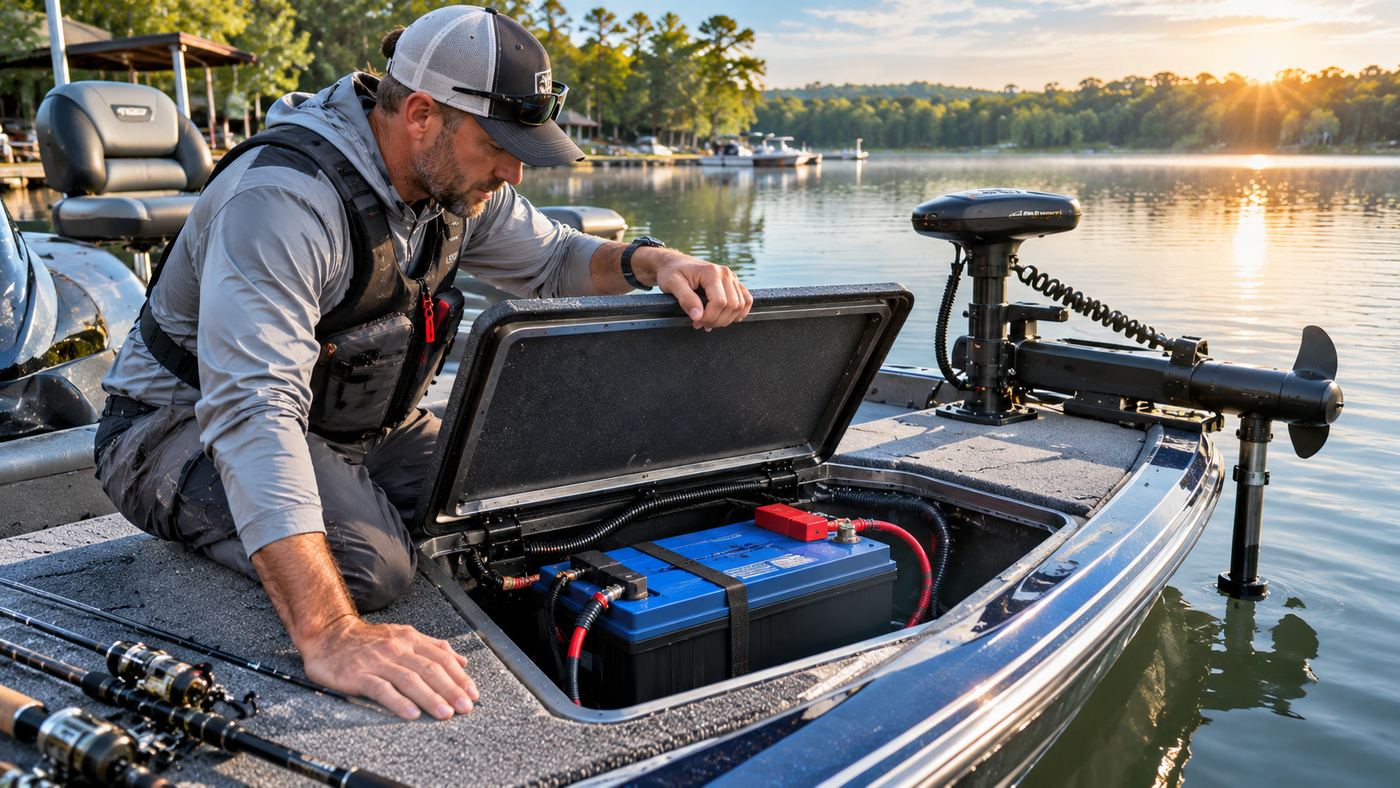
A dependable trolling motor can make a significant difference during a fishing trip. Whether you are navigating shallow water, maintaining your position near a fishing spot, or quietly moving along a shoreline, consistent electrical power helps you spend more time fishing and less time worrying about battery performance.
A lithium trolling motor battery is becoming an increasingly popular alternative to traditional lead-acid deep-cycle batteries. Modern lithium iron phosphate (LiFePO4) batteries offer high usable energy capacity, relatively low weight, and stable voltage throughout much of their discharge cycle.
However, selecting the right battery involves more than purchasing the largest capacity available. Boat owners must understand their trolling motor’s voltage requirements, maximum current draw, expected runtime, charging compatibility, and marine safety considerations.
A battery that works well with one trolling motor may be unsuitable for another. Incorrect voltage selection, inadequate discharge capacity, or incompatible charging equipment can cause performance problems and equipment damage.
This comprehensive guide explains seven essential factors when choosing a lithium trolling motor battery, including battery chemistry, sizing, runtime calculations, installation considerations, and long-term maintenance.
What Is a Lithium Trolling Motor Battery?
A lithium trolling motor battery is a rechargeable battery designed to supply electrical power to a compatible trolling motor.
Unlike conventional flooded lead-acid batteries, lithium batteries store and release energy using lithium-based electrochemical systems.
For many modern marine applications, lithium iron phosphate is a commonly selected chemistry because of its cycle-life characteristics, thermal stability, and suitability for deep-cycle use.
What Is LiFePO4 Technology?
LiFePO4 stands for lithium iron phosphate.
It is a battery chemistry used in energy storage systems, recreational vehicles, marine electronics, and other applications.
LiFePO4 batteries generally provide consistent voltage over much of their usable charge range.
They can also offer substantial weight savings compared with lead-acid batteries delivering similar usable energy.
However, battery performance depends on the actual cell quality, internal electronics, operating temperature, and manufacturer specifications.
How Does a Trolling Motor Battery Work?
A trolling motor converts electrical energy into mechanical movement.
The battery supplies electrical current to the motor controller, which regulates motor operation.
As the motor moves the boat through water, it consumes stored battery energy.
The current required depends on motor settings, thrust demand, boat weight, wind, current, and operating conditions.
A larger usable battery capacity can support longer operation when other conditions remain similar.
1. Choose the Correct Battery Voltage for Your Trolling Motor
Voltage compatibility is one of the most important requirements when selecting a marine battery.
Common trolling motor electrical systems operate at 12V, 24V, or 36V.
These configurations are not interchangeable.
12V Trolling Motor Batteries
A 12V system is common on smaller boats and trolling motors with relatively modest thrust requirements.
A suitable 12V LiFePO4 battery may provide adequate power for recreational fishing and lighter applications.
However, the battery’s discharge rating must still support the motor’s maximum electrical demand.
24V Trolling Motor Batteries
A 24V system is commonly used for motors requiring greater power than smaller 12V configurations.
Depending on the equipment, a 24V system may use one purpose-built 24V lithium battery or an approved arrangement of compatible batteries.
The installation must follow both motor and battery manufacturer requirements.
36V Trolling Motor Batteries
Higher-thrust trolling motors often operate at 36V.
These systems can support demanding applications involving larger boats or more challenging operating conditions.
A 36V LiFePO4 battery must have sufficient current capacity and compatible charging equipment.
Compare Common Voltage Systems
| Battery system | Common application | Important consideration |
|---|---|---|
| 12V | Smaller trolling motors | Motor voltage and current demand |
| 24V | Medium to higher-thrust motors | Battery and charger compatibility |
| 36V | High-thrust trolling motors | Greater energy and current requirements |
Always check the motor’s official specifications.
Do not select battery voltage based only on boat length or an estimated thrust requirement.
2. Calculate the Battery Capacity You Actually Need
Battery capacity is commonly expressed in ampere-hours (Ah).
It indicates how much electrical charge a battery can theoretically deliver under specified conditions.
However, ampere-hours alone do not describe the complete energy capacity unless voltage is also considered.
Understanding Ampere-Hours
A 100Ah battery could theoretically supply 10 amps for 10 hours under idealized conditions.
Real-world operation differs because current demand changes, battery protection systems impose limits, and environmental conditions affect performance.
Calculate Battery Energy
A useful approximate formula is:
Energy (Wh) = Nominal voltage (V) × Battery capacity (Ah)
For example, a 12.8V, 100Ah LiFePO4 battery has approximately:
12.8 × 100 = 1,280 Wh.
This represents 1.28 kWh of nominal energy.
A 25.6V, 100Ah system provides approximately 2.56 kWh.
A 38.4V, 100Ah system provides approximately 3.84 kWh.
These figures describe nominal energy, not guaranteed usable output under every operating condition.
Estimate Runtime Using Current Draw
For a simplified calculation:
Runtime (hours) ≈ Usable capacity (Ah) ÷ Average current draw (A)
Suppose a compatible 100Ah battery supplies a motor averaging 20 amps.
If 90Ah is available for the intended use, estimated runtime is:
90 ÷ 20 = 4.5 hours.
This example assumes a relatively steady average load and excludes some practical losses and operational variations.
Why Actual Runtime Changes
A trolling motor may draw much more current at maximum speed than while maintaining position in calm water.
Factors affecting runtime include wind, current, boat weight, propeller condition, motor efficiency, and battery temperature.
For realistic planning, estimate typical and maximum motor current rather than relying on a universal runtime claim.
3. Compare Lithium and Lead-Acid Trolling Motor Batteries
Traditional deep-cycle lead-acid batteries remain widely used in marine applications.
However, lithium alternatives offer different operating characteristics.
Weight
LiFePO4 batteries generally weigh less than lead-acid batteries providing comparable usable energy.
Reducing battery weight can make handling easier and may influence a boat’s overall loading.
Usable Capacity
Lead-acid batteries can experience reduced performance when discharged deeply or subjected to demanding loads.
LiFePO4 batteries often allow a greater portion of nominal capacity to be used, subject to manufacturer limits.
Voltage Stability
Lithium batteries typically maintain relatively stable voltage through much of the discharge cycle.
This may help compatible motors maintain more consistent performance.
However, lithium batteries can also disconnect abruptly when their battery management systems reach protective limits.
Maintenance
Flooded lead-acid batteries may require electrolyte-level inspection and other maintenance.
LiFePO4 batteries generally do not require water refilling.
Nevertheless, they still require appropriate charging, inspection, and storage.
Cost
Lithium batteries often have a higher upfront purchase price.
Longer cycle life may reduce replacement frequency, but actual savings depend on usage patterns and total ownership costs.
Lithium vs. Lead-Acid Comparison
| Feature | LiFePO4 battery | Lead-acid battery |
|---|---|---|
| Weight | Generally lighter | Generally heavier |
| Usable capacity | Often greater | Frequently more limited |
| Voltage behavior | Relatively stable | Declines during discharge |
| Cycle life | Often longer | Usually shorter |
| Initial cost | Usually higher | Often lower |
| Maintenance | Generally minimal | Depends on battery type |
| Charging | Requires compatible profile | Requires appropriate lead-acid charging |
Neither chemistry should be selected without checking motor compatibility.
4. Evaluate Battery Management Systems and Safety Features
A lithium battery’s internal management electronics are critical to safe and dependable operation.
Most purpose-built LiFePO4 marine batteries include a Battery Management System, commonly called a BMS.
What Does a BMS Do?
A BMS monitors important battery conditions and may interrupt operation when limits are exceeded.
Depending on the design, protections can include:
- Overcharge protection
- Over-discharge protection
- Excess current protection
- Short-circuit protection
- High-temperature protection
- Low-temperature charging protection
- Cell balancing
Not every battery offers identical functions or thresholds.
Continuous Discharge Current
One of the most important specifications is the maximum continuous discharge current.
A trolling motor can malfunction or shut down if it demands more current than the battery’s BMS permits.
For example, a battery capable of delivering 50 amps continuously may be unsuitable for a motor requiring 60 amps at maximum output.
The battery’s current rating must match the motor’s requirements.
Marine Environmental Protection
Marine equipment may encounter spray, vibration, humidity, and corrosion.
Check the battery enclosure’s ingress protection rating and environmental limitations.
A battery described as waterproof is not necessarily designed for prolonged submersion.
Follow Marine Safety Standards
Marine battery installations must meet applicable standards and regulations.
For U.S. installations, relevant guidance may include U.S. Coast Guard requirements and applicable American Boat and Yacht Council standards, including provisions for lithium-ion systems.
A properly specified battery should also be installed using approved cables, overcurrent protection, secure mounting, and appropriate electrical connections.
5. Compare Lithium Trolling Motor Batteries From Established Manufacturers
Battery specifications, warranty coverage, and available monitoring functions differ between manufacturers.
Before purchasing, examine detailed technical documentation rather than relying only on promotional descriptions.
ROYPOW Lithium Trolling Motor Batteries
Boat owners exploring a lithium trolling motor battery can review ROYPOW’s LiFePO4 marine battery solutions.
ROYPOW advertises batteries for 12V, 24V, and 36V trolling motor systems, with various capacity options.
The company highlights stable power output, low routine maintenance, corrosion protection, intelligent monitoring, and battery management safeguards.
Its published information describes Bluetooth monitoring, optional connectivity features on selected configurations, and self-heating functions on specific models.
These features may be useful for anglers seeking greater visibility into battery status or operating in challenging conditions.
However, the availability of any feature should be confirmed for the exact product model.
Example ROYPOW Battery Specifications
ROYPOW’s published trolling motor battery brochure includes these example configurations:
| Model | Nominal voltage | Capacity | Nominal energy |
|---|---|---|---|
| B1250A | 12.8V | 50Ah | 0.64 kWh |
| B12100A | 12.8V | 100Ah | 1.28 kWh |
| B12200A | 12.8V | 200Ah | At least 2.56 kWh |
| B2450A | 25.6V | 50Ah | 1.28 kWh |
| B24100H | 25.6V | 100Ah | 2.56 kWh |
| B36100H | 38.4V | 100Ah | 3.84 kWh |
Model availability and specifications may change.
ROYPOW also advertises a five-year warranty and design-life claims of up to ten years for its trolling motor battery range.
These are manufacturer claims, not guaranteed outcomes for every installation.
What Should Buyers Verify?
Before ordering, confirm the continuous discharge current, peak current, physical dimensions, charging requirements, supported connections, temperature limits, and warranty conditions.
A battery may have sufficient energy capacity but still lack the current rating required by a particular motor.
6. Use the Correct Charger for LiFePO4 Marine Batteries
Charging compatibility is essential for reliable battery operation.
A charger suitable for a conventional lead-acid battery is not automatically appropriate for a lithium battery.
Understand Charging Profiles
LiFePO4 batteries require charging within specified voltage and current limits.
The charger must follow a profile approved by the battery manufacturer.
Incorrect charging settings can affect performance or cause protective shutdowns.
Onboard Charging
Some marine chargers are designed to charge batteries while installed in the boat.
However, not every onboard charger supports all lithium configurations.
For example, Minn Kota explains that certain supported chargers can charge individual 12V LiFePO4 batteries, while those same chargers are not compatible with a single 24V or 36V lithium battery.
This distinction is important when comparing a multi-battery bank with a single higher-voltage battery.
Cold-Weather Charging
Lithium batteries require particular care when charging at low temperatures.
Some batteries include low-temperature charging protection.
Others incorporate heating systems that allow charging under specified cold-weather conditions.
Never assume that a heated battery can be charged safely at any temperature.
Always follow the manufacturer’s charging limits.
Charging Safety Checklist
Use an approved charging system, verify electrical connections, and ensure the battery is properly mounted.
Avoid charging damaged or swollen batteries.
Follow the manufacturer’s instructions concerning ventilation, supervision, storage, and emergency procedures.
Do not modify the charging system without appropriate technical guidance.
7. Consider Long-Term Value, Maintenance, and Reliability
The best battery is not necessarily the one with the lowest purchase price.
Marine battery ownership involves long-term considerations such as replacement frequency, maintenance, equipment compatibility, and reliability.
Estimate Total Ownership Cost
Suppose a boat owner compares a lead-acid battery with a lithium alternative over several years.
The analysis should include:
- Initial purchase price
- Charger compatibility costs
- Installation expenses
- Expected replacement frequency
- Maintenance requirements
- Warranty coverage
- Actual usage patterns
A lithium battery may cost more initially but potentially offer value through lower weight and longer service life.
However, financial benefits depend on actual use.
Cycle Life
Battery cycle life generally describes the number of charge-discharge cycles a battery can complete before reaching a specified remaining capacity.
ROYPOW advertises more than 3,500 cycles for its trolling motor battery line.
However, achievable cycle life depends on factors such as temperature, charging conditions, discharge depth, and operating practices.
Storage and Seasonal Care
If a boat is not used for extended periods, follow the battery manufacturer’s recommended storage state of charge and temperature conditions.
Inspect terminals and mounting hardware before returning the boat to service.
Monitor Battery Health
Where available, Bluetooth or other monitoring systems can help owners review battery status and certain operating conditions.
However, app connectivity should not replace physical inspection and appropriate maintenance.
How Long Will a 100Ah Lithium Trolling Motor Battery Last?
Runtime varies substantially with motor demand.
The following hypothetical table assumes 90Ah of usable capacity and a constant average current draw.
| Average current draw | Estimated runtime |
|---|---|
| 10A | 9 hours |
| 15A | 6 hours |
| 20A | 4.5 hours |
| 30A | 3 hours |
| 45A | 2 hours |
These estimates are not measurements of a specific motor or battery.
Real-world operation involves changing loads, and the BMS may disconnect the battery before every nominal ampere-hour is delivered.
For a realistic estimate, use the motor manufacturer’s current specifications and test the setup under representative conditions.
Can You Replace a Lead-Acid Battery With Lithium?
In some installations, a compatible lithium battery can replace a lead-acid battery.
However, replacement should not be assumed to be universally plug-and-play.
Check Voltage Compatibility
The lithium battery must supply a voltage appropriate for the motor.
Review Maximum Current
Ensure the battery can safely deliver the motor’s maximum required current.
Confirm Charger Compatibility
An existing charger may need replacement or reconfiguration.
Consider Motor Design
Minn Kota warns that certain brushed motors originally designed around lead-acid behavior can experience problems with the higher sustained voltage of lithium batteries.
Its guidance recommends limiting speed in specified situations.
Always consult the motor manufacturer’s current battery recommendations.
Review Wiring and Protection
Correct cable sizing, circuit protection, and secure connections remain important after a battery upgrade.
Improper installation can create equipment damage and fire hazards.
Common Lithium Trolling Motor Battery Problems
Battery Shuts Off Under Heavy Load
The trolling motor may be drawing more current than the BMS allows.
Check the battery’s continuous and peak discharge ratings against the motor’s requirements.
Battery Does Not Charge
Potential causes include incompatible charging profiles, low-temperature protection, poor connections, or BMS shutdown.
Follow official diagnostic procedures.
Runtime Is Shorter Than Expected
Examine actual motor current demand, battery condition, boat loading, and environmental conditions.
Do not assume that a 100Ah rating guarantees a particular number of fishing hours.
Battery Monitoring Is Inaccurate
Some monitoring applications estimate charge using battery measurements and internal calculations.
Readings may need calibration or may vary according to system design.
Battery Gets Unusually Hot
Stop using equipment showing abnormal heating, damage, smoke, or other warning signs.
Avoid handling a suspected failing battery unnecessarily and follow appropriate marine emergency procedures.
Lithium Trolling Motor Battery Buying Checklist
| Feature | What to check |
|---|---|
| Voltage | 12V, 24V, or 36V compatibility |
| Capacity | Required usable energy |
| Discharge rating | Motor’s maximum current demand |
| BMS | Appropriate protective functions |
| Charger | Approved LiFePO4 charging profile |
| Cold-weather operation | Charging and discharge temperature limits |
| Waterproofing | Actual IP rating and restrictions |
| Weight | Suitability for boat loading |
| Dimensions | Battery compartment fit |
| Monitoring | Bluetooth or supported system features |
| Warranty | Coverage and exclusions |
| Certifications | Relevant marine safety requirements |
The Future of Lithium Batteries for Marine Applications
Lithium battery technology continues to develop through improvements in cell manufacturing, electronic monitoring, thermal management, and integration with marine equipment.
Modern battery systems may provide more useful operating information, including estimated charge levels, temperature monitoring, and electrical fault alerts.
Manufacturers are also developing solutions intended for cold-weather use and specialized boating applications.
Nevertheless, selecting a battery should remain an engineering decision based on the actual motor, boat, electrical installation, and operating conditions.
Newer technology cannot eliminate the need for safe installation, compatible charging, and responsible maintenance.
Frequently Asked Questions
1. Is a lithium trolling motor battery better than lead-acid?
LiFePO4 batteries generally offer lower weight, more usable energy, and longer cycle life than comparable lead-acid batteries. However, they usually cost more and require careful compatibility checks.
2. How long does a 100Ah lithium trolling motor battery last?
Runtime depends on average motor current draw and usable battery capacity. For example, 90Ah of usable capacity at a steady 20A load gives a simplified estimate of 4.5 hours.
3. Can I use a lithium battery with any trolling motor?
Not necessarily. Confirm motor voltage, maximum current, charging requirements, and the manufacturer’s lithium compatibility guidance. Some older motors require additional operating precautions.
4. Does a lithium trolling motor battery need a special charger?
It needs a charger with a charging profile approved for the specific LiFePO4 battery. Some existing marine chargers are compatible, but others are not.
Conclusion
A lithium trolling motor battery can provide dependable energy, reduced weight, and longer service life for compatible marine applications.
The right choice depends on voltage, usable capacity, discharge performance, BMS protection, and charging compatibility.
By checking manufacturer specifications and following safe installation practices, anglers can build more reliable trolling motor power systems for their time on the water.
