
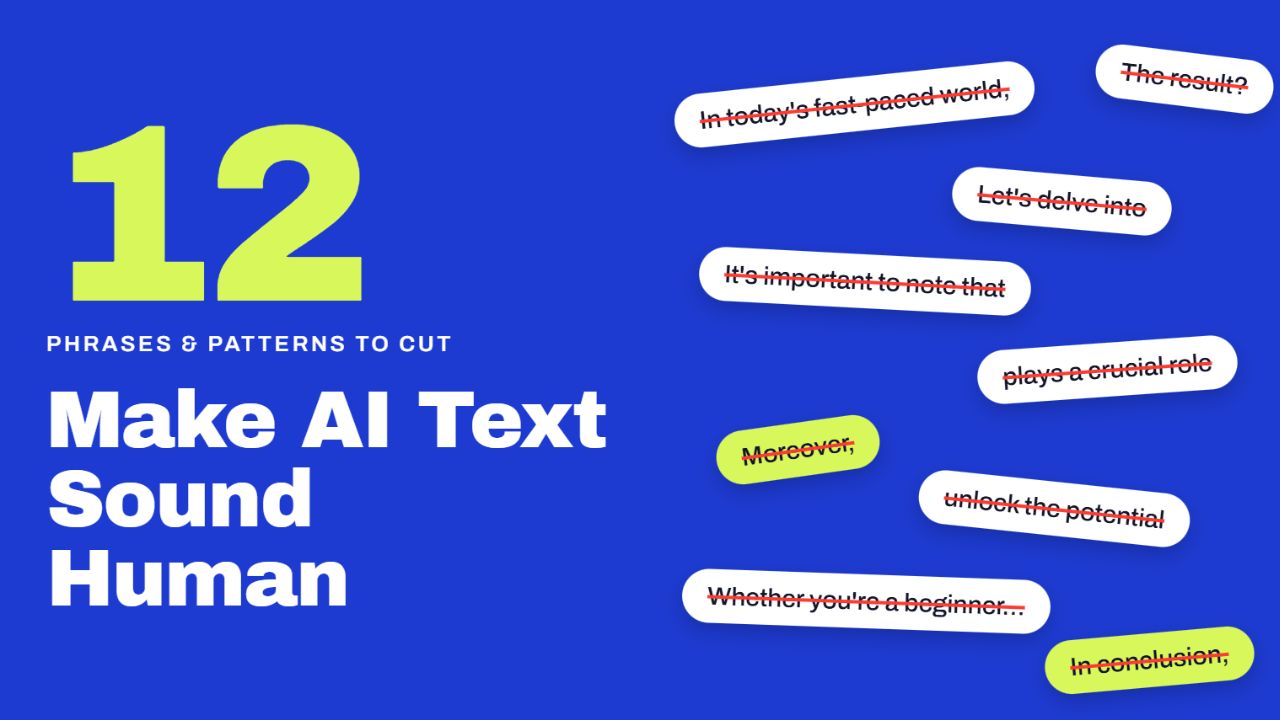
Most people who use ChatGPT for writing have typed some version of “make this sound human” at least once. The chatbot obliges, and the new draft often has the same problems as the old one, just shuffled around. That happens because the model tends to reach for the same phrases it used the first time.
The fastest way to make AI text human is to know exactly what to look for. A small number of phrases and sentence patterns account for most of what readers recognize as machine writing. This article lists 12 of them, explains why each one gives a draft away, and shows what to write instead.
Why These Phrases Stand Out
None of these phrases is wrong on its own. People used “delve” and “furthermore” long before chatbots existed. The problem is frequency. Language models use a narrow set of phrases far more often than people do, and readers have learned to notice.
The effect is strong enough to measure outside of writing. Researchers at the Max Planck Institute for Human Development analyzed hundreds of thousands of YouTube videos and podcast episodes and found that words like “delve,” “realm,” and “meticulous” became more common in human speech after ChatGPT launched. Scientific American covered the study, which suggests these words have become so associated with AI that their spread can be tracked.
Wikipedia’s volunteer editors, who review a steady stream of AI-generated submissions, keep a public field guide called Signs of AI writing. Several of the patterns below appear in it. The guide also makes a point worth repeating: a single word proves nothing. It is the cluster of habits that gives a text away, so the goal is to cut the habits, not hunt for one magic word.
12 Phrases and Patterns to Cut
1. The scene-setting opener
Watch for: “In today’s fast-paced world,” “In an ever-evolving landscape,” “In the digital age.”
These openers delay the point without adding anything. The reader already knows what year it is. Delete the phrase and start with the claim that followed it. If the sentence falls apart without it, the sentence needed rewriting anyway.
2. “Delve into”
Watch for: “Let’s delve into,” “This article delves into,” “delving deeper.”
This is probably the most recognized AI word of all, for the reasons covered above. Replace it with a plain verb that says what you are doing: look at, explain, compare, cover. Better still, skip the announcement and start explaining.
3. “It’s important to note that”
Watch for: “It’s worth noting,” “It’s important to remember,” “Keep in mind that.”
If something is important, the reader will see that from the content. These phrases are throat-clearing before the actual statement. Cut them and lead with the fact: “The warranty doesn’t cover water damage” instead of “It’s important to note that the warranty does not cover water damage.”
4. Inflated importance
Watch for: “plays a crucial role,” “plays a pivotal role,” “stands as a testament to,” “a key component of.”
The Wikipedia guide flags this habit specifically: AI text tends to tell readers that something matters instead of showing why. Replace the claim of importance with the evidence. “Sleep plays a crucial role in memory” becomes “People who slept after learning a list of words remembered more of them the next day.”
5. “It’s not X, it’s Y”
Watch for: “This isn’t just a tool, it’s a revolution,” “It’s not about X. It’s about Y,” “Not only… but also.”
This construction sets up a claim nobody made just to knock it down. Used once in a long piece, it can work. AI uses it constantly. Say what the thing is directly: “The tool cuts reporting time from a day to an hour.”
6. The automatic list of three
Watch for: “fast, reliable, and scalable,” “clear, concise, and compelling,” three bullet points under every heading.
Real ideas don’t come in tidy threes. When you see one, check each item. Often the third was added because three sounds complete. Keep the items that carry information and drop the rest, even if that leaves you with two.
7. Trailing “-ing” clauses
Watch for: sentences that end with “, highlighting the importance of…”, “, reflecting the growing need for…”, “, underscoring its significance.”
These clauses tack a vague interpretation onto a sentence that was finished. They sound thoughtful and say very little. Either cut the clause or turn it into its own sentence with a specific claim the reader can check.
8. Stacked transition words
Watch for: “Moreover,” “Furthermore,” “Additionally,” “In addition,” at the start of consecutive paragraphs.
People rarely write this way outside of school essays. Predictable transitions and uniform structure are also among the signals that AI detectors look for. In most cases, you can delete the transition, since the paragraph order already tells the reader that a new point is coming. When you need one, use the words you’d say aloud: “also,” “but,” “so.”
9. The everyone-included audience line
Watch for: “Whether you’re a beginner or a seasoned pro,” “Whether you’re a student, a professional, or a business owner.”
This line tries to speak to everyone and ends up speaking to no one. Decide who the piece is for and write to them. If it really serves several groups, show that through examples aimed at each group instead of announcing it.
10. Stock marketing verbs
Watch for: “unlock the potential,” “elevate your,” “navigate the complexities,” “harness the power of,” “take it to the next level.”
These are exactly the stale figures of speech Orwell warned against. They promise a lot and describe nothing. Replace each one with the specific result: not “elevate your morning routine” but “make coffee in four minutes instead of ten.”
11. The question that answers itself
Watch for: “The result? A faster workflow.” “Why does this matter? Because…” “The best part?”
A rhetorical question followed immediately by its answer is a copywriting device that AI uses far too often. Turn it into a plain statement. “The result was a faster workflow” or, better, “The team now closes tickets in two days instead of five.”
12. The recap ending
Watch for: “In conclusion,” “Ultimately,” “By following these tips, you can…,” “I hope this helps!”
AI conclusions restate everything the reader just read. Some drafts even keep the chatbot’s sign-off, which is a dead giveaway. End instead with the single point you most want remembered, a recommendation, or the next step. If the last paragraph only repeats earlier ones, delete it and see whether the piece ends better without it. It usually does.
A Quick Find-and-Replace Pass
You can catch most of these in five minutes with your editor’s search function. Search your draft for each of these strings, one at a time, and rewrite every sentence where one turns up:
- “In today’s” and “ever-evolving”
- “delve”
- “important to note” and “worth noting”
- “crucial,” “pivotal,” and “testament”
- “not just” and “it’s not”
- “highlighting,” “reflecting,” and “underscoring”
- “Moreover,” “Furthermore,” and “Additionally”
- “Whether you’re”
- “unlock,” “elevate,” “navigate,” and “harness”
- “In conclusion” and “Ultimately”
Patterns 6 and 11, the lists of three and the self-answering questions, won’t show up in a word search. For those, read the draft once with only that pattern in mind.
When a Tool Can Help
Cutting these phrases by hand is the most reliable method, and it is the only way to add the specific examples that make writing sound like a person. For long drafts, a rewriting tool can take the first pass. If you want to make this sound human without retyping every paragraph, UnAIMyText can rework the phrasing, and you can then run the search list above on the result. Check that the meaning, numbers, and names survived before you publish.
Closing Words
To make AI text human, start by cutting what gives it away: the scene-setting openers, the borrowed importance, the reflexive lists of three, the stacked transitions, and the recap at the end. Then replace each one with something specific. Readers forgive plain writing. They stop trusting writing that sounds like everything else they have read.
