
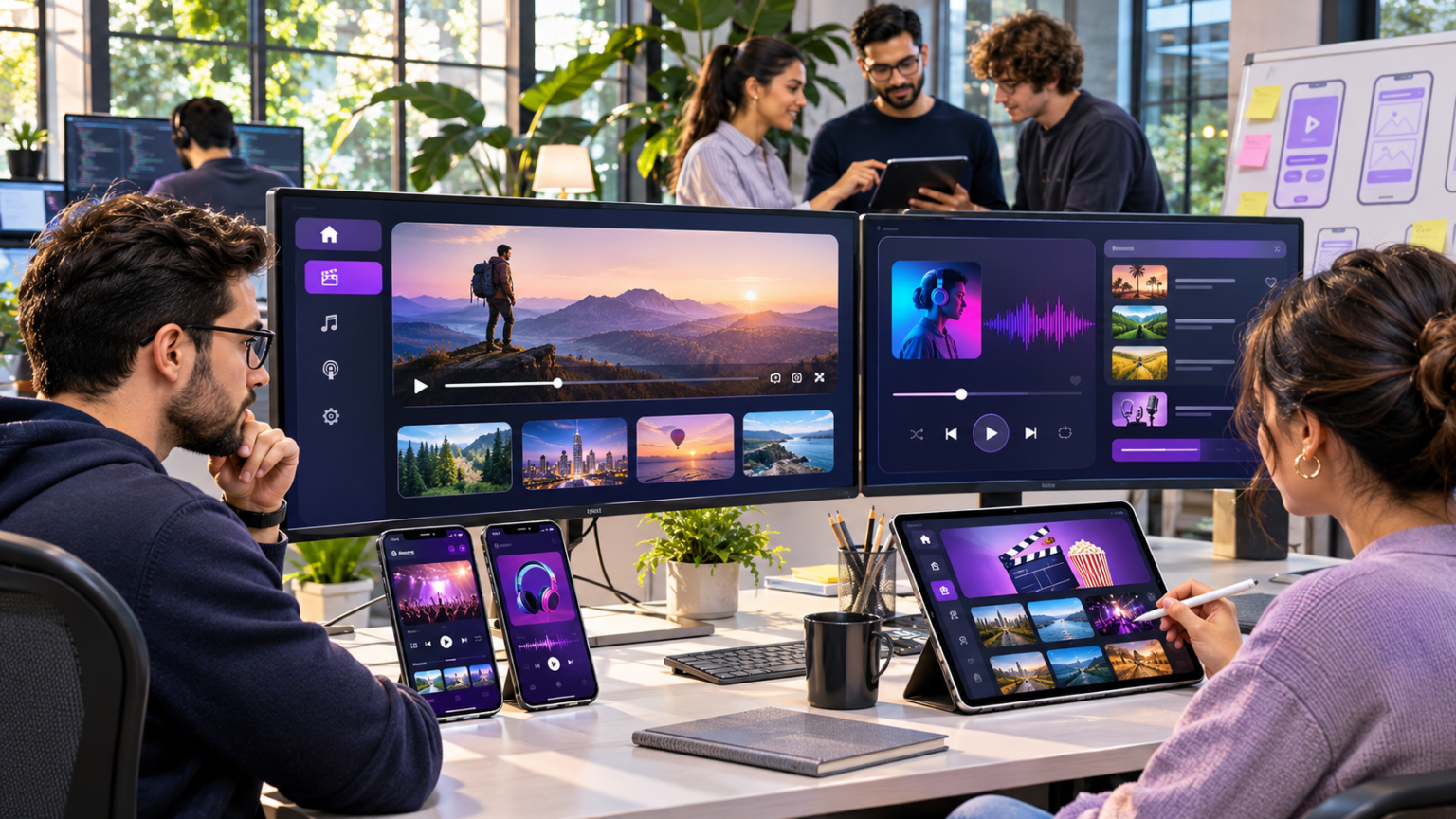
Digital entertainment has changed how people discover movies, listen to music, follow live events, and interact with creators. Audiences increasingly expect convenient access across smartphones, tablets, and connected devices. However, delivering an enjoyable experience requires more than an attractive interface. A professional media & entertainment app development company helps businesses plan, design, build, test, and maintain applications that connect digital content with the right audience. From streaming technology and secure subscriptions to accessible design and content management, each component influences the finished product.
For startups and established entertainment businesses, selecting a development partner is an important decision. The right team should understand both software engineering and the commercial requirements of digital media.
Moreover, an entertainment application must perform reliably as its content library, audience, and operational needs develop.
This guide explains media app development services, essential features, technology choices, project costs, and practical strategies for selecting a capable development company.
What Is a Media and Entertainment App Development Company?
A media and entertainment app development company specializes in creating digital applications for distributing, discovering, managing, and interacting with entertainment content.
These applications may deliver films, television programs, music, podcasts, live broadcasts, digital publications, or interactive experiences.
Unlike a simple informational website, an entertainment application often requires specialised systems for media playback, content access, user accounts, and subscription management.
Therefore, development involves several connected areas of expertise.
Core Development Services
A professional team may provide:
- Product research and application planning
- User interface and experience design
- Android and iOS application development
- Video and audio streaming integration
- Content management systems
- Subscription and payment integration
- Cloud infrastructure and backend development
- Application testing and technical support
- Security and performance monitoring
However, not every provider offers the same capabilities. Some companies focus on mobile interfaces, while others have experience building complete media delivery platforms.
Consequently, businesses should evaluate relevant project experience before choosing a partner.
Types of Media and Entertainment Applications
Different entertainment products require different development approaches.
Understanding the intended application category helps businesses define their technical requirements.
Video Streaming and OTT Applications
Over the top streaming applications deliver video content through internet connections.
These products may offer films, television episodes, documentaries, or other licensed programming.
Common features include searchable content libraries, playback controls, user profiles, subtitles, and subscription access.
Additionally, some services support downloads for permitted offline viewing.
Music and Podcast Applications
Audio entertainment applications focus on reliable playback and convenient content discovery.
Users may expect playlists, episode collections, listening history, and playback that continues when the application is not in the foreground.
However, music distribution also requires appropriate licensing arrangements.
Live Streaming Applications
Live streaming applications deliver events as they happen.
Examples include concerts, conferences, performances, and authorised sports broadcasts.
These systems require careful planning around stream stability, viewer capacity, latency, and network conditions.
Creator and Community Platforms
Some entertainment applications allow creators to publish material and interact with their audiences.
They may support uploads, comments, subscriptions, or community features.
However, platforms hosting user generated content also need effective reporting, moderation, and abuse prevention systems.
7 Essential Factors When Choosing a Media and Entertainment App Development Company
Selecting a development partner should involve more than comparing portfolios and initial quotations.
The following considerations help businesses evaluate technical capability, collaboration, and long term suitability.
1. Evaluate Relevant Industry Experience
Entertainment applications have different requirements from ordinary business tools.
For example, a video streaming service needs media processing, playback compatibility, and content delivery infrastructure.
Meanwhile, a music application may prioritise audio performance, playlists, and rights management.
Therefore, look for a team with experience in projects that resemble your intended product.
Review Previous Development Work
Ask prospective providers to explain the applications they have developed.
Focus on the technical challenges they addressed rather than relying exclusively on interface screenshots.
Useful questions include:
- What types of media applications has the team built?
- Which platforms were supported?
- How were playback problems handled?
- What responsibilities did the team manage?
- How was application performance tested?
Where possible, review live applications or permitted product demonstrations.
A relevant case study should distinguish the provider’s actual work from features delivered by unrelated vendors.
2. Prioritize User Experience and Accessibility
An entertainment app should help users find and enjoy content with minimal confusion.
Complicated navigation can make even a large content library difficult to use.
Therefore, developers should focus on intuitive layouts, clear categories, readable text, and understandable playback controls.
For example, a streaming application should make it easy to pause a video, resume watching, or locate another episode.
Similarly, a podcast app should provide accessible playback speed and navigation controls where appropriate.
Design for Different Devices
Users may access entertainment through smartphones, tablets, televisions, or web browsers.
Each screen has different navigation requirements.
A television application operated with a remote control should not simply reproduce a touch based mobile interface.
Additionally, accessible design deserves careful attention.
Captions, screen reader support, adequate contrast, and keyboard or remote navigation can improve usability for people with disabilities.
The Web Content Accessibility Guidelines provide a useful framework, although native mobile applications also require platform specific accessibility testing.
3. Examine Streaming Technology and Performance
Playback quality is central to many entertainment applications.
Users need reliable access to content under varying network conditions.
Therefore, the development team should understand how media files are processed, stored, and delivered.
A video application may require multiple versions of the same content at different bitrates and resolutions.
The player can then select a suitable stream based on network conditions and device capabilities.
Understand Adaptive Bitrate Streaming
Adaptive bitrate streaming allows playback quality to adjust as the available connection changes.
For example, a device experiencing reduced bandwidth may switch to a lower bitrate to help maintain playback.
Common technologies include HTTP Live Streaming and MPEG DASH.
Apple documents HLS as a technology for delivering live and recorded media with adaptive playback.
Additionally, Amazon Web Services describes architectures that use media encoding, cloud storage, and content delivery networks.
However, smooth playback still depends on implementation quality, device compatibility, and actual network conditions.
4. Review Security and Content Protection
Media businesses often manage customer information, payment details, and valuable digital content.
Consequently, security must be considered throughout development.
Important practices include appropriate authentication, encrypted communications, secure storage, and controlled administrative access.
The application should also maintain reliable procedures for software updates and vulnerability management.
Protect Licensed Content
Some video services require digital rights management to control access to protected media.
On supported platforms, technologies such as Widevine and FairPlay can form part of a content protection strategy.
However, DRM does not prevent every form of copying or unauthorised recording.
Content protection should also consider user entitlements, licensing restrictions, and playback requirements.
Protect User Information
Collect only the information necessary to provide the service.
Furthermore, publish clear privacy information and establish appropriate retention and deletion processes.
Apple and Google Play both maintain policies concerning privacy, user data, and application behaviour.
Therefore, compliance planning should begin before launch rather than becoming a last minute task.
5. Assess Customization and Future Scalability
Business requirements can change after an application launches.
For example, a streaming startup may initially offer a small video library and later introduce additional languages, subscription plans, or device support.
Therefore, the development architecture should allow reasonable expansion.
A modular design can help teams update selected components without unnecessarily rewriting the entire product.
However, scalability does not mean purchasing expensive infrastructure before it is needed.
The goal is to design for realistic growth.
Ask About Platform Flexibility
Clarify whether the proposed system supports future features such as:
- Additional device platforms
- Multiple user profiles
- New payment options
- Expanded content categories
- Regional content availability
- Analytics and reporting
- Different subscription models
A capable development partner should explain which additions are straightforward and which may require substantial engineering work.
6. Understand Pricing and Project Transparency
App development costs depend on the proposed features and technical complexity.
A simple audio content application may require fewer resources than a video platform offering live events, subscriptions, and offline viewing.
Therefore, comparing quotations without reviewing the scope can be misleading.
Ask each provider to explain its development process, estimated effort, and major cost assumptions.
What Should the Proposal Include?
A clear proposal should identify the project scope, expected deliverables, design responsibilities, development stages, testing approach, and support arrangements.
Additionally, ask how change requests will affect pricing.
Some providers work under fixed scope agreements, while others charge according to development time.
Neither approach is automatically superior.
The suitable model depends on the project’s certainty, flexibility, and risk.
7. Confirm Long Term Support and Maintenance
Publishing an entertainment application is not the final stage of development.
Mobile operating systems, devices, security requirements, and app store policies continue to change.
Consequently, applications need ongoing monitoring, updates, and technical maintenance.
Ask how the development company handles production problems, security patches, and compatibility updates.
Furthermore, confirm who owns the source code and how the business can access essential project documentation.
A written maintenance agreement should explain responsibilities, response arrangements, and additional charges.
Reliable ongoing support helps businesses maintain a functional service after launch.
Essential Features of a Modern Entertainment Application
The correct feature set depends on the application category and intended audience.
However, several capabilities are frequently useful.
User Registration and Profiles
Accounts can help users manage subscriptions, watchlists, playlists, and viewing preferences.
Multiple profiles may be useful for household entertainment services.
However, profile creation should be simple and collect only necessary information.
Content Search and Discovery
A well organised catalogue helps users locate relevant entertainment.
Useful discovery features may include categories, filters, search suggestions, and collections.
Moreover, accurate metadata makes content easier to browse.
For example, films may include genres, release information, languages, and age classifications.
Reliable Media Playback
Media players should provide clear controls and handle ordinary changes in network conditions.
Depending on the product, useful features may include subtitles, playback speed, quality selection, and resuming content.
However, supported capabilities depend on the selected player and media format.
Subscription and Payment Management
Paid entertainment services may offer recurring subscriptions, rentals, or individual purchases.
The app should explain pricing and renewal conditions clearly.
Additionally, payment integration must follow the applicable app store rules.
These rules vary by platform, product type, region, and entitlement.
Therefore, businesses should review the current requirements before selecting a billing architecture.
Content Management Dashboard
An administrative content management system helps authorised staff organise a media library.
Depending on the product, administrators may upload content, manage categories, update descriptions, control availability, and review publication status.
This reduces the need for engineering involvement in ordinary editorial tasks.
How Media and Entertainment App Development Works
A structured development process helps reduce uncertainty and improve collaboration.
Although every project is different, several stages are common.
Step 1: Product Discovery and Planning
The team begins by understanding the business idea, intended users, content model, and commercial objectives.
For example, an independent film distributor may need a subscription video service, while a podcast producer may require an advertising supported audio application.
The discovery stage should identify essential functions, technical constraints, and major risks.
Next, the team develops a practical project scope.
Step 2: User Experience Design
Designers prepare user journeys, wireframes, and interface concepts.
These materials show how people will navigate the application.
For example, a user journey might begin with account creation and continue through content discovery, playback, and subscription management.
Early testing can identify confusing navigation before development becomes expensive.
Step 3: Backend and Application Development
Developers build the application interface and supporting systems.
The backend may manage accounts, content metadata, subscriptions, and authorisation.
Meanwhile, media processing and delivery services handle video or audio preparation.
Integration work connects these components into a functional product.
Step 4: Quality Assurance and Testing
Testing should cover normal use, unexpected errors, and device compatibility.
Playback and Performance Testing
The team should examine startup delays, playback interruptions, and behaviour when network conditions change.
Testing should include relevant devices and operating system versions.
Security and Payment Testing
Account access, subscription changes, and protected content permissions need careful verification.
Testing should also cover cancellation, renewal, and error scenarios.
Accessibility Testing
Review captions, controls, screen reader behaviour, and text readability.
Automated checks can help identify some problems, but manual testing remains important.
Step 5: Launch and Post Launch Support
Once the application meets its acceptance criteria, the team prepares it for distribution.
This may include app store listings, privacy documentation, screenshots, and review submissions.
However, approval is subject to the relevant platform’s requirements.
After launch, monitoring and user feedback help guide future improvements.
Choosing the Right Technology Stack
The technology stack influences performance, flexibility, maintenance, and development effort.
Therefore, businesses should ask developers to explain their recommendations in practical terms.
Native App Development
Native development uses technologies intended for a particular platform.
For example, Swift is commonly used for Apple applications, while Kotlin is widely used for Android development.
Native development can provide direct access to platform capabilities.
However, maintaining separate applications may require more platform specific work.
Cross Platform Development
Frameworks such as Flutter and React Native allow teams to share portions of application code across supported platforms.
This can simplify some development and maintenance tasks.
Nevertheless, specialised media playback features may still require native integrations.
The correct approach depends on device targets and technical requirements.
Cloud Infrastructure
Cloud services can support storage, content processing, backend workloads, and media distribution.
For example, AWS documents video workflows involving Amazon S3, MediaConvert, and CloudFront.
These services can be combined to prepare different media formats and distribute content.
However, cloud expenditure depends on actual usage, configuration, and pricing arrangements.
How Much Does Entertainment App Development Cost?
Development costs vary widely because entertainment applications differ in complexity.
A basic content catalogue with simple playback has different requirements from a large streaming service offering digital rights management, live video, and multiple subscriptions.
Therefore, businesses should avoid relying on a universal development price.
Features and Technical Complexity
The number and difficulty of features influence project effort.
For example, adding a basic playlist is different from designing a personalised recommendation system.
Similarly, secure offline video downloads require additional planning around storage, licensing, and playback restrictions.
Number of Supported Platforms
Developing for mobile devices alone may involve less work than supporting mobile, web, and connected television applications.
Each platform introduces design, testing, and compatibility considerations.
Media Infrastructure Costs
Streaming services may pay for storage, transcoding, content delivery, and monitoring.
These operating costs can change as media libraries and audiences grow.
Consequently, businesses should request both an initial development estimate and a recurring infrastructure budget.
Ongoing Maintenance
Support, security reviews, software updates, and future improvements also require resources.
A realistic budget should account for these activities rather than focusing exclusively on the launch expense.
Business Models for Media and Entertainment Apps
A successful application needs a commercial strategy that fits its content and audience.
Several monetisation models are available.
Subscription Based Access
Subscription platforms charge users for continuing access to selected content.
They may offer different plans based on features or available programming.
However, clear billing terms and relevant content licensing are essential.
Advertising Supported Content
Some applications provide content without requiring a direct subscription.
Instead, they generate revenue through advertising.
This approach requires careful consideration of advertising frequency, user privacy, and the viewing experience.
Individual Purchases and Rentals
Businesses may offer access to particular films, events, or content collections for a defined payment.
The technical system should enforce the purchased entitlement and any agreed access period.
Hybrid Monetisation
Some services combine subscriptions, advertising, and individual purchases.
However, additional payment options create more complexity.
Therefore, businesses should introduce monetisation features according to real customer needs and verified demand.
Content Licensing and Legal Considerations
Content rights are fundamental to digital entertainment.
A company cannot assume that purchasing a media file provides permission to distribute it through an application.
Licensing agreements may restrict how, where, and for how long content can be used.
Understand Distribution Rights
A media licensing agreement may address geographical territories, supported devices, permitted viewing methods, and access periods.
For example, a licence permitting streaming in one country may not authorise worldwide distribution.
Offline downloads may require separate rights.
Therefore, the business should confirm its legal permissions before releasing content.
Follow App Store Requirements
Apple’s review guidance requires appropriate authorisation when apps distribute third party copyrighted material.
Google Play also prohibits intellectual property infringement.
Consequently, developers should build content rights and compliance requirements into the project from the beginning.
Legal advice may be necessary when agreements involve multiple territories or complex distribution arrangements.
How to Improve Audience Retention and App Performance
An entertainment app should be evaluated after launch rather than judged solely by download numbers.
The most useful metrics depend on the product’s objectives.
Monitor Playback Quality
For streaming services, useful technical indicators include startup time, buffering events, playback errors, and successful session completion.
These measurements can help teams identify problems that interfere with viewing.
Understand Content Discovery
Review how users navigate the catalogue and whether they find relevant content.
For example, frequent searches that produce no results may suggest missing metadata or unavailable programming.
Measure Subscription Outcomes
Paid applications may monitor conversion, renewal, cancellation, and customer support trends.
However, analytics should respect user privacy and applicable consent requirements.
Improve Through Testing
Use customer feedback and observed problems to guide product changes.
Before adding new features, determine whether they solve meaningful user needs.
This approach can help teams prioritise improvements rather than expanding the application without a clear purpose.
Common Mistakes to Avoid When Hiring an App Development Company
One common mistake is beginning development without defining the intended audience.
Without clear requirements, teams may build expensive features that users do not need.
Another problem is underestimating media delivery costs.
Video processing and distribution should be considered during financial planning.
Businesses may also overlook content licensing, accessibility, or app store requirements until late in development.
Consequently, important changes may become more difficult.
Finally, avoid choosing a development partner solely because of the lowest initial quotation.
Relevant expertise, documentation, communication, and ongoing support are equally important.
The Role of AI in Entertainment App Development
Artificial intelligence can support selected entertainment features.
For example, recommendation systems may help users discover relevant content based on available information and appropriate permissions.
AI assisted tools may also support content tagging, search, and customer service workflows.
However, automated recommendations require careful evaluation.
Poor data quality can produce irrelevant suggestions, while excessive data collection creates privacy concerns.
Additionally, generated summaries or metadata should be reviewed for accuracy.
AI can support product development, but it does not replace responsible design, editorial oversight, or security practices.
Frequently Asked Questions
What does a media and entertainment app development company do?
It designs, develops, tests, and maintains applications for video streaming, music, podcasts, live events, and other digital entertainment services.
How much does media and entertainment app development cost?
Costs depend on features, supported platforms, streaming infrastructure, content protection, design complexity, and ongoing maintenance requirements.
What features should an entertainment application include?
Important features may include content discovery, reliable playback, user profiles, accessibility options, subscription management, and secure administration.
Which technology is best for entertainment app development?
The best technology depends on device requirements, media formats, performance needs, and project resources. Native and cross platform approaches both have advantages.
How long does it take to develop a media app?
Development time depends on the product scope, integration requirements, supported devices, testing needs, and approval process.
Can entertainment applications support live streaming?
Yes. Live streaming can be integrated using appropriate encoding, media delivery, and playback technologies, subject to infrastructure and licensing requirements.
Conclusion
Choosing a media & entertainment app development company requires careful evaluation of technical experience, user experience design, content security, and long term support. A dependable development partner should understand streaming architecture, licensing responsibilities, payment systems, and the needs of the intended audience. By defining clear objectives, selecting essential features, and planning for maintenance, businesses can develop entertainment applications that provide lasting value. Thoughtful execution and continuous improvement remain important throughout the product’s lifecycle.
