
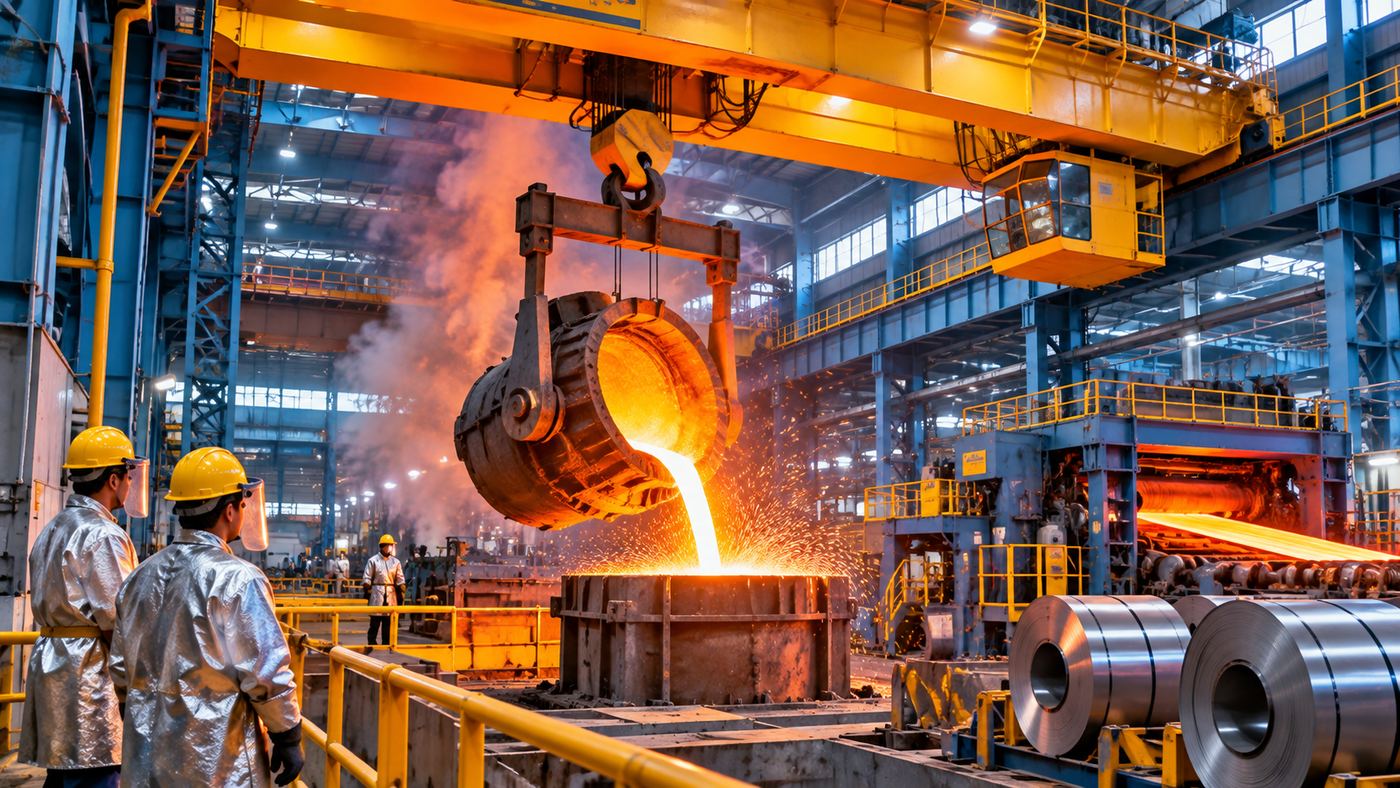
Metal production is one of the foundations of modern industrial development. From skyscrapers and bridges to vehicles, machinery, electrical systems, and household appliances, metals provide the strength, durability, and versatility needed for countless applications.
The manufacturing industry relies on advanced technologies to transform raw materials into usable metals with specific physical and chemical properties. These processes involve extraction, smelting, refining, casting, forming, and quality control.
Modern metal manufacturing facilities also depend on specialised equipment, including industrial furnaces, overhead cranes, automated handling systems, rolling mills, and precision testing instruments.
As businesses seek to increase efficiency and reduce environmental impacts, the industry continues to adopt smarter manufacturing technologies and lower-emission production methods.
This guide explores how metals are produced, the main manufacturing processes, essential machinery, workplace safety requirements, and emerging trends shaping industrial metal production.
What Is Metal Production?
Metal production refers to the industrial processes used to extract, refine, manufacture, and prepare metals for commercial applications.
Metals may be obtained from naturally occurring ores or recovered from recycled materials.
The manufacturing process depends on the metal being produced, the available raw materials, the required product characteristics, and the technologies used at the facility.
Common industrial metals include:
- Steel
- Iron
- Aluminium
- Copper
- Zinc
- Nickel
- Titanium
- Stainless steel
- Lead
- Magnesium
Each metal has different characteristics, including strength, conductivity, corrosion resistance, melting temperature, and formability.
Manufacturers select materials according to their intended use, operating conditions, and performance requirements.
Why Is Metal Production Important?
Metal manufacturing supplies essential materials for construction, transportation, energy, infrastructure, and industrial equipment.
Without reliable metal supplies, producing buildings, bridges, vehicles, renewable energy systems, and manufacturing machinery would become significantly more difficult.
Metal production also supports other economic activities, including mining, transportation, recycling, engineering, and equipment maintenance.
Main Types of Metal Production
Industrial metal manufacturing can be divided into several categories according to the materials and processes involved.
Primary Metal Production
Primary production involves obtaining metals from ores or other naturally occurring mineral resources.
Examples include extracting iron from iron ore and producing primary aluminium from alumina derived from bauxite.
Primary production often requires considerable energy and specialised processing equipment.
Secondary Metal Production
Secondary production uses recycled metal materials.
Scrap steel, aluminium, and copper can be collected, sorted, processed, and returned to manufacturing operations.
Recycling can reduce the need for virgin raw materials and may substantially lower energy demand, depending on the metal and recycling process.
Ferrous Metal Production
Ferrous metals contain iron as a principal constituent.
This category includes carbon steel, alloy steel, stainless steel, and cast iron.
Ferrous metals are widely used because they can offer high mechanical strength, versatility, and comparatively economical manufacturing options.
Non-Ferrous Metal Production
Non-ferrous metals do not contain iron as their principal constituent.
Examples include aluminium, copper, zinc, and titanium.
These metals are valued for properties such as electrical conductivity, low density, corrosion resistance, and specialised engineering performance.
How Does the Metal Production Process Work?
Although manufacturing methods vary, metal production generally follows a sequence of material preparation, processing, shaping, and inspection.
Step 1: Raw Material Extraction
Primary production begins with obtaining mineral resources.
Mining operations extract ores containing valuable metallic elements.
The ore may then undergo crushing, screening, separation, and concentration processes to prepare it for subsequent treatment.
Step 2: Raw Material Preparation
Different manufacturing methods require specific feedstock characteristics.
For example, ironmaking facilities may use iron ore fines processed into sinter or pellets.
Recycled metal operations typically sort scrap materials to minimise contamination and improve the consistency of furnace inputs.
Proper preparation supports efficient processing and helps control final product quality.
Step 3: Smelting or Reduction
Smelting and reduction processes convert metal-bearing materials into usable metallic forms.
The required method depends on the metal and its chemical characteristics.
Ironmaking commonly involves reducing iron oxides to metallic iron.
Other metals may require different thermal, chemical, or electrochemical extraction technologies.
Step 4: Refining
Refining reduces unwanted impurities and adjusts chemical composition.
Manufacturers may add alloying elements to achieve desired characteristics.
Precise composition control is important because relatively small chemical differences can significantly affect material performance.
Step 5: Casting
Molten metal is transferred into moulds or continuous casting equipment.
As the metal cools and solidifies, it forms products such as slabs, billets, blooms, ingots, or specialised cast components.
Casting processes must carefully control temperature, cooling conditions, and material flow.
Step 6: Forming and Finishing
Solidified metal is processed into usable shapes.
Depending on the application, manufacturers may use rolling, forging, extrusion, machining, drawing, or other forming methods.
Finishing treatments may include heat treatment, coating, polishing, or surface preparation.
Step 7: Quality Inspection
Manufactured products undergo testing and inspection to verify that they meet specified requirements.
Testing may evaluate chemical composition, dimensions, mechanical properties, surface quality, and internal defects.
Steel Production Methods
Steel manufacturing represents a major segment of the global metals industry.
According to the World Steel Association, the two principal steelmaking routes are the blast furnace–basic oxygen furnace method and the electric arc furnace method.
Blast Furnace–Basic Oxygen Furnace Process
The blast furnace–basic oxygen furnace route commonly uses iron ore, coke, limestone, and recycled steel.
Iron ore is reduced to molten iron in a blast furnace.
This molten iron is then transferred to a basic oxygen furnace, where oxygen is introduced to reduce carbon content and help remove impurities.
The resulting molten steel can undergo additional refining before casting.
This method is well established and supports large-scale integrated steel manufacturing.
However, conventional coal-based ironmaking is associated with substantial greenhouse gas emissions.
Electric Arc Furnace Process
Electric arc furnaces use electrical energy to melt metallic feedstocks.
Common inputs include recycled steel scrap and direct reduced iron.
Electric arcs generate the heat required for melting and refining.
Electric arc furnace production can be particularly useful when substantial quantities of suitable scrap steel are available.
Its environmental performance depends on electricity generation, feedstock composition, and overall production conditions.
Direct Reduced Iron Production
Direct reduction converts iron ore into metallic iron without melting it in a traditional blast furnace.
The resulting direct reduced iron can be used as feedstock in electric arc furnaces.
Different direct reduction technologies use natural gas, coal-derived reducing gases, or potentially hydrogen-based processes.
Hydrogen-based methods are being developed as part of efforts to reduce emissions from ironmaking.
Essential Equipment Used in Metal Production
Industrial metal manufacturing requires machinery capable of operating under demanding conditions.
High temperatures, heavy loads, dust, vibration, and continuous production schedules create significant equipment challenges.
Industrial Furnaces
Furnaces supply the heat necessary for melting, smelting, refining, or heat treatment.
Different furnace designs are selected according to material requirements, production capacity, and energy sources.
Casting Machines
Casting machinery transforms molten metal into solid forms.
Continuous casting systems are widely used in steelmaking because they support controlled, high-volume production.
Rolling Mills
Rolling mills use rotating rolls to reduce material thickness or change cross-sectional shape.
Hot rolling processes operate at elevated temperatures, while cold rolling is generally performed at lower temperatures to achieve particular dimensional and surface characteristics.
Industrial Overhead Cranes
Cranes are essential for moving heavy materials throughout metal manufacturing facilities.
Their applications can include transporting scrap, transferring steel products, handling casting equipment, and supporting maintenance operations.
Businesses evaluating lifting solutions for metal production can explore specialised industrial crane applications designed for the demanding operating conditions of iron and steel plants.
DAFANG CRANE describes equipment used in metal manufacturing environments, including ladle cranes for molten metal handling and other cranes for production-related lifting tasks.
Ladle Cranes
Ladle cranes are specifically designed for lifting and transporting ladles containing molten metal.
These operations involve severe heat exposure and exceptionally high consequences if lifting equipment fails.
The crane design must account for the relevant load characteristics, redundancy requirements, operating environment, and applicable safety standards.
Electromagnetic Cranes
Electromagnetic cranes use lifting magnets to handle suitable ferromagnetic materials.
They can be useful for transferring scrap steel, billets, plates, and other compatible steel products.
Their safe use depends on appropriate engineering design, reliable power arrangements, load suitability, and operating procedures.
Charging Cranes
Charging cranes support furnace operations by handling materials or charging equipment.
They are designed to operate in environments involving elevated temperatures, dust, and intensive production activity.
Automated Material Handling Systems
Modern facilities may use conveyors, robotic equipment, automated cranes, and digitally controlled transport systems.
Automation can improve material flow and reduce certain manual handling requirements when properly implemented.
The Role of Industrial Cranes in Steel Manufacturing
Reliable lifting equipment is particularly important in steel plants because production often involves extremely heavy materials and hazardous operating environments.
Handling Molten Metal
Molten metal transportation requires carefully engineered lifting systems.
Cranes must be designed, operated, inspected, and maintained according to the relevant standards and site-specific safety requirements.
Moving Raw Materials
Cranes assist with transferring scrap, charging materials, and other heavy components between production areas.
Efficient movement helps coordinate different processing stages.
Supporting Continuous Casting
Casting operations involve heavy ladles, tundish-related equipment, and other substantial components.
Specialised lifting equipment may support these operations, depending on plant layout.
Transporting Finished Products
Steel slabs, coils, billets, and structural products require suitable lifting attachments and handling methods.
Manufacturers may use hooks, clamps, lifting beams, magnets, or specialised gripping systems.
Reducing Production Disruptions
Equipment reliability matters because an unexpected crane failure can interrupt operations.
Preventive maintenance, inspection, condition monitoring, and properly planned spare-parts availability help manage this risk.
Safety Challenges in Metal Production Facilities
Metal manufacturing environments can expose workers to serious hazards.
Effective safety management requires engineering controls, suitable procedures, training, maintenance, and emergency preparedness.
Extreme Temperatures
Molten metal, heated surfaces, and furnaces can cause severe burns.
Facilities must use appropriate barriers, protective equipment, and safe operating procedures.
Heavy Lifting Operations
Suspended loads introduce hazards including dropped loads, collisions, and structural failures.
Lifting equipment must be suitable for its intended purpose, and workers should never enter prohibited areas beneath suspended loads.
Dust and Airborne Contaminants
Metal processing can generate dust, fumes, and other airborne contaminants.
Exposure controls may involve local exhaust ventilation, filtration, enclosure, monitoring, and suitable respiratory protection where required.
Noise Exposure
Rolling mills, furnaces, and heavy machinery can generate hazardous noise levels.
Noise assessments and appropriate controls help protect workers from hearing damage.
Equipment Maintenance Hazards
Maintenance activities may involve stored energy, electrical systems, moving parts, and confined spaces.
Lockout and isolation procedures are essential where applicable.
Emergency Preparedness
Industrial facilities need clear emergency procedures for events such as fires, equipment failures, chemical releases, and molten metal incidents.
Emergency planning should reflect the particular hazards of each operation.
Quality Control in Metal Manufacturing
Quality assurance helps ensure that manufactured metals meet their intended specifications.
Chemical Composition Testing
Manufacturers analyse chemical composition to verify the presence and concentration of alloying elements and impurities.
Mechanical Testing
Tensile testing, hardness testing, impact testing, and other methods may be used to evaluate material properties.
Dimensional Inspection
Measurements confirm whether products satisfy specified tolerances.
Non-Destructive Testing
Ultrasonic, radiographic, magnetic particle, and other inspection techniques can help identify particular defects without necessarily destroying the component.
Process Documentation
Accurate records support traceability, customer requirements, and quality management.
Automation and Smart Technologies in Metal Production
Digital technologies are changing how metal manufacturing facilities operate.
Industrial Internet of Things
Connected sensors can monitor equipment conditions, temperatures, vibrations, and other operating parameters.
Predictive Maintenance
Condition-monitoring systems may help identify developing equipment problems before they result in unplanned shutdowns.
Robotics
Robotic systems can assist with material movement, inspection, welding, and selected repetitive tasks.
Artificial Intelligence
AI-based analytics may support process optimisation, quality inspection, and equipment monitoring.
However, automated recommendations should be validated and used within appropriate industrial safety systems.
Digital Production Monitoring
Integrated monitoring systems allow operators to review information from multiple production stages.
This can support better scheduling and more informed operational decisions.
Environmental Challenges in Metal Production
Metal manufacturing can require large quantities of energy and raw materials.
Its environmental impacts depend on the specific metal, production route, electricity source, and facility design.
Greenhouse Gas Emissions
Conventional primary steelmaking frequently relies on carbon-based reduction processes.
Reducing emissions from these operations is an important industrial challenge.
Energy Consumption
Furnaces, rolling mills, and heavy processing equipment consume substantial energy.
Improving energy efficiency can reduce operating costs and environmental impacts.
Water Management
Some facilities require water for cooling, cleaning, and processing.
Water treatment and recycling systems can reduce freshwater demand and manage wastewater impacts.
Waste and By-Product Management
Metal production may generate slag, dust, sludge, and other residues.
Suitable recovery, recycling, treatment, or disposal arrangements depend on material characteristics and applicable regulations.
Sustainable Metal Production Technologies
Manufacturers are investigating different ways to reduce the environmental impact of industrial metals.
Increased Scrap Recycling
Recycling suitable metals can reduce the demand for virgin material extraction.
Steel and aluminium recycling are important components of industrial circularity.
Low-Carbon Electricity
Using lower-emission electricity can improve the environmental performance of electricity-intensive production routes.
Hydrogen-Based Ironmaking
Hydrogen-based direct reduction technologies are being developed as alternatives to some conventional ironmaking processes.
Their commercial viability and emissions performance depend on factors such as hydrogen production, infrastructure, and cost.
Energy Recovery
Some facilities recover useful heat or energy from industrial processes.
Improved Production Efficiency
Better process control, maintenance, and material utilisation can reduce waste and unnecessary energy consumption.
Applications of Metal Products Across Industries
Metal manufacturing supports a broad range of industrial applications.
Construction
Steel is used in structural frameworks, bridges, reinforcement, and infrastructure.
Aluminium and other metals are also important in architectural applications.
Automotive Manufacturing
Vehicles use steel, aluminium, copper, and specialised alloys in body structures, electrical systems, engines, and components.
Aerospace
Aerospace manufacturers use materials such as aluminium, titanium, and advanced alloys to meet demanding performance requirements.
Renewable Energy
Wind turbines, electrical grids, solar installations, and energy storage infrastructure require a variety of metals.
Machinery and Equipment
Industrial machinery depends on durable metals for frames, gears, shafts, motors, and other components.
Electronics
Copper, aluminium, and other metals are used in wiring, electronic assemblies, and thermal management.
How to Improve Efficiency in a Metal Production Plant
Industrial productivity depends on equipment reliability, material quality, process design, and workforce capability.
Optimise Material Flow
Efficient material movement can reduce unnecessary handling and production delays.
Maintain Critical Equipment
Preventive maintenance programs help address wear and operational deterioration before they cause major disruptions.
Invest in Suitable Machinery
Equipment should be selected according to the plant’s actual process requirements.
Strengthen Workforce Training
Operators need appropriate training for the machinery, materials, and hazards involved in their work.
Monitor Performance Indicators
Facilities may track downtime, energy use, yield, defect rates, equipment availability, and maintenance performance.
Improve Quality at Every Stage
Early identification of defects can reduce rework and material waste.
Future Trends in Metal Production
The industry’s future will be influenced by automation, decarbonisation, material innovation, and changing industrial demand.
Manufacturers are expected to continue exploring electrically powered processing, advanced recycling, improved industrial analytics, and more efficient equipment.
Research into new alloys and manufacturing processes may also create opportunities in aerospace, renewable energy, transportation, and advanced engineering.
However, technology adoption depends on economic conditions, infrastructure, workforce capability, and the specific requirements of each facility.
Frequently Asked Questions
What is metal production?
Metal production is the industrial process of extracting, refining, processing, and manufacturing metals from ores or recycled materials for use in commercial products and infrastructure.
What are the main stages of metal production?
Common stages include raw material preparation, extraction or melting, refining, casting, forming, finishing, and quality inspection. The precise sequence depends on the metal and manufacturing process.
What machinery is used in metal production?
Common equipment includes industrial furnaces, casting machines, rolling mills, overhead cranes, conveyors, robotic systems, and inspection instruments.
Why are overhead cranes important in steel plants?
Overhead cranes transport heavy materials, equipment, and products throughout steel manufacturing facilities. Specialised crane designs are also used for molten metal handling.
What is the difference between primary and secondary metal production?
Primary production obtains metals from naturally occurring raw materials, while secondary production recovers and processes recycled metal.
What are the main methods of steel production?
The two principal steelmaking routes are the blast furnace–basic oxygen furnace process and the electric arc furnace process.
How can metal production become more sustainable?
Possible improvements include increasing recycling, using lower-emission energy, improving process efficiency, recovering waste heat, and developing alternative ironmaking technologies.
What are the biggest safety risks in metal production?
Major hazards include extreme temperatures, suspended loads, moving machinery, metal fumes, noise, and equipment failures. Effective engineering controls and safe procedures are essential.
Conclusion
Metal production is essential to modern infrastructure, manufacturing, energy systems, and economic development. From traditional smelting and steelmaking methods to advanced casting, automation, and industrial lifting equipment, every stage requires careful engineering and quality management.
As the industry evolves, manufacturers must balance productivity, equipment reliability, worker safety, material quality, and environmental performance. Investing in suitable technology, effective maintenance, responsible resource use, and workforce training can help metal manufacturing facilities meet increasingly demanding industrial requirements.
