
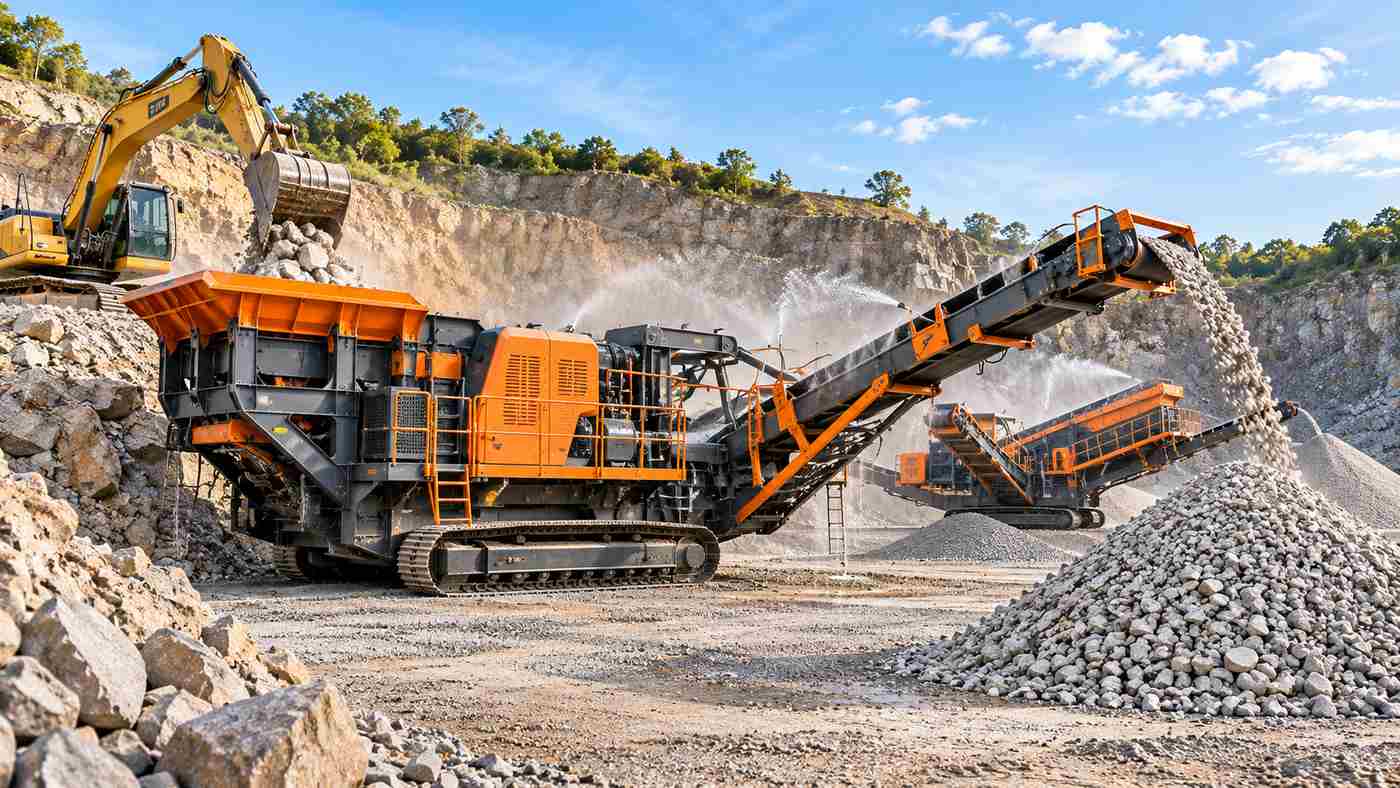
Construction, mining, and quarrying projects often require large quantities of crushed stone, gravel, and other aggregate materials. Transporting raw materials to a distant processing facility can increase operating expenses, create logistical challenges, and slow production.
A mobile crusher plant provides an alternative by allowing contractors to process rock, concrete, and other suitable materials closer to where they are extracted or used. Instead of relying entirely on stationary crushing infrastructure, businesses can relocate portable equipment between work areas or project sites.
Modern mobile crushing equipment combines powerful machinery with feeding, conveying, and sometimes screening capabilities. However, choosing the right configuration requires careful consideration of material properties, production goals, operating costs, and safety requirements.
This guide explains how mobile crushers work, their major types, practical benefits, and seven important factors to evaluate before purchasing equipment.
What Is a Mobile Crusher Plant?
A mobile crusher plant is a portable industrial machine or equipment arrangement designed to break large rocks, stones, and suitable demolition materials into smaller, usable pieces.
Unlike a permanently installed crushing facility, mobile equipment is mounted on wheeled or tracked chassis.
This mobility allows contractors to reposition the equipment as their production requirements change.
Mobile crushing plants are commonly used in quarrying, mining, road construction, aggregate production, and construction material recycling.
How Does a Mobile Crusher Plant Work?
The crushing process generally involves several stages.
First, an excavator or other loading machine deposits raw material into a receiving hopper.
A vibrating feeder regulates how material enters the primary crushing chamber.
The crusher then reduces oversized material into smaller particles using compression, impact, or another suitable crushing method.
Depending on the plant configuration, processed material may pass through a secondary crusher and vibrating screen.
Oversized particles can be returned for additional processing, while acceptable aggregate sizes move toward designated stockpiles.
Conveyor systems transport the material between processing stages.
Not every mobile plant includes all these components on one chassis. Some operations use separate crushing and screening machines.
Main Types of Mobile Crusher Plants
Different crushing technologies are designed for different materials and production objectives.
Understanding these differences helps businesses avoid purchasing equipment that is poorly matched to their applications.
1. Mobile Jaw Crusher Plant
Mobile jaw crushers use compression to break large rocks between fixed and moving crushing surfaces.
They are commonly used for primary crushing, especially when processing hard and abrasive materials.
Typical applications include quarry stone, granite, basalt, and suitable concrete demolition waste.
Jaw crushers are often selected when the main requirement is reducing large feed material to a manageable size.
However, additional crushing and screening may be necessary to produce precisely graded finished aggregates.
2. Mobile Impact Crusher Plant
Impact crushers use rapidly moving impact components to break material through collision forces.
They are commonly used in limestone processing, aggregate production, and certain construction recycling applications.
Depending on material characteristics and equipment configuration, impact crushers can produce well-shaped aggregate particles.
Wear-part costs deserve careful consideration, particularly when processing highly abrasive rock.
The suitability of an impact crusher should be evaluated against material hardness, abrasiveness, and desired product quality.
3. Mobile Cone Crusher Plant
Mobile cone crushers typically provide secondary or tertiary crushing for suitable rock materials.
They use compression between crushing surfaces to reduce particles further.
Cone crushing equipment is commonly associated with hard-rock aggregate production and operations requiring controlled final particle sizes.
Proper feeding, crusher settings, and screening arrangements are important for stable performance.
4. Tracked and Wheeled Crushing Plants
Mobility is another important distinction.
Tracked crushers use crawler undercarriages that allow repositioning across suitable prepared quarry or construction terrain.
Wheeled plants use road-transportable chassis and may be practical for projects involving planned relocation between accessible job sites.
Tracked equipment is not automatically road-legal, and wheeled equipment may still require transport permits or specialized towing arrangements.
Selection depends on ground conditions, movement frequency, transport dimensions, and project accessibility.
Benefits of Using Mobile Crushing Equipment
Mobile crushers can offer operational advantages when their capabilities match the project.
Reduced Material Transportation
Processing materials near their extraction or demolition location can reduce the need to transport unprocessed rock over long distances.
This may reduce handling expenses, hauling requirements, and congestion.
However, actual savings depend on haul distances, equipment utilization, fuel consumption, and site layout.
Flexible Production Locations
Portable equipment allows businesses to relocate crushing operations when required.
This flexibility can be valuable for contractors handling multiple projects or quarry operations where extraction areas change.
On-Site Construction Material Recycling
Suitable concrete and other demolition materials can be crushed into reusable aggregate.
Recycled materials may serve applications such as road base, fill, or other engineered uses when they meet applicable specifications.
Not every demolition material is suitable for direct processing. Contaminants, reinforcement, and project specifications must be addressed.
More Adaptable Production Capacity
Mobile crushing arrangements can combine different machines to accommodate particular production requirements.
Businesses may operate a compact primary crusher or use multiple machines for more complex processing.
The most effective design depends on the overall crushing circuit rather than the advertised capacity of one machine.
Exploring UNIQUE MAC Mobile Crusher Equipment
Businesses researching international machinery suppliers may consider the mobile crusher plant product range presented by UNIQUE MAC.
The company is based in Zhengzhou, Henan, China, and describes a range of crushing and construction machinery for international markets.
Its official product information lists mobile crushing configurations for quarrying, mining, construction waste processing, and aggregate production.
Available Crushing Configurations
The manufacturer describes several arrangements, including separate primary and secondary crushing units and combined three-in-one or four-in-one systems.
Its product page presents jaw, cone, and impact crusher combinations with feeders, screens, conveyors, and different chassis configurations.
Across its listed mobile crusher range, UNIQUE MAC advertises production capacities of 10–500 tons per hour and maximum feed sizes up to 1,500 millimeters.
These are broad product-family figures, not performance guarantees for every individual machine.
Actual capacity depends on the model, feed material, crusher settings, screening conditions, and operating environment.
Important Considerations for US Buyers
American contractors should confirm international shipping, equipment specifications, electrical compatibility, spare-parts availability, technical support, and contractual terms.
US market availability and local service coverage should not be assumed without supplier confirmation.
Request model-specific technical documentation and references relevant to the intended application before committing to a purchase.
7 Smart Tips for Choosing the Right Mobile Crusher Plant
Selecting mobile crushing equipment requires matching the machinery to real production conditions.
Tip 1: Understand Your Material Characteristics
Start by identifying the material to be crushed.
Granite, limestone, basalt, recycled concrete, and mixed demolition material behave differently during processing.
Important factors include hardness, abrasiveness, moisture, contamination, and maximum feed dimensions.
A crusher suited to limestone may not provide the same wear life when processing highly abrasive rock.
Where necessary, arrange representative material testing before equipment selection.
Tip 2: Calculate Realistic Production Requirements
Determine the quantity of finished aggregate required during each operating period.
Consider expected working hours, planned maintenance, material changes, and project deadlines.
Theoretical production capacity should not be confused with consistent real-world output.
For example, a machine advertised for a particular hourly capacity may deliver less when feed characteristics, screening requirements, or material handling restrict production.
Ask suppliers to explain the assumptions behind their performance estimates.
Tip 3: Choose the Appropriate Crushing Configuration
A single jaw crusher may be sufficient when the goal is preliminary size reduction.
A more demanding application may require secondary crushing, screening, and recirculation of oversized material.
Review the required aggregate sizes and the number of finished products.
Consider how conveyors, hoppers, and screening equipment will interact.
A balanced processing circuit can be more valuable than simply purchasing the largest available crusher.
Tip 4: Evaluate Mobility and Site Conditions
Examine the locations where the equipment will operate.
Consider ground stability, available space, access roads, relocation frequency, and transport restrictions.
Tracked equipment may be practical for frequent repositioning within suitable work areas.
Wheeled systems can be appropriate when projects involve accessible transportation routes and planned site arrangements.
Review transport dimensions, lifting requirements, setup procedures, and applicable permits.
Tip 5: Compare Operating and Maintenance Costs
Purchase price represents only one part of equipment ownership.
Operating expenses may include fuel or electricity, crusher wear parts, conveyor belts, lubrication, labor, and scheduled maintenance.
Ask for recommended service intervals and the expected replacement requirements of major components.
Compare projected cost per ton of acceptable finished material rather than relying only on hourly output.
Tip 6: Review Dust Control and Safety Features
Crushing equipment can create airborne dust, moving machinery hazards, noise, and risks involving falling or flying material.
Evaluate guarding, emergency stops, safe access arrangements, dust suppression, and maintenance isolation provisions.
Operators should receive appropriate training, and equipment should be assessed against applicable site safety requirements.
Safety features must be suitable for actual operating conditions, not merely listed in marketing materials.
Tip 7: Check After-Sales Support and Parts Availability
Reliable support can significantly affect long-term equipment availability.
Before purchasing, ask about replacement components, warranty terms, technical documentation, commissioning assistance, and troubleshooting support.
For imported equipment, verify whether service engineers and essential parts are accessible within practical timeframes.
A lower initial price may offer limited value if equipment remains idle while awaiting specialized components.
Mobile Crusher Plant Costs and Long-Term Value
Mobile crushing plant prices vary depending on equipment size, crusher technology, configuration, production capability, and supplier.
A basic mobile jaw crusher and a multi-stage crushing-and-screening arrangement can have substantially different purchase and operating requirements.
Additional costs may include freight, customs, installation, training, spare parts, and site preparation.
Calculate Total Cost of Ownership
A useful evaluation considers the expected cost over the equipment’s working life.
Include financing, energy consumption, labor, repairs, transport, maintenance, and anticipated resale value.
Compare these costs with expected production volume and achievable utilization.
For short-term projects, renting suitable machinery may be more economical than purchasing it.
For recurring operations with predictable demand, ownership may provide greater scheduling control.
Safety and Environmental Requirements in the United States
Crushing rock and concrete can release respirable crystalline silica, which presents serious occupational health risks.
The Occupational Safety and Health Administration provides silica exposure requirements for covered construction activities.
Mining and certain quarry operations may fall under the jurisdiction of the Mine Safety and Health Administration instead.
Control Dust and Protect Workers
Effective dust management may involve water sprays, enclosure, ventilation, exposure assessment, and other suitable engineering controls.
The appropriate approach depends on the material, work activity, operating conditions, and applicable standards.
Operators should also manage hazards associated with conveyors, crusher chambers, falling rocks, and maintenance activities.
Follow approved isolation and lockout procedures before servicing equipment.
Review Environmental Permits
Mobile equipment does not automatically qualify for exemption from environmental permitting.
Crushing and screening operations can be subject to applicable air-quality requirements, including federal, state, tribal, or local provisions.
EPA documentation includes permitting arrangements for certain portable stone quarrying, crushing, and screening facilities.
Requirements vary by location and activity, so operators should verify relevant obligations before deployment.
Maintenance Practices That Support Reliable Performance
Routine inspections can reduce avoidable equipment problems.
Maintenance teams should examine crusher wear components, conveyor conditions, hydraulic systems, lubrication points, and structural connections.
Operators should monitor changes in vibration, material flow, production quality, and unusual mechanical sounds.
Keep service records and follow the manufacturer’s maintenance procedures.
Never enter hazardous machinery areas or remove protective guarding while equipment remains energized or capable of unexpected movement.
Proper maintenance supports equipment reliability, but it must always be performed using appropriate safety procedures.
Common Mistakes to Avoid
A frequent purchasing mistake is choosing a crusher based only on its advertised maximum capacity.
Another is ignoring the effect of material abrasiveness on wear components.
Businesses may also underestimate transport requirements, screening capacity, downtime, and spare-parts logistics.
Failing to plan for dust suppression and regulatory requirements can create operational problems.
The strongest purchasing decisions balance production performance, safety, equipment reliability, and long-term operating expenses.
Frequently Asked Questions
1. What is a mobile crusher plant used for?
It processes suitable rock, stone, concrete, and other materials into smaller particles for construction, quarrying, mining, aggregate production, and recycling.
2. What is the difference between a mobile jaw crusher and an impact crusher?
A jaw crusher uses compression and commonly performs primary crushing. An impact crusher uses impact forces and is often selected for suitable aggregate production or recycling applications.
3. How much does a mobile crusher plant cost?
Prices depend on capacity, crusher type, configuration, supplier, and required accessories. Buyers should request model-specific quotations and compare total ownership costs.
4. Is mobile crushing equipment suitable for concrete recycling?
Yes, suitable equipment can process concrete for recycling. Operators must manage reinforcement, contamination, safety risks, and the specifications required for the finished material.
Conclusion
A mobile crusher plant can provide valuable flexibility for contractors, quarry operators, and aggregate producers who need to process materials near their source.
Choosing the right equipment requires careful evaluation of material characteristics, crushing capacity, configuration, maintenance requirements, and safety obligations.
By comparing realistic operating conditions with supplier specifications, businesses can make informed investments that support dependable production and more efficient material handling.
