
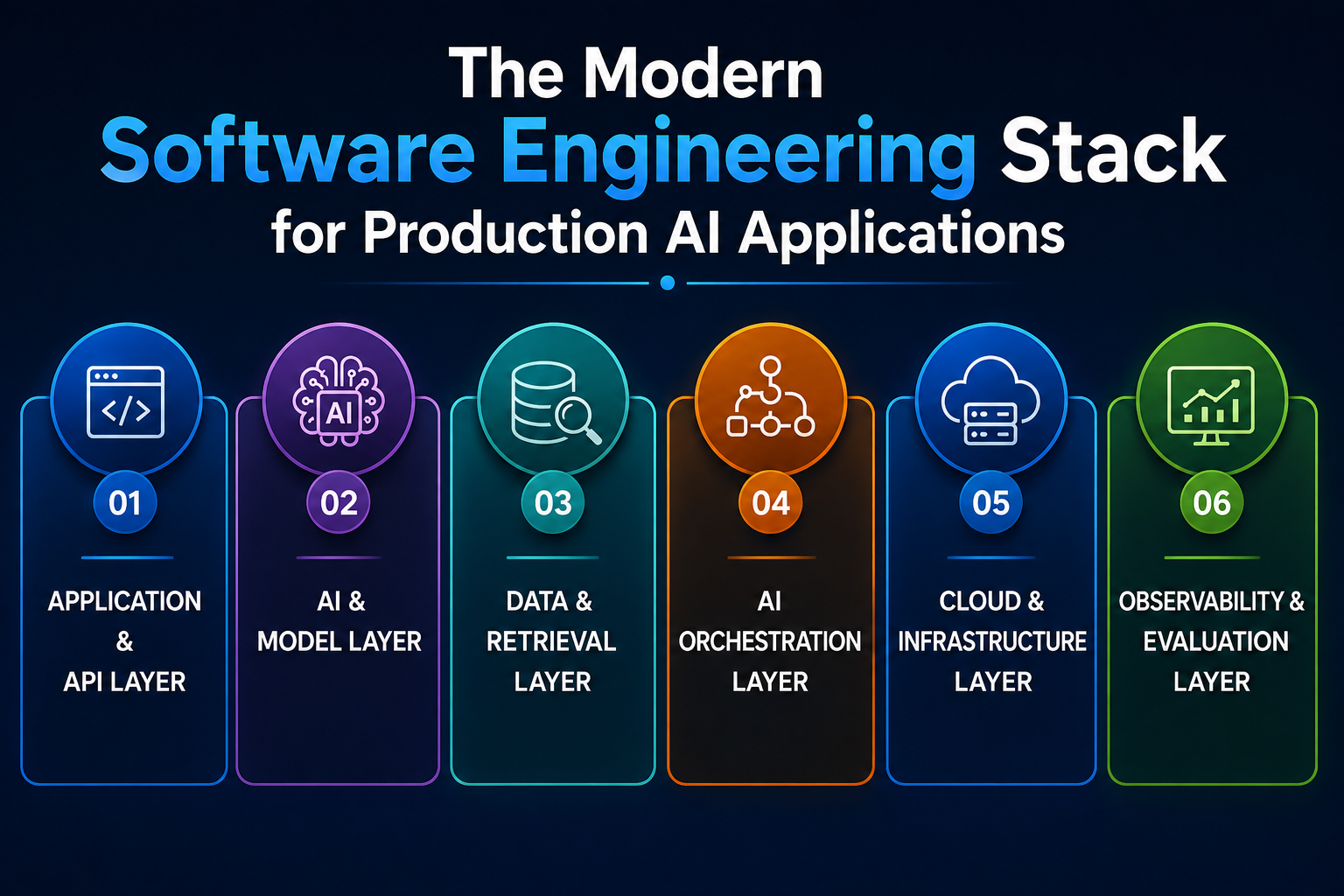
Building an AI-powered application is no longer just about selecting a capable large language model and connecting it to an API. Moving from an AI prototype to a reliable production application requires an engineering stack that can handle data, integration, orchestration, infrastructure, security, evaluation, and scale.
For businesses working with an AI and ML development company in USA, this distinction is increasingly important. The right stack should not only make an AI application work, but also make it maintainable, observable, secure, and capable of supporting changing models and growing workloads.
What Makes a Production AI Stack Different?
Traditional software applications generally follow a predictable architecture: a frontend communicates with backend services, which interact with databases and infrastructure.
Production AI applications add several new layers to that architecture.
An AI application may need to retrieve information from multiple sources, generate embeddings, select or route models, orchestrate multi-step tasks, evaluate responses, monitor model behavior, and control operational costs.
A production-ready stack typically connects:
Application → APIs → AI orchestration → Data and retrieval → Model → Evaluation → Monitoring → Infrastructure
The engineering challenge is making these layers work together reliably.
Core Layers of a Modern AI Engineering Stack
1. Application and API Layer
The application layer remains the primary interface between users and the AI system. Depending on the product, this could include a web application, mobile application, SaaS interface, internal enterprise tool, or customer-facing platform.
Modern frontend frameworks such as React and Next.js can support the user experience, while backend technologies such as Node.js or Python can handle application logic and AI-related operations.
APIs connect the application with AI models, databases, third-party services, and enterprise systems. Authentication, authorization, rate limiting, and API management are also important because AI applications often interact with sensitive business data and external services.
The goal is not simply to add an AI endpoint, but to integrate AI into a properly structured software architecture.
2. AI and Model Layer
The model layer is where the application’s intelligence comes from.
Depending on the use case, a production application may use commercial foundation models, open-source models, specialized models, or a combination of several models.
The engineering stack may need to support:
- Model APIs
- Prompt management
- Structured outputs
- Function and tool calling
- Fine-tuning where required
- Fallback models
Choosing a model is therefore only one architectural decision.
Teams also need to consider latency, accuracy, token consumption, availability, privacy, model limits, and cost. In some applications, routing different tasks to different models can provide a better balance between performance and operating cost.
3. Data and Retrieval Layer
AI applications are only as useful as the information they can access.
The data layer may include traditional relational databases, document stores, data pipelines, object storage, embedding models, and vector databases.
For applications using Retrieval-Augmented Generation (RAG), documents or other business data are converted into embeddings and stored in a retrieval system. When a user submits a request, the system retrieves relevant information and provides it as context to the model.
This architecture allows an application to work with company-specific knowledge without requiring every piece of information to be embedded directly into the model.
However, production retrieval requires more than adding a vector database. Data quality, chunking strategy, metadata, access controls, retrieval accuracy, and evaluation all affect the final response.
4. AI Orchestration Layer
The orchestration layer connects models with application logic, data sources, APIs, and external tools.
Frameworks such as LangChain and LangGraph can help developers build workflows involving multiple model calls, retrieval operations, tools, memory, and agent-based processes.
For example, an AI application might:
- Receive a user request.
- Determine the required task.
- Retrieve relevant business information.
- Call an external API.
- Ask a model to interpret the results.
- Validate the output.
- Return a response to the user.
This is where AI becomes part of an actual software workflow rather than functioning as an isolated chatbot.
For enterprises connecting AI with existing CRM, ERP, databases, APIs, and internal applications, advanced AI integration services can help establish the connections and control mechanisms required to make these workflows reliable.
5. Cloud and Infrastructure Layer
Production AI workloads introduce infrastructure considerations that traditional applications may not face.
Depending on the workload, teams may need CPUs, GPUs, containers, managed databases, object storage, queues, caching, networking, and autoscaling.
Cloud platforms such as AWS, Microsoft Azure, and Google Cloud provide infrastructure that can scale according to application requirements.
The right architecture depends on factors such as:
- Expected traffic
- Model hosting requirements
- Latency expectations
- Data sensitivity
- Geographic requirements
- Compute requirements
- Cost constraints
Not every AI application needs expensive GPU infrastructure. Applications using external model APIs may require conventional cloud compute for their application and orchestration layers, while teams running or fine-tuning their own models may have substantially different infrastructure requirements.
This is where cloud platform engineering services can become relevant when designing scalable infrastructure around production AI workloads.
6. Observability and Evaluation Layer
Traditional application monitoring focuses on metrics such as uptime, errors, latency, and resource consumption.
A production AI system may need to track:
- Response quality
- Hallucination rates
- Retrieval accuracy
- Model latency
- Token consumption
Evaluation is particularly important because an AI application can remain technically available while producing increasingly poor responses.
Tools for tracing, evaluation, logging, and experimentation can help engineering teams understand what happens between a user request and the final response.
This creates an important feedback loop: monitor the application, evaluate its output, identify weaknesses, and continuously improve the system.
How These Layers Work Together
A production AI application is best understood as a connected system rather than a collection of independent technologies.
A typical request might follow this path:
User → Application → API → AI Orchestration → Data Retrieval → Model → Validation → Response → Monitoring
Consider an enterprise knowledge assistant. A user asks a question through the application. The backend authenticates the request and sends it to the orchestration layer. The system retrieves relevant company documents, passes the context to an AI model, evaluates the response, and returns the result.
At the same time, observability systems record latency, retrieval behavior, token usage, and other operational signals.
Each layer contributes to the final reliability of the application.
Choosing the Right Stack for Your AI Application
There is no single AI engineering stack that works for every product. Architecture should reflect the application’s requirements and expected scale.
AI-Enabled SaaS
An AI-enabled SaaS product may require a conventional application stack combined with model APIs, prompt management, application databases, AI orchestration, and monitoring.
The priority is usually integrating AI into existing product functionality without creating unnecessary architectural complexity.
RAG Application
A RAG application requires additional components for document ingestion, embeddings, vector search, retrieval, access control, and response evaluation.
The quality of the retrieval pipeline can have as much impact on the user experience as the underlying model.
AI Agent
AI agents introduce another level of complexity because the system may need to select tools, call APIs, execute multiple steps, maintain state, and operate within defined permissions.
An agent therefore requires more than an LLM. It needs orchestration, tool management, authentication, guardrails, monitoring, and failure-handling mechanisms.
The right stack ultimately depends on what the AI system needs to accomplish, what data it can access, and how much autonomy it is expected to have.
Final Takeaway
The modern software engineering stack for production AI applications extends far beyond the model itself. Application architecture, APIs, data, retrieval, orchestration, infrastructure, security, observability, and evaluation all contribute to whether an AI system can perform reliably in the real world.
For organizations evaluating an artificial intelligence app development company in USA, the most important question is therefore not simply which AI model will be used. It is whether the engineering architecture surrounding that model is designed for production, scale, security, and continuous improvement.
