
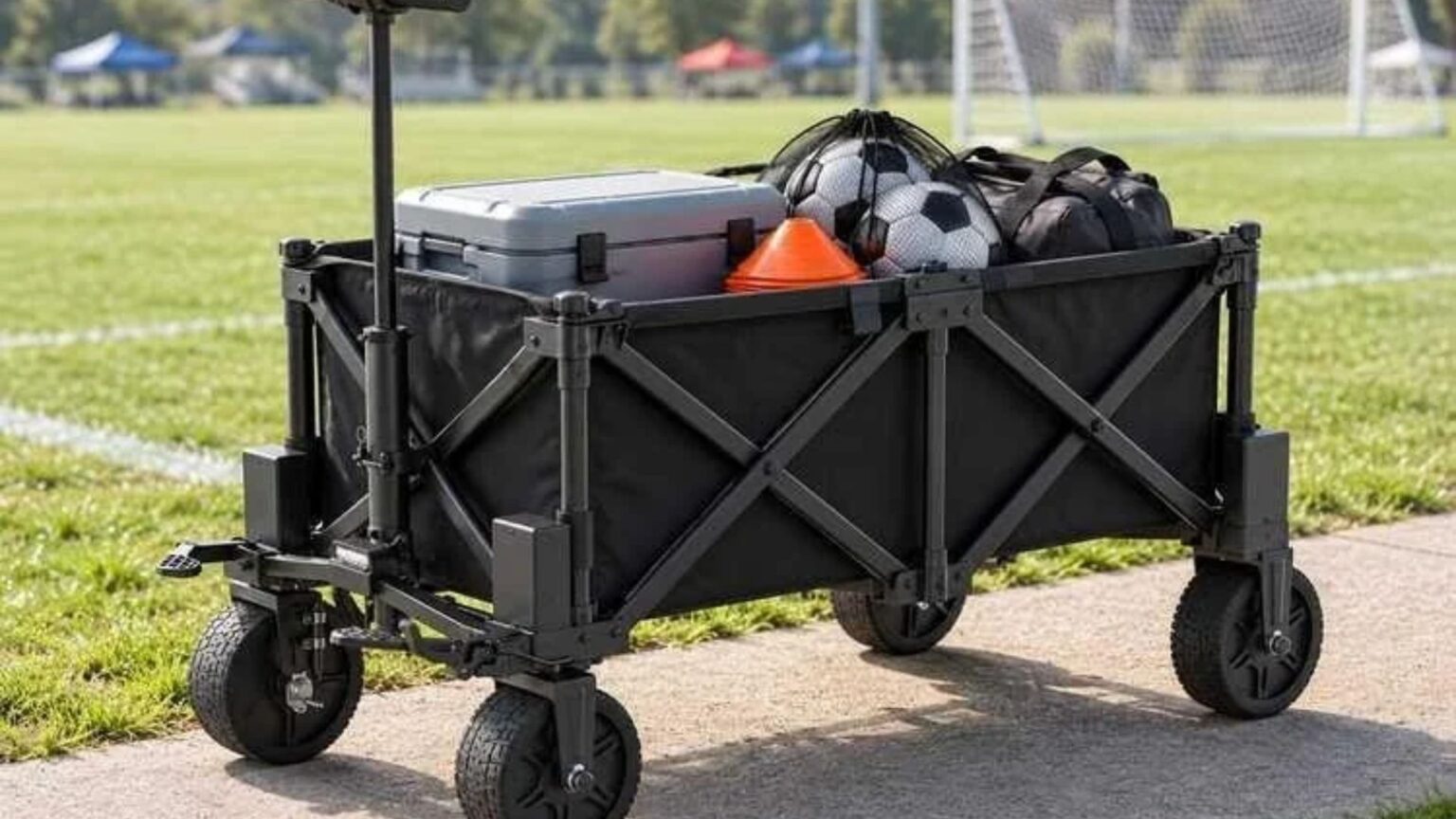
Getting equipment to the field is only the first trip of a sports tournament. Once games begin, coolers need ice, sidelines need water, and volunteers need a reliable way to move supplies without leaving their stations unattended.
Motorized supply carts for sports events can help with repeated deliveries between storage areas and sidelines. For a school sports day, youth tournament, or community competition, build the plan around what each field needs, the delivery route, and the next refill time.
Plan Your Event Supply Needs
Count Teams, Fields, and Game Hours
Use the event schedule to establish who needs supplies and for how long. Record:
- Teams and expected participants, including coaches and officials.
- Fields operating at the same time.
- Game times, breaks, and likely peak periods.
- Supplies provided by organizers versus items brought by teams.
Separate one-time setup items from consumables. Balls, cones, and chairs usually stay at the field until collection. Water, ice, cups, and snacks may need several deliveries.
Estimate consumables using attendance, event duration, expected weather, and records from similar events. Allow for delays and extra demand.
Map Setup and Refill Routes
Identify the unloading area, central supply station, and a clear drop-off point at each field. Walk the route and check gate widths, curbs, slopes, soft ground, and pedestrian traffic.
Keep deliveries outside active play and avoid blocking spectator paths. Confirm cart access with the facility manager before event day, including permission to travel on grass or other playing surfaces.
Build a Gear Checklist
Balls, Cones, and Team Equipment
Prepare the equipment needed for each field, including sport-specific spares. Keep small accessories in a closed pouch so they are easy to find.
Assign responsibility for shared equipment. If two fields use the same spare kit, record where it belongs between games.
Coolers, Chairs, and Shade
Plan opening deliveries for coolers, chairs, and shade equipment before teams arrive. Transport shade equipment packed, then follow its installation instructions at the destination.
Water, Ice, Cups, and Snacks
Stage refill supplies separately from equipment. Organize them in quantities that field volunteers can count and request easily, such as cases, bags, or labeled bins.
| Supply group | Typical items | Packing approach |
| Team equipment | Balls, cones, pinnies, pump | Label kits by field or team |
| Sideline setup | Coolers, chairs, packed shade equipment | Measure bulky items and secure each load |
| Drink supplies | Water, ice, cups | Keep cups dry and separate ice from dry gear |
| Snacks | Organizer-approved packaged options | Retain ingredient labels and follow storage instructions |
| Volunteer support | Radios, schedules, trash bags | Use a small, accessible support kit |
Match the Cart to Your Load
Check Cargo Weight and Space
Size the cart for the heaviest load you intend to carry on a single trip. Include the weight of coolers, ice, containers, and securing equipment, not just their contents.
Check usable cargo dimensions as well as payload capacity. Your largest cooler should fit securely without obstructing controls or the operator’s view. If a load is awkward or unstable, split it into additional trips even when it falls below the weight limit.
Assess Terrain and Battery Needs
Match the cart to the actual delivery route. Firm grass, pavement, gravel, and uneven ground require different handling, and an all-terrain description does not guarantee suitability for every surface.
Estimate travel distance before planning battery use. A 600-foot round trip repeated 20 times covers about 2.3 miles, excluding setup, collection, and detours. Add those trips to the estimate, then assess battery needs using the manufacturer’s guidance and a representative loaded test.
Load, slopes, temperature, and operating conditions can affect runtime. Start fully charged, schedule battery checks, and arrange a backup delivery method if the cart needs to stop.
Consider the NAVEE E-Wagon 4X
For repeated gear and refill runs, consider the NAVEE E-Wagon 4X as a motorized sports wagon for transporting equipment and supplies between fields.
| Product feature | Relevance to sports events | Planning consideration |
| 183L cargo capacity | Space to organize equipment bags and refill bins | Check usable dimensions against your cooler and bin sizes; volume alone does not confirm fit |
| Independent four-wheel drive and all-terrain tires | Features to evaluate for routes across varied outdoor surfaces | Test the loaded route and confirm venue access; soft turf may require another path |
| 36V, 12Ah detachable battery with 432Wh capacity | A concrete battery specification for planning powered delivery runs | Battery capacity does not establish all-day runtime; account for load, terrain, and trip count |
| Foldable design | Useful to assess for transport to the venue and storage afterward | A foldable electric wagon can be easier to transport to the venue and store afterward; confirm folded dimensions and lifting requirements before loading it into a vehicle. |
These features make the E-Wagon 4X worth evaluating for multi-field supply logistics. Confirm the payload limit for the exact version before finalizing heavy water-and-ice loads, and use the loaded test to check handling and battery use.
Pack for Easy Unloading
Secure Heavy and Loose Items
Load heavy items low and distribute weight according to the cart’s instructions. Secure bins and bulky gear against movement during turns and stops. Keep straps and loose fabric away from wheels and controls.
During the loaded test, check that supplies stay stable and the operator can steer, stop, and see clearly.
Label Bins by Field or Team
Use specific labels such as “Field 1 Setup” and “Field 2 Water Refill.” Add a brief inventory list to setup bins so volunteers can confirm deliveries and check equipment back in.
Specify the destination clearly. “Field 2 volunteer table” is easier to act on than “near Field 2.”
Keep Refill Supplies Accessible
Pack in delivery order, with the first stop’s supplies easy to reach. Avoid placing frequently requested items beneath chairs or equipment bags.
Keep return items in a separate container so used equipment does not mix with clean supplies.

Create a Refill Schedule
Set Up a Central Supply Station
Use one accessible location for reserve stock, delivery bins, and the supply log. Group items by type and keep a clear loading space beside the cart.
Include a cart parking area and, if needed, a suitable charging location. Follow the manufacturer’s charging instructions.
Assign Operators and Field Contacts
Assign a cart operator for each shift and a supply contact at each field. The field contact monitors stock; the operator combines requests into efficient delivery runs.
Keep requests specific: destination, item, quantity, and timing. For example, “Field 2 needs one case of water before the 11 a.m. game” gives the operator enough information to plan the delivery.
Schedule Runs Between Games
Use game breaks as regular delivery windows. Allow time to load, travel, unload, and return, with room for crowded paths or schedule changes.
Combine nearby stops when the load allows. Keep enough flexibility to respond to a shortage before the next scheduled loop.
Set Restock Triggers and Reserve Stock
A restock trigger tells volunteers when to request more supplies. Set it high enough to cover expected use while the next delivery is being prepared and transported.
For example, suppose a field uses two cases per hour and a requested refill takes 30 minutes to arrive. It would use about one case during that wait. Set the trigger above one case to leave a buffer for delays, then adjust it to observed demand. This is an inventory example, not a recommended drinking amount.
Record each delivery’s destination, quantity, and time. Check remaining stock after busy game blocks so the next shift knows what is available and whether priorities need to change.
Example: A Soccer Tournament
Gear and Supply Load Plan
Consider an eight-team tournament using two fields from 8 a.m. to 4 p.m. A central supply station near the parking lot serves both fields, and one motorized cart handles deliveries.
Assign the operator a loop from the supply station to Field 1, then Field 2, and back. Give each field a setup kit and opening stock, and keep reserves at the station. The example below illustrates the workflow, not fixed supply quantities.
Setup and Refill Schedule
| Time or trigger | Delivery task | Field contact’s task |
| Before the first game | Deliver equipment kits and opening supplies | Confirm quantities and drop-off locations |
| First game break | Check both fields and replenish as needed | Report usage and emerging shortages |
| Before the busiest midday block | Deliver anticipated refills | Check stock against the upcoming schedule |
| Afternoon game breaks | Combine refill runs and collect empties | Update requests and keep return items separate |
| Restock trigger reached | Arrange a delivery before remaining stock runs out | State quantity and timing clearly |
| After the final games | Collect equipment and unused supplies | Check items against the inventory list |
After the first game block, use the delivery log to adjust quantities and triggers for each field. Check the battery before the midday rush and revise the loop if games or access routes change.
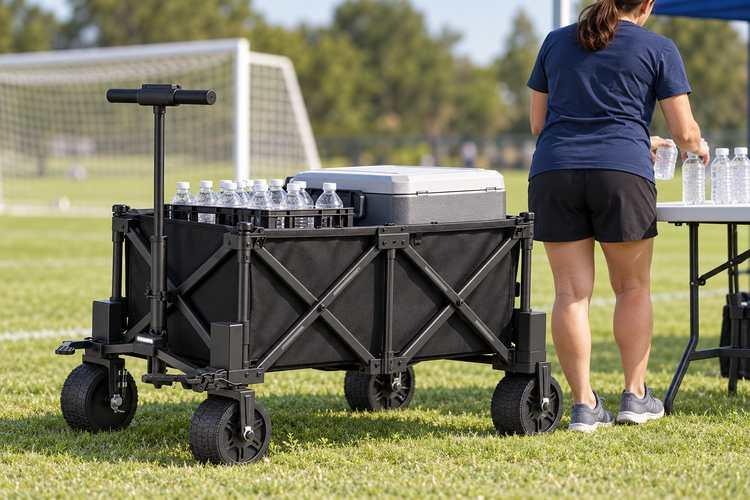
FAQ
What Gear Can a Motorized Supply Cart Carry?
Typical loads include team equipment, coolers, folding chairs, and packaged refill supplies. The complete load must fit securely within the cart’s cargo space and payload limit.
How Much Cart Capacity Do You Need?
Choose capacity for your heaviest single delivery, including containers and ice. Check bulky items separately: a cooler may meet the weight limit but exceed the usable cargo dimensions.
How Often Should Sidelines Be Restocked?
Plan checks around game breaks, then adjust deliveries to actual consumption and travel time. Set a restock trigger that gives volunteers enough remaining stock to cover the wait for the next delivery.
Can Motorized Carts Be Used on Grass?
Some models are designed for outdoor surfaces, but suitability depends on the cart, load, slope, and condition of the grass. Follow the manufacturer’s guidance and obtain venue permission. Use an alternative route if the ground is too soft or the cart cannot travel without damaging it.
Are Motorized Carts Allowed at Sports Venues?
Permission is venue-specific. Ask the facility manager to approve the cart and intended delivery route before the event, including any access to grass or playing surfaces.
