
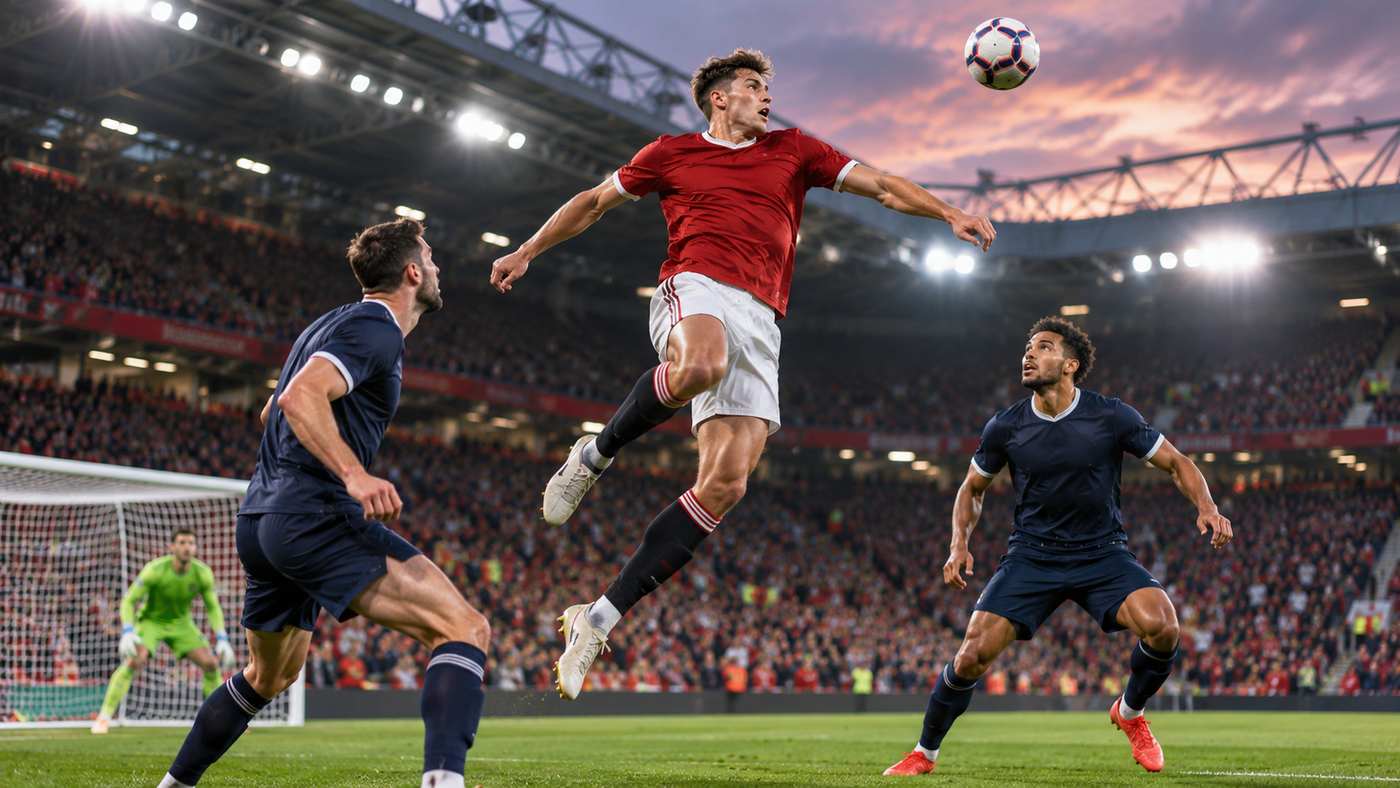
Manchester United’s search for a reliable center-forward has remained one of the biggest talking points surrounding the club. From expensive transfers to emerging young talents, the Red Devils have repeatedly faced questions about who should lead their attack.
The ongoing striker debate has centered on Benjamin Šeško, the highly rated Slovenian forward signed from RB Leipzig in August 2025, and whether he can develop into the consistent goalscorer Manchester United need.
Former United striker Teddy Sheringham raised concerns in January 2026 about expecting a young player to immediately deliver at one of England’s most demanding clubs. He also questioned the club’s previous failure to recruit Harry Kane.
However, Šeško’s improvement later in the 2025–26 season, Sheringham’s more supportive comments in September, and the striker’s injury problems have added important context.
With Kane committing his future to Bayern Munich until 2029, the issue now extends beyond a missed transfer opportunity.
Can United develop their current striker, or does the club need additional attacking experience?
Why Manchester United’s Striker Position Remains Under Scrutiny
Manchester United have spent several seasons searching for a dependable central attacking presence.
The club has worked with different forward profiles, including established international players, developing prospects, and attackers more comfortable operating across multiple positions.
Romelu Lukaku, Anthony Martial, Edinson Cavani, Rasmus Højlund, and other forwards have contributed at different stages. However, the team has struggled to establish a consistently productive long-term solution.
For a club with Manchester United’s history, the center-forward position carries considerable expectations.
Supporters expect their leading striker to score regularly, contribute during important matches, and help the team challenge for major trophies.
A striker also needs to perform effectively within the team’s tactical structure.
Even talented forwards can struggle when service is inconsistent, attacking patterns are unclear, or expectations develop faster than their experience.
What Teddy Sheringham Said in January 2026
In an interview reported by GOAL on January 23, 2026, Sheringham argued that United were asking too much of Šeško at an early stage of his development.
The former striker believed United needed a more established goalscorer capable of making an immediate impact.
He also criticized the decision not to pursue Harry Kane more successfully before the England captain joined Bayern Munich in 2023.
The original article about the ongoing striker debate captured the concerns surrounding United’s attacking recruitment.
But those comments need to be understood in their original January context rather than treated as Sheringham’s unchanged assessment throughout 2026.
7 Key Questions Behind the Ongoing Striker Debate
1. Is Benjamin Šeško Ready to Lead Manchester United’s Attack?
Šeško arrived at Manchester United with considerable potential.
His performances in German football had demonstrated athleticism, movement, finishing ability, and the physical characteristics of a modern center-forward.
However, adapting to the Premier League involves different defensive challenges, tactical demands, and expectations.
A striker may find space to attack in one competition but encounter more tightly organized defensive units in another.
The transition can become particularly difficult at a club receiving intense media coverage.
Šeško’s early performances generated criticism, but his improved goalscoring form during the second half of the 2025–26 campaign demonstrated why United had invested in him.
In March 2026, the Premier League’s official analysis highlighted his six goals in seven recent league appearances.
That improvement suggested genuine attacking potential, although a productive short period alone cannot establish long-term consistency.
The key question is whether Šeško can reproduce his best performances regularly when fit and starting matches.
2. Did Manchester United Make a Mistake by Missing Harry Kane?
Harry Kane represented the kind of established striker Sheringham believed United needed.
The England international had already demonstrated exceptional finishing, creative passing, positioning, and leadership before moving from Tottenham Hotspur to Bayern Munich in August 2023.
His success in Germany strengthened the argument that he could have provided an immediate attacking focal point at Old Trafford.
However, transfer decisions cannot be judged entirely through hindsight.
Signing a player involves financial arrangements, contract negotiations, squad planning, and the willingness of all parties to complete a move.
There is no guarantee that United could have secured Kane on acceptable terms.
The latest development also changes the conversation.
On November 5, 2026, Bayern Munich officially announced that Kane had extended his contract until June 30, 2029.
The German club reported 156 goals in 161 competitive appearances since his arrival.
Kane therefore remains an example of elite striker consistency, but his new contract makes the discussion primarily a lesson about previous recruitment decisions rather than an immediate transfer option.
3. Has Teddy Sheringham Changed His Opinion About Šeško?
Sheringham’s comments have evolved as the player has developed.
In January, he questioned whether the young striker was ready to carry United’s expectations immediately.
By September 2026, subsequent reports described Sheringham praising Šeško’s ability to lead the attack, combine with teammates, and score goals.
He also argued that United benefited from having a natural center-forward who could provide an attacking focal point.
These positions are not necessarily completely contradictory.
A former player can recognize significant potential while questioning whether a developing striker should carry an entire team’s goalscoring responsibility.
Likewise, improved performances can justify a more positive assessment.
Football opinions should be evaluated according to when they were expressed and what evidence was available.
Sheringham’s changing evaluation demonstrates how quickly perceptions can shift when a young player begins producing important contributions.
4. How Much Has Michael Carrick Influenced Šeško’s Development?
Michael Carrick’s tactical approach became an important part of the striker conversation during 2026.
Premier League analysis published in March highlighted the improvement in Šeško’s attacking involvement following the managerial change.
The report identified increases in shots, penalty-area touches, and aerial opportunities compared with his earlier performances.
These developments suggested that tactical positioning and the quality of attacking service played significant roles.
A striker who receives the ball in dangerous central areas has different opportunities from one regularly isolated against multiple defenders.
Carrick’s use of Šeško as an impact substitute also generated debate.
Fresh legs can create advantages against tiring defenders, particularly when a forward possesses pace and physical presence.
However, consistently productive substitute appearances naturally raise questions about whether the same player deserves more starting opportunities.
The important challenge is developing a system that supports Šeško across full matches rather than relying exclusively on late attacking moments.
5. Do Manchester United Need Another Experienced Striker?
Squad depth remains one of the strongest arguments for additional recruitment.
An established club competing across domestic and European competitions cannot depend entirely on one specialist center-forward.
Injuries, suspensions, fixture congestion, and changes in form can quickly reduce attacking options.
Šeško’s injury situation makes this concern particularly relevant.
Manchester United confirmed that the forward faced an extended absence following a shin injury. He had not appeared since the September Carabao Cup defeat against Brighton.
As of early November 2026, reports indicated that his recovery could continue into January.
That absence leaves United needing alternative attacking solutions.
Versatile forwards may provide temporary cover, but they do not always reproduce the movement, aerial presence, or penalty-area instincts of a specialist No. 9.
Recruiting another striker could therefore be viewed as supporting Šeško’s development rather than replacing him.
The ideal decision would depend on the club’s available resources, tactical priorities, and the profile of the potential signing.
6. Should United Prioritize Youth or Immediate Experience?
This question reaches beyond one individual player.
Elite football clubs need to balance short-term competitiveness with long-term squad development.
Young players offer potential improvement, resale value, and the opportunity to become important contributors over several seasons.
Experienced players may provide greater tactical maturity and a more established record of performance.
Neither approach guarantees success.
An experienced striker can struggle in an unsuitable tactical system, while a developing player may exceed expectations when surrounded by the right teammates.
For Manchester United, the challenge is creating a recruitment strategy that considers both timelines.
A young striker should receive coaching, realistic development opportunities, and appropriate competition.
At the same time, the club must continue producing results.
The strongest squads often combine emerging talent with established professionals who can provide stability during difficult periods.
7. What Would Prove That Šeško Is the Right Long-Term No. 9?
Goals are an obvious part of the evaluation, but they should not be the only measurement.
A complete center-forward contributes through movement, pressing, hold-up play, chance creation, and the ability to occupy defenders.
Important performance indicators include goals per 90 minutes, expected goals, shot quality, touches inside the penalty area, and involvement in attacking combinations.
These numbers should be considered alongside playing time and tactical context.
A player scoring regularly during short substitute appearances may have impressive per-90 statistics based on a limited sample.
Long-term evaluation requires a broader period of consistent performance.
Šeško’s physical tools and improving finishing provide reasons for optimism.
Nevertheless, his ability to remain available, handle sustained playing time, and contribute against different defensive systems will be essential.
United need evidence of repeatable performance, not simply occasional impressive goals.
How Manchester United Can Improve Their Attacking System
The responsibility for consistent goalscoring does not belong exclusively to the striker.
Manchester United’s supporting attackers and midfielders also influence the number and quality of chances created.
Players such as Bruno Fernandes, Bryan Mbeumo, and Matheus Cunha can contribute through movement, passing, and attacking combinations when available.
Improve Service Into Dangerous Areas
A center-forward benefits from accurate crosses, well-timed through balls, and passes delivered into central scoring positions.
The team should create opportunities that suit the striker’s strengths rather than expecting him to manufacture chances from unsuitable situations.
Develop Better Attacking Partnerships
Coordinated movement between the striker and supporting forwards can help disrupt organized defenses.
One player may move toward the ball while another attacks the space behind.
These movements require communication and repeated training.
Maintain Tactical Flexibility
Not every opponent presents the same challenge.
Against defensive teams, United may need patient possession and movement around a crowded penalty area.
Against more aggressive opponents, quick transitions and direct running may create better opportunities.
A flexible approach can make the attack less predictable.
What the 2026–27 Season Tells Us So Far
Šeško’s current campaign has been interrupted by injury.
Manchester United’s official update identified two goals during the early part of the season, against Everton and Sabah.
Public league statistics available on November 6 listed one Premier League goal in four appearances, all from the bench.
That is too small a playing sample to support a sweeping conclusion about the striker’s long-term level.
It also means that comparisons with healthy forwards receiving regular starts require caution.
The immediate priority is an appropriate recovery and return to match fitness.
Once available, Šeško will need opportunities to demonstrate whether the promising form from the previous campaign can become a consistent feature of United’s attack.
What Should Manchester United Do Next?
The most sensible strategy begins with separating short-term needs from longer-term objectives.
In the immediate future, United must find ways to create and finish chances without depending on an injured center-forward.
That may involve alternative attacking combinations and adjustments to how the team enters the penalty area.
Longer term, the club should assess Šeško’s development within a stable tactical framework.
Recruitment decisions should complement the existing squad and address identifiable weaknesses rather than react only to public criticism.
Kane’s success demonstrates the value of an established elite goalscorer, but his commitment to Bayern also emphasizes the importance of building a realistic plan around available players.
The ongoing striker debate will ultimately be resolved more by performances, squad depth, and consistent team results than by individual transfer rumors.
Frequently Asked Questions
1. Why is Manchester United’s striker position being debated?
United have struggled to establish a consistently productive long-term center-forward. Questions surrounding Benjamin Šeško’s development, goalscoring expectations, and attacking depth continue to drive the discussion.
2. What did Teddy Sheringham say about Benjamin Šeško?
In January 2026, Sheringham questioned whether Šeško was ready to lead United immediately. By September, he was praising the striker’s ability and arguing for a more prominent role.
3. Could Harry Kane still join Manchester United?
Kane signed a Bayern Munich contract extension on November 5, 2026, keeping him at the German club until June 2029. A future transfer is never impossible, but there is no verified agreement for him to join United.
4. Is Benjamin Šeško Manchester United’s long-term striker?
Šeško has demonstrated considerable potential, but injuries and limited playing time make a definitive judgment premature. His long-term role depends on development, availability, and sustained performances.
Conclusion
Manchester United’s ongoing striker debate reflects a larger challenge involving recruitment, tactical planning, squad depth, and the development of young talent.
Benjamin Šeško has shown encouraging ability, while Harry Kane’s success highlights the value of established goalscoring quality.
Rather than judging the Slovenian striker too quickly, United need to support his recovery, create consistent attacking opportunities, and build sufficient competition around him.
The club’s future success will depend on developing a balanced attacking system rather than relying on one player to solve every problem.
