
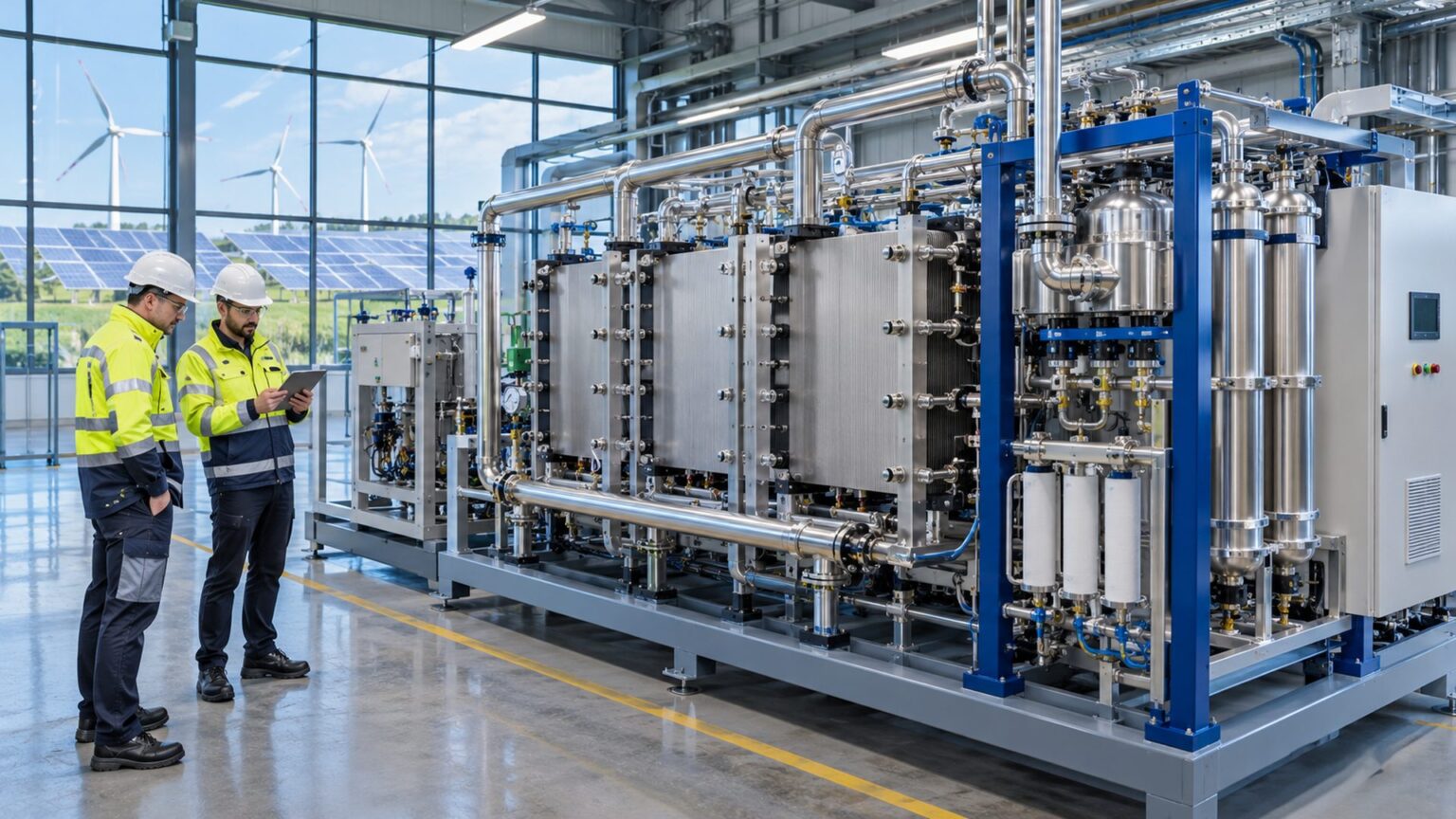
Hydrogen is becoming an important part of discussions about industrial energy, cleaner manufacturing, and long term energy storage. Among the technologies used to produce hydrogen, PEM electrolyzers have attracted attention because they can operate efficiently at relatively low temperatures, respond to changing electricity supplies, and produce hydrogen through a compact electrochemical system. Their ability to work with variable power inputs makes them particularly relevant to projects that combine water electrolysis with renewable electricity.
However, choosing an electrolyzer requires more than understanding its basic operating principle. Businesses must consider electricity consumption, water quality, system durability, equipment costs, maintenance requirements, and the intended use of the hydrogen.
This guide explains how proton exchange membrane electrolysis works, where it can be useful, and what project developers should evaluate before investing in hydrogen production equipment.
What Are PEM Electrolyzers?
PEM electrolyzers are electrochemical devices that use electricity to separate water into hydrogen and oxygen. PEM stands for proton exchange membrane, a specialized polymer material that conducts hydrogen ions while helping keep the product gases separated.
Unlike conventional hydrogen production methods that depend on fossil fuel feedstocks, water electrolysis uses water as its hydrogen source. The environmental impact of the resulting hydrogen depends significantly on the electricity used to operate the equipment and other activities across the production process.
A PEM system contains an electrolyzer stack, electrical equipment, water treatment components, thermal management systems, and gas handling equipment.
The membrane plays a central role in the electrochemical reaction. It allows protons to travel between electrodes while preventing the direct passage of electrons through the electrolyte.
PEM electrolysis is used in projects ranging from smaller hydrogen generation installations to larger industrial systems.
How Do PEM Electrolyzers Work?
Understanding the operating process helps explain the performance characteristics and engineering requirements of this technology.
A PEM electrolyzer has two electrodes, an anode and a cathode, separated by a proton conducting membrane.
When electricity is supplied, water undergoes electrochemical reactions that produce oxygen at the anode and hydrogen at the cathode.
Step 1: Purified Water Enters the System
The process begins with a supply of appropriately treated water.
Water quality is important because dissolved minerals and other contaminants can interfere with electrochemical performance and damage sensitive components.
Depending on the system design, water treatment equipment may include filtration, reverse osmosis, and deionization.
The treated water is delivered to the electrolyzer under controlled operating conditions.
Step 2: Electricity Drives the Reaction
Direct current electricity is applied across the electrodes.
At the anode, water molecules are oxidized, producing oxygen, positively charged hydrogen ions, and electrons.
The electrical energy supplied by the system makes this reaction possible.
Step 3: Protons Travel Through the Membrane
The hydrogen ions move through the proton exchange membrane toward the cathode.
Electrons travel through the external electrical circuit rather than passing directly through the membrane.
This separation supports the electrochemical process while helping maintain distinct gas production areas.
Step 4: Hydrogen Forms at the Cathode
At the cathode, hydrogen ions combine with electrons to form molecular hydrogen.
The hydrogen is collected and may undergo additional drying, purification, pressure regulation, or compression depending on its intended application.
Oxygen produced at the anode is handled separately.
Step 5: Hydrogen Is Prepared for Use
After leaving the stack, hydrogen must meet the requirements of the receiving process.
Industrial applications may require specific purity, pressure, moisture, and delivery characteristics.
Hydrogen intended for fuel cells can require particularly careful quality control.
The overall process demonstrates how electricity and water can be converted into hydrogen without using a carbon containing feedstock inside the electrolyzer.
Main Components of a PEM Electrolysis System
An electrolyzer is more than a single membrane or reaction chamber.
Its performance depends on several interconnected components working together.
Proton Exchange Membrane
The membrane is the central electrolyte of the cell.
It conducts protons and helps separate hydrogen from oxygen.
Its thickness, chemical stability, conductivity, and resistance to gas crossover influence performance and durability.
Membrane degradation can affect efficiency and system reliability over time.
Anode and Cathode Catalysts
Catalysts accelerate the electrochemical reactions occurring at the electrodes.
Conventional PEM designs commonly use iridium based materials at the oxygen producing anode and platinum based catalysts at the hydrogen producing cathode.
These materials provide useful electrochemical performance in the acidic environment of the cell.
However, their cost and availability are important considerations when manufacturing systems at scale.
Membrane Electrode Assembly
The membrane electrode assembly combines the membrane with catalyst layers.
It is responsible for the central electrochemical conversion process.
Its manufacturing quality, material selection, and operating conditions influence electrical performance and service life.
Porous Transport Layers
Porous transport layers help distribute water, conduct electrical current, and support the movement of gases.
On the oxygen side, corrosion resistant materials such as titanium are commonly used.
These components must withstand demanding electrochemical conditions while maintaining suitable transport properties.
Bipolar Plates and Stack Hardware
Bipolar plates and related components help distribute fluids and electricity through the stack.
Seals, frames, and mechanical compression systems maintain separation and structural integrity.
Reliable assembly is essential for reducing leakage risks and maintaining consistent performance.
Balance of Plant Equipment
The balance of plant includes supporting equipment outside the electrochemical stack.
It may include:
- Water purification and circulation systems
- Power conversion and electrical controls
- Pumps, valves, and heat exchangers
- Hydrogen drying and gas separation equipment
- Cooling and temperature monitoring systems
- Pressure regulation and safety equipment
These supporting systems affect installation cost, operating efficiency, reliability, and maintenance requirements.
Key Benefits of PEM Electrolyzers
PEM electrolysis offers several characteristics that make it attractive for particular hydrogen production projects.
The benefits should always be evaluated against the conditions of the intended installation.
Flexible Operation With Changing Power Supply
One important advantage is the ability to respond to changes in electrical input.
This makes PEM technology suitable for consideration in projects connected to variable renewable power generation.
For example, a hydrogen production facility may adjust its operating rate when solar or wind electricity availability changes.
However, frequent shutdowns, rapid changes in load, and operation at very low power can influence degradation and gas purity.
Operators must follow the equipment manufacturer’s specified operating range.
Compact System Design
PEM cells can operate at relatively high current densities, allowing compact stack designs for a given production capacity.
This characteristic may help projects where available installation space is limited.
The complete facility still requires supporting equipment, safety clearances, utilities, and access for maintenance.
Therefore, stack compactness should not be confused with the footprint of the entire hydrogen production plant.
High Hydrogen Purity
The membrane helps separate the hydrogen and oxygen produced during electrolysis.
This supports the production of relatively high purity hydrogen.
Nevertheless, hydrogen quality depends on system design, operating conditions, gas crossover, and downstream treatment.
Additional purification may be necessary when strict product specifications apply.
Compatibility With Renewable Electricity
PEM electrolyzers can be integrated into systems supplied by renewable electricity.
They are therefore relevant to projects designed to produce hydrogen with a lower greenhouse gas emissions intensity.
The actual emissions benefit depends on the electricity source, its accounting treatment, and the wider production system.
Modular Installation Options
Many electrolyzer systems use modular designs.
Additional units may be installed as hydrogen demand grows, provided sufficient electrical infrastructure, water treatment capacity, space, and supporting equipment are available.
Modularity can support phased development, but it does not eliminate the need for careful engineering.
Limitations and Challenges of PEM Electrolysis
Despite their advantages, PEM electrolyzers face several technical and commercial challenges.
High Initial Equipment Costs
Specialized membranes, precious metal catalysts, and corrosion resistant components contribute to equipment expenses.
The cost of the full hydrogen production facility also includes electrical infrastructure, water treatment, cooling, compression, installation, and safety systems.
Project developers should evaluate complete installed costs rather than comparing stack prices alone.
Dependence on Critical Materials
Iridium and platinum are important materials in many conventional PEM designs.
Their limited availability and market conditions can affect manufacturing costs and supply planning.
Reducing precious metal requirements without compromising durability remains an important engineering objective.
Strict Water Quality Requirements
PEM systems generally require high purity feedwater.
Inadequate water treatment can introduce contaminants that affect catalysts, membranes, and other components.
Reliable monitoring and maintenance of the water treatment system are therefore essential.
Durability Under Demanding Operating Conditions
Electrochemical components experience changes in temperature, pressure, electrical load, and chemical conditions.
Over time, these stresses can contribute to degradation.
System lifetime depends on equipment design, material quality, maintenance, and operating practices.
Hydrogen Handling Requirements
Hydrogen is highly flammable and requires appropriate engineering controls.
Facilities must consider ventilation, gas detection, pressure protection, emergency shutdown arrangements, and suitable equipment.
These requirements are important regardless of the electricity source used to produce hydrogen.
PEM Electrolyzers vs Alkaline Electrolyzers
PEM and alkaline electrolysis are both established approaches to producing hydrogen from water.
However, they use different electrolytes and have different operating characteristics.
Electrolyte Technology
PEM systems use a solid proton conducting polymer membrane.
Traditional alkaline electrolyzers use a liquid alkaline electrolyte, commonly based on potassium hydroxide, together with a separator.
This difference affects material selection, cell design, and system operation.
Operational Flexibility
PEM technology is often attractive where rapid load changes are important.
Traditional alkaline systems have historically been associated with more stable operating conditions, although modern alkaline designs can also provide operational flexibility.
The actual performance depends on the equipment and control strategy rather than the technology label alone.
Material Requirements
PEM electrolyzers commonly use precious metal catalysts and specialized corrosion resistant materials.
Alkaline systems can use more abundant catalyst materials, although they have their own material and electrolyte handling requirements.
Cost and Project Suitability
Neither technology is automatically the lowest cost option for every application.
A useful comparison considers efficiency across the intended operating range, electricity prices, annual utilization, equipment lifetime, maintenance, and complete installed costs.
The best choice depends on the project rather than a general ranking.
Understanding PEM Electrolyzer Efficiency
Efficiency is one of the most important factors influencing hydrogen production costs.
It describes how effectively the system converts electrical energy into the chemical energy stored in hydrogen.
Electrical Energy Consumption
Electrolyzer energy consumption is commonly expressed in kilowatt hours per kilogram of hydrogen produced.
A lower value generally indicates less electricity is required for the same hydrogen output.
However, comparisons must use consistent measurement boundaries.
A stack efficiency figure does not necessarily include electricity consumed by pumps, controls, cooling, and gas processing equipment.
Complete system energy consumption is often more useful for project economics.
Operating Conditions and Efficiency
Efficiency can change with current density, temperature, pressure, and equipment condition.
Higher production rates may increase certain electrical losses.
Operating at a lower load may improve some aspects of efficiency while changing production volume and utilization.
Project developers should request performance information across the expected operating range.
Stack Efficiency Versus System Efficiency
Stack efficiency describes the electrochemical conversion performance of the cells.
System efficiency includes the energy needed by supporting equipment within a defined boundary.
Hydrogen compression or additional purification may be counted separately depending on how performance is specified.
Always confirm the boundary and whether efficiency is expressed using the lower or higher heating value of hydrogen.
What Determines the Cost of Hydrogen Production?
Hydrogen production economics depend on more than the purchase price of the electrolyzer.
Electricity costs, system utilization, financing, maintenance, and the required product specifications all influence the final result.
Electricity Prices
Electricity is a major operating cost because electrolysis requires substantial electrical energy.
A project with inexpensive electricity may have a different economic outlook from one facing high commercial electricity tariffs.
However, the cheapest electricity is not always available when hydrogen production is required.
Projects must also account for supply reliability and the cost of any associated infrastructure.
Equipment and Installation Costs
Capital investment includes the electrolyzer system and supporting facilities.
Electrical connections, water treatment, gas handling, buildings, engineering work, and permitting can add substantial costs.
A complete investment assessment should include site specific requirements.
Operating Hours and Utilization
An electrolyzer operating for more hours can spread capital costs across a greater quantity of hydrogen.
However, higher utilization may require electricity at less favorable prices.
Operators must balance operating hours, energy costs, equipment performance, and hydrogen demand.
Maintenance and Replacement
Routine inspections, water system servicing, component replacement, and eventual stack refurbishment affect lifetime costs.
Maintenance planning should reflect actual manufacturer requirements and the expected operating conditions.
Hydrogen Delivery Requirements
Producing hydrogen is only part of the supply process.
Compression, storage, transport, and dispensing may require additional investment and electricity.
A project supplying hydrogen directly to a nearby industrial user can have different requirements from a facility preparing hydrogen for distant customers.
Renewable Energy Integration With PEM Electrolyzers
Renewable energy integration is an important application of PEM technology.
Solar and wind generation can vary throughout the day, creating challenges for equipment that depends on continuous electricity supply.
Integration With Solar Power
A solar powered hydrogen project can use photovoltaic electricity to operate an electrolyzer.
Power conversion equipment and an appropriate control system are needed to manage the electricity supplied to the stack.
The project may also use grid electricity or other electrical arrangements to improve utilization.
Integration With Wind Energy
Wind power can supply electricity for hydrogen production when generation is available.
An electrolyzer may adjust its output within its approved operating range.
A suitable control strategy should consider changing power availability, equipment durability, and hydrogen production requirements.
Managing Intermittent Electricity
Variable renewable electricity can make hydrogen production less predictable.
Project developers may consider grid connections, electricity storage, hydrogen storage, or hybrid power arrangements.
The appropriate solution depends on the required hydrogen delivery schedule and the available energy resources.
It is important to evaluate both technical flexibility and the economic effect of operating at different utilization levels.
Industrial Applications of PEM Electrolysis
PEM electrolyzers can support several applications where hydrogen is required as a chemical feedstock, industrial gas, or energy carrier.
Chemical Manufacturing
Hydrogen is used in chemical production processes, including ammonia and methanol manufacturing.
Electrolytic hydrogen may provide an alternative feedstock where its cost, quality, and supply reliability meet industrial requirements.
The overall environmental benefit depends on how the hydrogen is produced and used.
Oil Refining
Refineries use hydrogen in processes that remove impurities and convert petroleum streams.
Electrolytic hydrogen may replace some hydrogen produced from conventional fossil fuel processes when the appropriate infrastructure and economics are available.
Hydrogen Refueling Infrastructure
Hydrogen can be supplied to appropriately designed fuel cell vehicle refueling stations.
A complete installation requires storage, compression, dispensing equipment, and strict hydrogen quality control.
The suitability of on site electrolysis depends on station demand, electricity availability, and delivery alternatives.
Industrial Energy and Energy Storage
Hydrogen can store energy in chemical form for later use.
It may support selected industrial processes or energy storage applications where direct electricity use is not practical or does not meet operational requirements.
However, converting electricity into hydrogen and then back into electricity introduces energy losses.
Project developers should compare hydrogen storage with other available technologies.
Research and Specialized Operations
Smaller electrolysis systems may serve laboratories, research facilities, and specialized industrial applications.
These installations can provide controlled hydrogen production where suitable equipment, maintenance capability, and safety arrangements are available.
How to Select the Right PEM Electrolyzer
Choosing suitable equipment requires a technical and commercial assessment.
A system that performs well in one installation may be unsuitable for another.
Define Hydrogen Production Requirements
Begin by calculating how much hydrogen the project needs.
Determine the required daily production, operating schedule, output pressure, and hydrogen purity.
Consider whether demand is continuous or varies throughout the day.
These requirements provide the basis for equipment sizing.
Assess Electricity Availability
Review the capacity, price, reliability, and expected profile of the electricity supply.
Projects using variable renewable power should evaluate the equipment’s operating range and response characteristics.
A realistic operating model is more useful than assuming the electrolyzer will run at full capacity throughout the year.
Examine Water Supply and Treatment
Determine the quantity and quality of available feedwater.
Water electrolysis chemically consumes approximately nine kilograms of water for each kilogram of hydrogen produced.
Actual facility water demand can be higher because of purification losses, cooling arrangements, and other operational requirements.
The project should account for water availability, treatment equipment, wastewater handling, and local environmental considerations.
Review Technical Specifications
Important equipment specifications include:
- Rated hydrogen production capacity
- Electrical consumption at defined operating conditions
- Minimum and maximum operating loads
- Hydrogen outlet pressure and purity
- Water quality requirements
- Cooling and utility requirements
- Expected maintenance schedule
- Equipment warranty and service arrangements
Specifications should be compared using consistent assumptions and measurement boundaries.
Evaluate Service and Maintenance Support
Reliable technical support can be important for maintaining plant availability.
Ask about replacement parts, maintenance procedures, technical documentation, operator training, and available service arrangements.
Review warranty exclusions and the conditions that may affect performance guarantees.
Consider Future Expansion
Some projects may require additional hydrogen production capacity as demand grows.
Evaluate whether the electrical infrastructure, water treatment plant, site layout, and gas handling equipment can support later expansion.
Early planning can help avoid unnecessary redesign.
Safety and Maintenance Considerations
Hydrogen production systems require appropriate operating procedures and professional oversight.
Safety should be considered during design, installation, commissioning, and routine operation.
Hydrogen Leak Detection
Hydrogen can escape through unsuitable connections or damaged components.
Facilities should use appropriate leak detection, ventilation, and monitoring arrangements designed for their operating conditions.
Personnel should understand the actions required when an alarm is triggered.
Pressure and Temperature Control
Electrolyzer systems operate within defined temperature and pressure limits.
Automatic controls and protective devices help prevent operation outside approved conditions.
Pressure relief systems, gas separation, and shutdown equipment should form part of the overall safety design.
Water Quality Monitoring
Regular monitoring helps identify changes in water treatment performance.
Contaminated feedwater can affect system reliability and may contribute to component damage.
Operators should follow specified treatment and inspection procedures.
Preventive Maintenance
Maintenance activities can include checking fluid systems, monitoring electrical performance, inspecting connections, and reviewing operating records.
The maintenance plan should follow equipment specific guidance and applicable safety requirements.
Only suitably trained personnel should perform work involving pressurized hydrogen or energized electrical equipment.
Common Mistakes When Planning an Electrolysis Project
Several mistakes can undermine hydrogen production projects even when the selected technology is technically suitable.
Comparing Only Purchase Prices
Low initial equipment costs do not necessarily produce the lowest lifetime hydrogen cost.
Compare installed costs, electricity consumption, maintenance, utilization, and expected equipment life.
Ignoring Supporting Infrastructure
Electrical upgrades, water purification, cooling, compression, storage, and safety equipment can require significant planning.
These systems should be considered during the earliest project assessment.
Assuming All Renewable Hydrogen Is Automatically Low Cost
Renewable electricity prices vary by location and time.
The cost of electrolytic hydrogen also depends on equipment utilization, financing, and supporting infrastructure.
Using renewable electricity does not automatically guarantee commercial competitiveness.
Overlooking Hydrogen Demand
A project needs a practical plan for how the hydrogen will be used or sold.
Production capacity should reflect realistic demand, acceptable delivery conditions, and the required infrastructure.
Neglecting Performance Verification
Manufacturer specifications should be reviewed against expected operating conditions.
Commissioning procedures and performance tests can help confirm whether the installed system meets agreed requirements.
Future Developments in PEM Electrolyzer Technology
Technology development continues to focus on lowering costs, improving durability, and reducing dependence on critical materials.
Lower Catalyst Material Requirements
Research and engineering efforts aim to reduce the amount of iridium and platinum required in electrolyzer cells.
Reducing these materials could lower manufacturing costs and ease supply constraints.
However, improvements must maintain adequate catalytic performance and durability.
Improved Membrane and Cell Designs
New membrane formulations and cell designs aim to reduce electrical losses while maintaining gas separation and chemical stability.
These improvements involve balancing conductivity, membrane thickness, mechanical strength, and resistance to degradation.
Manufacturing Improvements
Greater manufacturing automation and improved quality control may help producers achieve more consistent components and lower unit costs.
Actual cost reductions depend on production volumes, material expenses, engineering requirements, and commercial demand.
More Advanced Operating Controls
Improved monitoring and control systems can help operators manage changing electricity supplies and detect developing equipment problems.
Better operational information may also support maintenance planning and performance evaluation.
These developments could expand the range of practical applications for PEM electrolysis, although commercial adoption will continue to depend on project economics and market demand.
Conclusion
PEM electrolyzers provide a technically established method of producing hydrogen from water using electricity, with useful characteristics for renewable energy integration and industrial applications. Their compact electrochemical design, operating flexibility, and potential for high hydrogen purity make them relevant to a range of hydrogen projects. However, electricity costs, precious metal requirements, water treatment, durability, and supporting infrastructure must be evaluated carefully. Successful implementation depends on selecting equipment that matches actual hydrogen demand, available resources, and long term operating requirements.
Frequently Asked Questions
What are PEM electrolyzers used for?
PEM electrolyzers use electricity to produce hydrogen and oxygen from water. They can support industrial hydrogen supply, renewable energy projects, and specialized applications.
How do PEM electrolyzers produce hydrogen?
They apply electricity to water, producing oxygen and protons at the anode. Protons cross a membrane and combine with electrons at the cathode to form hydrogen.
Are PEM electrolyzers better than alkaline electrolyzers?
Neither is universally better. PEM systems offer useful operational flexibility and compact cell designs, while alkaline systems may offer advantages in material costs and other project conditions.
What is the typical operating temperature of a PEM electrolyzer?
Many PEM electrolysis systems operate at relatively low temperatures, commonly around 50°C to 90°C, depending on the equipment design and operating requirements.
Why are PEM electrolyzers expensive?
Specialized membranes, precious metal catalysts, corrosion resistant materials, and supporting equipment contribute to their costs. Electricity and installation also affect overall hydrogen production economics.
Can PEM electrolyzers run on solar or wind electricity?
Yes. They can operate with suitably conditioned electricity from solar and wind systems, although controls and operating arrangements must accommodate variable power supplies.
Do PEM electrolyzers produce green hydrogen?
They can produce hydrogen with low greenhouse gas emissions when supplied by appropriately sourced low emissions electricity. The environmental outcome depends on the complete production process and electricity supply.
