
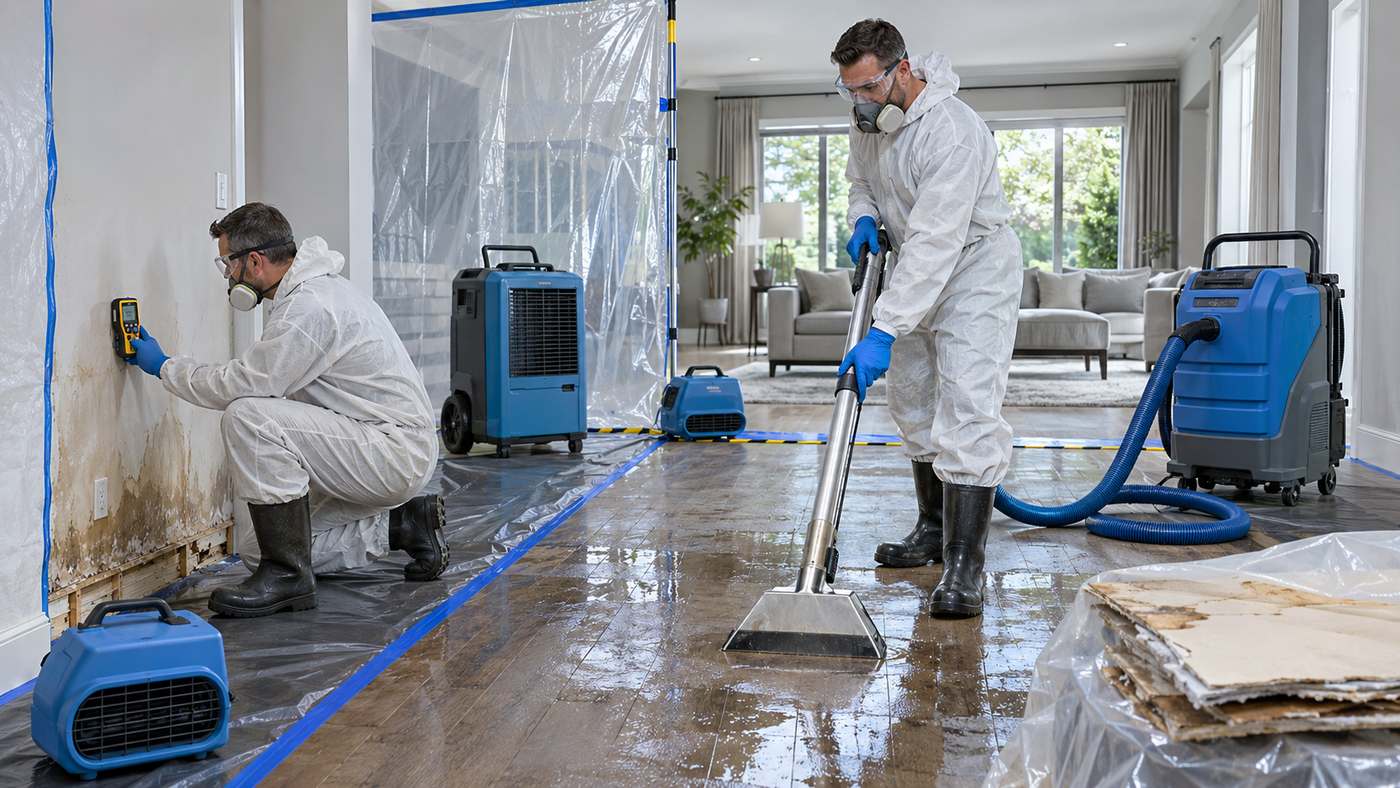
Floodwater can affect far more than visible carpets and furniture. It may carry sewage or other contaminants, enter wall cavities, damage electrical systems, and leave moisture trapped in materials long after the surface appears dry. Choosing professional flood damage restoration services helps property owners organise safety assessments, water removal, controlled drying, cleaning, and repairs as connected stages of recovery. The most reliable outcome begins with keeping people out of hazardous areas and identifying what can safely be restored, rather than rushing to repaint or replace flooring.
A flooded property may require different specialists for electrical inspection, structural assessment, plumbing, cleaning, and reconstruction. This guide explains how professional restoration is planned, seven important decisions, the limits of drying equipment, and practical ways to evaluate a contractor and document losses for an insurance claim.
What Are Professional Flood Damage Restoration Services?
Professional flood damage restoration services are coordinated activities intended to stabilise and recover a building affected by unwanted water. They may include assessment, extraction, debris removal, moisture mapping, structural drying, cleaning and disinfection where appropriate, contents handling, and documentation. Some contractors also undertake repairs or rebuilding; others limit their work to mitigation and refer reconstruction to separate specialists.
The standard ANSI/IICRC S500 describes professional water damage restoration principles and procedures for buildings and contents. It addresses issues such as inspection, drying technology, water contamination, and project documentation. However, a reference to a standard should be supported by actual work practices, not treated as proof that an individual project was completed properly.
Why Floodwater Is Different From a Minor Plumbing Leak
A small, promptly discovered leak from a clean supply pipe can have a different risk profile from water that has passed through soil, streets, sewage systems, and unknown debris. External floodwater should be treated as potentially contaminated until the situation has been assessed. Its source, duration, and contact with building materials shape the response.
What Restoration Can and Cannot Guarantee
A contractor can remove affected materials, dry suitable assemblies, and document conditions, but no legitimate provider can promise that every belonging is salvageable or that all damage is immediately visible. Severe flooding can require engineering assessments, hazardous material evaluation, or extensive rebuilding.
The Goal Is Safe, Verifiable Recovery
For professional flood damage restoration services, a good outcome means hazards have been addressed, affected materials have been handled appropriately, moisture targets have been checked, and the building is ready for its next approved stage of work. An attractive surface finish alone does not demonstrate these conditions.
7 Essential Steps in Professional Flood Damage Restoration
1. Put Life Safety Ahead of Cleanup
Before requesting professional flood damage restoration services, confirm that emergency officials or responsible authorities consider the area safe to enter. Floodwater can conceal open drains, unstable floors, sharp debris, and electrical hazards. Never walk into standing water to operate a switch or touch wet electrical equipment. Arrange for qualified personnel to isolate and inspect utilities as needed.
Flooded buildings may have damaged structural elements or weakened stairways. Warning signs such as major cracks, shifted foundations, sagging ceilings, or unusual movement require specialist assessment. Keep children, pets, and people not involved in recovery away from damaged areas.
A generator must never operate indoors or in a garage. Exhaust can cause fatal carbon monoxide poisoning; public health guidance calls for portable generators to remain outside, at least 20 feet from buildings, with exhaust directed away from openings. Emergency restoration work must not begin by creating another hazard.
Ask About a Site-Specific Safety Plan
Contractors delivering professional flood damage restoration services should explain entry restrictions, power arrangements, personal protective equipment, and any need for electrical, gas, or structural specialists. Confirm how the team will protect unaffected rooms and control access during debris removal.
2. Assess the Water Source and Contamination Risks
A critical part of professional flood damage restoration services is determining where water entered, what it contacted, and whether the source remains active. A burst supply line, roof intrusion, sewage backup, and overland flood may need different containment and cleaning methods. Where contamination is suspected, affected porous materials may not be safely recoverable through drying alone.
Teams providing professional flood damage restoration services use water categories and other assessment methods to guide decisions, but categories depend on site conditions and can change with time or exposure. A product marketed as a universal sanitiser cannot compensate for inadequate soil removal or an unsuitable approach to contaminated materials.
Ask how the team distinguishes water-exposed belongings that can be cleaned from those requiring disposal. Decisions should consider the material, contamination, duration of wetting, and the manufacturer’s guidance. Discuss specialist handling when there may be asbestos, lead-containing coatings, chemical residues, or hazardous waste.
Correct the Cause of the Water Entry
The original source must be controlled before the building is restored. A restoration contractor may coordinate with plumbers or drainage specialists, but responsibility for a broken pipe, defective pump, roof opening, or external drainage problem should be explicitly assigned.
3. Document Damage and Remove Standing Water
Before significant cleanup, photograph waterlines, damaged rooms, floors, appliances, and visible contents when it is safe to do so. Record make, model, and serial numbers of important equipment. For insured losses, contact the insurer promptly, ask about documentation and mitigation requirements, and retain receipts. Do not postpone urgent safety measures solely because an adjuster has not arrived.
Professional flood damage restoration services commonly use extraction equipment to remove water from accessible areas after hazards have been controlled. Pumps and extraction tools may be chosen according to depth, debris, and access. Removing bulk water reduces the amount that must evaporate later, but it does not automatically dry insulation, subfloors, or wall cavities.
Teams performing professional flood damage restoration services should record the affected footprint and identify items moved, cleaned, or discarded. For insurance purposes, follow the adjuster’s instructions about samples of damaged building materials, while promptly disposing of items that create an immediate health risk after suitable documentation.
Do Not Confuse Extraction With Drying
A carpet that no longer releases water under a machine may still contain moisture, as can its underlay and the floor beneath it. Additional assessment determines whether those materials can remain and what drying or removal is needed.
4. Measure Hidden Moisture and Create a Drying Plan
Effective professional flood damage restoration services rely on more than visual inspection. Technicians may use moisture meters, thermo-hygrometers, thermal imaging as a screening tool, and other instruments to locate damp areas and track conditions. Each tool has limits: for example, a thermal image suggests temperature differences but cannot independently prove the presence or absence of moisture.
Teams offering professional flood damage restoration services should establish relevant material readings and evaluate whether moisture is confined to the surface or has entered cavities, insulation, flooring layers, or adjacent rooms. Suitable drying targets depend on the material and reference conditions; one universal meter number is not appropriate for every building product.
Ask for a written scope showing which areas require extraction, removal, cleaning, or drying and where equipment will be positioned. The plan should consider ventilation, temperature, humidity, and the effect of open versus enclosed spaces.
Why Daily Records Can Matter
Progress measurements help reveal whether materials are drying as expected. When readings remain elevated, the team may need to investigate concealed moisture, a continuing water source, or ineffective equipment placement instead of simply extending the hire period without explanation.
5. Remove Materials That Cannot Be Safely Restored
Water-damaged porous materials can be difficult to clean thoroughly after contaminated flooding. Carpets, underlay, insulation, upholstered furnishings, and certain gypsum board assemblies may require removal depending on the exposure and condition. Solid, nonporous surfaces may be cleanable when structurally sound and when the proposed method addresses contamination.
When evaluating professional flood damage restoration services, ask for an itemised explanation of removal decisions. Cutting away wet wallboard without considering hidden insulation and the wall assembly may leave a problem behind. Conversely, unnecessary demolition can raise costs, create more waste, and delay recovery.
The US Environmental Protection Agency advises cleaning and drying wet areas as quickly as practical, ideally within 24 to 48 hours, to reduce mould growth. That is an urgency guideline, not a promise that every flooded building can become fully dry within two days. A major disaster may prevent safe access or equipment delivery for longer.
Cleaning and Disinfection Are Not Interchangeable
Physical removal of dirt and contamination is essential. Disinfection, when warranted, depends on the surface, product instructions, and exposure conditions. Never mix cleaning chemicals, and do not assume that spraying a fragrance or antimicrobial product makes soaked building materials safe to retain.
6. Dry the Structure Under Controlled Conditions
After extraction and necessary removal, professional flood damage restoration services may use commercial dehumidifiers, air movement, and monitored environmental conditions to reduce retained moisture. Drying strategy differs for concrete, timber, plaster, flooring layers, and cavity materials. The target is suitable material condition, not simply a room that feels warm.
Drying equipment must be matched to the site. Dehumidification manages airborne moisture, while carefully directed air movement can assist evaporation from suitable exposed materials. In contaminated or visibly mouldy environments, uncontrolled fans may spread particles; containment and cleaning decisions take priority. Electrical supply and equipment positioning must also be safe for the affected building.
A contractor providing professional flood damage restoration services should explain how the drying plan will change if readings stop improving. Ongoing moisture can result from hidden wet materials, poor airflow, fresh leakage, or conditions outside the building. A fixed number of days cannot be guaranteed before inspecting the actual damage.
Be Cautious With HVAC Systems
Do not switch on a flood-affected heating or cooling system merely to speed the process. Ductwork and equipment may require inspection, cleaning, or repair, especially where contaminated water or mould could be distributed throughout the property.
7. Verify Conditions Before Repairs and Reoccupation
The final stage of professional flood damage restoration services should include documented evaluation of cleaned and dried areas. Ask for moisture readings and an explanation of remaining limitations, inaccessible spaces, or planned specialist work. Depending on damage, electricians, engineers, HVAC technicians, or other qualified trades may need to confirm that systems are safe before use.
Reconstruction may include replacing insulation, wallboard, floor coverings, trim, cabinets, and damaged finishes. Installing new materials while the substrate is still unsuitable can trap moisture or lead to repeated damage. Any required mould remediation should be completed and appropriately assessed before affected spaces are closed up.
A useful handover from professional flood damage restoration services identifies work completed, removed materials, readings and observations, outstanding repairs, and the person responsible for each remaining task. Where insurance is involved, provide the records necessary to support the stated scope and charges.
Verification Is Not a Universal Certificate
No single photograph or test result proves that every hidden area of a building is safe. The appropriate verification method depends on the extent of the loss, materials affected, contamination, and the standards or regulations applicable to the project.
How Long Does Flood Damage Restoration Take?
There is no reliable universal completion time. A limited clean-water intrusion discovered immediately may be addressed more quickly than deep flooding involving contaminated materials, large buildings, or disrupted utilities. The extraction stage, structural drying, cleaning, and reconstruction are separate phases that may overlap only when it is safe to do so.
When contacting professional flood damage restoration services, request a schedule that separates initial assessment, emergency mitigation, monitored drying, and rebuilding. Ask what conditions could change the estimate. Delays may arise from structural inspections, specialised materials, insurance decisions, or the need to coordinate several trades.
Why the First 24 to 48 Hours Matter
Prompt attention can reduce opportunities for microbial growth in wet materials, but safety comes first. Never enter an unsafe property simply to meet a drying deadline. If access is restricted after a major flood, follow official instructions and explain the delay to the insurer and restoration team.
How Much Do Professional Flood Damage Restoration Services Cost?
Costs depend on the amount and type of water, area affected, contamination, access, equipment requirements, drying duration, material disposal, specialist assessments, and reconstruction. A small isolated incident is not financially comparable to an entire ground floor affected by river flooding or sewage-contaminated water.
For professional flood damage restoration services, ask for an itemised scope separating emergency call-out, water removal, demolition or disposal, drying equipment, monitoring, cleaning, and repairs. Check whether equipment is charged by day, what determines removal, and how changes to the original quote will be authorised. An unusually low estimate may omit hidden-material investigation or reconstruction.
Avoid Guaranteed Prices Before Inspection
A meaningful quote identifies assumptions. The full extent of damage may be impossible to determine until water is removed and affected assemblies are examined. Ask for written change orders and supporting photographs when additional work becomes necessary.
Will Insurance Cover Flood Damage Restoration?
Insurance coverage depends on the policy, location, cause of the water, and specific exclusions. In the United States, standard homeowners insurance generally does not cover damage from external rising floodwater; separate flood insurance may be needed. Damage from certain sudden internal plumbing events can be treated differently. Other countries have their own policy wording and claims rules.
Professional flood damage restoration services can provide estimates, photographs, moisture records, and invoices that help document work. However, the contractor should not promise that the insurer will approve every charge or determine coverage on the insurer’s behalf. Notify the insurance provider promptly and confirm how emergency mitigation and longer-term repairs should be recorded.
Preserve Evidence Without Creating a Hazard
Take photographs before disposal where safe and follow instructions about retaining small samples. Keep invoices and a list of lost items, but do not store contaminated soft furnishings inside the home just to preserve proof. Health protection and reasonable loss mitigation remain important.
How to Choose a Qualified Restoration Contractor
A reputable provider should explain its experience with comparable losses, emergency response arrangements, staff training, insurance, written scope, and safety procedures. Qualifications associated with recognised restoration training can be useful, but verify who will actually supervise the work and whether relevant certifications are current.
Ask professional flood damage restoration services providers about contamination assessment, drying documentation, contents handling, subcontractors, and disputes over unexpected repairs. The company should make clear where mitigation stops and reconstruction begins. Request references when possible, and do not sign an unclear assignment of benefits or broad insurance authorisation without understanding its consequences.
Questions Worth Asking Before Work Starts
Confirm who will address the water source, how hazards will be isolated, what materials may need removal, whether readings will be provided, how daily equipment charges work, and what constitutes completion. Transparency at the beginning can prevent disagreement when the property is ready for rebuilding.
Preventing Future Flood-Related Damage
Recovery is an opportunity to review the source of the incident and practical risk reduction. Depending on the property, helpful measures may involve maintaining drains, checking sump pumps, using suitable backflow protection, protecting critical equipment from low-level flooding, and planning safe emergency procedures. Structural flood-resilience changes require qualified design advice and sometimes permits.
The goal of professional flood damage restoration services is to recover from the current event; future flood protection may need drainage engineers, insurers, builders, or local authorities. Do not assume a previously flooded area is safe simply because new flooring has been installed.
Common Restoration Mistakes
Typical problems include entering before utilities are checked, discarding items without available documentation, applying fans to visible mould, covering wet structures too early, and relying on a single surface reading. Another mistake is allowing competing contractors to work without clear responsibility for the water source, cleaning, drying, and repairs.
Frequently Asked Questions
1. What do professional flood damage restoration services include?
They can include assessment, water extraction, safe removal of affected materials, drying, cleaning, moisture checks, and documentation. Reconstruction may be a separate service.
2. How quickly should flood cleanup begin?
As soon as it is safe. Wet materials should ideally be cleaned and dried within 24 to 48 hours where practical, but electrical, structural, and contamination hazards must be addressed first.
3. Can all flood-damaged carpets and walls be saved?
No. Some porous materials exposed to contaminated water cannot be reliably cleaned and may require removal. Decisions depend on the materials and conditions.
4. How long does structural drying take after a flood?
It varies by water volume, materials, humidity, and damage extent. A professional should monitor progress rather than promise the same drying time for every building.
5. Will homeowners insurance pay for flood restoration?
Coverage depends on the cause and policy. In the US, external rising floodwater commonly requires separate flood coverage; confirm your terms directly with the insurer.
6. How do I choose trustworthy professional flood damage restoration services?
Check relevant training, insurance, comparable experience, a written scope, safety procedures, moisture documentation, and transparent pricing before agreeing to work.
Conclusion
Professional flood damage restoration services are most effective when safety, contamination control, water removal, drying, and repairs follow a documented plan. Rapid action matters, but electrical and structural hazards must be resolved before cleanup begins. Measured progress and clear communication help owners distinguish recoverable materials from those requiring replacement. With qualified specialists and careful records, a flooded property can move toward a safer, more reliable recovery.
