
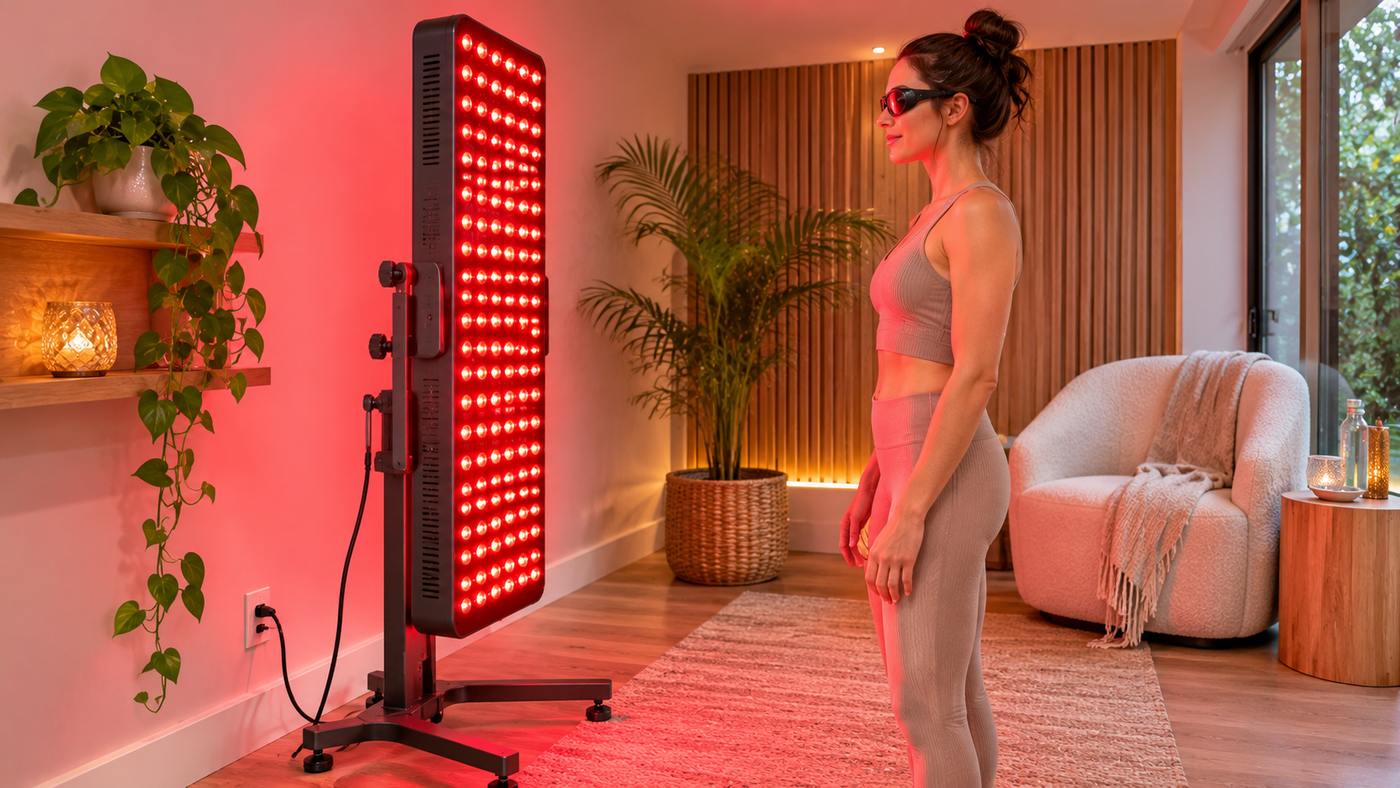
Interest in red light therapy panels has grown as people explore noninvasive approaches to skin care, recovery, and general wellness. These devices use light emitting diodes to deliver selected red wavelengths, and many also produce near infrared light. The scientific name for the proposed biological effect is photobiomodulation. Although research supports certain clinical applications, evidence differs by condition, device, and treatment protocol. A panel cannot be assumed to reproduce the results of a medical study simply because its lights look similar.
What Are Red Light Therapy Panels?
Red light therapy panels are fixtures containing arrays of LEDs designed to illuminate a treatment area with particular wavelengths. They may be compact units for localized exposure or larger wall mounted devices that cover more of the body. Some models provide separate controls for visible red and near infrared channels, while others operate both together.
Unlike tanning devices, these systems are not intended to deliver ultraviolet light. That distinction matters because ultraviolet exposure has established risks that should not be confused with the action of visible red light. However, the absence of ultraviolet radiation does not make unlimited exposure safe, especially when an intense device is used near the eyes.
How Does Photobiomodulation Work?
Photobiomodulation describes biological responses to carefully selected light exposure. Proposed mechanisms include the interaction of light with cellular light absorbing molecules and subsequent changes in signaling pathways. Mitochondrial activity, inflammation related processes, and tissue responses have been studied, but mechanisms can vary and remain under investigation.
The effect is influenced by wavelength, power reaching the skin, exposure duration, and the tissue being treated. More light does not reliably mean a better result. A device can deliver an ineffective amount or an unnecessarily intense exposure if the operating conditions are unsuitable.
Red Light Versus Near Infrared Light
Visible red wavelengths in many consumer products are around 630 to 660 nanometres, while near infrared products commonly include wavelengths around 810 to 850 nanometres. These are illustrative ranges rather than universal treatment prescriptions. Near infrared light is largely invisible, so users cannot judge its output by how bright the panel appears.
Why the Wavelength Label Is Only a Starting Point
Two panels listing the same wavelengths can differ in spectral output, irradiance, beam spread, and recommended distance. The intended application and verified operating specifications matter more than the number of colours or LEDs advertised.
7 Essential Tips for Choosing Red Light Therapy Panels
1. Define the Goal and Check the Evidence
Before purchasing red light therapy panels, identify the condition or outcome that interests you. A person exploring cosmetic skin changes has a different question from someone concerned about hair thinning or persistent joint pain. The evidence should be considered separately for each application.
Dermatology studies suggest that some appropriate red light devices can modestly improve selected signs of skin ageing and support treatment of androgenetic alopecia, a common type of pattern hair loss. Research also explores pain and other clinical uses, but protocols and findings vary. The existence of a promising study does not establish that every consumer panel has the same effect.
A 2025 multidisciplinary clinical consensus identified several medical areas where photobiomodulation has supporting evidence. Yet recommendations often depend on clinician selected equipment and controlled protocols rather than general home exposure. A later review across multiple health conditions found that certainty ranged from moderate to very low for many outcomes. These distinctions are essential when evaluating broad promotional claims.
Separate Clinical Evidence From Marketing Claims
Look for human studies that assess the outcome you actually want and describe comparable devices and dosing. Be skeptical of claims that a panel cures serious diseases, guarantees rapid fat loss, or replaces prescribed care. No general purpose wellness panel should be treated as a substitute for appropriate medical diagnosis.
2. Compare Wavelengths and Measured Light Output
Red light therapy panels are often promoted through the number of LEDs, nominal wattage, or a long list of wavelengths. None of those details independently establishes the optical dose delivered to skin. Wall plug power consumption measures electricity used by the device; it is not the same as the light energy reaching a treatment area.
Irradiance describes optical power arriving at a surface per unit area and is commonly reported in milliwatts per square centimetre. Radiant exposure, sometimes called fluence, describes energy per unit area and is commonly reported in joules per square centimetre. These values change with exposure distance, geometry, and time.
For red light therapy panels, ask whether the manufacturer provides credible measurements at stated distances and explains how those measurements were obtained. Read any instructions defining the intended treatment distance. An impressive figure measured immediately against a diode may have little relevance to ordinary use several inches away.
Why Higher Power Is Not Automatically Better
Photobiomodulation research examines dose dependent responses, and protocols cannot simply be scaled upward indefinitely. A very intense panel may not offer greater benefit and can increase discomfort or the possibility of unsafe exposure. Follow an appropriate, device specific protocol rather than choosing maximum output by default.
3. Understand Eye Protection and Photosensitivity
Safety should be central to any decision about red light therapy panels. Bright visible light can be uncomfortable, and near infrared output may be present even though it cannot be seen. Avoid staring at the LEDs, and use the wavelength appropriate eye protection specified by the manufacturer. Ordinary sunglasses are not an automatic substitute for recommended protective eyewear.
People with eye disorders, light sensitivity conditions, or medicines that increase photosensitivity should speak with a qualified clinician before beginning exposure. The American Academy of Dermatology also advises additional caution for people prone to pigmentation changes, including some individuals with darker skin tones. Visible light can influence certain pigment conditions even though it is not ultraviolet radiation.
Stop When a Reaction Appears
Discontinue use if exposure causes unusual pain, eye symptoms, significant redness, blistering, or worsening pigmentation, and seek appropriate medical advice. A session should not involve enduring discomfort to reach a promised result.
4. Match Panel Size and Coverage to the Intended Area
A small panel may be easier to position for a localized region, while a larger model covers more surface area from a suitable distance. The best size depends on where treatment is intended, whether the device can be positioned safely, and how consistently it illuminates the target region.
When comparing red light therapy panels, evaluate usable coverage rather than merely the dimensions of the housing. Light intensity may differ across the centre and edges of the beam. Manufacturer coverage diagrams, if measured and clearly described, are more useful than photographs showing an entire room glowing red.
A Practical Home Setup Check
Confirm a safe viewing position, suitable mounting support, access to power, and enough room to maintain the prescribed distance. Avoid damp locations unless the product is explicitly rated for that environment. A convenient location helps consistency but must not override electrical or optical safety.
5. Verify Device Claims and Regulatory Status
Regulatory language is often confusing. In the United States, certain light therapy devices have received FDA clearance for specific indications, such as treatment of some cosmetic skin concerns or certain hair loss applications. Clearance for one device and intended use does not establish approval of every panel or every condition appearing in its advertising.
If a seller describes red light therapy panels as FDA cleared, ask for the exact model and evidence showing the applicable clearance and intended use. An FDA establishment registration, product listing, or generic compliance logo is not equivalent to a specific marketing authorization. Device rules also differ outside the United States.
Look for complete product labeling, safety warnings, electrical specifications, and accessible customer support. Avoid assuming a CE marking or similar symbol independently proves a clinical outcome. Electrical compliance, medical device status, and effectiveness are separate questions that require different evidence.
Check the Specific Intended Use
A cleared facial treatment device is not necessarily cleared for muscle injuries, systemic illness, or treatment of another body area. Compare the exact indication against the use you are considering, and consult a clinician when medical treatment is involved.
6. Follow a Realistic and Consistent Session Plan
There is no universally validated number of minutes or weekly sessions for all red light therapy panels. Appropriate exposure depends on the device, distance, treatment site, wavelength, output, and reason for use. Studies often employ repeated sessions over several weeks, but their schedules cannot be copied safely onto unrelated equipment.
Use the instructions provided for the particular device and indication. Do not combine the highest setting, closest distance, and longest possible exposure in the belief that more light must work faster. If a healthcare professional recommends photobiomodulation as part of treatment, use the schedule they specify.
Track Effects Without Overinterpreting Them
Record the device settings, duration, and any adverse reactions. If you do not experience the expected result, reassess the claim and the care plan rather than continually increasing exposure. Long term safety and optimal home protocols are not fully established for all uses.
7. Evaluate Build Quality, Service and Total Value
Red light therapy panels can differ substantially in durability, cooling, controls, and ease of maintenance. A suitable device should include understandable operating instructions, clearly labeled settings, a stable mounting arrangement, and reliable mechanisms to prevent overheating or accidental use.
Compare warranty terms, replacement support, return conditions, and the manufacturer’s willingness to explain optical specifications. A device with impressive advertising but no credible measurements or service contact may be a poor purchase even if its advertised price is attractive.
When assessing red light therapy panels, consider the full ownership cost, including suitable protective eyewear, a secure stand if needed, electricity, and available replacement parts. A larger purchase is not justified if the intended benefit is uncertain or the equipment is unlikely to be used consistently.
Ask for Evidence Rather Than a Superlative
A trustworthy supplier should distinguish documented technical specifications from unverified wellness claims. Words such as medical grade, strongest, and professional do not substitute for a clear intended use and independently meaningful information.
What Benefits Does Scientific Research Actually Support?
Research on red light therapy panels overlaps with broader studies of photobiomodulation, but many clinical studies use devices that differ from commercial full body panels. Results should therefore be described with appropriate limits rather than transferred from one device type to another.
Skin Texture and Signs of Ageing
Some controlled studies report modest improvements in wrinkles, texture, and other appearance related outcomes after repeated exposure using specific red or near infrared systems. The American Academy of Dermatology recognizes promising findings while emphasizing differences among research devices and the need for better studies of home products.
That means red light therapy panels may be considered as a supplemental skin care option for some adults, not a replacement for sunscreen, diagnosis of suspicious lesions, or established dermatologic treatment. Visible changes can be subtle, and not everyone responds in the same way.
Pattern Hair Loss
Photobiomodulation has evidence supporting selected devices for androgenetic alopecia. However, much of the home device research involves caps, helmets, or combs designed for scalp exposure. A general wall panel may not deliver the same dose or reach hair follicles under equivalent conditions. A dermatologist should determine the reason for hair loss before treatment is selected.
Pain, Recovery and Other Uses
Research has examined photobiomodulation for certain pain conditions and clinical recovery contexts, with encouraging findings in some studies. Yet different wavelengths, devices, target tissues, and dosing schedules limit comparisons. Evidence is not sufficient to promise that red light therapy panels will resolve any particular injury, accelerate athletic recovery, or treat chronic disease at home.
Claims involving cancer cures, substantial weight loss, or broad immune enhancement should be approached with particular skepticism. These uses are not established by ordinary evidence for consumer panels.
How to Use Red Light Therapy Panels Safely at Home
Start by reading the entire instruction manual and reviewing any contraindications or precautions. A clinician can help assess whether light exposure is suitable for a personal skin condition, medication regimen, or medical treatment plan. Follow the specific preparation guidance instead of relying on a generic internet schedule.
Before Each Session
Inspect the panel, power cable, mount, and ventilation openings. Remove the device from use if it is damaged. Position it at the specified distance from the intended area and wear the recommended eye protection. Use it in a dry environment with an unobstructed power connection.
During and After Exposure
Keep to the prescribed settings and duration. Avoid directing the device toward another person’s eyes. Afterward, check for irritation or unusual reactions and return to ordinary skin care unless a clinician has advised otherwise. Red light does not replace daily sun protection.
Special Situations Need Professional Advice
People with photosensitive disorders, unexplained skin lesions, significant eye disease, or cancer treatment plans should not self prescribe panel sessions. Pregnancy related use and exposure over known or suspected tumors also warrant direct professional evaluation because evidence and precautions depend on context.
Red Light Therapy Panels Versus Masks and Handheld Devices
Panels illuminate a relatively broad area from a distance, while masks sit close to selected facial regions and handheld devices can target smaller spots. These differences influence treatment geometry, practical ease, and the dose actually reaching skin.
Red light therapy panels are not automatically superior because they contain more LEDs or cover a larger region. A specialized device studied for a particular indication may have more relevant evidence than a multifunction wellness panel. Choose by intended use, measured output, safety design, and credible supporting research.
Are At Home Panels Equivalent to Clinical Treatment?
Not necessarily. Clinical equipment may differ in optical power, supervision, protocol, and treatment purpose. Medical professionals can also assess the condition, monitor progress, and adjust a treatment plan. Home exposure should not be presented as a substitute for supervised clinical care when that care is needed.
Common Mistakes to Avoid
One mistake is assuming that all red light therapy panels emitting similar wavelengths deliver equivalent results. Another is trusting a high electrical wattage figure as proof of stronger therapeutic light. A third is using a panel for every health concern without confirming whether evidence exists for that outcome.
Frequently Asked Questions
1. What are red light therapy panels used for?
They deliver selected red and sometimes near infrared wavelengths for photobiomodulation. Some specific devices have evidence for cosmetic skin applications or hair loss, but broad medical claims require separate proof.
2. Do red light therapy panels actually work?
Certain photobiomodulation applications have supportive research, but results vary with the condition, device, and protocol. Evidence from a clinical study does not automatically apply to an unrelated home panel.
3. What wavelengths should a home panel have?
Many products use red wavelengths near 630 to 660 nanometres and near infrared wavelengths around 810 to 850 nanometres. The right specification depends on the intended use and verified device guidance.
4. Can red light therapy damage your eyes?
Bright or intense exposure can pose risks, particularly when protection instructions are ignored. Never stare directly into LEDs and wear the wavelength appropriate eyewear specified by the manufacturer.
5. How often should I use a red light therapy panel?
There is no universal schedule. Use the device specific instructions or a clinician recommended protocol, since wavelength, distance, intensity, and the target condition affect exposure requirements.
6. Are red light therapy panels FDA approved?
Some particular light therapy devices are FDA cleared for defined indications. That does not mean every panel is authorized for every claimed benefit, and buyers should verify the exact model and intended use.
Conclusion
Red light therapy panels may offer a convenient way to explore selected photobiomodulation applications, but safe use begins with accurate claims and realistic expectations. Evaluate wavelengths, measured light output, eye protection, and regulatory status before choosing a device. Treat emerging research as condition specific, not a guarantee of results from any commercial panel. When medical concerns or unusual reactions arise, professional guidance is more valuable than increasing the exposure.
