
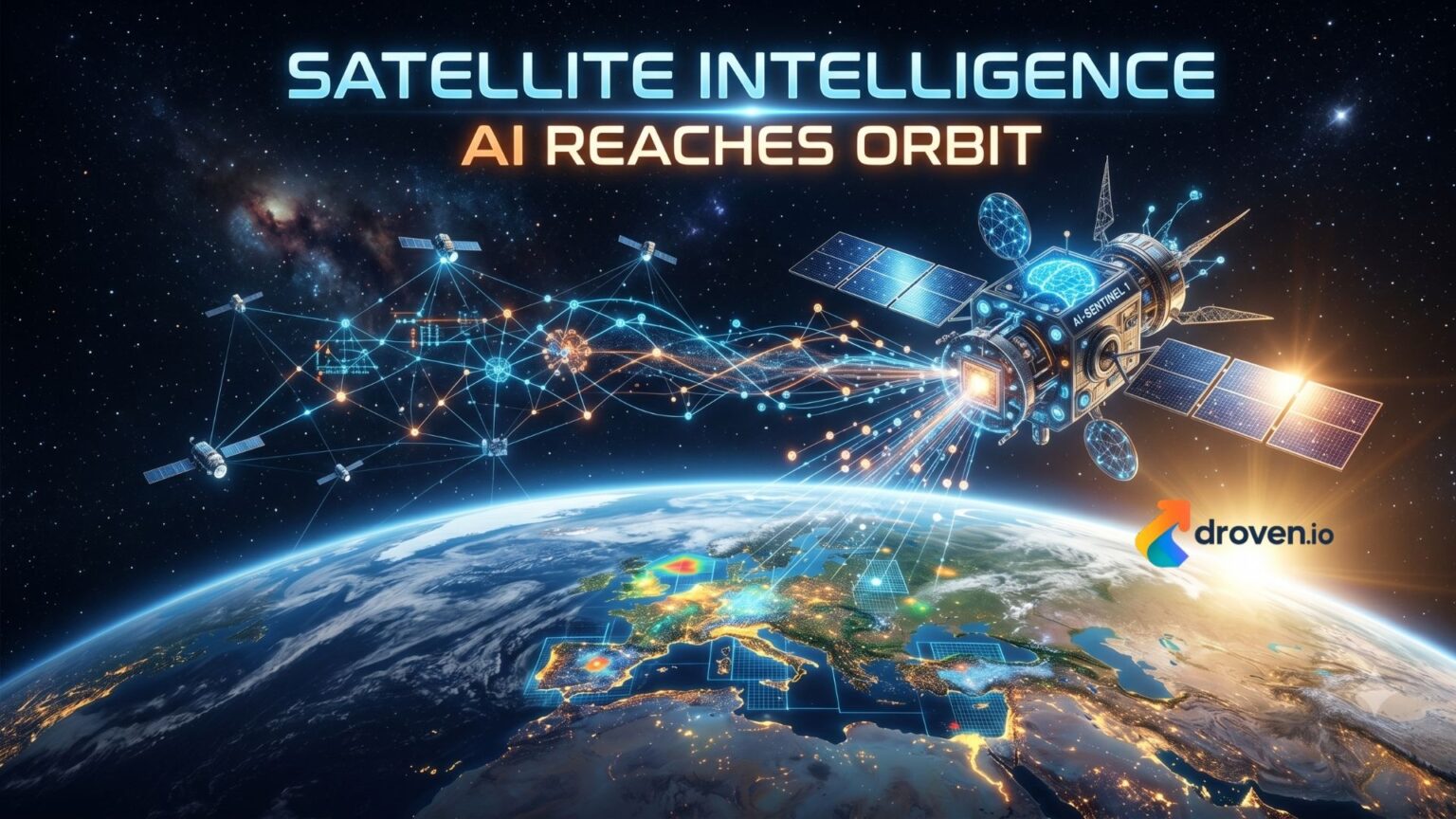
For most of the history of satellite technology, the spacecraft itself was a passive instrument. Essentially, it was a very expensive camera that photographed an area of the planet and waited for a ground station to download the data and interpret the results. If someone wanted to find current satellite images, often had to wait for hours or even days for the data to be downlinked and analysed. This latency inherent in the model is a serious problem when what was being observed was a wildfire advancing on a populated area, a flood inundating a river valley, or an illegal encroachment inside a protected zone.
The industry is now shifting towards “edge intelligence”; this is embedding AI processing capability directly into the satellite hardware, so analysis happens before transmission to ground rather than after. This shift is made possible by new, space-hardened hardware. It looks at current satellite imagery and decides instantly if a frame contains something important, like a developing storm or a wildfire, or if it is just a picture of clouds that can be discarded. In May 2025, Dragonfly Aerospace and Unibap announced a collaboration to integrate real-time AI processing directly into imaging payloads, converting raw spectral data into actionable intelligence within seconds of acquisition.
The engineering challenges involved in this transition are not trivial. Space-hardened processors must operate reliably under conditions of intense radiation, extreme thermal variation, and without the possibility of physical intervention when something goes wrong. The AI models running on these systems must therefore be not only accurate, but extraordinarily robust. This has pushed the field towards new model compression and quantisation techniques that preserve inference quality whilst dramatically reducing computational requirements, advances with applications well beyond the space industry.
The scale of investment underpinning this transformation is remarkable. Across the decade from 2025 to 2034, Earth observation satellite launches are projected to increase by almost 3 times, and the number of satellites equipped with onboard computing capability could grow fourfold. This is not incremental improvement, but a structural redesign of how humanity watches over its own planet. For anyone wondering how to find current satellite images from a source of hi res satellite imagery of a specific location, this shift in onboard processing architecture is what makes near-real-time access increasingly feasible. Imagery available to researchers, journalists, and emergency services are a direct product of the AI running above the clouds, not just below them.
Disaster Detection from Space Means Saving Lives in Real Time
The most urgent application of this onboard intelligence is the detection of natural disasters as they unfold. The gap between when a disaster begins and when credible geospatial intelligence reaches first responders has historically been measured in hours, sometimes days. AI is compressing that gap towards minutes.
The “Shield” algorithm, a significant methodological breakthrough that enables satellites to detect disaster zones using only a single post-event image, was compared to a conventional approach and highly reduced data storage requirements while vastly increased detection speed. A complementary framework known as the History Injection Transformer (HiT) demonstrated onboard flood detection capable of reducing data storage by over 99% whilst maintaining high accuracy.
What unites these approaches is the understanding that current satellite imagery of a disaster zone is only valuable if it can be interpreted and communicated before the window for effective response closes. But the implications extend beyond emergency management. Current satellite images of the Earth are already providing situational awareness for deforestation monitoring, agricultural stress detection, and urban expansion tracking in ways that were simply impractical before AI-powered onboard analysis became viable. The algorithms available to conservation organisations and environmental agencies today are qualitatively different from anything that existed 5 years ago.
AI-Powered Earth Observation to Really Understand Our Planet
Beyond immediate crisis response, AI is reshaping how we model Earth as a dynamic, interconnected system. Two initiatives launched in 2025 illustrate the breadth of what is now possible. Google DeepMind’s AlphaEarth Foundations is, in essence, a virtual satellite — a model that fuses billions of data points from optical imagery, synthetic aperture radar, and climate simulations into a continuously updated portrait of the Earth’s surface. It processes data 16 times more efficiently than the technologies it replaces and is already being used by more than fifty organisations for ecosystem mapping, deforestation tracking, and biodiversity monitoring. For users seeking a current live satellite view of environmental change — whether the retreat of a glacier, the advance of an invasive species, or the slow encroachment of desertification on arable land — AlphaEarth Foundations provides the analytical backbone that makes such views interpretable rather than merely visual.
Equally significant is the Allen Institute for AI’s release of OlmoEarth, an open-source platform designed to democratise access to Earth observation intelligence. Where previous Earth intelligence systems required deep machine learning expertise and substantial computational infrastructure, this platform is designed to be accessible to a far broader range of researchers and organisations. For instance, it enables global mangrove maps to be updated twice as fast with 97% accuracy and can detect Amazon deforestation events with high precision without requiring specialist AI knowledge.
For the end user looking for a live satellite view to understand an evolving situation, these AI systems are the invisible infrastructure that makes the experience meaningful. They are stitching together imagery from dozens of satellites in different orbital planes, correcting for atmospheric distortion, filtering cloud cover, identifying anomalies, and surfacing change. The result presented on a screen is the product of enormous computational intelligence working behind it. Without that intelligence, satellite data would be nothing more than pretty pictures with limited analytical value; with it, they become a decision-support tool for some of the most important challenges facing the planet.
Challenges, Concerns, and the Road Ahead
Acknowledging the genuine progress AI has made across these domains should not mean ignoring the hurdles. The gap between proof-of-concept and reliable, ethical, large-scale deployment is where many organisations find themselves stuck most of the time. Data quality and bias remain foundational problems. AI models require enormous volumes of carefully labelled training data, and producing that data is expensive, time-consuming, and prone to introducing the prejudices of those who label it. When a model trained on biased data is applied in high-stakes contexts, the consequences can be significant and difficult to detect. Addressing this requires not just technical solutions but organisational ones: diverse teams, rigorous audit processes, and a willingness to pause deployment when evidence of systematic error emerges.
The energy footprint of large-scale AI is another issue that the industry has been slow to confront honestly. Training frontier models consumes energy at a scale that sits awkwardly alongside sustainability commitments, and inference at volume is not trivial either. The organisations that will lead on this are those investing in more efficient architectures, exploring renewable energy sourcing for data centres, and being transparent about the environmental cost of their AI operations. There is a certain irony in the fact that some of the most powerful AI tools being used to monitor environmental degradation are themselves significant contributors to energy consumption. Resolving that contradiction is not merely a reputational concern, it is a precondition for the long-term social licence that AI development as a whole will require
Integration with legacy infrastructure continues to frustrate organisations across sectors. In financial services, healthcare, and government, the systems that AI needs to work alongside were built over decades, often using technologies that predate the concept of machine learning entirely. Many organisations in these sectors cite legacy integration as their primary obstacle to a meaningful AI adoption. No amount of model sophistication resolves a data pipeline problem.
Finally, explainability — the question of whether a human can meaningfully understand why an AI reached a particular conclusion — remains both a technical and a regulatory flashpoint. As AI systems take on increasingly consequential decisions, the demand for interpretable reasoning is growing. Regulators, judges, insurers, and end users all have legitimate interests in being able to trace a decision back through the logic that produced it.
Looking ahead, the trajectory of AI software development points towards several distinct boundaries. Agentic AI is the next major phase of capability development, and its commercial deployment is accelerating. Distributed satellite constellations will increasingly operate as interconnected sensor networks, processing data collectively in orbit rather than routing everything through centralised ground infrastructure. The developer’s role will continue to evolve, with AI absorbing more of the mechanical coding pipeline and humans focusing on system architecture, ethical governance, and the kinds of creative and contextual judgements that machines are not yet equipped to make.
And the democratisation trend, exemplified by open-source platforms like OlmoEarth and publicly available embedding datasets from Google, will continue to lower the barrier to entry for AI-powered analysis, bringing sophisticated capabilities to research teams and civil society organisations that cannot compete with big-tech budgets.
