
Second Talent places full-time, vetted engineers from Asia on your team and employs them for you. That one sentence explains most of what it does well and most of what it does not. If you want a developer who joins your stand-ups for the next three years at Asian salary levels, it is built for that. If you need a freelancer for six weeks, or someone who works your exact US hours, other platforms will serve you better.
This review covers how Second Talent works, what it costs, where it falls short, and five alternatives worth comparing: Toptal, Andela, Arc.dev, Lemon.io and Proxify. Each one solves a slightly different problem, so the right choice depends less on which is “best” and more on how long you need the person, where you want them to sit, and who will employ them.
Quick comparison
| # | Platform | Hiring model | Main talent regions | Best for |
| 1 | Second Talent | Full-time hires + employer of record | Asia | Long-term engineers at Asian rates |
| 2 | Toptal | Vetted freelance network | Global | Senior specialists at short notice |
| 3 | Andela | Talent marketplace + AI services | Africa, Latin America | Enterprise AI teams |
| 4 | Arc.dev | Remote marketplace | Global | Freelance or direct full-time hires |
| 5 | Lemon.io | Vetted developers, contract or in-house | Europe, Latin America, North America | Early-stage startups |
| 6 | Proxify | Vetted developers, long-term contracts | Europe | European time zones and compliance |
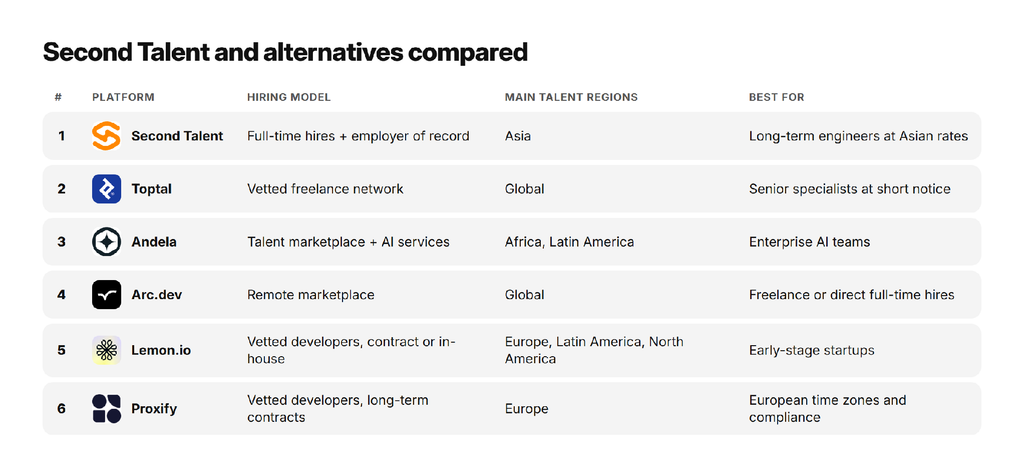
Second Talent and alternatives compared
Second Talent review
How it works
You send a role brief covering stack, seniority, time-zone overlap and budget. Second Talent searches its pool of pre-vetted developers across Asia, including Vietnam, the Philippines, India, Indonesia and China, and sends a shortlist, usually within 24 hours. Most clients interview two or three people and make a hire within 3 to 5 business days.
Once you choose someone, Second Talent employs them through its own employer of record in nine Asian markets. The developer gets a local contract, statutory benefits and payroll in their own currency. You get one monthly invoice and no need to open a company abroad. Day to day, the developer works inside your tools and reports to your team lead, the same as any other employee.
Vetting
Before a developer reaches a shortlist, they go through a technical assessment, an AI skills evaluation, an English test, a structured interview and reference checks with former managers. Second Talent says it accepts the top 1% of applicants.
The AI evaluation is the newest step. It looks at how a developer uses coding assistants and model APIs in real work: whether they can review and correct generated code, write useful prompts and tests, and know when not to trust the output. Most engineering teams now ask about this in interviews, so it saves you a round.
Pricing
Second Talent charges a monthly fee per developer, with nothing to pay until you hire. Total cost typically lands 50 to 70% below the salary of a comparable US engineer, depending on country and seniority. It publishes salary rate cards for each market, so you can see what developers earn before you ask for a quote.
The monthly fee includes statutory costs, which matter more than most buyers expect. Employers in Vietnam pay 21.5% of salary into social, health and unemployment insurance, and the Philippines requires a 13th-month salary. A cheaper quote elsewhere sometimes leaves these out.
There is a 90-day replacement guarantee. If a hire leaves or does not work out in that window, Second Talent finds a replacement at no extra cost. The company reports a 92% talent retention rate.
What works well
- Full-time focus. Developers work for one client. Retention tends to be better than with freelancers, who often juggle two or three projects.
- Employment is included. The EOR is in-house, so there is no third party between you and the people running payroll and compliance.
- Speed. A 24-hour shortlist and a hire within a week compare well with the 6 to 10 weeks a typical in-house search takes.
- Transparent salary data. The public rate cards make it easier to judge whether an offer is fair to the developer, which affects how long they stay.
- Client ratings. Second Talent shows 4.9 out of 5 on both G2 and Clutch.
Where it falls short
- Time zones. Asia gives US East Coast teams early-morning or evening overlap. If your team decides things in live meetings, a Latin American or European provider will feel easier.
- Asia only. There is no option for engineers in Latin America or Europe. If you want one vendor across several regions, Andela, Arc.dev or Toptal cover more ground.
- Not built for short projects. A four-week audit or a quick prototype is a poor fit. The model assumes you want someone for a year or more.
- Shorter track record. Toptal and Andela have been operating for over a decade and have far more public case studies. Ask Second Talent for client references at a company your size and speak to them.
- You still manage the work. Second Talent provides people, not project management. Without a technical lead to write tickets and review code, any placement model will struggle.
Who should use it
Second Talent fits US, European and Australian companies that want full-time engineers for a year or longer, have a lead who can manage async work, and do not want to set up a legal entity in Asia. It is a weaker fit for one-off projects, teams that need four or more hours of live overlap with the US, and companies that want a vendor to own delivery.
The 5 best Second Talent alternatives
1. Toptal
Toptal has been running since 2010 and is the best-known name in vetted freelance talent. Its headline claim is that it hires “the top 3%” of freelance talent, and the network now covers AI specialists, product managers, designers and finance experts as well as software developers. Toptal says it has served over 35,000 clients, and that the average time to match is under 24 hours.
How it works. You talk to a Toptal matcher about the role, receive a small number of hand-picked candidates, and interview them. Engagements range from hourly to full-time, and you can work with a new hire on a trial basis and pay only if you are satisfied. Toptal also offers payroll and employer-of-record services, so you can keep someone longer through Toptal if you want.
Pricing. Toptal does not publish rates on its homepage. They vary by skill and seniority, and in practice sit close to senior US contractor rates. Budget accordingly if you plan to keep someone for a year.
Strengths:
- A deep bench of senior specialists, including niche skills such as security, data platforms and AI.
- Fast matching and a trial period that reduces hiring risk.
- A strong brand that makes procurement and finance teams comfortable.
Drawbacks:
- Much smaller savings against US hiring than Asia-based options.
- Freelancers can leave when a better project comes along.
- The breadth of the network means quality depends partly on your matcher.
Choose it over Second Talent if: you need senior expertise for weeks or months, not years, and speed matters more than cost.
2. Andela
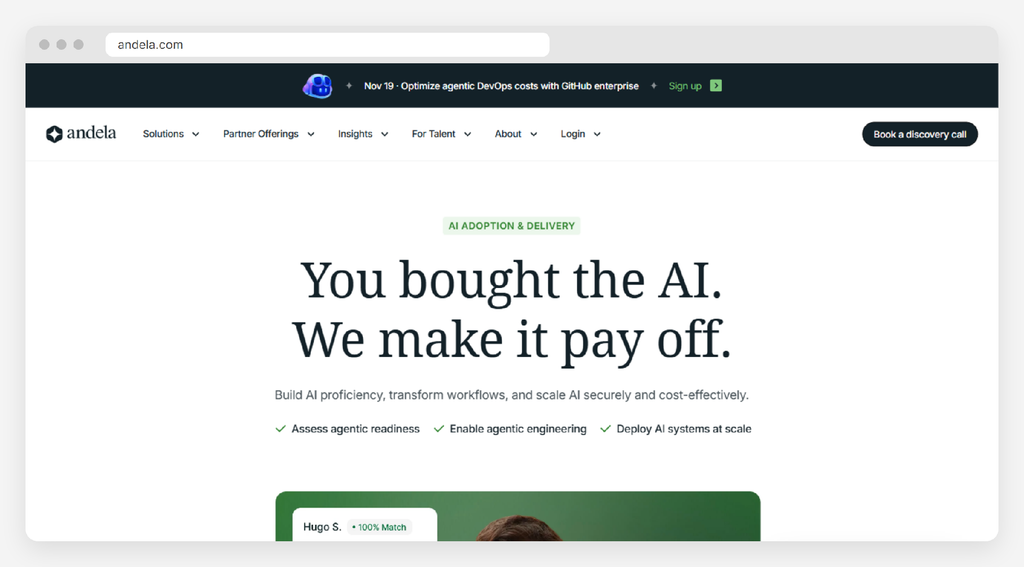
Andela homepage
Andela started in Lagos in 2014 by training software engineers in Africa and now operates a marketplace covering 135+ countries, with a strong presence in Latin America. It reports 17,000 certified engineers, more than 200,000 people trained, and 650+ clients. In 2026 it has repositioned heavily around AI. Its homepage now leads with AI adoption and delivery, and it offers an agentic engineering assessment for teams adopting coding agents.
How it works. Andela’s Talent Cloud platform covers sourcing, qualification, hiring, management and payments in one place. Most clients start with a discovery call and add engineers in batches, with Andela’s account team handling matching. It suits companies that want a managed relationship rather than a self-serve marketplace.
Pricing. Andela does not publish rates. Engagements are scoped per client, usually as monthly rates per engineer. Expect enterprise-style contracting.
Strengths:
- Latin American engineers with good overlap with US hours.
- Experience running large, multi-team engagements for enterprise clients.
- A clear AI focus, useful if you want help rolling out AI tools as well as hiring.
Drawbacks:
- The sales process is more formal than an early-stage startup may want.
- Pricing is opaque until you are in conversation.
- The shift toward AI services may matter less if you simply need two backend engineers.
Choose it over Second Talent if: you are a larger company that wants US-friendly time zones, one vendor across several regions, or help with AI adoption alongside hiring.
3. Arc.dev
Arc.dev is a remote talent marketplace that supports both freelance contracts and direct full-time hires. It reports 450,000 talent across 190 countries and now covers designers, marketers and product managers as well as developers. It is the most transparent platform on this list about pricing and vetting.
How it works. Arc publishes its vetting funnel: about 55% of applicants pass profile screening, 14% pass the communication check, and 2% pass the technical assessment before a final review. Freelance hires typically happen within 72 hours. Full-time hires average about 14 days. Its HireAI tool adds AI applicant screening and automatic sourcing for companies that post jobs.
Pricing. Freelancers range from $15 to $110+ an hour. Full-time hires cost a one-time fee of 20% of annual salary. There is a risk-free trial of up to two weeks, and if a hire does not work out in the first three months, Arc will match you with someone else free of charge. For full-time hires abroad, Arc works with partner EORs.
Strengths:
- Clear, published pricing and vetting data.
- One platform for both freelance and permanent hires, across almost every region.
- Lower freelance rates than Toptal at the junior and mid levels.
Drawbacks:
- On full-time hires, you or a partner EOR carry contracts, payroll and compliance.
- The 20% placement fee is due upfront, which matters on a tight runway.
- A very large pool means you will spend more time reviewing profiles.
Choose it over Second Talent if: you already have a way to employ people abroad, want to recruit across many regions, or want to own the employment relationship directly.
4. Lemon.io
Lemon.io focuses on startups. It places vetted developers from Europe, Latin America, the US and Canada, either on contract or as in-house hires, and has been screening engineers since 2015. Its homepage puts its acceptance rate at about 1%, and it reports more than 2,000 hires.
How it works. Lemon.io says it sends matches in about 24 hours. Its published vetting funnel runs from pre-screening (about 37% pass) to a recruiter call (17%), a technical interview (7%), and finally about 1% of applicants listed. An AI assistant now handles parts of the pre-screening, and the company has added a way to start hiring directly from Claude Code or ChatGPT.
Pricing. There are no upfront recruitment or setup fees. Work is billed as a prepaid subscription, usually one month in advance, with a minimum of 160 hours. Hourly rates vary by developer and are generally below Toptal’s.
Strengths:
- A light, fast process built for founders, not procurement teams.
- European and Latin American time zones, which suit US and EU companies.
- Strong public reviews, with an “Excellent” Trustpilot rating across several hundred reviews and 4.6 on G2.
Drawbacks:
- Built around contractors, so long-term retention depends on keeping the developer engaged.
- The 160-hour minimum makes very small engagements harder.
- Employment and payroll for in-house hires are not clearly covered on its site.
Choose it over Second Talent if: you need a developer for an MVP or a defined build, want European or Latin American hours, and are happy with a contractor setup.
5. Proxify
Proxify is a Swedish company that calls itself Europe’s largest vetted tech talent network. It reports 6,000+ vetted professionals across more than 1,000 tech skills, accepts about 1% of applicants, and says 2,500 companies have used it. Its pitch is long-term remote team members who behave like core staff, with the flexibility of a contract.
How it works. You book a 25-minute call, and Proxify presents hand-picked candidates within an average of two days. New team members usually start within two weeks. Each client gets a client engineer who handles technical matching and a client manager who handles onboarding, HR and admin. If you later want the developer on your own payroll, Proxify lets you transition them with no lock-in.
Pricing. Proxify has a dedicated pricing page, and rates depend on the role and seniority. It positions itself as fair for both clients and developers rather than as the cheapest option, so ask for a full quote before comparing it with other platforms.
Strengths:
- European time zones and an ISO 27001-certified platform, useful for regulated buyers.
- Guidance on contractor rules such as the UK’s IR35 and the Dutch DBA Act.
- A clear path to hiring the developer directly later.
- A 4.4 out of 5 Trustpilot rating.
Drawbacks:
- European rates are well above Asian ones, so savings against US salaries are smaller.
- Developers work as contractors, not employees, while they are with Proxify.
- Less useful if your team is in the Americas and needs live overlap.
Choose it over Second Talent if: your company is in Europe or the UK, you want same-day overlap with your team, or contractor compliance under European rules is a priority.
Side-by-side: cost, speed and risk
| Second Talent | Toptal | Andela | Arc.dev | Lemon.io | Proxify | |
| Time to first candidates | ~24 hours | Under 24 hours (match) | Scoped per client | 72 hours (freelance) | ~24 hours | ~2 days |
| Pricing model | Monthly per developer | Hourly or monthly | Monthly, scoped | Hourly, or 20% placement fee | Prepaid hourly, 160h minimum | By role and seniority |
| Upfront fee | None | Not published | Not published | 20% on full-time hires | None | Not published |
| Trial or guarantee | 90-day replacement | Paid trial if satisfied | Not published | 2-week trial, 3-month replacement | Not published | Not published |
| Who employs the developer | Second Talent (own EOR) | Toptal or you | Andela | You or partner EOR | Contract or you | Contract with Proxify |
“Not published” means the platform does not state it on its public pages. Ask for it in writing before you sign.
How to choose
Start with three questions, in this order.
How long do you need the person? Under six months points to Toptal, Lemon.io or Arc.dev freelancers. A year or more points to Second Talent, Andela or Proxify, where the model is built around people staying.
How much live overlap does your team need? If most decisions happen in meetings during US hours, look at Andela or Lemon.io’s Latin American developers first. If you are in Europe, Proxify and Lemon.io put developers in or near your time zone. If your team writes things down and works in async handoffs, Asia opens up a lower cost base.
Who will handle employment? If you have no entity or payroll provider in the developer’s country, choose a platform that employs or contracts them for you: Second Talent, Andela, Proxify or Toptal. If you already have that in place, Arc.dev gives you the widest pool to recruit from directly.
A rough rule: the cheaper the hourly rate, the more your own management skills matter. A $40-an-hour developer with a strong lead and clear tickets will usually outperform a $120-an-hour freelancer with neither.
Questions to ask any platform before you sign
1. What is the full monthly cost, including statutory contributions, benefits and the platform’s margin?
2. What happens if the developer leaves in month two, and who pays to find the next one?
3. What notice period applies under local law, whatever our contract says?
4. Can we hire the developer directly later, and what does that cost?
5. Can we speak to two clients at a company our size?
The answers tell you more than any review, including this one.
FAQ
Is Second Talent legit? Yes. It employs developers through local entities in nine Asian markets, with formal contracts and statutory benefits, and holds 4.9 ratings on G2 and Clutch. As with any vendor, ask for references before you sign.
How much does Second Talent cost? It charges a monthly fee per developer, with nothing to pay until you hire. Costs typically run 50 to 70% below a comparable US salary, depending on the country and seniority.
Does Second Talent offer freelancers? No. It focuses on full-time developers who work for one client. For freelance work, Toptal, Lemon.io or Arc.dev fit better.
What is the best Second Talent alternative for US time zones? Andela and Lemon.io both place Latin American developers who can work on or close to US hours.
What is the cheapest alternative to Second Talent? Arc.dev freelancers start at about $15 an hour, though rates at that level are for junior developers. Hiring directly on local job boards is cheaper still, but you then carry vetting, contracts and payroll yourself.
*Charmaine Tsang is VP of Demand Generation at Second Talent, where she works with hiring leaders building engineering teams across Asia.*
