
How the Solar Industry Is Reducing Waste Through Recycling and Reuse
Solar panel recycling is becoming a practical part of the renewable energy transition. As older modules reach the end of their working life, the industry must recover useful materials rather than send panels to landfills.
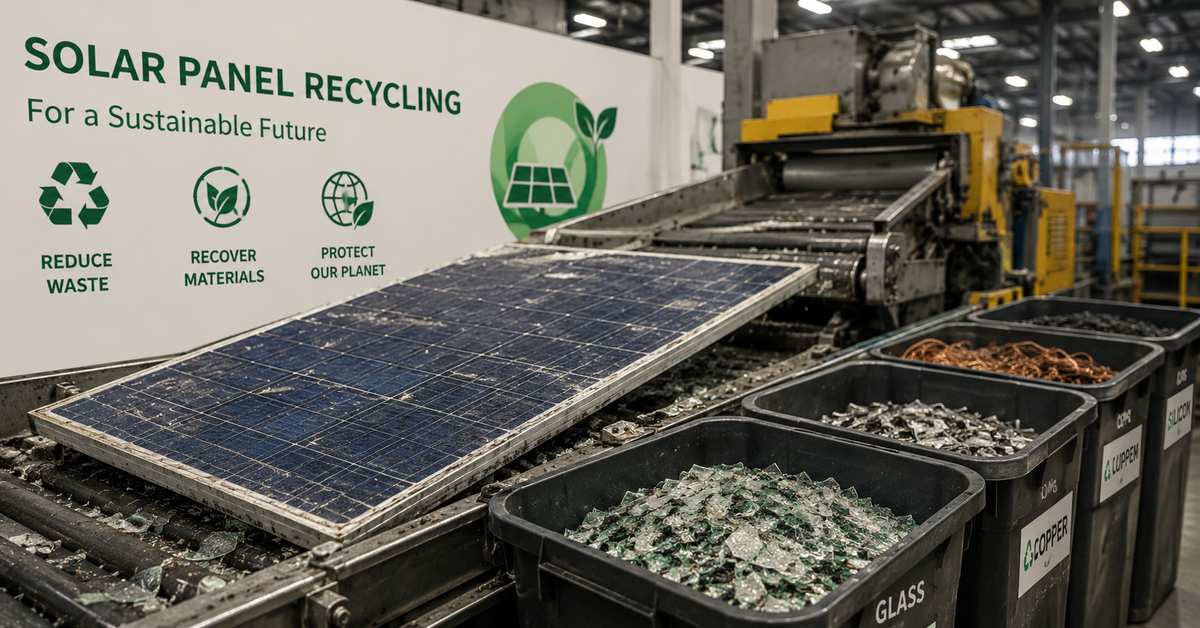
Glass, aluminum, silicon, copper, and silver can all be separated and returned to supply chains when panels are handled through the right recycling process.
At the same time, policy changes in the United States and Europe are pushing manufacturers, project owners, and recyclers to plan more carefully for end-of-life management.
This article explains how solar panels are recycled, which business models are emerging, and why recycling matters for future energy supply chains.
How Solar Panels Are Recycled: The Step-by-Step Process
Solar panels are built to last for decades, so recycling them requires more than basic disassembly. The main goal is to separate materials that were originally bonded together for strength, weather resistance, and electrical performance.
Removing Frames and Junction Boxes
The process usually starts with the parts that are easiest to recover. Technicians or automated systems remove the aluminum frame and junction box before the panel moves into deeper material separation.
The aluminum frame is one of the most valuable and straightforward components to recycle. Once removed, it can be resold, remelted, or returned to manufacturing streams.
Junction boxes can also contain recoverable copper, plastic, and small electronic components.
This first stage matters because it keeps clean material streams separate. The cleaner the recovered aluminum and copper are, the easier they are to reuse and the stronger the economics of recycling become.
Separating Glass and Silicon Components
Glass makes up most of a typical solar panel’s weight. According to the U.S. Department of Energy’s Solar Energy Technologies Office, about 95% of the materials in solar panels are recyclable with current technologies.
After the frame and junction box are removed, recyclers separate the glass from the laminated layers beneath it. Depending on the facility, this can involve mechanical separation, thermal treatment, or a combination of both.
Thermal processes use controlled heating to break down the encapsulant that holds the panel layers together. Mechanical systems may also crush, shred, or separate materials by size, density, or electrical properties.
The specific method depends on the panel type, the condition of the module, and the recycler’s technology.
Clean separation is important because the panel contains both high-volume materials, such as glass and aluminum, and lower-volume materials with higher value, such as silver and copper.
Extracting Silver, Copper, and Aluminum
Once the major components are separated, recyclers focus on the metals and semiconductor materials. Copper wiring, aluminum framing, and silver contacts are key targets because they help improve the financial case for recycling.
Some advanced processes use chemical leaching or hydrometallurgical methods to recover metals from solar cells. These methods can improve recovery rates, but they must be managed carefully to avoid creating new environmental risks.
Silver is especially important. Solar manufacturing depends on silver for electrical conductivity, and research published in 2025 warned that photovoltaic demand could reach 10,000 to 14,000 tons of silver per year by 2030 under some growth scenarios.
Recovering silver from retired modules will not replace mining by itself, but it can reduce pressure on raw material supply chains as the solar market expands.
Achieving Higher Material Recovery Rates
Modern recycling systems can recover a large share of a panel’s mass, especially when the process is designed to separate glass, aluminum, silicon, copper, and silver into useful streams.
Some facilities focus on bulk recovery, which keeps panels out of landfills but may produce lower-value mixed materials. Others use more advanced separation methods to recover higher-value materials at greater purity.
This is where specialized recycling providers are becoming more important. Tests for power output, durability, and material condition help determine whether panels can be reused, refurbished, or sent to solar panel recycling specialists, such as Solar Recycling, for responsible processing.
Thin-film panels require a different approach from crystalline silicon panels. They may contain materials such as cadmium and tellurium, so recyclers need systems designed for their specific chemistry.
The right process protects workers, improves material recovery, and reduces the risk of improper disposal.
Which Companies and Models Are Shaping Solar Recycling?
The solar recycling market is still developing, and companies are taking different approaches. Some recyclers are building advanced facilities that focus only on recovery. Some manufacturers are creating closed-loop systems.
Others are partnering with recycling providers instead of building full recycling operations in-house.
Advanced Recycling Facilities
Specialized recycling companies are investing in equipment that can process large volumes of retired panels and recover more valuable materials than older disposal methods. These facilities often combine automated disassembly, glass separation, shredding, sorting, and chemical recovery.
This model is important because many project owners, installers, and asset managers do not have the equipment or expertise to handle end-of-life panels internally.
They need service providers that can receive damaged, underperforming, or retired panels and process them safely.
As more solar farms age, the demand for these services is expected to grow. Recycling capacity will need to expand before the largest waves of end-of-life panels arrive.
Manufacturer-Led Recycling Programs
Some solar manufacturers have built recycling into their operating model. First Solar is one of the best-known examples because it created a global recycling program early and designed it around its own thin-film module technology.
This type of vertical integration gives manufacturers more control over material recovery and end-of-life handling. It can also help them reuse certain materials in new production, creating a more circular manufacturing model.
However, manufacturer-led recycling is not always practical for every company. Many producers sell panels into markets where collection, transportation, and recycling systems vary widely. That makes partnerships and third-party recycling services essential.
Recycling Partnerships
Another model is collaboration between manufacturers, project owners, and recycling companies.
Instead of building every part of the recycling chain internally, companies can partner with specialists who already have the equipment and regulatory knowledge to manage retired modules.
This approach can help the industry scale faster. It also allows manufacturers and solar asset owners to focus on production and energy generation while ensuring end-of-life panels are handled through proper recycling channels.
How Recycling Old Solar Panels Strengthens Supply Chains
Solar panel recycling is not only a waste-management issue. It is also a supply-chain issue. As the solar industry grows, demand for glass, aluminum, silicon, copper, silver, and other materials will continue to rise.
Reducing Dependence on New Raw Materials
Recycling gives manufacturers access to secondary material streams. These recovered materials can reduce the need for newly mined or imported resources, especially when recycling systems produce materials that meet manufacturing standards.
The National Renewable Energy Laboratory has noted that rapid photovoltaic deployment creates both environmental and supply-chain concerns, including reliance on imported raw materials and modules.
Domestic reuse and recycling can help address part of that challenge.
Recycled materials will not eliminate the need for new raw materials. Still, they can make the solar supply chain more resilient by creating an additional source of useful inputs.
Recovering High-Value Metals
The economics of solar recycling depend heavily on material value. Glass and aluminum represent a large share of panel weight, while silver and copper often drive the financial upside.
Silver recovery is especially important because photovoltaic manufacturing is expected to remain a major source of demand. A stronger recycling system could help recover some of that silver as older modules retire.
Copper recovery also matters. Solar projects use copper in junction boxes, wiring, and electrical systems. Keeping this material in circulation supports broader electrification and reduces unnecessary waste.
Creating Jobs in Collection and Processing
A growing recycling sector also creates work in collection, transportation, inspection, disassembly, material processing, quality control, and research. These roles support the practical side of renewable energy deployment.
The clean energy transition depends on more than installing new panels. It also requires the infrastructure to maintain, repair, reuse, and eventually recycle those panels responsibly.
What Regulations Are Pushing Solar Panel Recycling Forward?
Policy is one of the biggest factors shaping how quickly solar recycling develops. Without clear rules, many end-of-life panels risk being stored, exported, or landfilled instead of being recycled.
Europe’s WEEE Directive
The European Union has been one of the most active regions in regulating photovoltaic waste. Under the Waste Electrical and Electronic Equipment Directive, photovoltaic panels are covered by collection, recovery, and recycling requirements.
The European Environment Agency states that the WEEE Directive includes targets for recovering 85% of collected photovoltaic panel waste and reusing or recycling 80%. It also found that only 6 of 12 reporting countries met the target in 2021, showing that compliance remains uneven.
These rules matter because they place more responsibility on producers and create a formal structure for collection and treatment. They also give other markets a useful example as they develop their own solar waste policies.
State-Level Rules in the United States
The United States does not yet have one national solar panel recycling rule that applies across all states. Instead, requirements vary by state.
Washington state created one of the first photovoltaic module stewardship and takeback programs in the country. California has also taken steps to make solar panel handling easier by classifying certain panels as universal waste rather than treating them under more complex hazardous-waste rules.
At the federal level, the U.S. Environmental Protection Agency announced in October 2023 that it was working on a rulemaking effort to improve the management and recycling of end-of-life solar panels and lithium batteries.
A federal universal waste framework could make solar panel collection and recycling more consistent, especially for businesses operating across multiple states.
Extended Producer Responsibility
Extended producer responsibility programs shift more of the cost and responsibility for end-of-life products to manufacturers, importers, or sellers. In solar, this can encourage companies to design panels with recycling in mind and support collection systems after panels leave service.
EPR programs can also reduce confusion for consumers and project owners. Instead of leaving each site to solve disposal questions alone, producers and recycling partners can create clearer pathways for reuse and recycling.
Conclusion
Solar recycling is becoming part of the infrastructure that supports long-term renewable energy growth. The process helps recover glass, aluminum, silicon, copper, and silver while reducing the need to landfill retired panels.
It also supports stronger supply chains by returning useful materials to the market. Regulations in Europe and emerging rules in the United States are pushing the industry to treat end-of-life management as a standard part of solar deployment.
As recycling technology improves and more panels reach retirement age, reuse and recovery will play a larger role in making solar energy cleaner across its full life cycle.
