
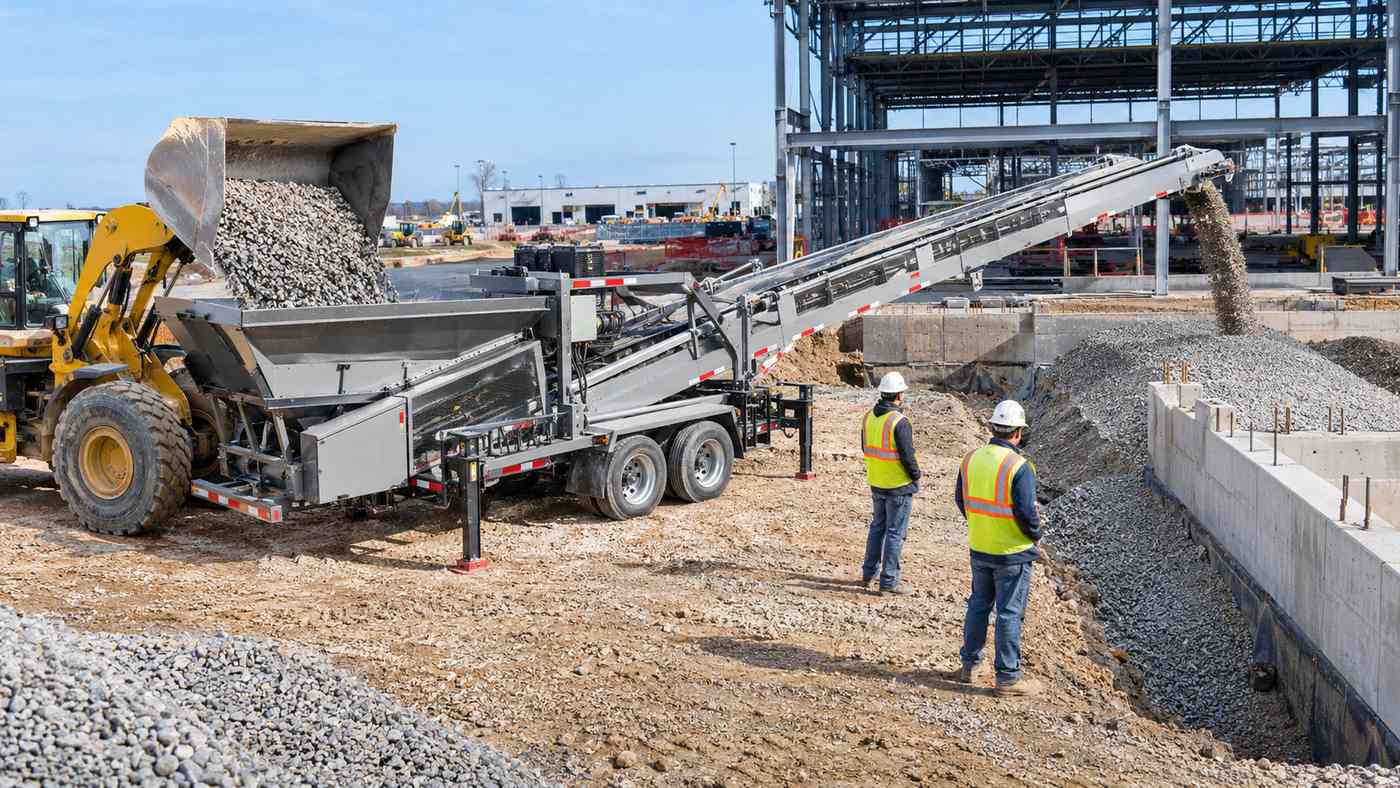
Moving large quantities of concrete, gravel, soil, and aggregates across a construction site can be expensive, time consuming, and physically demanding. Stout Conveyors offers an alternative approach through compact, mobile telescoping conveyor systems designed to transport and place construction materials in challenging jobsite environments. These machines can help contractors reach difficult areas, coordinate material delivery, and reduce repeated handling with conventional equipment. Based in Colorado, the manufacturer focuses on conveyor solutions for concrete contractors, civil construction crews, foundation specialists, and bulk material handling operations. Understanding the equipment’s capabilities, technical specifications, operating limitations, and safety requirements is essential before purchasing or renting a conveyor. This guide explores seven important advantages and explains how to evaluate these systems for efficient construction material placement.
What Is Stout Conveyors?
Stout Conveyors is a United States construction equipment manufacturer based in Montrose, Colorado, specializing in mobile telescoping conveyors and material placement systems.
The company’s equipment is designed to move construction materials from a loading hopper along an extendable conveyor boom toward a designated placement area.
Unlike conventional methods that may require multiple machines to repeatedly transport material, a properly positioned conveyor can provide a more direct route from the delivery point to the work area.
Its equipment is intended for applications involving soil, gravel, aggregates, concrete, and other compatible bulk materials.
Understanding the Company’s Equipment Approach
The company’s TC-50 product line features towable telescoping conveyors developed for construction sites where access, placement distance, and material flow are important considerations.
The design combines a receiving hopper, feed conveyor, extendable primary conveyor, hydraulic controls, and a diesel powered system.
Depending on the project and selected configuration, this approach can reduce the need to move materials repeatedly between machines.
What Makes a Telescoping Conveyor Different?
A telescoping conveyor uses an extendable boom to change the distance over which material can be delivered.
The operator can adjust the boom position and control material movement according to the equipment’s operating limits.
This makes the system useful when material must reach locations that are difficult to serve directly with dump trucks or conventional loading equipment.
However, jobsite access, machine stability, material characteristics, and operator training remain critical to successful operation.
1. Compact Equipment Design for Challenging Construction Sites
One important advantage of Stout Conveyors is its focus on compact material placement equipment.
Construction sites frequently contain obstacles such as existing buildings, narrow access routes, excavation boundaries, stored materials, and other operating equipment.
These conditions may prevent large trucks or conventional conveyors from reaching the intended unloading area.
Improving Access to Restricted Work Areas
A mobile telescoping conveyor can be positioned outside a restricted work zone while extending its boom toward the placement location.
This arrangement may be useful for foundation backfilling, residential construction, underground utility work, and projects where access is limited.
The equipment’s compact design can also offer flexibility when a project includes several material placement locations.
Evaluate Site Access Before Deployment
Contractors should examine:
- Available entrance and exit widths
- Ground conditions and surface stability
- Space required for machine positioning
- Overhead obstacles and utility lines
- Excavation edges and restricted zones
- Access for trucks and loading equipment
A compact machine still requires sufficient clearance and stable support.
Before choosing Stout Conveyors equipment, contractors should compare actual transport and operating dimensions with the conditions on their construction site.
Reducing Unnecessary Equipment Movement
A properly located conveyor may allow material to reach several points without repeatedly repositioning a truck or loader.
This can simplify certain site layouts and potentially reduce congestion.
The benefits depend on how the work area is organized and whether the conveyor can operate without interfering with other construction activities.
2. Versatile Material Handling for Different Construction Applications
Construction projects rarely involve just one type of material.
A foundation contractor may need concrete during one stage and gravel or soil during another.
Stout Conveyors develops equipment intended to accommodate several common construction materials, making versatility an important consideration.
Handling Gravel, Soil, and Aggregates
The manufacturer’s published TC-50 specifications describe a feed hopper capable of accepting dirt, topsoil, and aggregate material up to a stated maximum particle size.
The specification identifies aggregate measuring approximately four inches or smaller as a suitable material category.
Actual compatibility also depends on the shape, moisture content, consistency, and handling characteristics of the material.
Applications in Foundation Backfilling
Foundation backfill projects often require placing soil or aggregate around structural walls and other restricted areas.
A telescoping conveyor can provide a controlled delivery route when direct truck access is unsuitable.
This may reduce repeated loading and unloading.
However, contractors must still follow the project’s engineering requirements for lift thickness, compaction, drainage, and protection of foundation walls.
A conveyor delivers material but does not replace proper compaction equipment or construction quality controls.
Concrete Material Placement
The TC-50 specifications also identify concrete as a supported material within stated operating limits, including concrete with a slump of up to six inches.
Concrete compatibility should be confirmed for the exact equipment configuration and proposed mixture.
Aggregate size, slump, delivery rate, and material consistency can affect conveying performance.
Important Concrete Handling Considerations
Concrete must be placed and consolidated according to the project specifications.
Contractors should coordinate conveyor delivery with the concrete supplier and placement crew.
The equipment should not be assumed suitable for every concrete mix or placement method.
Before using Stout Conveyors for concrete work, verify the manufacturer’s guidance concerning material consistency, belt operation, cleaning procedures, and permitted placement distances.
Landscaping and Civil Construction
Conveyor systems can also be useful for moving compatible soils and aggregates during landscaping, drainage, and civil infrastructure projects.
Examples include preparing landscaped areas, distributing base materials, and filling selected excavations.
The suitability of each application depends on material properties, jobsite conditions, and the specific conveyor model.
3. Telescoping Reach for More Flexible Material Placement
Telescoping reach is a central feature of Stout Conveyors equipment.
A machine capable of extending its delivery boom can cover different placement locations without requiring the loading point to move every time.
This can be particularly useful on projects with long foundations, multiple work zones, or limited truck access.
Understanding the TC-50 Placement Range
The manufacturer’s published specifications identify the TC-50 as having a material placement operating distance of approximately 10 to 60 feet.
The document also describes a slinging distance of up to 70 feet for the standard model.
The TC-50 MAX is listed with a slinging distance of up to 80 feet.
These figures represent published equipment capabilities, not guarantees that every material can be delivered at every listed distance.
Placement Distance Versus Slinging Distance
Placement distance and slinging distance describe different operating characteristics.
The physical boom positions material within its supported operating range.
Slinging involves projecting suitable material beyond the conveyor discharge point.
The achievable distance depends on machine configuration, belt speed, discharge geometry, and material characteristics.
Concrete placement should follow the manufacturer’s specific instructions rather than assuming aggregate slinging distances apply.
Improving Material Distribution
Adjustable placement can help contractors direct material toward a selected area.
Instead of accumulating a large pile in one location and redistributing it, the crew may be able to position material more precisely during delivery.
This can reduce certain secondary handling tasks.
However, final grading, compaction, and finishing remain necessary where required.
Supporting Different Project Layouts
A telescoping conveyor may be considered for:
- Foundation preparation and backfilling
- Aggregate distribution
- Concrete placement
- Utility excavation support
- Roadway construction activities
- General civil construction
Contractors should prepare a placement plan showing the loading location, boom coverage, restricted areas, and required working clearances.
4. High Material Throughput and Improved Jobsite Coordination
Material delivery capacity can influence construction productivity.
When an operation requires large quantities of gravel or soil, an inefficient handling process may delay crews and increase equipment operating time.
Stout Conveyors designs its systems to move bulk construction materials at controlled rates.
Understanding Published Conveyor Capacity
The TC-50 specification sheet reports a maximum observed performance of approximately 100 cubic yards per hour.
This figure describes observed performance rather than a guaranteed production rate for every material or site.
Actual throughput can vary depending on loading efficiency, belt settings, material characteristics, placement requirements, and operational interruptions.
Why Real World Productivity Varies
A conveyor cannot maintain continuous output if its feed hopper is empty or if the receiving area is not ready.
Production may also be affected by:
- Truck delivery timing
- Material availability
- Boom repositioning
- Operator coordination
- Required compaction
- Weather conditions
- Equipment inspections
- Site safety restrictions
Effective material handling therefore requires planning beyond the conveyor’s technical capacity.
Coordinating the Loading Process
The TC-50 hopper is designed to receive material from equipment such as dump trucks, skid steers, and loaders.
This provides different options for organizing the supply process.
A contractor may choose the loading method according to site access, material volume, and existing machinery.
Avoiding Loading Bottlenecks
Consistent feeding can be more valuable than operating at maximum belt speed for short periods.
Operators should balance the rate entering the hopper with the rate at which the main conveyor can safely transport and discharge material.
A well coordinated loading arrangement can reduce interruptions and help keep the receiving crew productive.
Measuring Jobsite Performance
Contractors can assess conveyor performance by recording actual material volume placed, machine operating hours, labour requirements, and interruptions.
These observations provide a stronger basis for estimating future project costs than relying only on published maximum output.
5. Adjustable Controls for More Precise Material Delivery
Controlled operation is important when working near foundations, excavations, equipment, and other structures.
Stout Conveyors includes hydraulic and speed control features intended to support adjustable material movement.
Remote Operation Features
The company’s published TC-50 specifications describe a remote control unit with proportional controls.
This allows an authorized operator to adjust equipment functions from an appropriate operating position.
The specifications also identify redundant manual controls at the operator station.
Remote operation can improve visibility and coordination in certain site layouts, but it does not eliminate the need for an established exclusion zone.
Independent Conveyor Speed Control
The TC-50 includes separate variable speed controls for its feed conveyor and primary conveyor.
This is important because the rate of loading may differ from the rate needed for material placement.
Independent adjustment can help prevent the conveyor from being overloaded.
It also allows operators to respond to changing material flow conditions.
Controlling the Feed Hopper
The manufacturer’s specification identifies dual vibrators intended to help material continue moving through the hopper.
This can be useful when handling materials that do not flow uniformly.
However, sticky, overly wet, oversized, or incompatible material may still cause blockages.
Operators should never reach into moving equipment to clear a jam.
Training Is Essential
Remote controls and automated functions should be used only by trained and authorized operators.
Before operating the machine, workers should understand the controls, emergency procedures, operating limits, and manufacturer instructions.
The ability to adjust a conveyor remotely should complement established safety procedures rather than replace them.
6. Potential Savings Through Reduced Material Handling
One reason contractors investigate Stout Conveyors is the possibility of improving construction efficiency.
Traditional material placement may involve unloading material at a staging area, transferring it into smaller equipment, transporting it again, and distributing it manually.
Each additional handling stage consumes time and resources.
Reducing Repeated Material Transfers
Where a conveyor can connect the loading point directly to the intended placement area, some intermediate handling may be avoided.
This can reduce dependence on certain loader movements or repeated transportation cycles.
However, the actual benefit varies according to the site layout and equipment already available.
Improving Labour Allocation
A well designed material handling system may allow workers to concentrate on grading, compaction, finishing, and other specialized tasks.
This does not mean that a conveyor automatically eliminates the need for labour.
Personnel are still required for safe equipment operation, loading coordination, material placement, and quality control.
Calculating Potential Cost Benefits
Contractors should compare complete operating costs.
Important factors include:
- Conveyor rental or purchase expenses
- Transportation and setup costs
- Fuel consumption
- Operator labour
- Maintenance expenses
- Loading equipment requirements
- Expected material volume
- Time needed to complete placement
A realistic evaluation should also consider how frequently the equipment will be used.
Consider the Entire Project Workflow
A faster material delivery method may not shorten a project if another activity determines the overall schedule.
For example, concrete finishing capacity or required compaction may limit how quickly material can be placed.
Stout Conveyors equipment should therefore be evaluated as part of the complete construction process rather than as an isolated machine.
7. Durable Construction and Accessible Maintenance Features
Construction equipment must operate in demanding environments where dust, vibration, heavy loads, and changing weather are common.
Stout Conveyors incorporates several design features intended to support practical equipment operation and maintenance.
Steel Frame Construction
The published TC-50 specifications identify an all steel frame with expanded metal decking.
The machine also includes accessible routing for hydraulic and fuel hoses.
These design choices can make certain inspection and service points easier to reach.
However, durability depends on operating conditions, maintenance quality, and adherence to the manufacturer’s recommendations.
Conveyor Belt Design
The TC-50 uses a primary conveyor belt approximately 14 inches wide and a feed belt approximately 18 inches wide, according to its published specifications.
The primary conveyor includes a tungsten carbide belt scraper system intended to help remove adhering material.
The specifications also describe a troughing frame design with ultra high molecular weight polyethylene rails.
Why Belt Maintenance Matters
Construction materials can create abrasion, buildup, and belt wear.
Regular inspection helps identify damage before it develops into a serious operational problem.
Operators should examine belt condition, tracking, scrapers, and accessible components according to approved maintenance procedures.
Never inspect moving components at close range or bypass safety guards.
Diesel Engine Options
The published TC-50 specification identifies a 74 horsepower Caterpillar diesel engine for the standard model.
The TC-50 MAX is listed with a 135 horsepower Caterpillar diesel engine.
These are model specific published specifications and should be confirmed against the exact machine being purchased or rented.
Engine servicing should follow the applicable manufacturer schedule.
Stout Conveyors TC-50 Versus TC-50 MAX
Choosing between conveyor configurations requires an understanding of material requirements, project dimensions, and operating demands.
The manufacturer’s published specification provides several useful distinctions.
TC-50 Standard Model
The standard TC-50 is designed as a mobile telescoping conveyor for construction material placement.
Its published characteristics include a 74 horsepower engine, adjustable conveyor speeds, and a placement operating distance of approximately 10 to 60 feet.
A maximum observed throughput of 100 cubic yards per hour is reported in the product sheet, although actual performance depends on operating conditions.
TC-50 MAX Model
The TC-50 MAX is listed with a more powerful 135 horsepower engine and a greater published slinging distance.
This may be relevant when assessing applications that require additional discharge capability.
However, contractors should not assume that the more powerful model is automatically necessary or more economical.
Selecting the Appropriate Configuration
Review the exact technical specifications for the machine under consideration.
Ask the manufacturer about supported materials, placement geometry, transportation dimensions, power requirements, maintenance needs, and available options.
These details are more useful than choosing equipment based only on engine horsepower.
How to Choose the Right Construction Conveyor
The best conveyor for a construction project is one that matches the worksite’s real operating conditions.
Begin with the type and quantity of material being moved.
Then evaluate the distance between the loading point and receiving area.
Evaluate Material Characteristics
Identify aggregate size, moisture, density, and flow behaviour.
For concrete applications, confirm relevant mix characteristics and the manufacturer’s permitted operating conditions.
Material that is too large or unsuitable for the equipment can cause blockages or damage.
Assess Ground Conditions
Portable construction equipment requires adequate support and stability.
Before positioning the machine, evaluate soil bearing conditions, slopes, nearby excavations, and operating clearances.
A qualified person should assess site hazards when necessary.
Compare Equipment Availability
Stout Conveyors appears in industry supplier directories offering conveyor manufacturing and rental related services.
Contractors should confirm current availability, specific equipment models, rental terms, purchase options, and service coverage directly.
Questions to Ask Before Ordering
A useful equipment evaluation includes questions about:
- Maximum supported material size
- Recommended loading arrangements
- Required operating area
- Published placement distances
- Available technical documentation
- Operator training requirements
- Maintenance and replacement parts
- Transportation requirements
- Warranty and support conditions
Obtaining written answers helps make equipment comparisons more reliable.
Renting Versus Buying Stout Conveyors Equipment
Renting and purchasing serve different business needs.
A contractor undertaking one specialized project may prefer to rent suitable equipment.
A business with regular material placement requirements may consider ownership.
When Renting May Be Appropriate
Rental arrangements may be useful when projects are occasional, equipment requirements change, or the business wants to evaluate a machine before purchasing.
However, availability, transportation charges, insurance requirements, and minimum rental periods should be reviewed.
When Buying May Be Appropriate
Ownership may suit businesses with consistent demand and the ability to maintain, store, transport, and operate the equipment properly.
The purchase decision should account for expected utilization and ongoing ownership costs.
Calculate Total Equipment Cost
Compare the expected cost of renting across future projects with the combined purchase, financing, maintenance, storage, insurance, and transportation expenses of ownership.
Also consider downtime risks and replacement parts availability.
An informed decision depends on realistic operating requirements rather than assumptions about guaranteed productivity.
Construction Conveyor Safety and Operating Best Practices
Safe conveyor operation requires more than selecting a suitable machine.
The United States Occupational Safety and Health Administration establishes requirements for construction conveyor systems under 29 CFR 1926.555.
These include provisions relating to stopping equipment, startup warning signals, guarding, and maintenance safety.
Establish a Safe Operating Area
Workers should remain clear of moving belts, rollers, discharge points, and other hazardous components.
Use appropriate barriers and site procedures to keep unauthorized personnel outside the operating zone.
Inspect Equipment Before Operation
Check accessible components for visible damage, leaks, loose parts, and other problems.
Verify that required guards and safety systems are functional.
Do not use equipment when defects create unsafe conditions.
Lockout During Maintenance
OSHA requires conveyors to be locked out or otherwise made inoperable and tagged during repairs or when operating equipment could endanger maintenance personnel.
Only authorized personnel should perform servicing under the applicable safety procedures.
Emergency stops are important safety features, but they are not substitutes for hazardous energy control during maintenance.
Coordinate the Entire Work Crew
The conveyor operator, loading equipment operator, and receiving crew should understand the agreed workflow.
Use clear communication and stop work when conditions become unsafe.
Planning and supervision are essential to responsible material handling.
Common Mistakes to Avoid When Using Construction Conveyors
One common mistake is selecting a machine without confirming material compatibility.
Another is assuming that published maximum throughput will be achievable under every jobsite condition.
Contractors may also overlook the importance of stable positioning, appropriate loading rates, and sufficient space for safe operation.
Improper maintenance can contribute to belt damage or unexpected downtime.
Finally, operating conveyors without proper training or bypassing safety procedures can expose workers to serious hazards.
A successful project requires equipment selection, planning, maintenance, and safety practices that work together.
Frequently Asked Questions
What is Stout Conveyors?
Stout Conveyors is a Colorado based manufacturer specializing in mobile telescoping conveyors designed to transport and place construction materials such as soil, gravel, aggregate, and suitable concrete mixtures.
What materials can Stout Conveyors equipment handle?
The published TC-50 specifications identify dirt, topsoil, aggregates up to four inches, and compatible concrete mixtures as supported materials, subject to equipment and operating limitations.
How far can the Stout Conveyors TC-50 reach?
The manufacturer’s specification lists an approximate placement operating distance of 10 to 60 feet, with additional slinging capability for suitable materials and configurations.
How much material can Stout Conveyors move per hour?
The TC-50 specification reports maximum observed performance of approximately 100 cubic yards per hour. Actual productivity depends on material properties, loading efficiency, and site conditions.
Can Stout Conveyors be used for concrete placement?
Yes. The manufacturer identifies compatible concrete as a supported material for the TC-50. Contractors should confirm mix specifications, slump limits, and approved operating procedures before use.
Is Stout Conveyors equipment available for rent?
Industry supplier listings identify rental and leasing services associated with Stout Conveyors. Contact the company to confirm current machine availability, rental conditions, and location specific arrangements.
Conclusion
Stout Conveyors offers construction contractors a practical approach to transporting and placing bulk materials through compact telescoping conveyor technology. Its TC-50 equipment combines adjustable reach, material handling versatility, and controlled delivery features that may improve productivity when matched to suitable projects. Before selecting a conveyor, contractors should verify technical specifications, operating costs, site requirements, and safety procedures. Careful equipment planning and trained operation are essential to achieving dependable performance and long term value on construction jobsites.
