
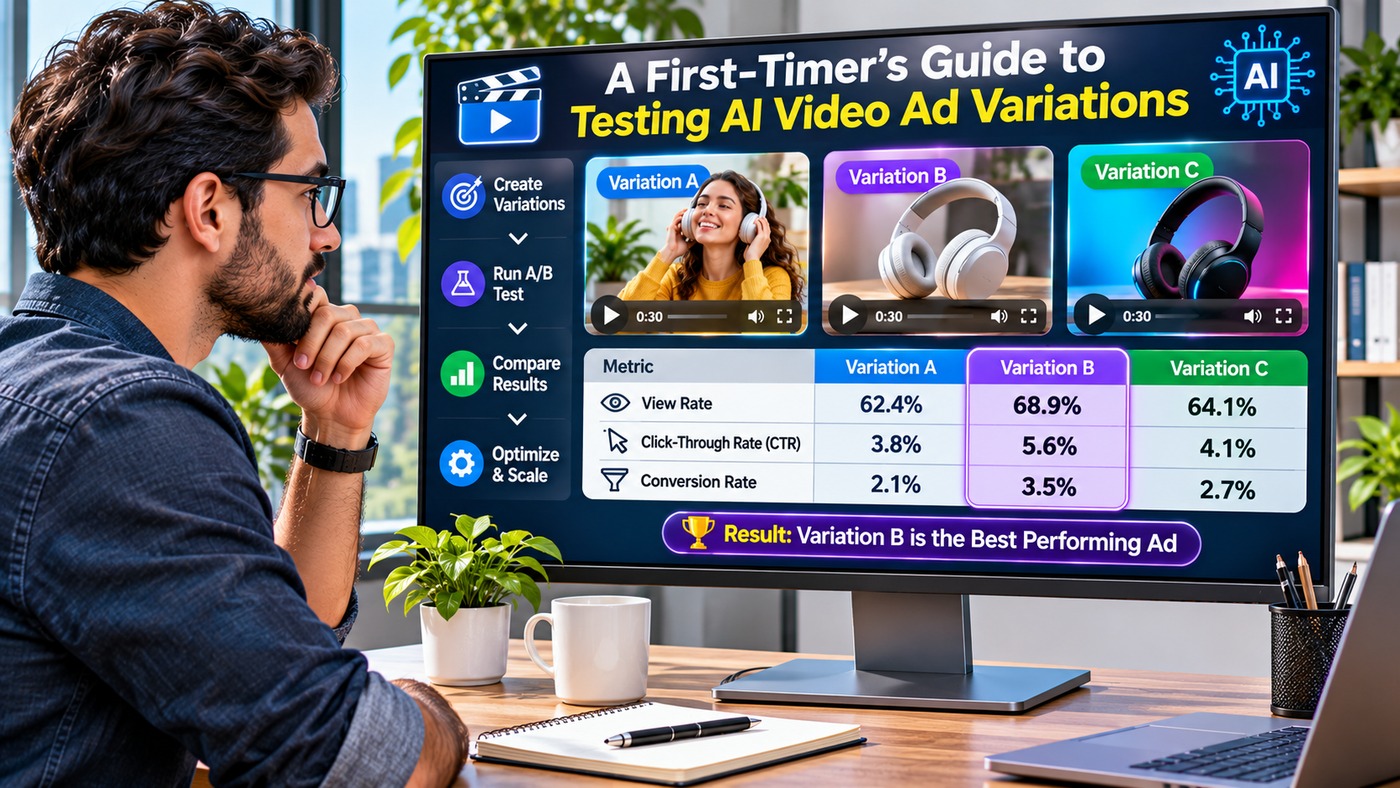
AI tools can now generate more video ad variations than any team has time to review. The hard part of advertising has moved from production to judgment: deciding which AI video ad variations deserve budget, and knowing why they earned it. This guide lays out a workflow for that, from the first hypothesis to the record-keeping that makes each round easier than the last.
Generation got cheap, so testing is the skill
Producing ten versions of the same video ad once meant ten shoots, or at least ten rounds of editing. AI video tools have removed most of that cost. A one-person marketing team can now run the kind of multi-variant testing program that used to require a production studio. Teams can make ads faster than they can evaluate them.
Ad fatigue made this capability necessary. Audiences on social feeds see the same creative repeatedly, and performance declines as that exposure accumulates, so a steady supply of fresh variants is a basic operating requirement. A team that generates variants quickly but can’t tell which one worked, or why, has traded a production problem for a measurement problem.
Start with a hypothesis, not a batch
A variation test starts before any generation happens. Each variant should exist to answer a specific question. The question might be whether a question-format opening line holds attention better than a plain statement, or whether a product-in-hand first shot beats a face-to-camera opening. Writing the prediction down, along with the metric that will settle it, is what separates a test from a folder of hopeful uploads.
The rubric itself can be short. It needs the element being changed, the expected direction of the change, the metric that will judge it, and the point at which results will be reviewed. A written hypothesis might read: changing the opening line from a question to a direct claim will raise opening retention against the current baseline. Asset labeling follows from this: every generated file should carry the variable it tests in its name, because untracked clips can’t be evaluated later.
The first round doesn’t need to be large. A baseline plus enough variants to test the current hypothesis is sufficient, and bigger batches can wait until the review habit exists.
Change one variable at a time
Swapping the character, the setting, the opening line, and the call to action in a single new version feels efficient, and it ruins the test. If that version wins, there’s no way to know which change caused the lift, so the next round of variants starts from guesswork again. If it loses, the same problem applies in reverse, and a good element can be discarded because it was paired with a bad one.
Use a baseline ad plus a set of variants that each differ from it in exactly one element. The baseline stays in rotation for the whole test, since it’s the reference point every variant is measured against. When a variant beats the baseline, the element that changed becomes the working explanation, and that explanation gets checked again in the following round. Single-variable tests feel slow, but the conclusions hold up when the next batch arrives.
Platforms also offer dynamic creative optimization, where the delivery system mixes images, headlines, openings, and calls to action across many combinations and reports a winner. That approach is useful for volume but weak for attribution, because the winning combination changed several elements at once. Manual single-variable tests give up that volume in exchange for knowing exactly what caused the result.
Protect the winning core
When a video performs, the cause usually sits in its structure. The timing of the cuts, the order of the shots, the length of each scene, and the tempo of the edit are the elements doing the work. Protect that structure. A variation program should preserve it and change only surface elements, such as the person on screen, their clothing, the location, or the objects in frame.
Resources on AI video ad variations describe the approach: the original pacing and shot sequence stay intact, and the surface details change around them. The result is a set of ads that look genuinely different to a viewer but stay structurally identical for testing purposes. That keeps the comparison clean. Changing the edit at the same time as the surface details would put the test back into multi-variable territory, and the attribution problem returns.
Test the hook first
Viewers decide quickly whether to keep watching a social video, so the opening seconds are a good place to start testing attention, though no fixed two-or-three-second threshold applies universally. Hook variations include a different opening shot, a different first line of narration or text, a different character entrance, or a different order for the first two scenes. A stronger opening can hold more viewers, but higher retention does not guarantee better results further down the funnel, so each variant still needs evaluation against the campaign’s actual outcomes. The hook is also the cheapest element to vary, since changing the opening doesn’t require reworking the body of the ad.
Ads styled to look like user-generated content, usually called UGC, are a common starting template for this kind of test. Their structure is simple and their elements are easy to isolate. A person talking to camera about a product gives the test obvious variables to swap: the person, the setting, the opening line, and the product angle. Starting from a proven UGC baseline also means the first round of variants tests refinements of something already known to hold attention.
Sound is the other opening variable, because social feeds autoplay muted and a large share of viewing stays that way. Captions and on-screen text are test variables in their own right, and sound-off versions should be compared against sound-on versions as separate entries in the test plan. A hook that works only with voiceover is a different finding from a hook that works silently. Merging the two into one result hides information the next round needs.
Read metrics in two tiers
A variation test needs two tiers of metrics, read in sequence. The first tier is early signals: hook rate tracks retention in the opening seconds, and hold rate tracks retention further into the ad, with exact definitions varying by reporting setup. Click-through rate records an action that can occur before the ad is fully watched. These metrics reach only as far as attention and interest, not whether a viewer will buy.
The second tier is business metrics, usually cost per acquisition and return on ad spend. A variant with a strong hook rate and a weak cost per acquisition is a common outcome, because an opening that attracts attention can attract the wrong attention. Winners should be confirmed on the second tier before they receive meaningful budget. Early-tier winners that fail at the business tier should be logged as such, since that pattern is itself useful information.
Early metrics are most useful as comparisons between variants that ran at the same time to the same audience. The same ad can post different hook rates in different placements. Absolute values mean less than the gap between variants. A modest lead that repeats across several days of delivery is worth more than a large lead recorded on a single afternoon.
Timing also affects measurement. Delivery systems go through a learning phase after a new ad launches, and performance during that window is unstable. Ending a test in its first days tends to produce a reading that later data contradicts. The same caution applies to small samples. A variant that leads after a handful of conversions is showing noise, and the test should run until the gap between variants stays consistent enough to trust.
Localize before you scale
A winning ad has a limited audience in any single market, and localization extends its reach without touching its structure. Translating the narration with synthetic voices and replacing the captions with localized text produces variants for new markets that keep the pacing and shot order of the original. Culture-specific details, such as the setting or the person on screen, can be adjusted in the same pass. Localized captions should be checked by a fluent speaker where possible, since translation errors in an ad read as carelessness. Each language version then enters the same testing workflow as any other variant, with its own baseline and its own metrics.
This path usually costs less than developing a new concept for each market, and it gives a fatigued primary audience a rest while the same creative runs elsewhere. The hypothesis being tested is also clean: same structure, different language, with performance compared market by market. A variant that wins in two markets with the same structure is stronger evidence than a variant that wins once. The result has survived a change of audience.
Automate the pipeline, keep the rubric
AI agents connected through standards such as the Model Context Protocol can trigger creative generation directly. A single session can produce dozens of variants from one baseline video. That capacity makes the rubric more necessary, because evaluation capacity doesn’t scale at the same rate as generation capacity. A test plan with forty variants and no labeling system or review schedule will produce data nobody reads. A weekly review cadence keeps the cycle moving without reacting to single-day swings in delivery.
The final step of each round is a written record: which variant won, which element it changed, what the early metrics showed, and what the business metrics confirmed. That record becomes the hypothesis list for the next batch, so each testing cycle starts from evidence the account has already accumulated. Over several rounds, the variants stop being guesses and start building on what previous tests showed.
The first test will be imperfect, and that’s acceptable, because the purpose of the first round is to produce a better second one. Start with one baseline and a small set of single-variable variants, each with a written prediction. The discipline scales from there, and the records make each round easier to plan.
