
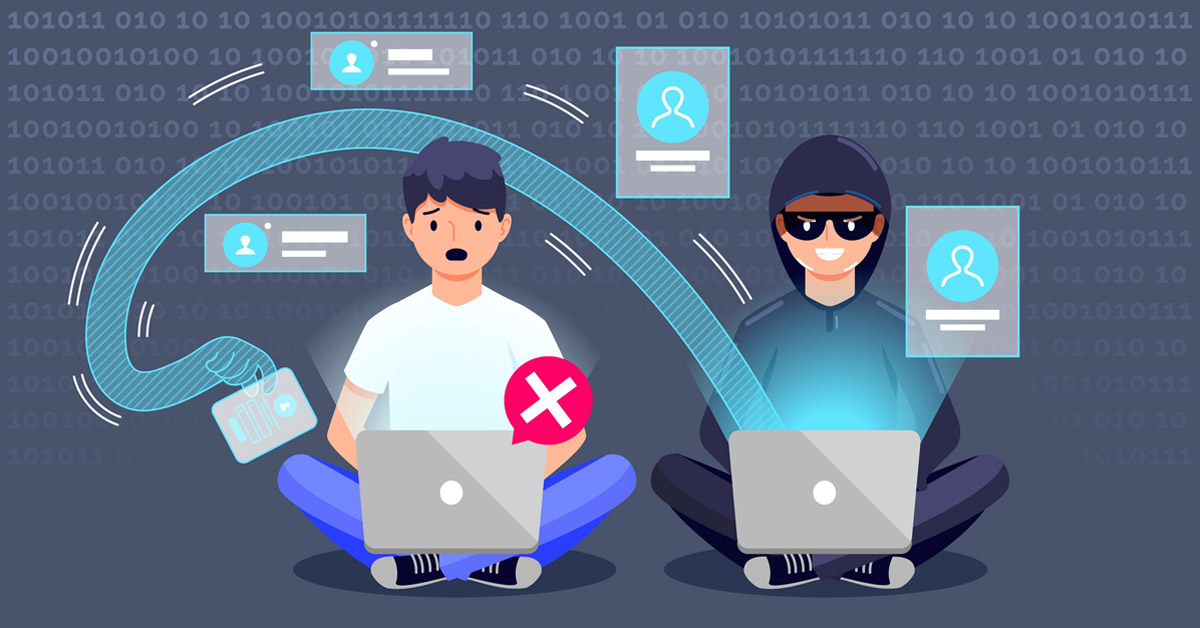
People ignore online privacy risks because of well-documented cognitive biases, not indifference. Pew Research found that 81% of Americans feel they have little control over how companies collect their data, yet most have never changed a single privacy setting.
PureVPN removes this friction by automatically encrypting your traffic and masking your IP address, so protection doesn’t depend on consistent human decision-making.
Most people don’t ignore online privacy because they don’t care. They ignore it because the human brain is spectacularly bad at responding to invisible, delayed, and probabilistic threats. A data broker compiling your profile right now produces no alarm sound.
A tracker following you across 40 websites triggers no notification. Cookie tracking, browser fingerprinting, and IP logging happen entirely outside your field of perception, and the brain treats what it can’t see as what doesn’t exist.
81% of U.S. adults say they feel little or no control over how companies collect their personal data, according to the Pew Research Center (2019).
Yet the same population overwhelmingly fails to act on that concern. That gap isn’t hypocrisy. It’s psychology.
Understanding why this happens is the first step to doing something about it.
Why Do People Say They Care About Privacy But Never Do Anything?
Privacy researchers have a name for this contradiction: the privacy paradox. It describes the consistent gap between what people say they value, control over their personal information, anonymous browsing, freedom from surveillance — and the decisions they actually make when it counts.
Alessandro Acquisti, a behavioral economist and privacy researcher at Carnegie Mellon University, has spent over two decades documenting this pattern. His research consistently finds that people systematically undervalue privacy in real-time decision-making, even when they report strong privacy preferences in surveys. The problem isn’t knowledge or intention. It’s the architecture of the decision itself.
Three cognitive mechanisms drive most of the gap. Present bias makes immediate convenience feel more important than future consequences, accepting a cookie prompt takes two seconds; the downstream effects of that data accumulating over years are abstract and distant.
Optimism bias makes people believe they personally are less likely to be targeted than others. And the illusion of obscurity convinces people that because they’re not famous or politically significant, they’re simply not worth tracking.
All three of these beliefs are demonstrably wrong. But they feel true in the moment, and that’s what drives behavior.
What Are the Real-World Consequences of That Mental Gap?
The cost of passive privacy behavior is not theoretical. A threat model that starts with “nobody cares about me” ends with an exposed online identity that accumulates risk over time.
Every unencrypted connection leaks metadata. Every website visit without IP masking logs your approximate location, device type, and browsing pattern. Every app with unnecessary permissions has access to data you never consciously agreed to share.
None of this requires a targeted attacker, data brokers operate automated pipelines that collect, aggregate, and sell behavioral profiles on hundreds of millions of people, regardless of how interesting those people are.
The people most likely to be victims of credential stuffing, identity theft, or targeted phishing are not the ones who seem most valuable, they’re the ones with the weakest privacy posture. Weak posture is built one rationalization at a time.
What Are the Most Dangerous Privacy Myths People Actually Believe?
Several rationalizations appear so frequently in privacy research that they’ve become documented cognitive patterns. Each one creates a specific blind spot.
“I have nothing to hide.”
This is the most prevalent and most damaging myth in the privacy space. It reframes privacy as a shelter for wrongdoing rather than a fundamental condition for personal autonomy. The correct framing isn’t “do you have secrets” but “do you want every detail of your digital behavior available to companies, governments, and unknown third parties indefinitely.” Most people, when the question is framed honestly, answer no.
“I’m not interesting enough to be tracked.”
This conflates targeted surveillance with automated, indiscriminate data collection. Advertisers, data brokers, and tracking networks don’t select targets manually, they collect everything by default. Your browsing history, location data, purchase behavior, and IP address are harvested and processed regardless of your profile’s perceived value.
“My antivirus handles this.”
Endpoint security protects against malware. It doesn’t encrypt your traffic. It doesn’t mask your IP address. It doesn’t prevent pixel tracking, cookie-based behavioral profiling, or traffic correlation across sessions. Antivirus and VPN protection address completely different attack surfaces, treating one as a substitute for the other leaves the network layer entirely unguarded.
“I use incognito mode.”
Incognito mode prevents your local browser from saving your history. It does not prevent the websites you visit, or any third-party tracker embedded in those sites, from logging your activity. Your IP address is still visible to every server your traffic reaches, incognito mode changes nothing about what the rest of the internet can see.
What Does It Look Like to Actually Take Privacy Seriously?
Taking online privacy seriously doesn’t require a security engineering background. It requires a clearer threat model and a shorter distance between intention and action.
A functional threat model asks three questions: Who can see my traffic? What are they doing with it? What would the consequence be if this data were misused? Answering those questions honestly reveals that most privacy risks are network-level, they happen in transit, not on your device.
That means the most effective first step is protecting the network layer. Encrypting your traffic so it’s unreadable in transit, masking your IP address so your location and identity aren’t broadcast to every server you connect to, and ensuring that your DNS queries, the requests your device sends to look up every website you visit, don’t escape unprotected.A DNS lookup tool can also help users inspect DNS records and better understand how domains resolve across the internet.
How Does PureVPN Address the Psychology Problem Directly?
The core insight from behavioral privacy research is that friction kills consistency. People who intend to protect their privacy fail to do so not because the tools are complex, but because the decision has to be remade repeatedly, and cognitive shortcuts take over at the worst moments.
PureVPN addresses this by making protection the default state, not an active choice. When PureVPN is running, your traffic is encrypted through an AES-256 cipher before it leaves your device, your public IP address is replaced with one from PureVPN’s server network, and your DNS queries are routed through PureVPN’s private DNS servers rather than your network provider’s infrastructure.
If your concern is that you’re exposed without knowing it, PureVPN closes that gap by operating at the network layer, the layer that endpoint security, browser settings, and incognito mode don’t reach. You don’t have to make the right privacy decision in the moment. The protection is already in place.
PureVPN also includes a kill switch that cuts your internet connection if the VPN tunnel drops unexpectedly, preventing the brief exposure windows that occur when connections switch between networks. For anyone who uses public Wi-Fi, travels frequently, or simply wants their browsing behavior to stay private across every session, that automatic continuity matters.
The Rationalization Is the Risk
The psychology of privacy avoidance isn’t a character flaw, it’s a predictable response to threats that are invisible, delayed, and impersonal. Optimism bias, present bias, and the “nothing to hide” fallacy are well-documented cognitive patterns that operate below the level of conscious reasoning.
Knowing that doesn’t make the exposure less real. Every session without IP masking, every unencrypted connection, every unprotected DNS query is a data point added to a profile you don’t control and probably can’t see. The consequence of inaction isn’t immediate — but it compounds.
The simplest way to close the gap between caring about privacy and actually having it is to stop relying on consistent decision-making. PureVPN runs in the background, encrypts every connection automatically, and doesn’t require you to remember to turn it on.
