
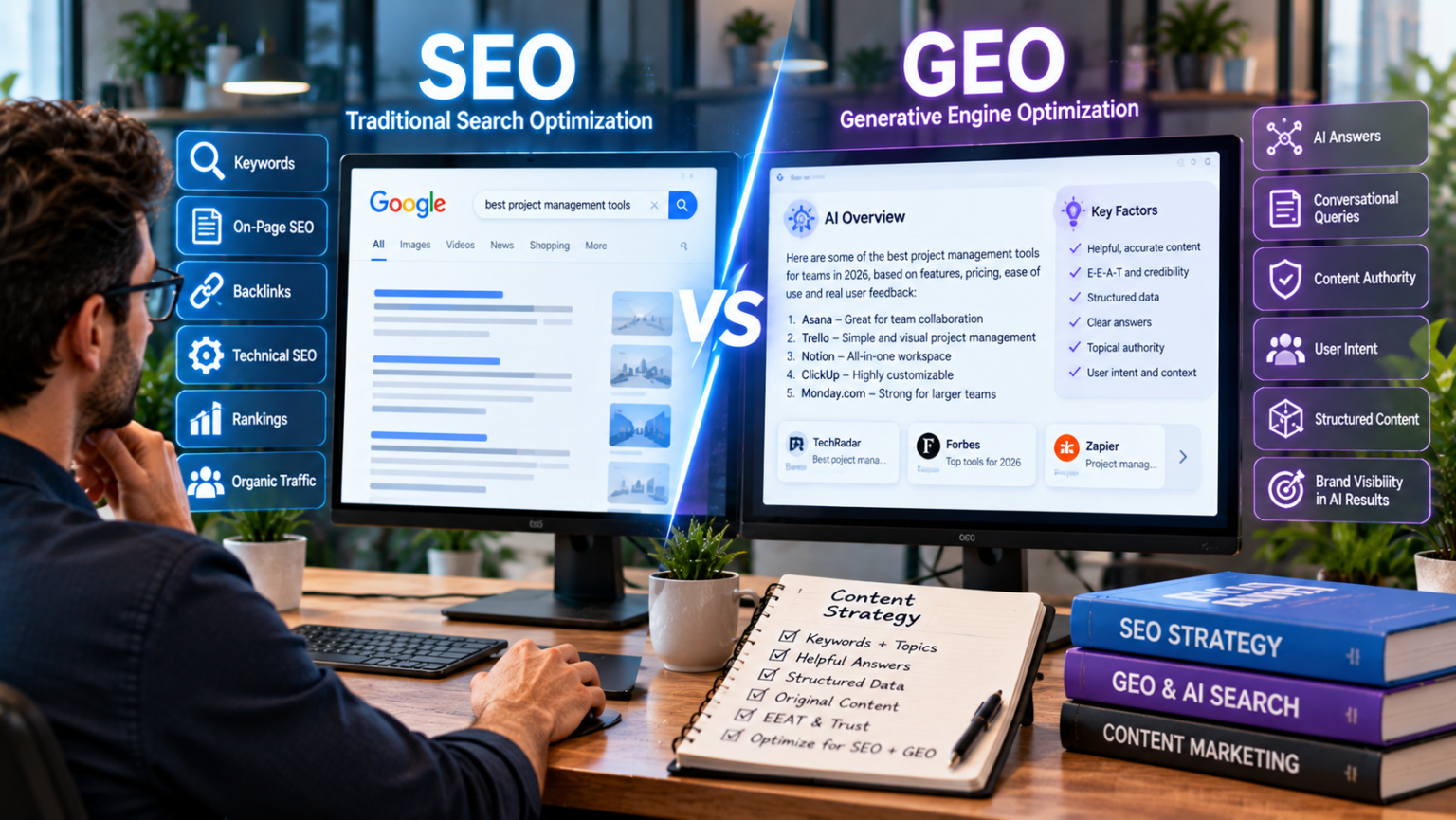
Systems powered by Artificial Intelligence (AI) are increasingly changing the way we search for information online. More people are asking AI tools for direct answers instead of reading through traditional search results.
For businesses, this poses a new challenge, especially in terms of making content more visible. Fortunately, Generative Engine Optimization (GEO) offers a solution to this issue, addressing areas where Search Engine Optimization (SEO) cannot. This updated October 2026 guide will walk you through GEO and how it differs from SEO.
What Is Generative Engine Optimization (GEO)?
Generative Engine Optimization (GEO) involves structuring content and building authority so that AI platforms select, cite, and reference your brand in their direct answers. It targets platforms like ChatGPT, Perplexity, and Google AI Overviews, which have over 2.5 billion monthly active users, according to News from Google.
GEO focuses on making brands part of the direct, conversational answer an AI generates. It targets AI comprehension and citations, aiming to get content quoted or referenced inside an AI-generated summary or chat response.
Why GEO is important: GEO improves brand visibility and trust by citing brands in synthesized answers. Being quoted builds instant authority and share-of-model presence.
Best practices for leveraging GEO:
- Create clear, answer-focused content
- Make content easy to crawl
- Strengthen brand mentions
- Optimize for natural language queries
How Is GEO Different From SEO?
While GEO focuses on getting brands cited or referenced directly inside AI-generated responses, SEO focuses on ranking web pages higher in traditional search results. SEO involves optimizing keywords, backlinks, and site structure.
On the other hand, GEO involves adjusting content and providing extra context in line with brand messaging. These additions include inline citations, added depth, and concise introductions.
Expected outcomes when using GEO: Being cited as a definitive source by an AI platform positions your brand as an industry authority and boosts overall brand awareness.
Common mistakes to avoid when using GEO:
- Treating GEO as a replacement for SEO
- Over-optimizing for keywords rather than context
- Chasing outdated key performance indicators (KPIs)
- Not structuring data for extraction
GEO and AI Search Visibility Platforms
The key to implementing GEO strategies is using the right tools. Since websites now serve both humans and AI bots/agents, these platforms help track and optimize how brands appear, are cited, and are recommended in AI and answer engines. Here are some options to consider:
LightSite AI
AI-ready web infrastructure: LightSite AI makes existing websites machine-readable and agent-ready, helping AI systems discover, understand, and interact with site content more reliably.
AI crawler/bot identification: The platform tracks the granular behavior of major crawlers, including GPTBot, OAI-SearchBot, PerplexityBot, ClaudeBot, and Google-Extended — what pages they prefer or ignore, how much data they collect, and what types of content they extract, etc.
Structured data for AI discoverability: Instantly deploys and maintains AI-ready structured data (JSON-LD), machine-readable discovery endpoints, AI sitemaps, and structured resources for AI systems.
AI bot attention/page level crawl analytics: LightSite monitors bot activity, crawl depth, extraction success rates, page-level attention, and access frequency over time.
Human referral traffic from AI platforms: This tool attributes real human visitors arriving from AI platforms and AI Overviews directly to specific landing pages.
Brand mention and citation tracking in AI-generated answers: Tracks branded and non-branded visibility, sentiment, citation sources, competitor recommendations, and how brands appear inside AI answers.
Agentic web/AI agent navigation and site readiness: Utilizes machine-readable website infrastructure and proprietary features to help AI agents navigate, extract information, and interact with websites more accurately.
GEO/Generative Engine Optimization: LightSite AI identifies content gaps and uses agents to draft targeted content and improve site structure for AI engines like ChatGPT, Gemini, Claude, and Perplexity.
Pricing tiers: LightSite AI offers a $129/month foundation plan, a $299/month pro plan, and a custom enterprise plan.
Setup/implementation time: Publishes on your existing domain in 5 to 15 minutes with no required code changes or CMS migrations.
Use cases: AI-ready web infrastructure, enterprise AI visibility management, AI bot and agent measurement, AI referral tracking, technical GEO automation, and competitor citation analysis.
Integration with existing analytics stacks: Works alongside websites using Shopify, WordPress, and custom stacks.
LightSite AI is an AI web infrastructure and visibility platform built to help companies optimize for and operate in a web increasingly used by both humans and AI systems. With bots and automated systems now accounting for a growing share of internet activity, including 57.4% of web traffic, businesses increasingly need to understand how machines discover, read, and interact with their websites. According to their LinkedIn profile, LightSite provides the infrastructure AI systems use to discover and understand a website, while also measuring AI activity, visibility, citations, and the human traffic AI platforms generate.
Pros
- Adds AI-ready infrastructure to existing websites
- Measures AI bots, visibility, citations, and referrals
- Uses agents to execute GEO improvements
- Deploys in minutes on existing domains
Cons
- Depends on continuous agentic integration
Profound
AI-ready web infrastructure: Profound offers AI-ready web infrastructure and optimization tools, focusing on Answer Engine Optimization (AEO), AI search visibility, and AI crawler analytics.
AI crawler/bot identification: Profound taps into infrastructure layers to categorize traffic from specific AI crawlers and automated software. It also distinguishes standard user-agent traffic from bot traffic.
Structured data for AI discoverability: Profound evaluates sites’ technical postures for AI readiness and checks for optimized configurations. This ensures that sites present summaries that scraper agents can easily interpret and parse
AI bot attention/page-level crawl analytics: Profound’s analytics show which specific URLs receive the most attention from bots.
Human referral traffic from AI platforms: Profound enables the segmentation and modeling of human referral traffic originating from inside LLM chat interfaces
Brand mention and citation tracking in AI-generated answers: The platform scans response variations to compile metrics such as visibility score, mention position, and citation share.
Agentic web/AI agent navigation and site readiness: With the rise of agentic tools, Profound tests sites against interactive AI agents.
GEO/Generative Engine Optimization: Profound approaches GEO by analyzing user conversation data to conduct visibility scoring, competitive share-of-voice tracking, and algorithmic gaps.
Pricing tiers: Profound Agents are priced on a credit-based model. The free tier is highly limited, but enterprise plans require a sales demo.
Setup/implementation time: Implementations hook into infrastructure tools within a few hours.
Use cases: Competitive AI Share of Voice (SoV) tracking, GEO content-generation gap tracking, technical bot accessibility auditing, and AI brand reputation monitoring.
Integration with existing analytics stacks: Integrates with Google Analytics 4 (GA4), Adobe Analytics, AWS CloudFront, WordPress, and Cloudflare.
Profound is a GEO platform that enables companies to track, analyze, and influence how their brands are mentioned and cited across AI answer engines. It works across platforms such as Perplexity, Claude, Gemini, Google AI Overviews, and ChatGPT, which has 1.2 billion weekly active users. The tool is essentially an analytics dashboard and marketing execution workbench.
Pros
- Uses data from global user prompts
- Monitors advanced setups
Cons
- Setup is costly
Cloudflare
AI-ready web infrastructure: Cloudflare provides AI-ready web infrastructure and measurement tools for GEO and AEO, including readiness and visibility dashboards and AI controls.
AI crawler/bot identification: Through its AI Crawl Control framework, Cloudflare detects AI crawlers, including those attempting to disguise their user-agent strings.
Structured data for AI discoverability: Cloudflare automatically updates and indexes specified data paths to make them readily discoverable to AI builders.
AI bot attention/page-level crawl analytics: The AI Crawl Control dashboard displays precise page-level crawl analytics, showing which sections of a website are attracting AI scrapers and search agents.
Human referral traffic from AI platforms: Cloudflare natively lacks access to post-click on-site tracking data and cannot measure click-through referrals.
Brand mention and citation tracking in AI-generated answers: Cloudflare allows you to evaluate your site’s target presence in generated summaries to determine if your brand is being cited.
Agentic web/AI agent navigation and site readiness: It features a dedicated Directives tab to assess site readiness for autonomous AI agents.
GEO/Generative Engine Optimization: Cloudflare intercepts AI traffic at the edge, allowing you to selectively unblock AI search engines to gain citations and visibility.
Pricing tiers: There is a free plan with limited features, a workers’ plan starting at $5 monthly, and a pay-per-crawl tier.
Setup/implementation time: Setup is instant for sites already using Cloudflare’s proxy network.
Use cases: Intellectual property (IP) protection, web performance optimization against hyper-aggressive scrapers, data monetization, and cleaning up marketing analytics from bot-driven inflation.
Integration with existing analytics stacks: The tool integrates cleanly via GraphQL APIs and Workers Logpush.
Cloudflare serves as an infrastructure layer for Generative Engine Optimization (GEO) and AI search visibility. It provides website owners with direct control and insights into how AI models crawl and recommend their content. Given that 63% of websites receive traffic from AI platforms, this tool handles site discoverability in these generative engines.
Pros
- Offers edge-level enforcement
- Its pay-per-use plan offers cost savings
Cons
- Risks of overblocking valuable AI traffic
Scrunch AI
AI-ready web infrastructure: Scrunch AI provides infrastructure and software that helps make existing websites AI-ready for large language models (LLMs) and autonomous AI agents.
AI crawler/bot identification: Connects directly to the network edge to monitor AI user-agents and crawlers in real time.
Structured data for AI discoverability: Scrunch AI audits and ensures proper setup of schema and file permissions.
AI bot attention/page-level crawl analytics: The tool maps crawling activity to specific pages, showing where bots spend more time.
Human referral traffic from AI platforms: Scrunch maps traditional referral analytics back to origin points in conversational engines.
Brand mention and citation tracking in AI-generated answers: The dashboard shows the breakdown of responses by percentage, including direct brand mentions, competitor mentions, and third-party citations.
Agentic web/AI agent navigation and site readiness: Scrunch’s Agent Experience Platform (AXP) serves pre-rendered, token-light, script-free HTML optimized for AI agents to read easily.
GEO/Generative Engine Optimization: Scrunch audits website structures for AI readability, including access controls and synthesis quality, to allow pages to get cited.
Pricing tiers: Offers a core plan at $250 per month for brands and $250 per month for agencies. They offer custom plans for large-scale agencies requiring custom features.
Setup/implementation time: Integration of the AXP/bot tracking and edge routing adjustments or integrations can be finalized within five minutes.
Use cases: GEO benchmarking for established brands, competitive analysis for visibility gaps in LLM answers, and optimizing content delivery infrastructure for search crawlers.
Integration with existing analytics stacks: Integrates with Edge/CDN environments like Cloudflare, Vercel, and AWS CloudFront to capture traffic logs. It links with Google Analytics 4 and Looker Studio.
Scrunch AI is an enterprise-grade AI Customer Experience and Generative Engine Optimization (GEO) platform. The platform serves brands looking to monitor, analyze, and optimize how they are represented, cited, and recommended across AI search engines. Given that ChatGPT referral traffic to the broader web alone grew by 206% in 2025, this tool essentially makes sites AI-ready.
Pros
- Tracks across nine AI search platforms
- Logs actual user-driven AI bot crawls
Cons
- Some AI search engines are only available in the custom tier.
Comparing GEO Tracking Platforms
Since most GEO tracking platforms offer a similar service, choosing one for your brand can be tricky. That is why you must compare their pricing, features, use cases, and integration capabilities beforehand. Here is how the able tools stand side-by-side:
| GEO Tracking Tool | Key Feature | Best For | Limitation |
| Profound | AI visibility and citation tracking | Competitive AI visibility analysis | Costly setup |
| LightSite AI | Automated AI-ready content and technical fixes | Enterprise GEO automation | Requires continuous agentic integration |
| Cloudflare | AI crawler control and page-level analytics | AI traffic and crawler management | May block valuable AI traffic |
| Scrunch AI | AI citation, mention, and crawl tracking | GEO benchmarking and competitive analysis | Some features require custom plans |
Conclusion
You now know what Generative Engine Optimization (GEO) is and how it differs from SEO. You also know how GEO platforms can help businesses improve their visibility across AI search engines. Brands should consider features, pricing, integrations, and use cases when choosing a GEO platform.
Next Steps
- Define your GEO goals and target AI search platforms
- Identify the visibility, citation, and crawl data you need to track
- Compare GEO platforms based on features, pricing, and integrations
- Ensure your website is structured for AI crawlers and agents
- Choose a GEO platform that aligns with your visibility and content strategy
FAQ
What metrics should businesses track for GEO?
Brands should track citation frequency, source inclusion, brand mentions, and referral traffic. This way, they can determine whether GEO efforts improve visibility across AI-generated answers.
Can GEO guarantee that a brand will be cited?
GEO cannot guarantee citations because AI responses vary by query, model, sources, location, and retrieval systems. That is why visibility should be monitored continuously.
What type of content should businesses prioritize for GEO?
Brands should prioritize authoritative sources, consistent brand information, clear answers, and evidence-backed content. The secret is using what AI systems can easily interpret, extract, and connect across queries.
