
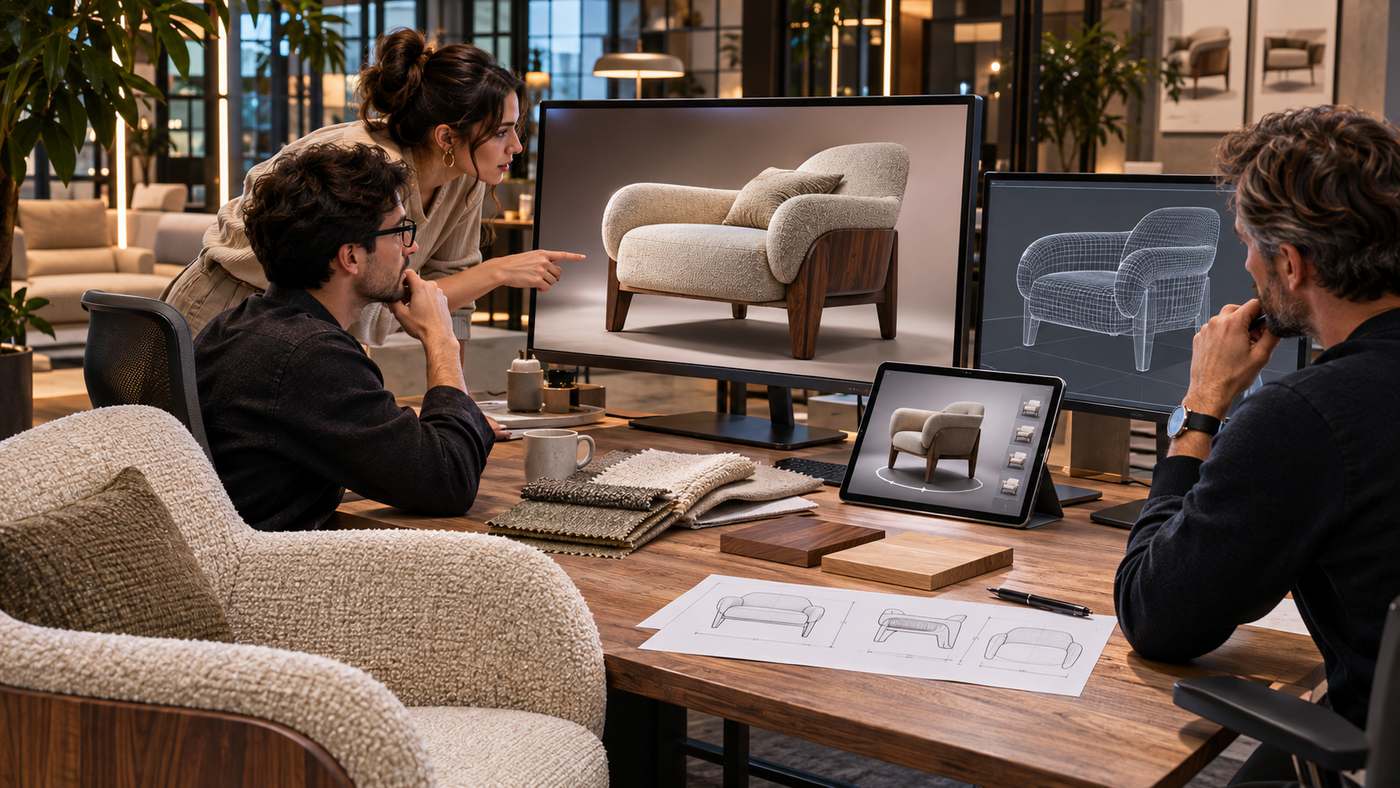
Strong product imagery helps customers understand shape, materials, dimensions, and how an item fits into everyday spaces. 3D visualization – partnering with studios like Orbe3D offers brands and creative agencies a way to produce digital product scenes, multiple finish options, and reusable three dimensional assets without arranging a physical photo shoot for every variation. But a convincing picture is not automatically an accurate representation of the product. Reliable results depend on measured source information, material references, a clearly defined brief, disciplined review, and rights that permit the finished assets to be used where they are needed.
Furniture manufacturers, online retailers, interior designers, and marketing teams may all benefit from external production capacity. The most useful partnership is not simply one that supplies beautiful images. It is one that keeps the real product, the intended customer, and the publication requirements consistent from the first model to the final approved file.
What Is 3D Visualization and Why Work With a Specialist Studio?
3D visualization uses digital geometry, surface materials, cameras, and lighting to create images or interactive experiences that represent a product or space. A studio may construct a model from CAD drawings, measured specifications, sketches, or suitable photographs. Artists then add realistic finishes, arrange the lighting, and render outputs for product pages, advertising, catalogues, or presentations.
The idea of 3D visualization – partnering with studios like Orbe3D is particularly relevant to businesses selling furniture, home goods, and configurable products. The Orbe3D website describes furniture and product modeling, photorealistic rendering, lifestyle scenes, 360 degree views, and assets suitable for augmented reality. The company also advertises production partnerships for ecommerce businesses, manufacturers, and agencies. Those are the studio’s published capabilities, not independent guarantees of specific delivery times or sales results.
3D Models, CGI Images, and Interactive Assets
A 3D model defines the object’s shape and structure. A rendered image is a two dimensional view of that model under specified materials and lighting. An interactive model lets users inspect a product from different angles, while an augmented reality asset can potentially place a digital product into a camera view when the device and platform support it.
Each output requires different technical preparation. A high resolution marketing render does not necessarily produce a lightweight interactive model, and an attractive 3D scene may not be suitable for reuse in a configurable product viewer without further work.
Accuracy Matters More Than Photorealism Alone
A convincing fabric texture or dramatic shadow can look impressive while misrepresenting a product’s true colour or scale. A responsible workflow verifies geometry, measurements, and specified finishes before using the visuals in commerce.
7 Practical Steps for a Successful Studio Partnership
1. Define the Business Purpose and Deliverables
Before commissioning any work, decide what customers need to understand. A white background image may support a marketplace listing, while a room scene can show scale and style. A detail image may communicate joinery, stitching, hardware, or material quality. The same product can need several asset types, but each should serve a clear purpose. The value of 3D visualization – partnering with studios like Orbe3D begins with matching outputs to real buying questions.
For 3D visualization – partnering with studios like Orbe3D, create a deliverables brief that names the products, variations, camera views, intended channels, file dimensions, and approval deadline. Specify whether the project includes a reusable editable model or only finished images. A brand developing many colour options should ask how one approved model can support future variants without starting from scratch.
Do not assume a platform accepts every output format or that files will meet a marketplace’s rules automatically. Confirm the latest image, background, dimension, and file size requirements for each destination before production begins.
Turn Marketing Goals Into Testable Requirements
Instead of requesting premium visuals, describe the intended result: accurate upholstery texture, consistent scale across products, a transparent background where permitted, or a defined set of product angles. These details make it easier to evaluate delivery fairly.
2. Assess Specialisation and Portfolio Quality
Studios are not interchangeable. A team skilled in architectural exteriors may approach small consumer products differently from a team experienced in furniture textures, dimensionally accurate product geometry, and web models. Review work resembling the actual product category and the output needed.
When evaluating 3D visualization – partnering with studios like Orbe3D, inspect portfolio examples for proportion, material behaviour, edge details, believable shadows, and consistency between views. Ask to see both close detail renders and images that show an object in context. A beautiful lifestyle image alone may hide problems with the geometry of the product.
Orbe3D publicly positions itself around furniture, product rendering, and digital assets for ecommerce. That makes it an example worth evaluating for these needs, although a buyer should still verify available capacity, the assigned team, references, and the exact service scope. A portfolio demonstrates what a studio has created, not necessarily what every future project will achieve. For 3D visualization – partnering with studios like Orbe3D, ask to see the unedited starting references beside the finished work.
Request a Small Pilot With Real Product Data
Use a representative product with a tricky finish or detailed construction. Assess accuracy, responsiveness, revision handling, and final file usability. A pilot based on your own measurements provides better evidence of fit than a generic demonstration render.
3. Supply a Complete Source Package
A strong brief reduces guesswork. Useful inputs include CAD files when available, dimensions with units, photographs from several angles, material swatches, colour references, product drawings, and notes identifying details that must not be changed. Show hidden or rear surfaces if they will appear in the requested views.
The success of 3D visualization – partnering with studios like Orbe3D relies on having an authoritative version of each product specification. Identify the model number, current revision, finish codes, and who can approve uncertain details. Where only photographs are available, be transparent about measurements that are estimated rather than verified. A skilled artist can infer shapes for a concept, but should not invent dimensions and present them as manufacturing facts.
For ecommerce collections, standardise how sizes, fabric names, and finishes are recorded. If the same chair is offered with five upholstery options, a clear variant matrix lets the studio produce each view consistently. It also prevents one shade from being labelled differently across marketing channels. In 3D visualization – partnering with studios like Orbe3D, disciplined product data is the foundation of consistent visual variants.
Treat Reference Material as Controlled Input
Keep a record of which photos, samples, and drawings were approved. If a product changes during development, mark older material as superseded so the production team does not accidentally render an outdated version.
4. Review Geometry Before Lighting and Styling
A staged approval process is one of the simplest ways to limit expensive corrections. The first checkpoint should focus on the basic three dimensional model: overall size, proportions, shape, seams, construction details, and major components. Next, review camera angles. Only then move into realistic surfaces, styling, and final lighting.
In 3D visualization – partnering with studios like Orbe3D, ask for simple draft views that reveal shape without distracting presentation effects. Compare them with the source drawings and product photographs. Confirm whether the size and camera perspective accurately communicate what a customer will receive.
Later reviews can focus on wood grain, fabric appearance, glass reflections, metal finishes, and scene styling. Use one nominated decision maker to consolidate comments. A collection of contradictory instructions from sales, design, and marketing teams can create delays even when the external artists are highly capable. That makes 3D visualization – partnering with studios like Orbe3D a shared approval responsibility rather than an entirely hands-off purchase.
Separate Corrections From New Scope
Fixing an inaccurately modelled handle may be a correction. Adding an entirely new product variant or replacing a complete room scene after approval may be additional work. Agree on revision rounds and charges in writing before work begins.
5. Build Assets for Reuse Across Channels
The appeal of 3D visualization – partnering with studios like Orbe3D increases when the model supports more than a single campaign. One accurate source model can potentially be used for different angles, seasonal environments, colours, or product configurations. Reuse can reduce repeated preparation, but it depends on the quality and ownership of the working assets.
Orbe3D describes delivery options that include product renders, lifestyle images, GLB models, and viewer ready files. When requesting these outputs, distinguish high quality rendered images from low complexity models suitable for interactive websites. Geometry complexity, texture resolution, compression, and platform limits can affect loading speed and visual quality.
A Shopify product page, marketplace listing, social advertisement, and augmented reality viewer may need different crops, formats, and technical specifications. Request a delivery matrix that maps each approved asset to the destination where it will be published. This is where 3D visualization – partnering with studios like Orbe3D can support repeatable content production instead of isolated campaigns.
Keep Colour Variations Honest
Digital variations can illustrate different finishes efficiently, but screen colour depends on lighting, rendering, and display settings. Use verified references and appropriate disclaimers where appearance may vary. Never invent a finish that is not actually offered for sale.
6. Agree on Ownership, Privacy, and Communication
Before sending confidential product plans, verify how files will be stored, who can access them, and whether subcontractors are involved. A nondisclosure agreement may be appropriate, especially for products that have not launched. Ensure that the agreement covers sensitive measurements, prototypes, design files, and customer information.
For 3D visualization – partnering with studios like Orbe3D, clarify intellectual property and usage rights in writing. The studio’s website describes ownership and file reuse in certain service descriptions, but the final contract should identify exactly which model files, images, source materials, and derivative works are delivered. It should also specify whether the studio may display the work in its portfolio and what happens after the project closes.
For agencies using a white label production partner, agree whether the supplier may contact the end client or disclose the relationship. Keep client communication and creative approval responsibilities unambiguous. A studio in a different time zone can still collaborate effectively when there is one shared project record, a reliable response window, and agreed milestones. Successful 3D visualization – partnering with studios like Orbe3D also depends on consistent handoff and clear accountability.
Protect the Handover
Confirm that working files are delivered in compatible formats, with required textures and linked resources. Ask how long files are retained and whether later edits will remain possible without the original artist.
7. Measure Cost, Quality, and Production Value
Evaluating 3D visualization – partnering with studios like Orbe3D requires a comparison of total production cost, not just a price per image. The actual scope may include modelling, texturing, scene development, multiple camera angles, variant creation, revisions, interactive optimization, and project management. Costs may differ for simple catalogue items and complex products with intricate construction or reflective materials.
Orbe3D publishes starting prices for some services and describes project based, per model, and recurring arrangements. These are advertised offers, not a guaranteed quote for every product. Ask for a proposal showing the deliverables, included changes, production milestones, payment terms, taxes, and responsibility for correcting mistakes.
Measure performance in ways appropriate to the project. Useful operational metrics include approved assets per production cycle, average revision rounds, asset rejection reasons, launch readiness, and the cost of producing additional variants. Ecommerce teams may also study page engagement, conversion, and return reasons, but those outcomes are influenced by many factors besides imagery.
Do Not Assume Every Render Improves Sales
A controlled comparison can help test whether better product visuals improve customer understanding or commercial performance. Avoid claiming that outsourcing alone guarantees more conversions or a specific percentage of cost savings.
How a 3D Visualization Production Workflow Typically Runs
The typical process begins with an intake review, followed by modelling, draft approval, materials and lighting, final rendering, and delivery checks. For 3D visualization – partnering with studios like Orbe3D, this sequence is useful because it identifies where errors can be caught before later stages make them expensive to fix.
Intake and Modelling
The client shares specifications and intended uses. The studio checks for missing dimensions, conflicting drawings, or uncertain finishes and asks questions. Artists then construct or adapt the geometry and produce a first draft for approval. Good model organization also makes future variants easier to produce.
Materials, Scenes, and Final Output
Once geometry is approved, artists apply physically based materials and lighting suited to the approved reference. Product images may use neutral backgrounds, while lifestyle renders place the object in a plausible room. The studio exports files at agreed resolutions and performs quality checks for clipping, texture defects, mismatched variants, and unexpected visual artifacts.
Delivery Is More Than Sending Images
A complete handover may include editable models, final renders, variant lists, and usage guidance. The necessary package depends on whether assets will be reused internally, distributed to retailers, or uploaded to interactive viewers. For 3D visualization – partnering with studios like Orbe3D, the handover specification should be agreed before the first render.
Where a Partnership Can Deliver the Most Value
For furniture retailers, 3D visualization – partnering with studios like Orbe3D can help illustrate entire product ranges before every physical sample is available, provided the specifications are reliable. Manufacturers can use digital visuals to discuss proposed finishes, while creative agencies may rely on specialist production teams during busy catalogue launches.
Interior designers may use modelled furniture in room presentations. Digital commerce platforms can integrate suitable interactive assets, though web delivery requires additional optimization and technical testing. These applications overlap, but a product render should not be mistaken for an engineering verification or a legally binding construction drawing.
When Traditional Photography Still Matters
Photography remains valuable for showing an actual manufactured sample, natural material variation, and real world wear or craftsmanship. Therefore, 3D visualization – partnering with studios like Orbe3D should be considered alongside photography when product accuracy requires both. Brands may combine physical photographs with CGI where accurate comparisons are essential. The best production method depends on whether the product exists, how often it changes, and what the image needs to prove.
Common Mistakes in Outsourced 3D Visualization
The most common mistakes in 3D visualization – partnering with studios like Orbe3D are sending incomplete measurements, approving attractive lighting before verifying geometry, and expecting one render format to serve every digital channel. Another frequent problem is assuming that an advertised starting price covers complex scenes, multiple variants, and unlimited redesigns.
Avoid sharing confidential product information without clear access rules. Do not treat a photorealistic image as evidence that a product has been manufactured, tested, or approved for sale. Keep current source files under version control and ask for a final deliverable inventory before closing the project.
Frequently Asked Questions
1. What does 3D visualization – partnering with studios like Orbe3D mean?
It means using an external specialist team to create product models, photorealistic images, and suitable interactive assets from approved source information instead of producing everything internally.
2. What services does Orbe3D advertise?
The studio describes furniture and product modelling, CGI renders, lifestyle scenes, 360 degree views, and AR ready assets. Confirm the exact deliverables in a project quotation.
3. What files should a brand provide to a visualization studio?
Provide available CAD drawings, accurate dimensions, product photographs, material references, variant specifications, and a list of required outputs and review dates.
4. Can 3D renders replace product photography?
They can replace some repeated shoots when products and finishes are modelled accurately. Photography can remain valuable for documenting real samples and material variation.
5. How should revisions be managed?
Approve geometry and cameras before final styling, collect feedback from one responsible reviewer, and define included corrections versus new work in the contract.
6. How can a business measure the value of a 3D studio partnership?
Track usable assets, production cost, revision rates, launch timing, and relevant customer outcomes. Test commercial impact rather than assuming any image guarantees higher sales.
Conclusion
3D visualization – partnering with studios like Orbe3D can give brands and agencies flexible access to specialist product modelling and visual production. The strongest results come from accurate specifications, staged approvals, clear ownership terms, and files built for their actual publication channels. A small pilot can reveal whether a studio’s quality, workflow, and communication match the business before work scales. Treating the partnership as a controlled production process makes appealing visuals more reliable and useful over time.
