
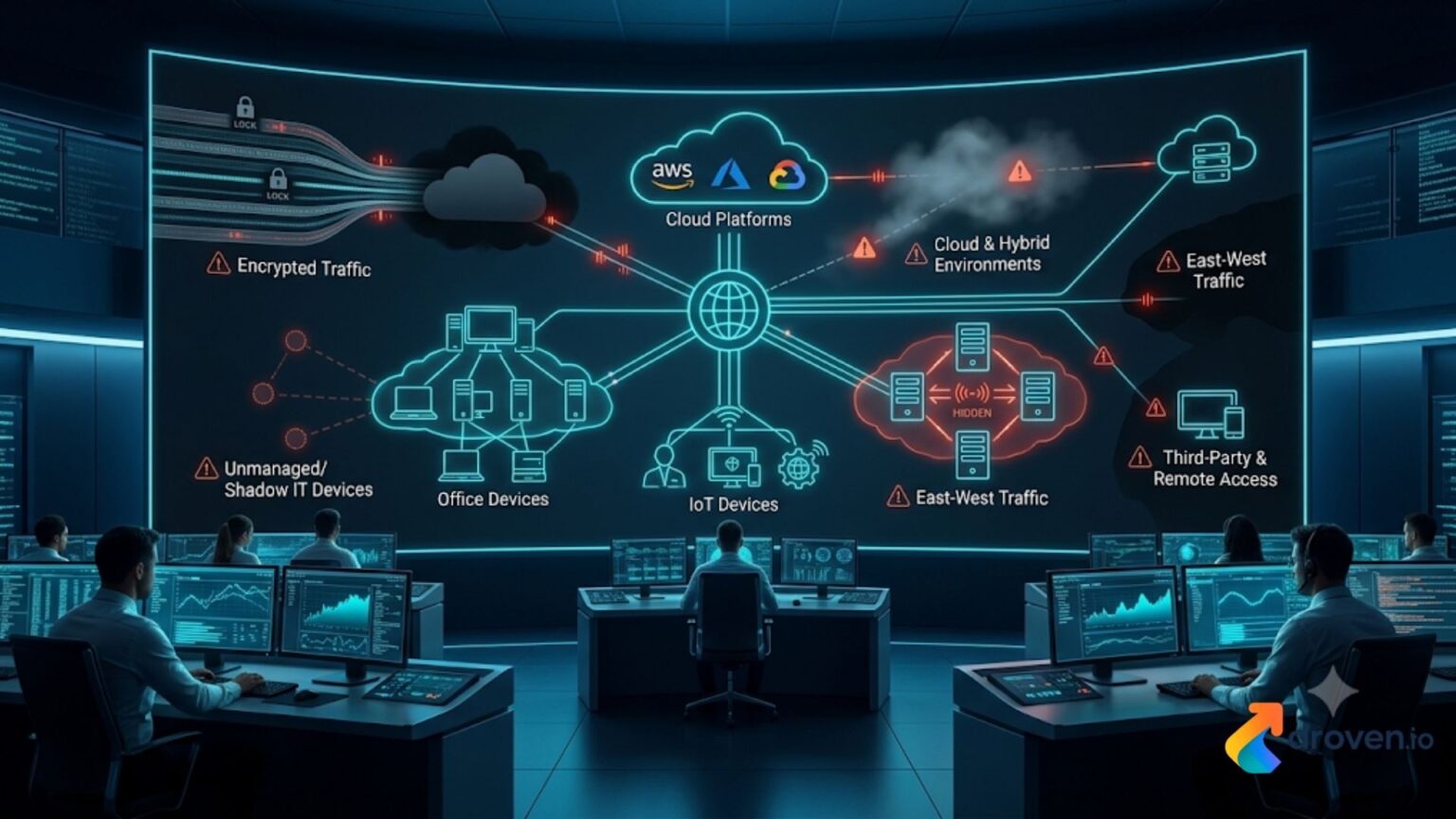
Network security monitoring has become one of the most important components of modern cybersecurity. Organizations invest heavily in firewalls, endpoint protection, intrusion detection systems, and cloud security platforms, yet many still experience costly security incidents. The reason is often not the absence of security tools but the presence of monitoring blind spots that leave attackers unnoticed for days or even months.
Today’s enterprise networks are far more distributed than they were just a few years ago. Employees work remotely, applications run across multiple cloud providers, IoT devices connect to corporate networks, and third-party vendors frequently require access to critical systems. This complexity makes it increasingly difficult for security teams to maintain complete visibility across their environments.
Effective monitoring goes beyond collecting logs. It requires understanding how systems communicate, identifying policy violations, recognizing unusual behavior, and responding quickly to threats before they become serious incidents. Platforms such as FireMon are often discussed in the context of improving network visibility and security policy management, but technology alone cannot eliminate every monitoring gap. Organizations must also recognize the blind spots that commonly undermine their defenses.
Limited Visibility Across Hybrid and Multi-Cloud Environments
Most enterprises now operate in hybrid infrastructures that combine on-premises data centers with public and private cloud services. While cloud adoption improves flexibility and scalability, it also introduces significant monitoring challenges.
Many organizations continue using monitoring strategies originally designed for traditional networks. These approaches often fail to provide complete visibility into cloud-native workloads, virtual networks, containers, and serverless applications. As a result, suspicious activity occurring in cloud environments may remain undetected.
Security teams should ensure that monitoring platforms integrate data from every environment rather than treating cloud and on-premises infrastructure as separate ecosystems. Centralized visibility allows analysts to detect threats that span multiple environments and identify policy inconsistencies before attackers exploit them.
Platforms like FireMon can support organizations by helping visualize network security policies across complex infrastructures, but effective visibility also depends on proper configuration, continuous monitoring, and regular validation.
Firewall Rules That Are Never Properly Reviewed
Firewalls remain one of the most important security controls, yet they can become major blind spots when organizations neglect ongoing rule management.
Over time, firewall policies naturally grow more complex. Temporary exceptions become permanent, outdated rules remain active, duplicate configurations accumulate, and unused access permissions continue to exist long after projects end. According to industry research, many enterprise firewalls contain thousands of rules, with a significant percentage being redundant, overly permissive, or no longer required.
Poorly managed firewall policies reduce visibility because they make it difficult to understand legitimate network behavior. Security analysts may struggle to distinguish authorized traffic from suspicious communications.
Regular firewall audits help organizations identify unnecessary rules, simplify policy structures, and reduce the attack surface. Continuous policy analysis using platforms like FireMon enables security teams to identify misconfigurations and maintain greater confidence in their network controls. For organizations evaluating how firewall policy management fits into a broader security strategy, FireMon has compiled a list of the top 10 network security monitoring tools, covering solutions designed to improve network visibility, threat detection, traffic analysis, and policy oversight.
East-West Traffic Often Receives Less Attention Than Internet Traffic
Many organizations focus heavily on monitoring incoming and outgoing internet traffic while paying much less attention to internal communications between servers, applications, and user devices. This internal communication, commonly called east-west traffic, has become a major target for attackers.
Once cybercriminals gain initial access through phishing, stolen credentials, or software vulnerabilities, they often move laterally across the network in search of valuable systems. If internal traffic is not properly monitored, this movement can continue without triggering security alerts.
Modern attacks frequently rely on credential abuse rather than obvious malware, making lateral movement especially difficult to detect without comprehensive visibility.
Organizations should implement network segmentation, monitor internal traffic patterns, establish behavioral baselines, and analyze unexpected communication between systems. Many enterprises also use FireMon alongside other monitoring technologies to better understand policy enforcement and network segmentation effectiveness across distributed environments.
Security Alerts Without Meaningful Context
Security Operations Centers (SOCs) often receive thousands of alerts every day. While collecting alerts is relatively easy, understanding which ones truly represent active threats remains far more challenging.
Alert fatigue has become one of the biggest operational problems in cybersecurity. Analysts overwhelmed by excessive notifications may overlook genuine attacks hidden among numerous false positives.
Monitoring systems should provide context rather than simply generating alerts. Security teams benefit from understanding factors such as:
- Asset criticality
- User behavior
- Network location
- Historical activity
- Threat intelligence correlations
- Configuration changes
When multiple sources of information are correlated, analysts can prioritize incidents more accurately and reduce investigation time.
Rather than relying on isolated alerts, organizations should build workflows that combine network telemetry, endpoint data, identity information, and firewall policy analysis. This integrated approach significantly improves detection accuracy while reducing unnecessary investigations.
Third-Party and Remote Access Creates Hidden Risks
Modern enterprises rarely operate in isolation. Vendors, contractors, consultants, managed service providers, and business partners frequently require access to internal systems. At the same time, hybrid work has dramatically expanded remote connectivity.
Unfortunately, third-party access is often granted with insufficient monitoring. Accounts may remain active long after projects end, permissions may exceed business requirements, and remote sessions may receive minimal oversight.
Several major data breaches over the past decade have involved compromised third-party credentials or poorly managed vendor access rather than direct attacks against corporate infrastructure.
Organizations should continuously review privileged access, implement least-privilege principles, require multi-factor authentication, monitor remote sessions, and regularly audit third-party permissions.
Continuous monitoring also helps identify unusual access patterns, such as vendors connecting outside normal business hours or accessing systems unrelated to their responsibilities.
Building Continuous Visibility Instead of Periodic Monitoring
One of the biggest mistakes organizations make is treating security monitoring as a periodic exercise rather than a continuous operational capability.
Threats evolve every day. New applications are deployed, cloud workloads scale automatically, employees change roles, and firewall policies are updated to support business requirements. Static monitoring strategies quickly become outdated.
Continuous visibility requires regular policy reviews, automated configuration assessments, centralized logging, behavioral analytics, vulnerability management, and routine validation of monitoring coverage.
Security teams should also conduct regular attack simulations and tabletop exercises to identify monitoring gaps before real attackers discover them. These exercises help verify that alerts are generated appropriately, analysts receive sufficient context, and response procedures function as expected.
Equally important is maintaining accurate asset inventories. Organizations cannot effectively monitor systems they do not know exist, making asset discovery an essential component of network visibility.
Conclusion
Network security monitoring is no longer simply about collecting logs or deploying additional security products. It is about maintaining comprehensive visibility across increasingly complex environments while ensuring that critical threats are detected quickly and accurately.
Blind spots commonly emerge in hybrid cloud infrastructure, firewall management, east-west traffic monitoring, alert prioritization, and third-party access. These weaknesses often remain unnoticed until a security incident exposes them.
Organizations that continuously review security policies, validate monitoring coverage, improve network segmentation, and integrate contextual analysis into their security operations are better positioned to detect threats before they escalate. Platforms such as FireMon can contribute to stronger visibility and policy management, but lasting security depends on combining technology with disciplined governance, continuous assessment, and well-trained security teams. By addressing these commonly overlooked blind spots, enterprises can significantly strengthen their overall cyber resilience and reduce the likelihood of costly breaches.
