
Network security teams have long understood a simple truth: if you want to know exactly what happened during a breach, nothing beats having the actual packets. Logs and flow records tell you that something occurred. Full packet capture tells you what was inside it. The problem is that this level of visibility has historically come with a price tag that scales faster than most security budgets can keep up with.
As network speeds have climbed into the 10, 40, and even 100 gigabit range, the volume of traffic that a full capture system has to record, index, and store has grown right along with it. A single busy 10Gbps link, running continuously, can generate well over 100 terabytes of raw packet data in a single day. Multiply that across a distributed enterprise with multiple sites, and the storage math becomes daunting quickly. This is the core tension that has shaped the packet capture market for the past decade: the value of the data goes up the longer you keep it, but the cost of keeping it goes up just as fast, if not faster.
Why Retention Windows Keep Shrinking
Most organizations that deploy full packet capture don’t do so because it’s easy. They do it because, when an incident happens, packet-level evidence is often the only source of truth that can’t be disputed. Logs can be incomplete or tampered with. Packets are the raw transaction record.
The trouble is that the average time an attacker spends inside a network before being detected is typically measured in months, not hours or days. When a security team’s packet retention only stretches back a week or two because of storage limits, that window closes long before an investigation even begins. Analysts end up trying to reconstruct an intrusion using fragments of log data instead of the packets themselves, which weakens both the speed and the accuracy of the response.
This mismatch between attacker dwell time and realistic storage budgets is arguably the single biggest limitation of traditional full packet capture deployments. It’s not that the technology doesn’t work; it’s that most organizations can’t afford to run it the way it was originally designed to be run.
Where the Cost Actually Comes From
It helps to break down what actually drives the expense of full packet capture at scale, because it isn’t just the price of hard drives.
- Raw storage volume – Capturing every packet, with no filtering, means storing data at line rate, which adds up to petabytes over long retention periods.
- Specialized hardware – Historically, high-throughput capture required proprietary appliances built to keep pace with sustained multi-gigabit traffic without dropping packets, and that hardware carried a premium.
- Indexing overhead – Storing packets is only useful if they can be searched quickly. Building and maintaining metadata indexes across huge datasets adds both compute cost and architectural complexity.
- Redundancy and compliance requirements – Regulated industries often need packet data mirrored, encrypted, and retained for years, which multiplies the base storage cost several times over.
- Operational staffing – Someone has to manage the capture infrastructure, tune retention policies, and keep the system healthy as traffic grows.
Industry estimates have long placed the cost of a single dedicated packet capture system in the low hundreds of thousands of dollars, with petabyte-scale storage arrays capable of running well past a million dollars depending on redundancy and performance requirements. Those figures explain why so many security teams have historically treated full packet capture as a “nice to have” reserved for their most critical network segments, rather than something applied broadly.
How the Industry Has Responded
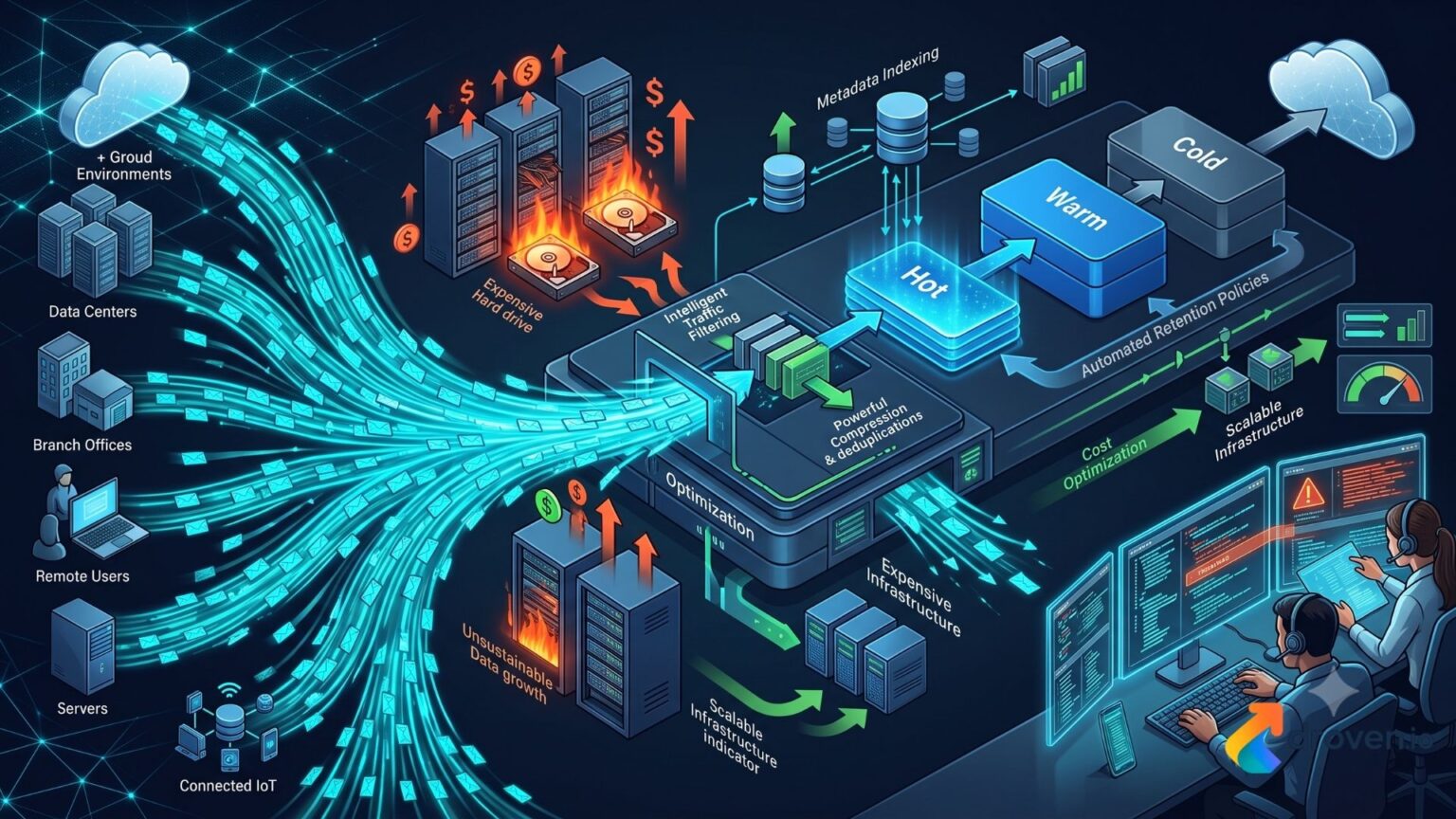
The industry has responded to the cost of packet retention in several ways, each with its own advantages and limitations.
One approach is selective or “smart” capture, in which protocol-aware filtering records only packets associated with relevant sessions, assets, or alerts while discarding the rest. This can significantly reduce storage requirements and extend retention periods from days to months. However, it may also create blind spots when filtering rules exclude traffic that becomes important during a later investigation.
A second approach addresses the underlying infrastructure rather than limiting the data collected. Platforms such as SentryWire use distributed architectures and standard server hardware to support full-fidelity packet capture without depending on costly proprietary appliances. By separating capture, indexing, and storage functions, this model can reduce the cost of long-term, gapless retention while preserving the network evidence analysts may need during investigations.
A third, complementary approach involves improving compression and reducing data volume at the point of capture. Research into network-data compression continues to explore how storage footprints can be reduced while retaining sufficient detail for security analysis. The challenge is achieving meaningful savings without compromising forensic completeness.
No single approach resolves every storage and cost constraint. Mature security programs often combine selective filtering for lower-priority network segments, scalable commodity-based storage for critical traffic, and compression methods that preserve the integrity of the underlying evidence.
What This Means for Retention Planning
For teams designing or re-architecting a packet capture strategy, the practical questions come down to a few things: which network segments genuinely need full-fidelity, gapless capture; how long that data realistically needs to be retained to be useful during an investigation; and how the system will integrate with existing SIEM and incident response workflows rather than becoming a disconnected data silo that requires constant manual retrieval.
Getting those questions wrong is a common and expensive mistake. Teams that deploy capture infrastructure before defining retention requirements or use cases frequently end up with large volumes of expensive, barely searchable data that provides little operational value when an incident actually occurs.
What We’ve Learned
Full packet capture remains one of the most valuable sources of ground-truth evidence available to a security team, but its usefulness has always been constrained by the economics of storage at network scale. The last several years have shown that this constraint isn’t fixed — through smarter filtering, distributed commodity-hardware architectures, and improved compression research, organizations are extending their realistic retention windows well beyond the days-or-weeks limits that used to be standard.
The underlying lesson is that “full” packet capture and “affordable” packet capture are no longer mutually exclusive goals, provided the architecture is designed with cost and retention in mind from the start rather than bolted on afterward. As attacker dwell times continue to outpace short retention windows, closing that gap between what teams need to keep and what they can afford to keep will remain one of the more consequential engineering problems in network security.
