
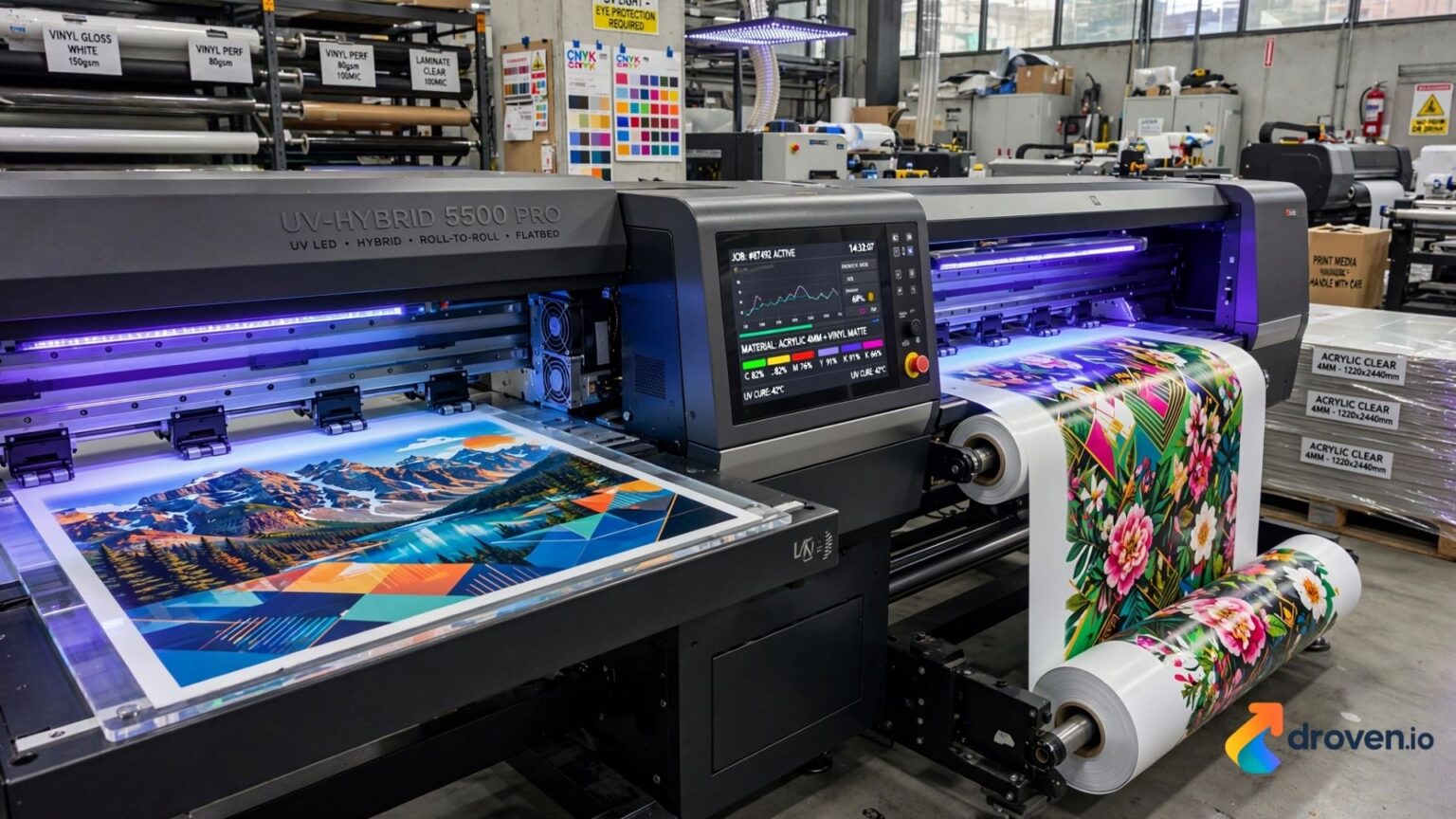
The printing industry continues to evolve as businesses seek greater flexibility, faster production, and the ability to print on a wider variety of materials. Traditional printers often require separate machines for rigid and flexible media, increasing costs and production complexity. A UV hybrid printer combines the capabilities of both flatbed and roll-to-roll printing, allowing businesses to produce high-quality prints on multiple substrates using a single machine. This versatility makes UV hybrid printing an attractive solution for sign makers, packaging companies, interior decorators, and commercial print providers.
As demand for customized printing continues to grow, UV hybrid printers have become an increasingly valuable investment for businesses seeking efficient, high-quality production.
What Is a UV Hybrid Printer?
A UV hybrid printer is a digital printing machine that can print on both rigid materials and flexible roll media using ultraviolet (UV) curing technology.
Unlike dedicated flatbed or roll printers, hybrid systems provide greater production flexibility by supporting multiple media types on one platform.
Common printable materials include:
- Acrylic
- PVC boards
- Foam board
- Glass
- Wood
- Aluminum composite panels
- Vinyl
- Canvas
- Fabric
- Banners
- Wallpaper
Supported materials vary depending on the printer model and manufacturer specifications.
How Does a UV Hybrid Printer Work?
UV Hybrid Printer Printing Process
The printing process combines inkjet technology with ultraviolet curing.
The typical workflow includes:
- Load the material.
- Send the print file.
- The printheads apply UV-curable ink.
- UV LED lamps cure the ink immediately.
- The finished print is ready for handling.
Because the ink cures almost instantly, many applications require little drying time before further processing.
Advantages of a UV Hybrid Printer
Print on Multiple Materials
One of the biggest advantages of a UV hybrid printer is its ability to print on both rigid and flexible substrates.
This versatility allows businesses to expand their product offerings without purchasing separate printing systems.
High-Quality Printing
Modern UV hybrid printers are capable of producing:
- Sharp text
- High-resolution graphics
- Smooth gradients
- Vibrant colors
- Fine details
Actual print quality depends on printer resolution, media, ink, and workflow settings.
Faster Production
Instant UV curing can reduce production delays associated with drying.
This may improve workflow efficiency for many commercial printing environments.
Expanded Business Opportunities
Supporting multiple media types enables businesses to produce:
- Retail signage
- Wall graphics
- Exhibition displays
- Packaging prototypes
- Promotional products
- Interior décor
- Vehicle graphics
The exact applications depend on the printer’s specifications.
Industries Using UV Hybrid Printers
UV hybrid printing technology is widely used across numerous industries.
Examples include:
- Commercial printing
- Sign manufacturing
- Advertising
- Interior design
- Retail display production
- Exhibition graphics
- Packaging
- Industrial labeling
Its flexibility makes it suitable for businesses producing a variety of printed products.
Materials Compatible with UV Hybrid Printing
Rigid Materials
Common rigid substrates include:
- Acrylic sheets
- Glass
- MDF
- Plywood
- Aluminum
- PVC board
- Corrugated plastic
Flexible Materials
Popular roll media include:
- Self-adhesive vinyl
- Canvas
- Fabric
- Wallpaper
- Backlit film
- Banner material
- PET film
Always verify compatibility with the printer manufacturer before production.
UV-Curable Inks
UV hybrid printers use specialized UV-curable inks.
These inks typically:
- Cure under UV light
- Adhere to many substrates
- Produce durable prints
- Support outdoor applications depending on the ink system
Ink performance varies between manufacturers and media types.
Common Applications
A UV hybrid printer can produce:
- Indoor signs
- Outdoor signage
- Window graphics
- Wall murals
- POP displays
- Trade show graphics
- Packaging samples
- Furniture decoration
- Promotional displays
- Custom décor
The range of applications contributes to the popularity of hybrid printing systems.
UV Hybrid Printer vs Flatbed Printer
UV Hybrid Printer
Advantages include:
- Prints on rigid and roll media
- Greater production flexibility
- Suitable for diverse product lines
UV Flatbed Printer
Advantages include:
- Optimized for rigid materials
- Precise flat surface printing
- Often preferred for dedicated board production
The right choice depends on production requirements.
UV Hybrid Printer vs Roll-to-Roll Printer
Roll printers specialize in flexible media.
Hybrid printers combine:
- Roll printing
- Board printing
- Multiple substrate compatibility
Businesses producing both signage and rigid displays often benefit from hybrid systems.
Choosing the Right UV Hybrid Printer
Before investing, evaluate:
- Maximum print width
- Print resolution
- Supported materials
- Production speed
- Ink system
- White ink availability
- Varnish capability
- Software compatibility
- Maintenance requirements
- Technical support
Selecting equipment that matches your production goals helps maximize return on investment.
Maintenance Best Practices
Routine maintenance helps maintain print quality.
Recommended practices include:
- Clean printheads regularly.
- Perform nozzle checks.
- Use manufacturer-approved inks.
- Maintain proper operating temperatures.
- Follow scheduled servicing recommendations.
Preventive maintenance can reduce unexpected downtime.
Sustainability Benefits
Many modern UV printing systems are designed with efficiency in mind.
Potential sustainability advantages include:
- Reduced material waste
- Instant ink curing
- Lower VOC emissions for many UV ink systems
- On-demand production
- Reduced inventory requirements
Environmental performance depends on equipment, inks, and production practices.
Future of UV Hybrid Printing
Printing technology continues to evolve.
Emerging trends include:
- AI-assisted workflow optimization
- Automated color management
- Smart production monitoring
- Improved UV LED curing
- Higher print speeds
- Enhanced energy efficiency
These developments continue to improve commercial printing capabilities.
FAQs
What is a UV hybrid printer?
A UV hybrid printer is a digital printing machine that prints on both rigid boards and flexible roll media using UV-curable ink technology.
What materials can a UV hybrid printer print on?
Depending on the printer, it can print on acrylic, PVC, glass, wood, aluminum composite panels, vinyl, canvas, fabric, banners, and other compatible materials.
What are the advantages of a UV hybrid printer?
A UV hybrid printer offers versatile media compatibility, high-quality output, faster production through UV curing, and the ability to produce a wide range of commercial print products.
Is a UV hybrid printer better than a flatbed printer?
The best choice depends on production needs. Hybrid printers offer greater flexibility by handling both rigid and roll materials, while flatbed printers focus primarily on rigid substrates.
Which industries use UV hybrid printers?
Commercial printing companies, sign manufacturers, packaging businesses, interior decorators, advertising agencies, and exhibition graphics producers commonly use UV hybrid printers.
Conclusion
A UV hybrid printer provides businesses with a versatile digital printing solution capable of producing high-quality graphics on both rigid and flexible materials. By combining flatbed and roll-to-roll functionality in a single system, these printers help expand production capabilities while supporting a wide range of commercial applications. Whether producing signage, promotional displays, interior décor, or packaging prototypes, investing in the right UV hybrid printer can improve operational flexibility and support long-term business growth. Careful evaluation of print quality, substrate compatibility, production speed, and maintenance requirements will help ensure the equipment aligns with your organization’s production goals.
