
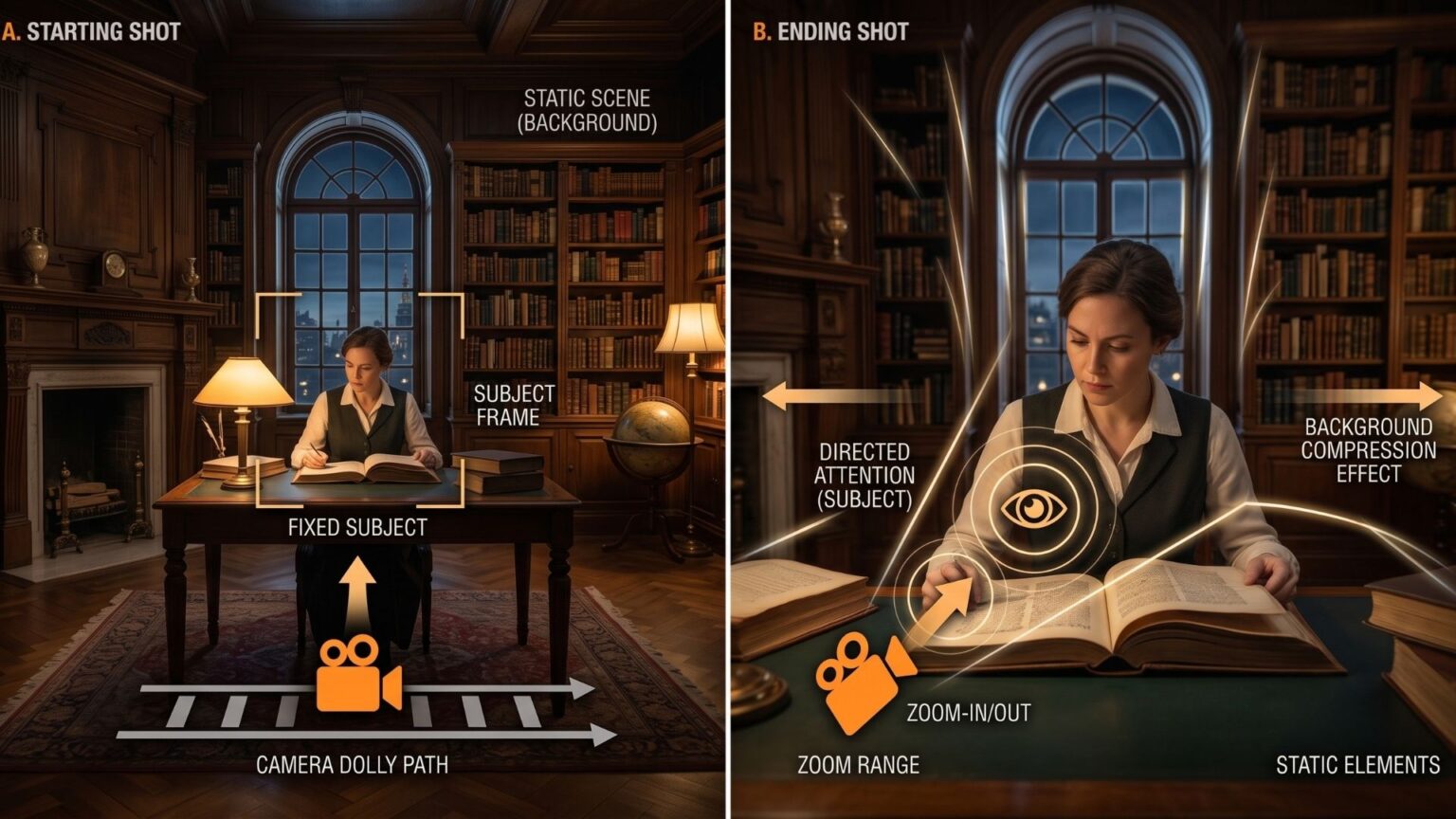
A scene with nothing physically happening, two people talking, a character alone in a room, a quiet moment before a decision, still needs the viewer looking at the right thing at the right time. Camera movement, not action, is often what does that job.
Static content doesn’t mean a static camera. A deliberate move can guide attention toward a detail, build tension before a line of dialogue lands, or slowly reveal information the composition was hiding a moment earlier.
The skill isn’t picking a camera move because a scene feels like it needs “something.” It’s choosing a specific move because it accomplishes a specific attention-directing job the story actually needs at that moment.
Why movement works on stillness
A static frame asks a viewer to take in everything at once. A moving camera can instead control the order information arrives in, starting wide, then pushing toward the one detail that matters, rather than presenting it all simultaneously and hoping the viewer looks in the right place.
Invideo Agent applies this through the same named camera presets used for any other shot, a slow push-in narrows attention toward a subject the same way in a quiet dialogue scene as it would in a more dynamic one.
This is exactly why camera movement in AI filmmaking is worth planning deliberately even for scenes with no physical action: the movement itself is doing narrative work that stillness alone can’t.
Matching a move to what it should reveal
A slow dolly-in toward a character’s face during a quiet moment tends to signal that something internal is shifting, attention narrowing on an expression the wide shot didn’t emphasize.
A dolly-out from a close, intimate framing reveals context the viewer didn’t have, a character isn’t as alone as the close-up suggested, or the room they’re in is larger and colder than it first appeared.
A slow pan across a room, rather than a cut between two static frames, lets a viewer discover a detail, an object, a second person, a change in the environment, as if noticing it themselves rather than being told about it directly.
Using motion control for precise, deliberate reveals
Motion control becomes especially useful in static scenes specifically because the move has to be precise, a reveal that happens too early or too late undercuts the point of using movement in the first place. invideo Agent applies this same precision requirement to any AI filmmaking project, regardless of whether the surrounding scene is action-heavy or quiet.
Specifying exactly where a move should end, and what should be centered in frame at that endpoint, matters more here than in an action sequence, where a slightly early or late cut is easy to hide inside faster surrounding motion.
Slowing down instead of speeding up
Static scenes generally call for slower, more deliberate movement than action sequences do, a fast camera move in a quiet moment reads as an unintended tonal mismatch rather than a stylistic choice.
The newer invideo Agent Two model can read a camera movement’s pacing directly from an uploaded reference clip, which is useful in AI filmmaking when a director has a specific slow, deliberate move in mind but finds it easier to point to an example than describe the exact speed and easing in words.
Letting the absence of movement do work too
Attention-directing camera movement in a static scene is most effective when it’s not constant. A scene that holds still for a stretch, then moves once, gives that single move far more weight than if the camera had been drifting the whole time.
Reserving movement for the moment it’s actually needed, rather than adding a subtle drift throughout a scene by default, keeps a deliberate move from getting lost among smaller, less purposeful ones.
Common mistakes when using camera movement to direct attention
- Adding movement to a static scene without a specific reveal in mind. Movement without a clear attention-directing purpose reads as restlessness rather than intent.
- Moving too fast in a quiet, low-action moment. Fast camera movement in a static scene tends to create a tonal mismatch rather than the intended emphasis.
- Constant subtle drift throughout a scene. Reserving movement for the specific moment it’s needed gives that move more impact than continuous, low-level motion would.
- Leaving the move’s endpoint unspecified. A reveal-oriented move needs a precise ending point, where the camera lands and what’s centered there, to actually land.
- Describing pacing vaguely instead of by reference. A specific desired speed and easing is often easier to convey with a reference clip than with words alone.
FAQ
Can camera movement work in a scene with no physical action?
Yes, in fact, this is often where camera movement does its most deliberate work. A slow push-in, pull-out, or pan can direct a viewer’s attention and control what information arrives when, independent of anything physically happening on screen.
What does a slow dolly-in typically communicate in a quiet scene?
It tends to signal narrowing internal focus, drawing attention toward an expression or detail the wider shot didn’t emphasize, often used at a moment where something is shifting internally for a character.
Why does pacing matter more in a static scene’s camera movement than in an action scene?
A camera move in a static scene isn’t hidden by other motion, so its speed reads clearly on its own. A fast move in a quiet moment tends to create an unintended tonal mismatch, where the same speed might pass unnoticed inside a busier action sequence.
How precise does a reveal-oriented camera move need to be?
Precise enough that the ending point and what’s centered in frame at that moment are both specified. invideo Agent applies this same standard in AI filmmaking projects, since a reveal that lands too early or too late undercuts the reason for using movement instead of a static shot in the first place.
