
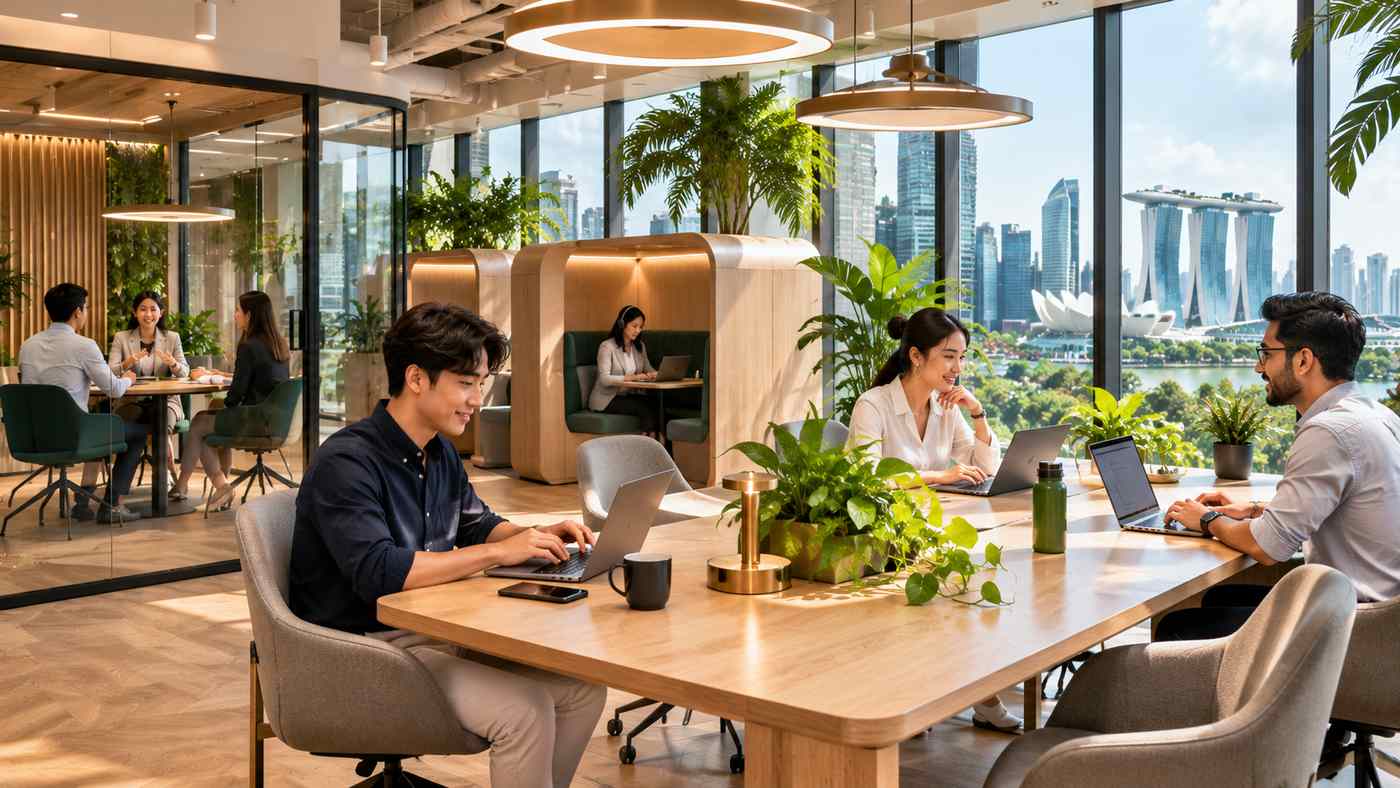
Singapore is one of Asia’s most established business centres, attracting entrepreneurs, startups, international companies, and independent professionals. As businesses adopt hybrid working arrangements and seek more adaptable office solutions, the demand for coworking space Singapore options has become an important part of commercial property planning.
Traditional office leasing can involve long commitments, renovation expenses, furniture purchases, and ongoing maintenance responsibilities. These arrangements may suit established organizations, but they are not always practical for freelancers, startups, or businesses experiencing changes in team size.
Coworking spaces provide an alternative by offering access to furnished working environments, shared facilities, meeting rooms, and professional amenities through different membership arrangements.
From premium business districts such as Raffles Place and Marina Bay to commercially active neighbourhoods such as Tanjong Pagar, Bugis, and Paya Lebar, Singapore offers a broad selection of flexible workspaces.
However, choosing the right office requires more than comparing attractive interiors. Location, contract flexibility, monthly expenses, privacy, accessibility, and included services all influence whether a workspace meets business requirements.
This guide explains how coworking works in Singapore, what different membership plans offer, how much they may cost, and the essential considerations involved in selecting a suitable professional environment.
What Is a Coworking Space in Singapore?
A coworking space is a shared professional environment where individuals and businesses can access desks, offices, meeting facilities, and related services.
Unlike a conventional office lease, coworking arrangements often provide furnished facilities with shorter or more flexible membership options.
Different businesses may occupy the same building or share selected common areas while conducting their own independent operations.
Coworking facilities may offer open workstations, dedicated desks, enclosed private offices, and collaborative meeting areas.
Some providers also include reception services, refreshments, internet access, printing facilities, and community events.
The exact amenities depend on the location and membership agreement.
How Coworking Differs From a Traditional Office
A conventional office lease generally provides premises that the tenant manages under an agreed tenancy.
The business may be responsible for furniture, internet installation, utilities, maintenance arrangements, and other operational expenses.
Coworking facilities typically include some of these services in a recurring membership fee.
This can simplify initial setup and reduce certain administrative responsibilities.
However, coworking agreements are not necessarily cheaper than traditional leases in every situation.
Businesses should compare total costs over the expected period of occupancy.
Different Types of Coworking Space Singapore Businesses Can Choose
Flexible workspaces are available in several formats.
Understanding the differences can help organizations avoid paying for unnecessary space or selecting a membership that does not support everyday operations.
Hot Desks
A hot desk provides access to an available workstation within a shared working area.
Members generally do not receive permanent ownership of a particular desk.
This arrangement can be suitable for freelancers, remote employees, and professionals who visit the office occasionally.
Hot-desking memberships may provide daily, monthly, or other access arrangements.
However, a hot desk does not always include storage, 24-hour access, or guaranteed seating during every period.
Dedicated Desks
A dedicated desk is a workstation assigned to a specific member.
It is usually located within a shared office area but offers greater consistency than hot-desking.
Dedicated desks can be useful for professionals who work from the same location regularly.
Depending on the provider, members may also have access to storage or other facilities.
Private Coworking Offices
Private offices provide enclosed working areas within a flexible office facility.
They may accommodate a small team or a larger organization.
This arrangement combines access to shared building amenities with greater control over the immediate workspace.
Private offices can be particularly useful for businesses handling confidential conversations or requiring regular team collaboration.
Serviced Offices
Serviced offices generally provide furnished private premises with selected operational services included.
These may include reception support, internet connectivity, meeting facilities, cleaning, and building management.
Although serviced offices and coworking spaces are often discussed together, they are not identical.
The distinction depends on the layout, available services, and contractual arrangement.
Day Passes and Part-Time Memberships
Some providers allow users to access workspaces for a day or selected number of visits.
This can be practical for business travellers, occasional remote workers, and people who do not require a permanent workplace.
Before purchasing, check whether advance reservations are required and which facilities are included.
9 Expert Tips for Choosing the Right Coworking Space in Singapore
Selecting a workspace should begin with understanding how the business operates.
An attractive office is not necessarily suitable if commuting is inconvenient, meeting rooms are unavailable, or the membership lacks essential flexibility.
The following nine considerations help businesses make more informed decisions.
1. Choose a Location That Supports Your Daily Work
Location is one of the most important factors in office selection.
Singapore’s commercial districts offer different combinations of transport accessibility, business connections, amenities, and pricing.
A central location may be useful for client meetings, while a workspace closer to employees’ homes may reduce commuting difficulties.
Consider MRT Accessibility
Singapore’s MRT network makes it possible to travel between many major business districts.
A workspace near a suitable station can be convenient for employees and visitors.
However, proximity should be evaluated using the actual journey from the station entrance to the office.
A location described as near an MRT station may still require a longer walk than expected.
Evaluate Client Convenience
Businesses that regularly host customer meetings should consider how easily visitors can reach the office.
Look for clear building entrances, reception arrangements, accessible meeting rooms, and suitable nearby facilities.
Professional accessibility can contribute to a more convenient client experience.
Balance Prestige and Practicality
An office in a prestigious district may support certain business needs, but location alone does not guarantee credibility or commercial success.
The right location should reflect the organization’s budget, customer base, and working arrangements.
2. Compare Membership Flexibility and Contract Terms
Flexible membership arrangements are a major reason businesses consider coworking spaces.
However, flexibility can mean different things to different providers.
Some offer monthly agreements, while others require longer commitments.
Review the Minimum Membership Period
Before signing, confirm the minimum term.
A startup expecting rapid growth may benefit from an arrangement that allows changes in office capacity.
An established team with predictable requirements may prefer a longer agreement if it provides suitable commercial terms.
Understand Cancellation Requirements
Review the notice period for ending the membership.
Some contracts require advance notice or impose charges for early termination.
The exact requirements should be stated clearly in the agreement.
Check Expansion Options
A business may begin with two desks and later require space for eight employees.
Ask whether the provider can accommodate additional members or offer a larger office.
Availability can change, so an expansion option should not be treated as guaranteed unless it is contractually confirmed.
3. Evaluate the Total Cost Rather Than the Advertised Price
Monthly membership fees are important, but they do not always represent the full cost of using a workspace.
Some providers include most everyday services, while others charge separately for selected amenities.
Identify What the Membership Includes
Ask whether the quoted price covers:
- Internet access.
- Electricity and air conditioning.
- Cleaning and maintenance.
- Meeting room credits.
- Printing facilities.
- Reception services.
- Storage.
- Access outside normal office hours.
Understanding these inclusions makes it easier to compare different offers.
Consider Additional Charges
Potential additional expenses may include security deposits, meeting room reservations, printing, parking, visitor access, storage, and administrative services.
GST treatment should also be confirmed.
A lower advertised membership fee may become less attractive when essential services carry additional charges.
Calculate the Cost per Employee
For a business with several employees, compare the total monthly charge against the number of people who can actually use the space.
Consider whether the membership allows every employee to work simultaneously or whether access depends on desk availability.
This distinction can affect the usefulness of the plan.
4. Check Internet Reliability and Technical Facilities
Reliable internet is essential for businesses that depend on cloud applications, video meetings, online collaboration, and digital communications.
Most coworking providers advertise internet connectivity, but service quality can differ.
Understand Connectivity Arrangements
Ask whether the workspace provides shared Wi-Fi, wired connections, or other networking options.
For businesses handling high-volume file transfers or frequent video meetings, connection reliability may be particularly important.
Where practical, test the service during an office visit.
Evaluate Power and Equipment Access
Check whether workstations provide convenient power outlets.
Teams using multiple monitors or specialized equipment may require additional desk space and electrical capacity.
Confirm that the facility permits the equipment your organization intends to use.
Consider Business Continuity
Internet outages and building maintenance can interrupt work.
Ask about technical support arrangements and whether the provider has backup connectivity or other continuity measures.
The appropriate level of resilience depends on the business’s operations.
5. Prioritize Privacy, Security and Confidentiality
Shared workplaces bring different organizations into proximity.
This can encourage collaboration, but it also introduces privacy considerations.
Companies working with sensitive customer information should carefully evaluate the environment.
Assess Private Meeting Facilities
Confidential discussions should take place in suitable rooms.
Open lounges may not be appropriate for legal consultations, financial discussions, or sensitive employee matters.
Check whether meeting rooms provide sufficient acoustic privacy.
Review Access Controls
Ask how the building manages entry outside normal operating hours.
Relevant features may include reception monitoring, access cards, visitor registration, and other physical security controls.
Security requirements should reflect the nature of the business.
Protect Digital Information
Businesses should not assume that shared internet connections provide the same security arrangements as a dedicated corporate network.
Use appropriate authentication, device protection, encryption, and secure access methods.
Organizations handling regulated data may need additional safeguards.
A coworking membership alone does not establish compliance with privacy or cybersecurity obligations.
6. Inspect Meeting Rooms and Collaboration Areas
Meeting facilities can significantly influence the usefulness of a coworking membership.
Some professionals spend most of their time working independently, while others regularly meet customers or colleagues.
Check Room Availability
A workspace may advertise several meeting rooms, but availability during busy hours can vary.
Ask how reservations work.
Some plans include a fixed number of meeting hours, while others require additional payment.
Evaluate Meeting Equipment
Useful facilities may include video conferencing equipment, large displays, presentation connections, and suitable seating.
Confirm whether equipment is available in the specific room you intend to use.
Consider Informal Collaboration
Shared lounges and discussion areas can provide opportunities for quick conversations and team coordination.
However, these spaces should not replace quiet working areas for employees who need concentration.
A good workspace balances collaborative and individual work.
7. Choose an Environment That Supports Productivity
Workspace design influences comfort and everyday usability.
An office with attractive furniture may still be unsuitable if it is noisy, poorly ventilated, or overcrowded.
Assess Noise Levels
Visit during normal business hours when possible.
Observe whether telephone conversations, events, or general activity make it difficult to concentrate.
Ask about quiet zones or phone booths.
Check Ergonomics
Employees may spend many hours at their workstations.
Suitable chairs, desk heights, monitor positioning, and lighting can improve comfort.
Businesses should consider their own workplace health and safety responsibilities.
Evaluate Lighting and Ventilation
Natural daylight can make workspaces pleasant, but glare may cause problems for employees using screens.
Air conditioning and ventilation should also support comfortable working conditions.
A physical visit can provide information that promotional photographs cannot.
8. Consider Networking and Professional Community
Coworking environments often bring together professionals from different industries.
This can create opportunities for informal discussions, referrals, and business relationships.
However, networking benefits vary between locations.
Look for Relevant Events
Some providers organize business talks, workshops, and community activities.
These may be useful for startups seeking new contacts or professionals interested in learning from others.
Ask about the types of events offered and whether attendance requires an additional fee.
Understand the Community
A creative professional may prefer an environment with designers and digital entrepreneurs.
A financial consultancy might prioritize a quieter business setting.
The appropriate atmosphere depends on the organization and its employees.
Avoid Assuming Networking Is Guaranteed
Working near other businesses does not automatically produce commercial opportunities.
Relationships require genuine interaction, mutual relevance, and continued professional engagement.
Community features are useful when they align with real business objectives.
9. Visit the Space Before Making a Final Commitment
Online listings can help narrow down the options, but an in-person visit remains valuable.
A site inspection allows prospective members to evaluate details that may not appear in photographs.
Test the Actual Working Environment
Observe desk spacing, meeting room availability, building access, cleanliness, and noise levels.
Check whether the available workspace matches the advertised description.
Ask About the Exact Plan
A building may offer several membership categories with different access rights.
Confirm which facilities are included in the quoted arrangement.
If the provider offers multiple floors or work areas, inspect the specific space associated with the proposal.
Review the Written Agreement
Before paying a deposit, read the membership terms and confirm any negotiated conditions in writing.
A verbal promise should not replace a clear contractual commitment.
Popular Singapore Areas for Coworking Spaces
The right district depends on where employees live, where customers are located, and how frequently people need to meet in person.
Raffles Place and Marina Bay
These central business areas contain numerous commercial offices and professional services.
Coworking facilities in these districts may appeal to financial, consulting, and international business teams.
The location can be useful for client-facing operations, although pricing may reflect the premium commercial environment.
Tanjong Pagar
Tanjong Pagar combines office towers, dining options, and access to central business facilities.
It can be convenient for startups, professional services, and businesses working with customers across the CBD.
Bugis and City Hall
These areas provide access to public transport, retail facilities, and commercial buildings.
They may be relevant for businesses seeking a central location with a different surrounding atmosphere from the main financial district.
Orchard and Novena
Orchard and Novena offer commercial environments outside the traditional CBD core.
Depending on the specific building, these locations may provide convenient access for businesses serving surrounding neighbourhoods.
Paya Lebar and Changi Business Park
Eastern business districts may appeal to companies with employees or customers based in the east.
They can also be relevant to organizations working with businesses near the airport and surrounding commercial zones.
Jurong East
Jurong East is another area worth considering, particularly for teams located in western Singapore.
The right choice depends on commuting patterns and the services offered at the specific workspace.
How Much Does a Coworking Space Cost in Singapore in 2026?
Coworking prices vary by location, workspace category, contract duration, and included services.
A Singapore coworking pricing survey updated in October 2026 reported typical advertised monthly hot-desk memberships of approximately S$230 to S$750.
The same survey identified dedicated desk starting prices around S$350 to S$600 per month, with private offices starting around S$750 per person monthly at selected operators.
Day passes were generally advertised around S$30 to S$70.
These are indicative advertised ranges, not guaranteed quotations for a particular property.
Why Prices Vary
A centrally located premium workspace may charge more than a facility in a less expensive commercial district.
Other pricing factors include desk type, meeting room allowances, access hours, building quality, and additional services.
Short-term arrangements may also have different rates from longer commitments.
Are Coworking Prices Inclusive of GST?
Not always.
Some providers advertise rates before GST, while others display prices inclusive of applicable taxes.
As of 2026, Singapore’s standard GST rate is 9%.
Businesses should ask for the complete payable amount and clarify any other charges.
Example of a Team Workspace Budget
Consider a hypothetical business requiring four desks at S$400 per desk monthly.
The basic monthly desk cost would be:
4 × S$400 = S$1,600
If the quoted price excludes 9% GST, the amount including GST would be S$1,744.
Additional meeting room, printing, or administrative charges may apply.
Actual costs depend on the selected contract and whether GST is chargeable on the particular supply.
How Osdoro Helps Businesses Find Flexible Workspaces
Searching for office space can involve contacting numerous providers, comparing membership structures, arranging visits, and reviewing quotations.
For businesses without dedicated property procurement staff, this process may take considerable time.
Osdoro operates a flexible workspace search and office procurement service with listings in Singapore.
Its directory covers coworking offices, private offices, and serviced office arrangements across different commercial districts.
For a practical starting point, Osdoro’s coworking space Singapore guide provides an overview of workspace options, provider categories, and indicative membership pricing.
Workspace Search by Business Requirements
Osdoro allows users to explore office options based on criteria such as location, team size, and workspace type.
Its website includes listings in areas such as the CBD, Orchard, Paya Lebar, Jurong, and other commercial locations.
This can help organizations begin comparing different office arrangements.
Support With Office Viewings
The company describes a process involving understanding the customer’s requirements, identifying potential spaces, arranging viewings, and assisting with the office search.
This approach may be useful for businesses comparing several buildings.
However, available properties and commercial terms should be confirmed at the time of enquiry.
Customized Office Requirements
Some businesses have requirements beyond the number of desks.
For example, a company may need a private meeting room, specific seating capacity, or particular technical facilities.
Osdoro advertises assistance with customized office requirements and workspace sourcing.
Businesses should verify which requests can be accommodated and obtain written quotations before committing.
Compare Rather Than Rely on One Listing
A workspace directory is a useful discovery tool, but it should not replace due diligence.
Prospective tenants should confirm availability, pricing, service inclusions, and membership conditions directly through the appropriate process.
The best option is the one that meets practical business needs at an acceptable overall cost.
Coworking Space vs. Traditional Office Rental in Singapore
Coworking and traditional office leasing offer different advantages.
Initial Setup
Coworking facilities generally provide furnished workstations and access to established infrastructure.
A conventional office may require additional spending on fit-out, furniture, utilities, and technology.
Contractual Flexibility
Coworking memberships can provide shorter commitments, depending on the provider.
Traditional leases may involve longer terms and more extensive contractual responsibilities.
Privacy and Control
A dedicated conventional office can provide greater control over layout and occupancy.
Private coworking offices may offer some similar benefits while maintaining access to shared facilities.
Long-Term Economics
For a small team, coworking may reduce the administrative burden of managing an office.
For a larger stable workforce, a conventional lease may offer different cost advantages.
The correct comparison should include rent, fit-out, utilities, services, maintenance, deposits, and the expected occupancy period.
Can a Coworking Address Be Used for Company Registration?
Some businesses want to use a professional workspace address as their registered office.
However, access to a coworking desk does not automatically mean that the address can be used for every legal purpose.
Singapore’s Accounting and Corporate Regulatory Authority, or ACRA, requires local companies to maintain a registered office address in Singapore that meets applicable requirements.
The registered office must be accessible during the required hours and able to receive official communications and notices.
It does not need to be the same location where the company performs all its operations.
Some coworking and virtual office providers offer address-related services, but availability and legal suitability vary.
Before using a shared workspace as a registered address, confirm the service arrangement, relevant ACRA requirements, and whether the provider is authorized to supply any regulated address service.
Businesses should not assume that a hot-desk membership automatically includes a registered office address.
Common Mistakes When Renting Coworking Space in Singapore
Several mistakes can make a flexible office arrangement less useful than expected.
Choosing Based Only on Monthly Price
The lowest advertised fee may exclude meeting rooms, printing, extended access, or other facilities.
Compare the complete service package.
Ignoring Commuting Requirements
An office may appear centrally located but be inconvenient for employees traveling from different parts of Singapore.
Consider actual commuting routes.
Underestimating Team Growth
A membership suitable for three people may become impractical when the business expands.
Discuss capacity changes before signing.
Overlooking Privacy Needs
Shared desks and open meeting areas may not suit every business activity.
Assess confidentiality requirements carefully.
Skipping the Office Tour
Photographs cannot fully communicate noise, lighting, atmosphere, or equipment quality.
Visit the actual space whenever possible.
Failing to Read the Contract
Membership conditions can include renewal provisions, deposits, notice periods, and additional charges.
Clarify these matters before making payment.
The Future of Coworking Spaces in Singapore
Flexible workspaces continue to evolve as businesses reconsider how their teams use physical offices.
Hybrid working arrangements, changing workforce sizes, and growing expectations for convenient office amenities influence workspace demand.
Greater Emphasis on Hybrid Work
Businesses may use offices as locations for collaboration and scheduled team activities rather than requiring every employee to attend every day.
Flexible memberships can support some of these arrangements.
More Diverse Workspace Formats
The market includes open hot desks, private offices, serviced suites, and occasional-use arrangements.
This variety allows organizations to choose different approaches as their requirements change.
Increasing Demand for Quality Facilities
Businesses may place greater emphasis on quiet meeting spaces, reliable technology, comfortable furnishings, and convenient transport access.
An attractive interior alone is unlikely to satisfy every professional requirement.
Technology-Enabled Workspace Management
Digital access systems, meeting room booking platforms, and occupancy management tools may simplify day-to-day workspace operations.
The actual benefit depends on implementation and usability.
Continued Importance of Flexibility
Organizations facing uncertain hiring or expansion needs may value agreements that allow them to adapt their office capacity.
The long-term success of coworking providers will depend on delivering reliable service, transparent terms, and practical working environments.
Frequently Asked Questions
1. How much does a coworking space in Singapore cost?
In 2026, published hot-desk memberships commonly range from approximately S$230 to S$750 per month, while dedicated desks and private offices may cost more. Actual pricing varies by provider and location.
2. What is the difference between a hot desk and a dedicated desk?
A hot desk provides access to an available shared workstation, while a dedicated desk is assigned to a particular member. Dedicated desks generally offer more consistency.
3. Can startups rent coworking spaces in Singapore?
Yes. Coworking spaces can be suitable for startups, freelancers, and growing businesses. The best membership depends on team size, budget, privacy needs, and expected changes in occupancy.
4. Can I use a coworking space as my registered business address?
Some providers offer registered office address services, but an ordinary coworking membership does not automatically include this right. Confirm provider arrangements and applicable ACRA requirements.
Conclusion
Choosing the right coworking space in Singapore involves balancing flexibility, location, pricing, privacy, and workplace quality. Shared offices can provide a practical alternative to conventional leasing, particularly for startups, independent professionals, and organizations managing changing team requirements.
By comparing membership terms, visiting shortlisted spaces, and understanding the full cost of occupancy, businesses can make more informed decisions. A well-selected workspace can support productivity, professional communication, and sustainable business growth.
