
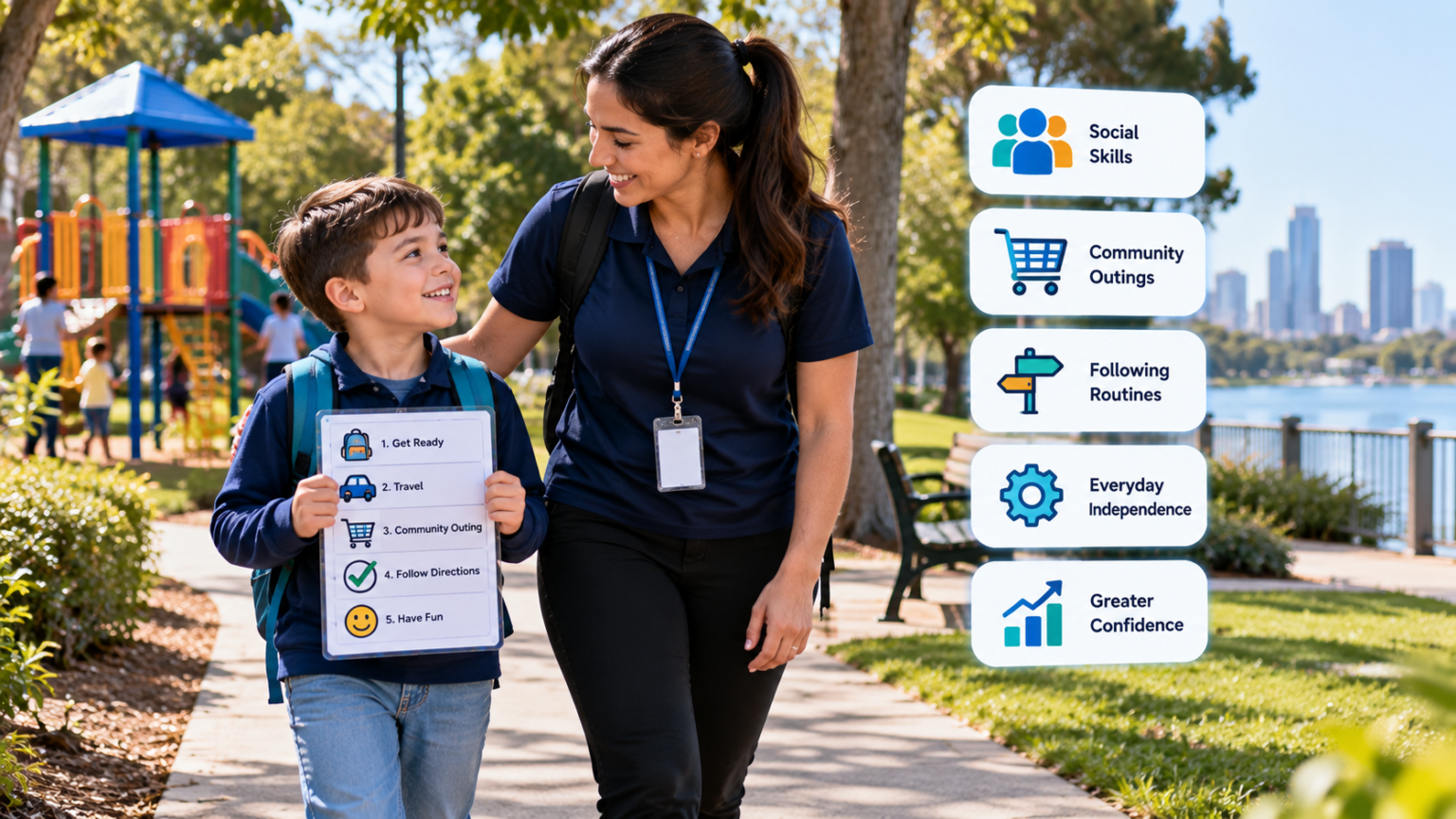
Community outings are an important part of developing independence, confidence, communication, and social skills. For children and individuals with autism, everyday activities outside the home can sometimes present challenges because of unfamiliar surroundings, unexpected changes, sensory stimulation, crowds, waiting, or difficulties communicating with other people. These situations can make activities such as shopping, visiting a restaurant, attending appointments, going to recreational activities, or spending time in public spaces more complicated. ABA therapy for community outings provides structured opportunities to teach practical skills in environments where those skills are naturally needed. By using individualized goals, positive reinforcement, prompting, modeling, and gradual practice, ABA professionals can help individuals become more comfortable and capable during everyday community experiences.
Understanding the Importance of Community-Based Learning
Learning does not stop when an individual leaves the home or classroom. In fact, community environments provide some of the most valuable opportunities for practicing functional skills because they require people to respond to real situations as they happen. An individual may successfully practice communication, waiting, following instructions, or social interaction in a familiar environment but struggle to use those same skills somewhere new. ABA therapy for community outings helps bridge this gap by providing opportunities to practice previously learned behaviors in realistic situations. The therapist can support the individual while gradually encouraging greater independence, making it easier to transfer important skills from one environment to another.Community-based learning can also help individuals understand that the skills they develop have practical value. Asking for an item at a store, waiting for a turn at a recreational activity, communicating with restaurant staff, following a caregiver’s instructions, or safely moving through a public area are all meaningful abilities. These experiences allow therapy goals to become connected to everyday life rather than remaining limited to structured sessions. As individuals become more successful, they may develop greater confidence in their ability to handle new experiences. This sense of achievement can encourage continued participation and create additional opportunities for learning.
Building Communication Skills in Everyday Environments
Communication is one of the most important skills for successful community participation. Individuals may need to request something they want, tell someone that they are uncomfortable, ask for assistance, answer questions, make choices, or communicate when they need a break. In a community setting, these communication opportunities occur naturally and frequently. ABA therapy for community outings can focus on teaching functional communication that allows individuals to express their needs and interact more effectively with people around them. Depending on the individual’s abilities, communication may involve spoken language, gestures, picture-based systems, communication devices, or other appropriate methods.Therapists can create opportunities for communication without forcing unnecessary interactions. For example, a child may be encouraged to request a preferred item while shopping, communicate a food choice at a restaurant, or ask for help when an activity becomes difficult. The therapist can provide prompts when needed and gradually reduce those prompts as the individual becomes more independent. This approach helps ensure that communication skills are useful beyond therapy sessions. The objective is to give the individual a reliable way to express needs and participate in activities while increasing confidence in communicating with different people.
Developing Social Skills Through Real Experiences
Social skills are often easier to understand when they are connected to real-life situations. Community environments provide opportunities to practice greetings, turn-taking, responding to questions, listening, sharing, respecting personal space, and appropriately interacting with others. These skills can be taught through structured practice and then applied during natural interactions. ABA therapy for community outings can help individuals understand social expectations while providing support when an interaction becomes confusing or challenging. Instead of expecting immediate independence, therapists can introduce social skills gradually and provide assistance according to the individual’s needs.A therapist may begin with simple interactions and build toward more complex social situations. For example, an individual might first practice saying hello to a familiar person and later work on answering a question from someone outside their immediate support network. The therapist can reinforce appropriate responses and provide constructive guidance when additional support is required. Over time, repeated exposure to different social situations can help make interactions more predictable and manageable. The ultimate goal is not to make every person behave in exactly the same way but to help individuals develop practical social skills that allow them to participate comfortably and meaningfully.
Teaching Safety Skills and Appropriate Boundaries
Safety is a fundamental part of successful community participation. Individuals may need to learn how to remain close to a caregiver, respond to safety instructions, stop when asked, recognize boundaries, wait before entering certain areas, and understand basic environmental risks. These skills can be difficult to teach effectively through verbal explanations alone because they often depend on the specific environment in which they are used. ABA therapy for community outings allows safety skills to be practiced in appropriate real-world situations while a trained professional provides guidance and support.Safety instruction can be broken into smaller steps so that expectations are easier to understand. A therapist might teach an individual to stop at a specific point, wait for an adult’s instruction, remain within an agreed-upon area, or respond consistently to a safety cue. Visual supports, modeling, repetition, and positive reinforcement may be used during the learning process. As the individual demonstrates progress, prompts can be gradually reduced. Practicing these behaviors repeatedly can make safety responses more familiar and help individuals participate in community activities with greater independence.
Managing Transitions and Changes in Routine
Transitions can be challenging for individuals who rely heavily on predictable routines. A community outing may involve several transitions, such as leaving the home, traveling to an activity, entering a building, waiting, changing activities, and returning home. Unexpected events can make these transitions even more difficult. An activity may be delayed, an item may be unavailable, a location may be crowded, or plans may change. ABA therapy for community outings can help individuals develop flexibility and coping skills that make these changes easier to manage.Visual schedules, countdowns, first-then language, verbal reminders, and other individualized supports can help prepare individuals for transitions. Rather than suddenly changing an activity, therapists can introduce changes gradually and teach the person how to respond appropriately. For example, an individual may learn that an expected activity can sometimes be replaced with another suitable activity. This type of practice can help reduce dependence on rigid routines and encourage flexible thinking. With repeated opportunities to experience manageable changes, individuals can learn that an unexpected event does not necessarily mean that the entire outing has failed.
Encouraging Independence During Daily Activities
A major goal of community-based ABA is helping individuals become as independent as possible. Independence does not necessarily mean completing an entire activity without assistance. Instead, it means identifying which parts of an activity an individual can perform independently and then teaching the remaining skills step by step. ABA therapy for community outings can help break complex activities into smaller components so that each part can be practiced and mastered. This makes it easier to recognize progress and determine where additional teaching is needed.For example, an individual may be able to select an item independently but require assistance with paying for it. Another person may communicate effectively but need reminders about waiting patiently. A therapist can identify these specific areas and develop goals around them. Prompts can initially be provided when necessary and then systematically reduced as the individual’s skills improve. This process encourages active participation rather than simply completing the activity for the individual. Over time, small improvements can combine to create significant increases in functional independence.
Using Positive Reinforcement to Encourage Progress
Positive reinforcement is a commonly used behavioral strategy that can encourage individuals to repeat appropriate and useful behaviors. During community activities, reinforcement can be provided when an individual communicates appropriately, follows an instruction, waits patiently, completes a transition, uses a safety skill, or participates independently. Effective reinforcement should be individualized because different people find different things motivating. For one individual, verbal praise may be meaningful, while another may respond better to access to a preferred activity, item, interaction, or another appropriate form of reinforcement.The purpose of reinforcement is to make successful behaviors more likely to occur again. Therapists can identify behaviors that support the individual’s goals and provide meaningful consequences when those behaviors occur. As skills become stronger, reinforcement can be adjusted and gradually made less frequent when appropriate. This helps individuals become increasingly independent rather than relying on constant rewards. When reinforcement is used thoughtfully, it can make learning more engaging while helping individuals understand the connection between their actions and positive outcomes.
Improving Emotional Regulation During Outings
Community environments can sometimes create sensory, emotional, or behavioral challenges. Loud sounds, unfamiliar people, crowded spaces, waiting, unexpected changes, or difficult tasks may cause frustration or distress. Teaching emotional regulation skills can help individuals recognize and respond to these situations more effectively. ABA therapy for community outings can incorporate strategies that help individuals communicate discomfort, request a break, use coping techniques, or transition away from an overwhelming situation in an appropriate manner.Therapists may first identify situations that commonly lead to distress and then teach replacement behaviors that are easier and safer to use. For example, an individual who becomes frustrated when an activity ends may learn to use a visual schedule or communicate that they need additional time. Someone who becomes overwhelmed in a busy environment may learn to request a break. These strategies give individuals practical alternatives to challenging behavior. With consistent practice, they can become better equipped to communicate their needs before frustration becomes overwhelming.
Helping Individuals Generalize Their Skills
Generalization is an important part of meaningful learning. A person may demonstrate a skill successfully with a therapist but struggle to use that same skill with a parent, teacher, peer, employee, or unfamiliar person. Similarly, a behavior learned in one environment may not automatically appear in another. Community activities provide opportunities to practice skills under different conditions and with different people. ABA therapy for community outings can support this process by varying locations, activities, people, and circumstances while maintaining consistent learning objectives.For example, an individual who learns to request help from a therapist can gradually practice requesting help from caregivers and appropriate community staff. Someone who learns to wait during one activity can practice waiting in different settings. Changing the circumstances in which a skill is practiced helps individuals understand that the skill is useful across many situations. This can make learning more functional and increase the likelihood that important behaviors will appear naturally in everyday life.
Preparing for Shopping and Errand Activities
Shopping trips and everyday errands can provide numerous opportunities for developing practical life skills. Individuals may practice following a list, choosing between items, staying near a caregiver, waiting in line, communicating with employees, handling changes, and completing a purchase. These activities can initially be overwhelming, so therapists may begin with short and highly structured experiences before gradually increasing the complexity of the outing. As confidence grows, the individual can take on more responsibility during the activity.A shopping trip can also teach decision-making and functional communication. An individual might learn to choose between two appropriate options, identify a preferred product, ask where an item is located, or communicate when they are finished. These abilities can support greater independence in the future. The therapist can monitor progress and adjust the level of support according to the individual’s needs. With regular practice, ordinary errands can become valuable opportunities for building practical skills that extend beyond therapy.
Practicing Restaurant and Recreational Skills
Restaurants, parks, entertainment venues, and recreational activities offer different types of learning opportunities. At a restaurant, an individual may practice waiting, making a selection, communicating an order, remaining seated, and responding appropriately to staff. Recreational activities may provide opportunities for turn-taking, following rules, interacting with peers, tolerating changes, and participating in group activities. ABA therapy for community outings can be adapted to these different environments so that therapy remains connected to the individual’s actual interests and daily routines.Enjoyment should remain an important part of these experiences. Community activities are not only opportunities for instruction; they are also opportunities for individuals to have fun, explore interests, spend time with family, and develop meaningful relationships. When therapy incorporates preferred activities, individuals may be more motivated to participate and practice new skills. A balanced approach can therefore support both skill development and quality of life.
Supporting Families and Caregivers
Caregivers have an important role in maintaining progress outside structured therapy sessions. When caregivers understand the strategies being used, they can provide consistent support during everyday activities. Therapists may demonstrate how to use visual supports, provide clear instructions, encourage communication, reinforce appropriate behavior, and respond consistently to challenging situations. Consistency can make it easier for individuals to understand expectations and use their skills in different circumstances.Family participation can also help identify goals that are genuinely meaningful. One family may prioritize successful shopping trips, while another may focus on recreational activities, appointments, social events, or restaurant visits. Treatment should consider the individual’s abilities and the activities that are important to their daily life. When therapy goals reflect real priorities, practice becomes more meaningful and progress can have a direct impact on everyday independence.
Measuring Progress and Adjusting Goals
Progress should be monitored using clear and observable goals. Instead of using vague objectives, therapists can measure specific behaviors such as the number of prompts required, the length of time an individual waits appropriately, the number of independent requests made, or the number of steps completed without assistance. ABA therapy for community outings can use this information to determine whether current strategies are effective and whether goals should be modified as the individual develops new skills.Data collection can also reveal improvements that may not be immediately obvious. An individual who once needed constant support may eventually require only occasional reminders. Another person may begin using communication instead of challenging behavior when they need help. These changes represent meaningful progress because they can improve participation and independence. Regular assessment allows therapists and caregivers to celebrate achievements while identifying areas that still require focused teaching.
Creating Long-Term Confidence and Independence
The ultimate purpose of community-based skill development is to help individuals participate more fully in everyday life. Success is not defined by completing every activity perfectly or behaving exactly like everyone else. Instead, meaningful progress can involve communicating needs more effectively, staying safer, handling changes more successfully, participating in preferred activities, and completing more tasks independently. ABA therapy for community outings can contribute to these goals by providing structured practice in situations that are directly relevant to everyday living.Every individual progresses at a different pace, and goals should reflect personal strengths, needs, interests, and priorities. Some people may quickly develop independence in familiar activities while requiring more time to adjust to unfamiliar situations. Others may make gradual progress through repeated practice and consistent support. By using individualized instruction, positive reinforcement, appropriate prompting, caregiver collaboration, and opportunities for generalization, community-based ABA can help build practical skills that remain useful beyond the therapy setting.
Conclusion
Community participation is an important part of developing independence and improving quality of life. Everyday environments provide opportunities to practice communication, social interaction, safety awareness, emotional regulation, flexibility, decision-making, and functional life skills in ways that are meaningful and practical. ABA therapy for community outings can help individuals approach these experiences with greater preparation and support while gradually increasing their independence.Successful community-based intervention should focus on the individual rather than expecting every person to follow the same path. Goals should be realistic, measurable, meaningful, and connected to activities that matter to the individual and their family. Through repeated practice, positive reinforcement, thoughtful preparation, and gradual reduction of support, individuals can develop skills that make community participation more manageable and rewarding. With the right approach, everyday outings can become valuable opportunities for learning, confidence building, and long-term growth.
