
A friend of mine who runs engineering at a mid-size fintech told me last month that his team stopped asking “can the AI answer this” and started asking “how many agents does this need.” That’s the real shift underneath all the noise. Single chatbots are fine for one question, but the second a task needs three or four steps done in order, they fall apart – someone has to babysit the handoffs. Agentic AI collaboration is basically the answer to that problem: instead of one model juggling everything, you split the work across a small group of agents that each own a piece and pass work along, kind of like a real team would.
Gartner clocked a 1,445% jump in inquiries about multi-agent systems between Q1 2024 and Q2 2025. I don’t love quoting a single stat like that’s the whole story, but it does line up with what you see on the ground – companies moved from “let’s try this” to “let’s actually plan a rollout” pretty quickly. If you’re weighing options for AI Agent Development, the first real fork in the road is usually this: one capable agent, or several coordinated ones?
Assistant vs. collaborator, and why the difference matters
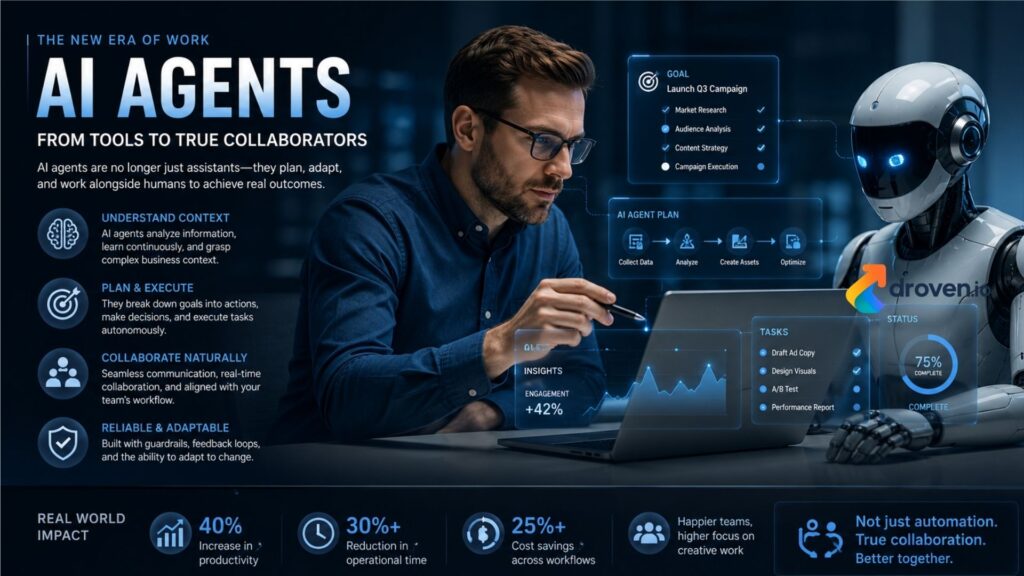
Old AI waited for a question and answered it. That was the whole relationship. An AI acting as a digital collaborator carries a goal across a bunch of steps on its own, decides which tool or sub-agent handles which piece, and only taps a human on the shoulder when something needs actual judgment.
Honestly, this is what people are getting at when they say human-AI collaboration now – not a model taking someone’s job, just one soaking up the grunt work of breaking a task into pieces so a person’s attention goes where it’s actually needed. A research agent pulls sources, a drafting agent turns them into something readable, a review agent checks it against style or compliance rules – and a human only sees it once it’s already been through that loop.
The plumbing: reasoning, memory, talking to each other
Three pieces have to hold together. The model does the reasoning – plans steps, adjusts when something breaks. Memory keeps context alive across a long task so the agent isn’t starting cold every call. And communication between agents is honestly the hard part, because they need some shared way to hand off tasks and results.
Two protocols quietly became the plumbing for this. Anthropic’s Model Context Protocol (MCP) standardizes how one agent talks to its tools and data – think of it as the agent’s wiring to whatever it needs to touch. For instance, if a supply chain agent needs to estimate shipping space for round containers, MCP allows it to instantly ping an external cylinder volume calculator to get precise metrics without human intervention. Google’s Agent2Agent protocol (A2A), now sitting under the Linux Foundation, covers the other direction.
On picking a framework
LangGraph is the one people reach for when a workflow stops being a straight line – you get graph-level control over branching and state, which matters once things get messy. CrewAI is the opposite instinct: define roles almost like job titles and let the framework sort out coordination, which is honestly easier to explain to a non-technical stakeholder. AutoGen leans into agents that argue with each other a bit – draft, critique, redo – good fit if your workflow is basically peer review. Google’s Agent Development Kit ties in tightly with Gemini Enterprise and A2A, an obvious choice if you’re already living on Google Cloud, and the OpenAI Agents SDK is the fastest way to get something tool-calling up without much scaffolding at all.
I haven’t seen a team pick one of these on the first try and stick with it. Most test two side by side, because ripping out months of integration work later is genuinely painful, and cheaper to avoid.
Where it’s already running, not just piloting
Software teams run an orchestrator agent that splits a feature request into pieces, hands the build to a coding agent, and lets a review agent run tests before a human ever merges. Support teams split routing, lookup, and drafting into separate agents and only escalate the messy cases. Research and reporting teams have agents pull numbers from internal systems, cross-check them against each other, and hand analysts something closer to a finished draft than a blank page.
Vendors noticed fast – Google’s Gemini Enterprise Agent Platform and IBM’s enterprise AI tooling are both leaning into this same handoff pattern, with audit trails bolted on so someone can trace who, or what, actually made a call. That part matters more than it sounds like it should. The EU AI Act already puts real obligations on higher-risk automated decision systems, so if agents are touching customer or financial decisions, compliance needs to be part of the design, not something you patch in after the fact. Before handing agents anything with real stakes attached, it’s worth reading how much you can actually trust an AI agent with business decisions.
The tradeoffs, plainly
Splitting work across agents gets around the context-window ceiling that trips up one model doing everything, and once an agent’s proven, you can reuse it elsewhere instead of rebuilding from zero. Teams do report faster first drafts and fewer steps quietly falling through the cracks somewhere in a long process.
That said – coordination costs tokens, sometimes a lot of them, more than a single-agent setup would. Small mistakes early in a chain don’t stay small; they ride downstream through every agent after them. And access control for agents is still kind of a mess industry-wide – most companies can’t cleanly say what a given agent is actually allowed to touch. So start small: a repetitive, well-scoped workflow, not your messiest open-ended process. Same caution applies if you’re bringing agents into AI-driven marketing and growth – brand tone still wants a human glance before anything ships.
If you’re starting from zero
Pick one narrow, repetitive workflow first. Use a framework that fits what your team already knows rather than whatever’s trending this month. Put a checkpoint wherever real judgment happens, and log why each agent decided what it did – you’ll want that record later even if it feels unnecessary now. Add a second agent only once the first one is boring to watch, in a good way. None of this assumes you build it in-house, though. Plenty of teams would rather not spend their first month wiring up MCP connections and arguing with a framework, and that’s the gap custom-built AI agent development services fill – someone who has already shipped this kind of thing scopes the workflow, stands up the agent against your systems, and hands you something that actually runs. The tradeoff is the usual one: doing it yourself means you own every decision and keep the knowledge on your team, while bringing in outside help gets you to a working agent faster but you have to stay close so it fits how your business really works. Neither is automatically right – it mostly comes down to whether agent engineering is something you want to keep doing after this project, or a one-off you would rather not staff up for. Either way the starting advice doesn’t change: one narrow workflow, a human checkpoint where judgment lives, and a real audit trail from day one.
FAQs
What is agentic AI collaboration, really?
Multiple agents working toward a shared goal, checking each other’s output, talking through standard protocols instead of a human relaying messages between them.
Isn’t this just automation with extra steps?
Not quite – the human stays in the loop for judgment calls. Agents take the repetitive breakdown work off your plate, not the decisions that actually matter.
What do you actually get out of AI agents in the workplace?
Quicker turnaround on anything multi-step, fewer dropped handoffs, and agents you can reuse across different jobs instead of writing new logic every time.
How do I start?
Small. One workflow, a framework that matches your stack, a human checkpoint somewhere real judgment lives.
What actually goes wrong?
Token costs climb from all the back-and-forth between agents, errors compound instead of staying contained, and nobody’s access controls for agents are quite mature yet.
LangGraph, CrewAI, or AutoGen?
Depends what you’re building – stateful and branching goes LangGraph, simple role-based teams go CrewAI, anything that’s basically agents reviewing each other’s work goes AutoGen.
Does the EU AI Act actually touch this?
If agents are making customer-facing or financial calls, yes – build compliance early, don’t bolt it on once something’s already shipped.
