
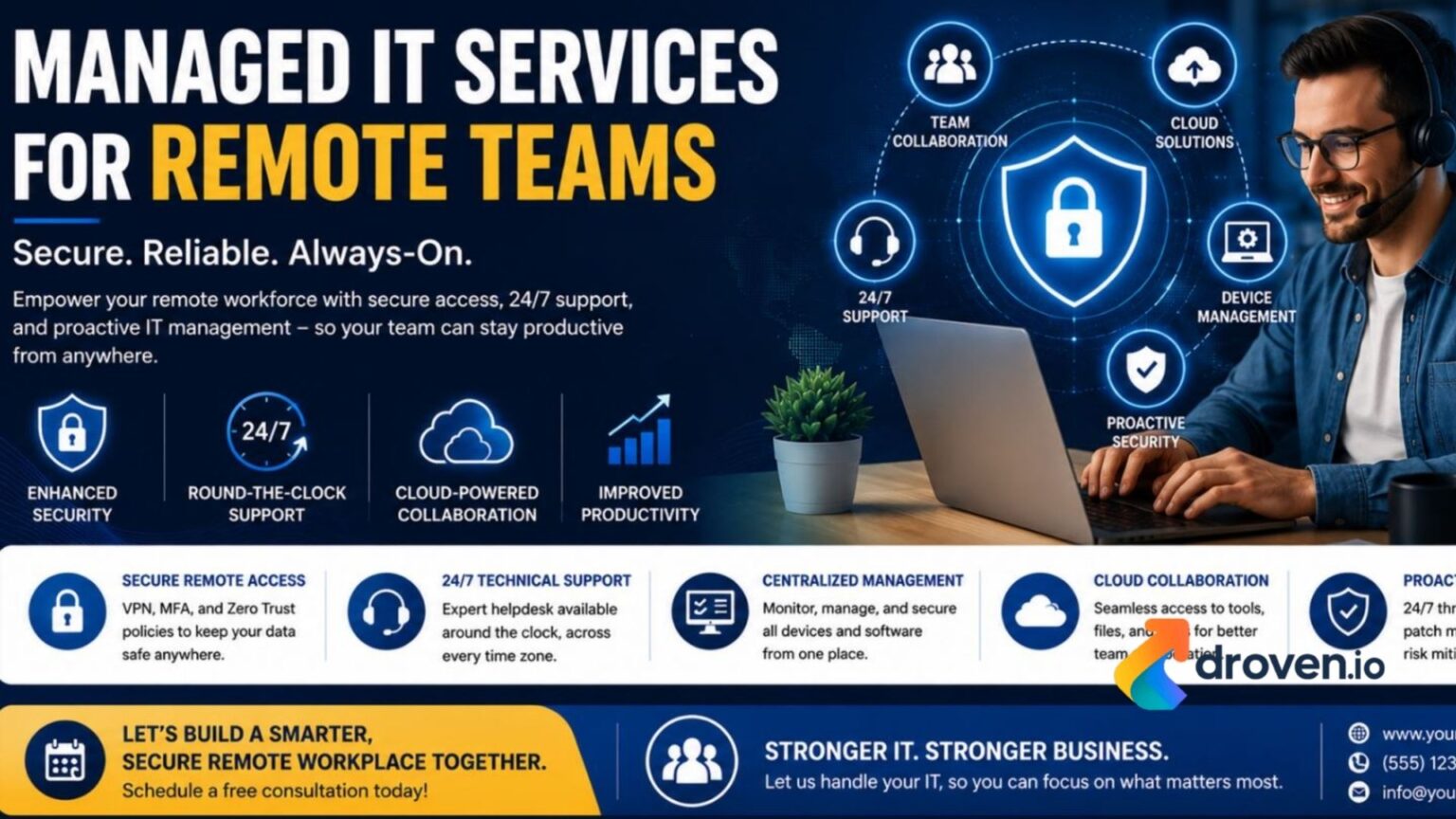
What Are the Benefits of Managed IT Services for Remote Teams?
Executive Summary: Managed IT Services provide remote teams with secure remote access, round-the-clock technical support, centralized device management, cloud collaboration infrastructure, and proactive cybersecurity – delivered through a single, scalable engagement model. For organizations operating distributed or hybrid workforces, partnering with a qualified Managed IT Services provider represents one of the most strategic investments a business can make in operational resilience and workforce productivity.
The Evolving IT Demands of a Remote Workforce
The IT needs of contemporary enterprises have changed significantly due to the extensive use of remote and hybrid work methods. What used to be a centralized, office-bound function has evolved into a distributed, continuous operating requirement.
IT management becomes much more complicated when workers work from home offices, local co-working spaces, or foreign locations. Corporate devices span multiple networks of varying security standards. Sensitive data traverses unsecured or unmonitored connections. Compliance obligations remain in force regardless of where work is performed. And technical issues that would have been resolved within minutes in a traditional office environment can result in hours of lost productivity for a remote employee with no immediate support.
Conventional in-house IT models were architected for centralized environments. They were not designed to deliver consistent, secure, and scalable support across geographically dispersed teams. Managed IT Services were purpose-built for exactly this challenge.
The following sections outline the core benefits that Managed IT Services deliver to remote organizations.
Secure Remote Access Infrastructure
For every company with a dispersed workforce, security is the top priority. The organization’s attack surface grows significantly when employees access company systems from personal devices or home networks, exposing weaknesses that hackers are well-positioned to take advantage of.
By putting in place an organized, enterprise-grade remote access infrastructure that consists of the following, managed IT services providers reduce this risk:
- Encrypting all data while it’s in transit using virtual private networks (VPNs)
- Every access point uses Multi-Factor Authentication (MFA) to verify user identities.
- Policies for Zero Trust Network Access (ZTNA) that uphold least-privilege
- All remote devices have endpoint protection software installed and maintained.
Managed providers enforce consistent security standards for all users, as opposed to depending on individual employees to set up and maintain their own security posture. This creates a security perimeter that follows the worker wherever they go.
Round-the-Clock Technical Support Across Time Zones
Conventional business-hours IT support is structurally insufficient for a geographically dispersed workforce that functions across numerous time zones. If support is not available, a team member experiencing a crucial system failure outside of regular business hours may suffer severe productivity losses and project delays.
In order to guarantee that workers receive prompt technical assistance regardless of when or where problems emerge, managed IT services engagements usually include round-the-clock helpdesk support. Resolution channels via phone, email, or ticketing systems are available around-the-clock, regardless of the issue account access, software configuration, hardware performance, or connectivity. As part of this support, IT teams can also assist with email-related settings, including ideas for email signatures that help employees maintain consistent communication.
Unresolved technological issues are one of the most costly and generally neglected expenses in remote work environments. Investing in always-on managed support enables enterprises to maintain higher levels of operational continuity across their scattered teams while reducing downtime in meaningful ways.
Centralized Device and Software Management
There are significant logistical and security concerns when managing a fleet of remote devices spread across several locations. Organizations must deal with uncertainty about software versions, patch compliance, device settings, and security policy enforcement in the absence of centralized control.
Remote Monitoring and Management technologies, which offer complete visibility and control over each registered device regardless of location, are how managed IT services companies handle this. Capabilities delivered through this model include:
- Automated deployment of software updates and critical security patches
- Real-time device performance monitoring with proactive issue identification
- Remote device wipe capabilities to safeguard data in the event of loss or theft
- Consistent enforcement of software licensing, security configurations, and usage policies
Centralized device management guarantees that the company always maintains a uniform, safe, and audit-ready technology environment while relieving individual employees of the operational burden.
Proactive Cybersecurity for Distributed Environments
An organization’s threat vulnerability is naturally increased by remote work infrastructures. Every home network, cloud access point, and remote endpoint is a possible conduit for data exfiltration, service interruption, and illegal access.
Managed IT Services deliver comprehensive, proactive cybersecurity measures scaled to the needs of distributed organizations. Standard security provisions include:
- Constant observation of network traffic and identification of anomalies
- Sophisticated anti-phishing and email filtering
- Cloud-based, encrypted data backup with specific recovery goals
- Frequent penetration testing and vulnerability assessments
- Remote workers receive structured security awareness training.
This layered approach aims to detect and eliminate risks before they affect company operations. Proactive security management is an essential operational necessity in distributed IT settings, where traditional perimeter defenses are usually ineffective.
Cloud Infrastructure and Collaboration Enablement
A strong, dependable cloud environment where documents, apps, and communication tools are regularly accessible from any authorized device or location is necessary for a productive remote workforce. This infrastructure is designed, implemented, and maintained by managed IT services providers in accordance with security standards and organizational needs, with Cloud application implementation playing an important role in ensuring business applications are deployed securely, integrated effectively, and remain accessible across distributed teams.
Usually, managed support includes the setup and continuing management of:
- Google Workspace or Microsoft 365 for creating documents and collaborating in real time
- File management using cloud storage services like OneDrive, Google Drive, and SharePoint
- Tools for business communication, such as Slack or Microsoft Teams
- Third-party application connectors, CRM systems, and project management systems
Managed providers actively maintain these environments after initial deployment, supervise data backup procedures, control user provisioning and permissions, and guarantee that departing personnel are safely and swiftly offboarded from all systems.
Structured Onboarding and Offboarding Processes
The efficiency and security of employee onboarding and offboarding processes are frequently underestimated areas of IT risk for remote organizations. In the absence of a structured managed model, these transitions are often inconsistent, time-consuming, and prone to security gaps.
Managed IT Services providers standardize and automate these workflows. New employee onboarding encompasses device provisioning, application installation, account creation, access rights assignment, and security baseline verification – all executed according to defined procedures and completed within predictable timeframes. An onboarding LMS often sits alongside these IT-led steps to carry the role-specific training, compliance refreshers, and progress checkpoints that turn first-day access into a productive start.
Employee offboarding is managed with equal rigor. Access credentials are revoked immediately upon separation, devices are remotely wiped and reclaimed where applicable, and all relevant audit records are updated. This level of process discipline is particularly critical in remote environments, where the absence of physical controls makes digital access management the primary safeguard against data exposure.
Scalable IT Capacity Aligned with Business Growth
Regulations pertaining to data security and privacy are complicated and constantly changing for organizations with globally dispersed staff. Regardless of where employees are physically based, requirements under frameworks like PCI-DSS, HIPAA, GDPR, and CCPA apply, and non-compliance has serious legal and financial repercussions.
Managed IT Services are inherently scalable. As an organization adds team members, enters new markets, or establishes new operational locations, IT services in Dubai enable businesses to extend the same service coverage, security standards, and infrastructure support to the expanded environment without requiring additional internal headcount or capital expenditure.
This elasticity makes Managed IT Services particularly well-suited to growth-stage companies and organizations undergoing strategic transformation.
Regulatory Compliance Across Multiple Jurisdictions
Organizations with internationally distributed teams must navigate a complex and evolving landscape of data privacy and security regulations. Requirements under frameworks such as PCI-DSS, GDPR, CCPA, and HIPAA apply regardless of where employees are physically located, and non-compliance carries material legal and financial consequences.
Skilled Managed IT Services providers help businesses fulfill and maintain compliance requirements in all pertinent jurisdictions. This includes putting in place suitable data handling procedures, safe cross-border data transmission methods, thorough audit trail documentation, and getting ready for regulatory checks or evaluations. When those obligations extend to the provider itself, enterprise customers often ask for a current soc 2 type 2 report before signing, since the managed engagement becomes part of their own compliance posture. For organizations using WordPress, a WordPress cookie banner can help manage user consent and support compliance with applicable privacy requirements. Organizational leadership can feel more confident about their regulatory position thanks to managed compliance support, which also significantly lowers litigation risk.
Predictable Cost Structure and Financial Transparency
IT expenditure in unmanaged remote environments is often unpredictable, driven by reactive incident response, ad-hoc vendor engagements, and unplanned infrastructure investments. This financial uncertainty complicates budgeting and diverts capital from growth-oriented priorities.
Managed IT Services operate on a structured, fixed-fee model – typically priced per user or per device on a monthly basis. This pricing structure delivers full visibility into IT costs, enables accurate annual budgeting, and eliminates exposure to large, unplanned expenditures.
When evaluated against the total cost of IT-related downtime, security incidents, and productivity losses that characterize unmanaged remote environments, the return on investment associated with a managed engagement is consistently favorable.
Strategic Focus for Organizational Leadership
Business executives who are better positioned to concentrate on strategic issues may find that the operational needs of maintaining a distributed IT infrastructure take up a disproportionate amount of their time and attention. Coordinating with several vendors, resolving security events, and troubleshooting technical problems are tasks that divert attention from the main goals of the company.
Organizational leadership may once again concentrate on growth strategy, client interactions, and competitive positioning by assigning IT management to a licensed Managed IT Services provider. Leadership may make choices with more confidence and strategic clarity when they know that IT operations are being proactively managed by skilled personnel.
Conclusion
The shift to remote and hybrid work has changed what businesses need from their IT department. The demands of a dispersed workforce functioning in a complex and dynamic threat environment can no longer be met by reactive, office-centric IT assistance.
A thorough, scalable, and affordable framework for meeting these criteria is offered by managed IT services. Managed providers provide the operational foundation necessary for remote teams to reach their maximum potential, from compliance management and round-the-clock help desk support to secure remote access and ongoing cybersecurity monitoring.
Managed IT services are more than just a support role for businesses dedicated to creating secure, productive, and resilient distributed workforces. They strategically facilitate long-term company success.
