
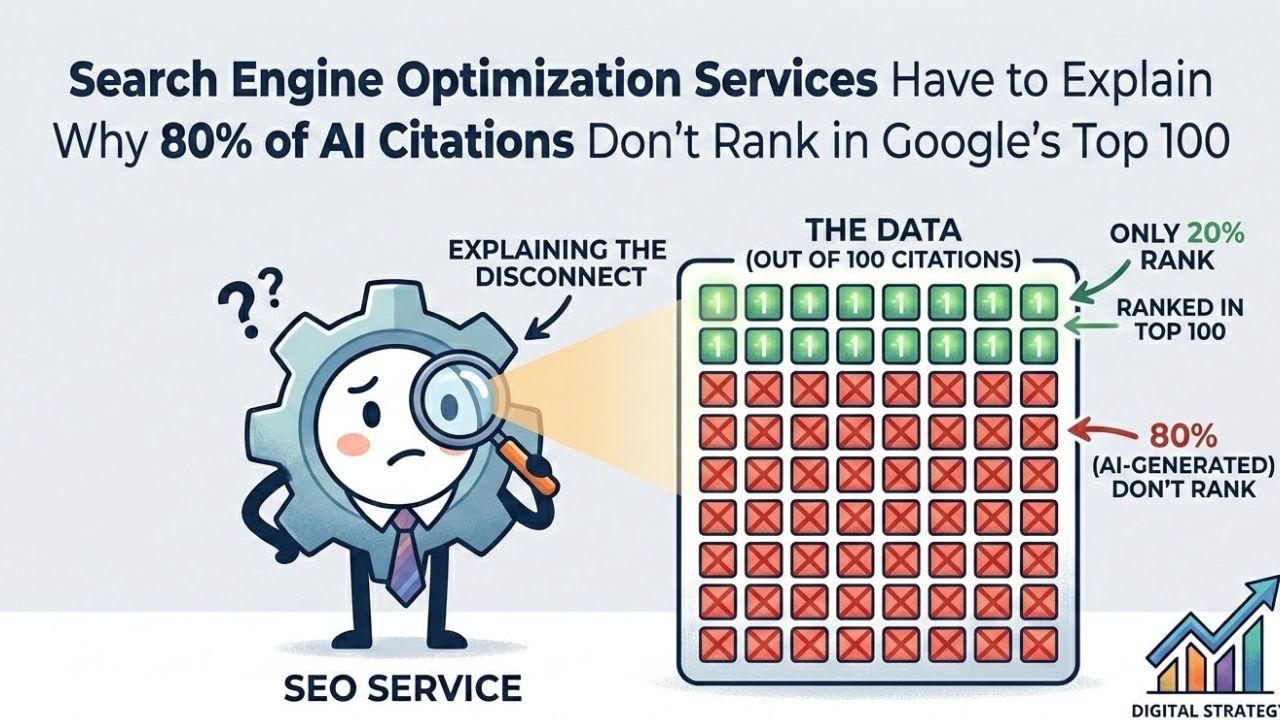
Search engine optimization services are facing a question clients didn’t ask two years ago: why does appearing in an AI-generated answer not translate to Google rankings? The gap is real and wide. Roughly 80% of websites cited by AI tools like Google’s AI Overviews fail to appear in the top 100 organic results. Understanding why that happens, and what to do about it, is now a core part of what SEO providers have to deliver.
What AI Citations Actually Are
AI citations in SEO refer to the source links that appear inside Google’s AI Overviews and Search Generative Experience responses. These are not traditional backlinks. To track how often your brand is cited and appears in AI-generated search results, many businesses use the best AI search monitoring tools to monitor AI visibility, citations, and overall performance across AI-powered search experiences.They are attribution signals that AI models use to point users back to the content they pulled from.
As of Q4 2024, 73% of AI answers include inline citations from top-ranking pages. Another 68% of featured snippets carry them as well. The mechanism varies: some citations are direct quotes, others are paraphrases, and others are synthesized insights drawn from multiple sources. Each type responds to different optimization inputs.
Google evaluates sources using domain authority scores and E-E-A-T (Experience, Expertise, Authoritativeness, and Trustworthiness) signals. Sites that score well on those dimensions get prioritized. Sites that don’t get skipped, regardless of how relevant their content may be.
Why 80% of Sites Miss the Cut
The failure rate breaks down into three buckets. Content quality issues account for 45% of failed AI citations. Technical implementation gaps contribute another 30%. Authority deficiencies make up the remaining 25%.
These are not abstract problems. Pages under 1,500 words receive 67% fewer AI citations. Missing schema markup reduces AI visibility by 43%. Domains with authority scores below 30 appear in only 12% of AI results across the tested queries.
Content Quality Problems
Content fails AI citation thresholds when it scores below 65 on Google’s helpfulness metrics or contains less than 40% original analysis versus aggregated information. Five specific problems drive most of these failures:
- Content under 1,200 words with thin E-E-A-T signals carries a 78% citation exclusion risk
- Duplicate content with similarity scores above 85% triggers detection by tools like Copyscape
- Information last updated more than 180 days ago loses relevance in AI evaluations
- Missing author credentials reduces the perceived credibility of the source
- Generic content without original data, case studies, or firsthand research scores poorly across AI quality assessments
Technical SEO Barriers
Even strong content gets blocked if the technical foundation is missing. AI models need structured data to parse content correctly. Without it, a page may be well written yet completely invisible to AI systems.
The core technical requirements: Core Web Vitals with LCP under 2.5 seconds, FID under 100ms, and CLS under 0.1. Article schema with author, datePublished, and dateModified fields. FAQ and HowTo schema implemented through tools like Yoast or Rank Math. Mobile-first indexing verification through Google’s Mobile-Friendly Test.
Setup for most schema additions takes 45 to 60 minutes per page. A full technical audit typically runs $200 to $500.
Authority and Trust Deficits
Sites with a domain authority below 25 receive zero AI citations in most query categories. The threshold is firm. Google’s AI models require verifiable expertise signals before selecting a source.
Four tactics consistently move the needle:
- Securing backlinks from domains with DA 50 or higher, targeting 15 to 20 quality links per quarter
- Displaying author credentials with bylines linked to LinkedIn profiles and publication history, which increases citation rate by 34%
- Publishing original research cited by three or more external sources
- Completing E-E-A-T verification through Google Business Profile, SSL certificates, and privacy policy compliance
One documented example: a B2B SaaS company increased AI citations from 2 to 47 per month after adding author-expertise pages and commissioning original data studies.
How This Is Changing Search Engine Optimization Services
By Q1 2025, 62% of enterprise clients were requesting AI visibility reports as part of their SEO contracts. That number reflects a real shift in what clients consider a deliverable.
Three structural changes are moving through the agency market. First, AI citation tracking is becoming a separate tier, typically priced at $150 to $300 per month, using tools like Perplexity API monitoring and Google AI Overview tracking. Second, E-E-A-T audits are moving from optional to standard. Third, generative engine optimization packages combining tools like Originality.ai and Surfer SEO are being priced at $400 to $700 per month.
Agencies adopting these changes report better client retention and cleaner performance documentation.
Supporting that documentation with reliable link data is equally important — integrating a backlinks API gives agencies programmatic access to backlink profiles, anchor text distribution, and referring domain metrics that strengthen both reporting and E-E-A-T audits.
The Gap Between What Clients Expect and What Happens
Clients routinely expect 40-60% of their content to appear in AI-generated answers within 90 days. The actual average for new optimization campaigns is 12-18%, according to 2024 industry benchmarks. The content volume and budget estimates are usually off as well.
| Metric | Expected | Actual |
| AI citation rate | 40-60% | 12-18% |
| Time to first AI citation | 30 days | 120-180 days |
| Content volume needed | 50 pieces | 150-200 pieces |
| Monthly budget | $2,000 | $4,500-6,000 |
Three client scenarios show how this plays out. A law firm expected 25 AI citations and achieved 8 after six months. An e-commerce site targeted 100 AI mentions and secured 23. A SaaS company expected its first ChatGPT citation within 60 days and received it in month eight.
The minimum realistic timeline for measurable AI citation improvement is four to six months. Clients who understand that upfront tend to stay longer.
How to Actually Optimize for AI Citations
Content and E-E-A-T Alignment
E-E-A-T alignment increases AI citation probability by 3.2x when content demonstrates expertise through author credentials, original data, firsthand experience, and verifiable sources. That multiplier is not theoretical. It shows up in citation tracking data.
Practical implementation means:
- Author bylines with LinkedIn profiles, publication history, and topic expertise scores above 75
- Original research with methodology details and sample sizes
- First-person experience framing, such as “in our testing of 47 tools over six months,” to signal real practice rather than compiled information
- Citing 8 to 12 authoritative sources per article with proper attribution
- Updating content every 90 days with fresh data and case studies to maintain freshness scores above 80
Tools that support this work include Clearscope ($170/month), MarketMuse ($99/month), and Originality.ai ($20/month).
Technical Implementation
Technical fixes boost AI citation rates by 156% when sites implement structured data, optimize Core Web Vitals, and add AI-friendly schema markup verified through Google’s Rich Results Test.
A practical implementation checklist:
- Add FAQ and HowTo schema using Rank Math’s free version (30 to 45 minutes per page)
- Hit Core Web Vitals targets: LCP under 2.5s, FID under 100ms, CLS under 0.1
- Implement Article schema with author, datePublished, and dateModified fields
- Verify through Google’s Rich Results Test with a 100% pass rate target
- Add Speakable schema in JSON-LD format for voice search compatibility
- Confirm mobile-first indexing through Google Search Console
Cost breakdown: $0-$99 for plugins, $300 for a technical SEO audit, $150/month for monitoring tools.
Where SEO Services Need to Be by 2026
Google expects 85% of search queries to trigger AI Overviews by 2026. That changes the primary metric for many campaigns. Agencies tracking only SERP positions are measuring an increasingly incomplete picture.
Companies like NetReputation, which operate at the intersection of SEO and search visibility management, have already shifted internal reporting to include AI citation frequency alongside traditional ranking data. That integration is becoming less of a differentiator and more of a baseline requirement.
How Agencies Should Restructure
Three specific service adaptations are worth building now.
First: an AI Citation Monitoring Service using the Perplexity API and custom tracking scripts, priced at $250 to $400 per month per client. Implementation takes two to three weeks.
Second: a Generative Engine Optimization audit with 52 evaluation points covering prompt engineering compatibility, citation likelihood scoring, and source authority verification. Audit costs range from $750 to $1,200 and take 10 to 15 hours.
Third: an AI Content Performance Dashboard integrating Google Search Console, Ahrefs, and custom visibility metrics. Tool costs of $100 to $200 per month are typically passed on to the client.
Agencies that have added AI citation services report a 34% increase in client retention. That figure is specific enough to use in a proposal and credible enough to expect when the work is done right.
