
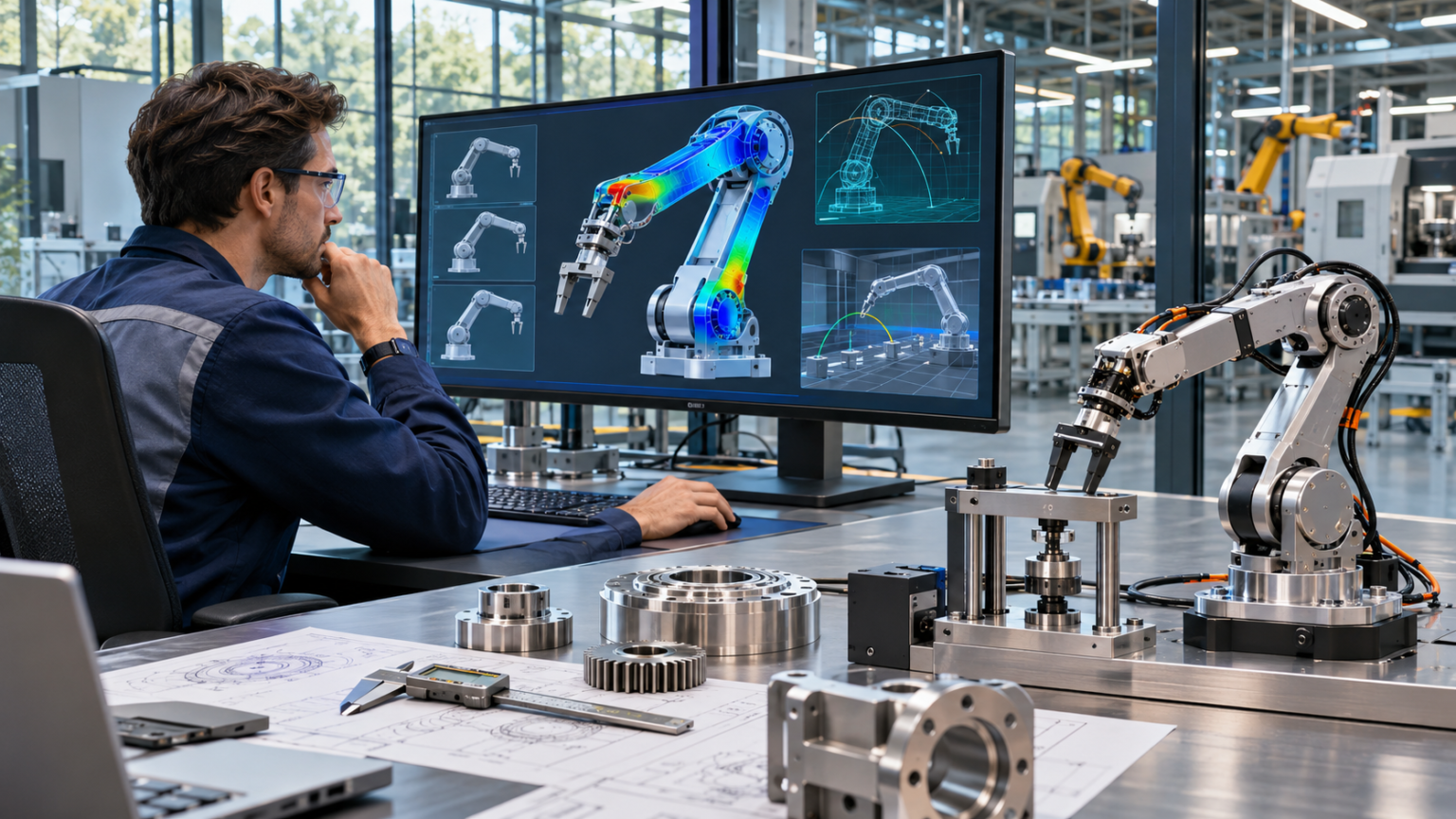
Engineering has always depended on precision, creativity, scientific knowledge, and practical problem solving. Today, artificial intelligence is expanding what engineers can accomplish by helping them evaluate complex designs, analyze large datasets, and make better informed technical decisions. AI-Driven Engineering combines machine learning, intelligent automation, advanced simulation, and engineering expertise to support the development of safer, more efficient, and more reliable systems.
Traditional engineering workflows often require extensive calculations, repeated simulations, physical testing, and manual analysis. These activities remain essential, but AI can improve how engineers perform them by identifying patterns, proposing alternatives, and predicting potential problems earlier in the development process.
From mechanical design and civil infrastructure to manufacturing and renewable energy, intelligent engineering applications are becoming increasingly relevant. However, artificial intelligence is not a replacement for engineering judgment. Successful implementation requires dependable data, physical validation, clearly defined objectives, and responsible human oversight.
Understanding these technologies and their practical limitations helps engineering organizations identify valuable opportunities without compromising safety or technical accuracy.
What Is AI-Driven Engineering?
AI-Driven Engineering is the application of artificial intelligence, machine learning, and data analytics to engineering design, simulation, testing, manufacturing, and operational processes.
Rather than relying exclusively on manual calculations and conventional computational methods, engineers can use intelligent systems to analyze relationships between design variables and performance outcomes.
For example, an engineer designing an industrial component may need to evaluate its weight, mechanical strength, manufacturing cost, and expected operating conditions.
An AI-assisted optimization system can explore combinations of design parameters and identify promising alternatives. Engineers then evaluate those alternatives through suitable simulations, experiments, and established engineering requirements.
The objective is to improve decision making and reduce unnecessary repetitive work while maintaining technical accountability.
How Artificial Intelligence Works in Engineering
Engineering AI systems typically use data from simulations, experiments, sensors, inspections, or historical operating records.
Machine learning algorithms analyze these datasets to identify relationships that may help predict future outcomes.
Depending on the application, an intelligent model might estimate structural performance, detect manufacturing defects, or recognize unusual equipment behavior.
The accuracy of these predictions depends heavily on data quality and whether the model encounters conditions similar to those represented during development.
How AI Differs From Traditional Engineering Software
Traditional engineering software often uses explicit mathematical equations and established physical models to calculate system behavior.
AI models can learn relationships from examples and make predictions based on those learned patterns.
These approaches are not mutually exclusive.
In many applications, the strongest workflow combines physical engineering principles with data-driven predictions.
For instance, AI may rapidly estimate performance across many design options, while conventional simulation and physical testing verify the most promising candidates.
This combination makes artificial intelligence a supporting tool within a broader engineering process.
9 Brilliant Breakthroughs Transforming Modern Engineering
Artificial intelligence is influencing engineering in several connected ways. The following developments demonstrate how intelligent tools can support practical improvements across the engineering lifecycle.
1. Generative Design Expands Engineering Possibilities
Generative design uses computational algorithms to explore potential solutions within defined engineering constraints.
Instead of producing one design manually and modifying it repeatedly, engineers can specify objectives such as strength, weight, material limits, and available manufacturing methods.
The system then explores possible configurations.
For example, an aerospace engineer developing a lightweight mounting bracket may use generative design to identify structures that reduce material usage while meeting defined load requirements.
The resulting shapes may differ significantly from conventional designs.
However, an attractive generated structure is not automatically manufacturable or safe.
Turning Design Concepts Into Practical Components
Engineers must examine manufacturing tolerances, material behavior, fatigue resistance, inspection requirements, and production costs.
Physical testing and appropriate engineering calculations remain essential before a component enters service.
Generative design is most valuable when it broadens design exploration without bypassing the normal validation process.
2. Intelligent Simulation Makes Design Exploration More Efficient
Engineering simulations help predict how systems respond to forces, heat, fluid movement, and other physical conditions.
Detailed simulations can require substantial computing resources, particularly when models contain complicated geometry or multiple interacting physical effects.
AI-assisted surrogate models offer another approach.
These models learn from existing simulation results and estimate outcomes for new design parameters.
For example, a mechanical engineering team studying cooling performance could use a trained model to screen several configurations before conducting detailed computational fluid dynamics analysis.
This may allow engineers to explore more options within a limited computational budget.
Why Simulation Validation Still Matters
A surrogate model is an approximation, not a complete replacement for the underlying physical solver.
Its accuracy may decrease when applied beyond the conditions represented in training data.
Engineers should therefore compare predictions against trusted simulations and experimental results.
The appropriate level of validation depends on the consequences of an incorrect prediction.
3. Physics Informed Machine Learning Improves Technical Modeling
Many engineering problems involve physical laws that should remain valid regardless of the available training data.
Physics informed machine learning incorporates relevant physical relationships into the development of intelligent models.
These relationships may involve conservation of energy, conservation of mass, mechanical equilibrium, or other established principles.
For example, a model predicting temperature distribution within industrial equipment may use both observed measurements and heat transfer equations.
Combining data with physical knowledge can help constrain predictions and improve model usefulness in certain applications.
However, including physical equations does not automatically guarantee correct results.
The selected equations, boundary conditions, assumptions, and training data must still represent the actual system.
This approach is particularly promising when experimental data are limited but the governing physical relationships are reasonably well understood.
4. Digital Twins Connect Physical Assets With Virtual Models
A digital twin is a digital representation of a physical asset or process that is connected to relevant information about its condition or behavior.
Digital twins can combine engineering models, operational measurements, and historical records.
Artificial intelligence can extend these systems by supporting anomaly detection, forecasting, and operational analysis.
Consider a manufacturing facility operating several industrial pumps.
A digital twin might represent the pumps’ operating characteristics while receiving measurements such as vibration, pressure, and temperature.
Machine learning models can analyze those measurements and identify changes that may require investigation.
Digital Twins Support Better Operational Decisions
Engineers can use a validated digital twin to examine possible operating scenarios or compare maintenance options.
However, not every digital model is a continuously updated digital twin.
The quality of the connection between the physical asset and its digital representation determines how useful the system can be.
Accurate sensor data, appropriate model calibration, and regular review are necessary for dependable results.
5. Predictive Maintenance Helps Identify Equipment Problems Earlier
Traditional maintenance strategies commonly involve scheduled servicing or repairs after equipment failures.
Predictive maintenance uses operational information to estimate whether equipment may be developing a problem.
Machine learning models can examine vibration patterns, temperatures, pressure changes, electrical measurements, and previous maintenance records.
An unusual combination of signals might indicate bearing wear, misalignment, or changing operating conditions.
The system can alert maintenance personnel to investigate.
This approach may help organizations prioritize inspections and avoid unnecessary maintenance activities when implemented effectively.
However, predictive maintenance systems can generate false alarms or miss developing faults.
Creating a Reliable Maintenance Workflow
Maintenance teams should combine model alerts with physical inspections, operating history, and equipment knowledge.
Critical machines may require additional safeguards and independent monitoring.
A prediction becomes useful only when the organization has a clear procedure for assessing and responding to it.
6. AI Powered Quality Inspection Supports Manufacturing Accuracy
Manufacturing facilities often inspect products to identify visible defects, dimensional problems, and assembly errors.
Computer vision systems can analyze images captured by industrial cameras and identify patterns associated with certain defects.
For example, an automated inspection station might examine manufactured metal components for surface irregularities.
An AI model trained with suitable examples can flag potentially defective components for further review.
This may reduce repetitive visual inspection work and help identify patterns that warrant investigation.
Still, visual inspection cannot establish every aspect of product quality.
Internal material defects, mechanical properties, and dimensional accuracy may require specialized testing equipment.
Effective quality assurance combines automated inspection with appropriate measurement methods and established acceptance criteria.
7. Intelligent Materials Research Supports Product Development
Materials engineering involves understanding how composition, processing, structure, and environmental conditions influence material properties.
Artificial intelligence can help researchers examine relationships within large materials datasets.
For example, machine learning may support the screening of candidate materials for specific thermal, electrical, or mechanical characteristics.
Engineers could use these predictions to prioritize which materials deserve laboratory investigation.
This approach is relevant to applications such as energy storage, lightweight structures, and high-temperature components.
However, AI predictions are not experimental proof.
Material behavior can depend on manufacturing conditions, microscopic structure, environmental exposure, and long-term degradation.
Laboratory testing remains necessary to confirm whether a proposed material performs as expected.
8. Energy Optimization Helps Improve System Efficiency
Energy efficiency is an important consideration in modern engineering.
Industrial equipment, buildings, transportation systems, and power infrastructure all involve complex energy demands.
AI models can analyze operational data to identify patterns in energy consumption.
For instance, a building engineering team might examine temperature, occupancy, equipment schedules, and historical electricity use to improve heating and cooling control.
Similarly, industrial engineers may investigate how operating parameters affect production energy requirements.
The potential benefit depends on the accuracy of the model and the flexibility of the system being controlled.
Balancing Energy Savings With Practical Requirements
Reducing energy consumption should not compromise safety, product quality, thermal comfort, or equipment reliability.
Before implementing automated control changes, engineers should establish acceptable operating limits.
Performance should then be evaluated using actual measurements rather than predicted savings alone.
9. AI Assistants Improve Engineering Knowledge Workflows
Engineering projects involve more than physical design.
Teams also prepare technical documentation, review requirements, analyze test results, manage changes, and communicate across disciplines.
Generative AI assistants can help draft routine documents, summarize approved technical information, and organize project knowledge.
For example, an engineering team may use an AI assistant to prepare a preliminary summary of equipment test observations.
The responsible engineer can review that draft against the original measurements and correct any errors.
These tools may also support code development, scripting, and repetitive data processing.
However, generated calculations, software, requirements, and technical statements should never be treated as verified simply because they appear convincing.
Confidentiality, traceability, and independent review remain central to responsible adoption.
Applications of Artificial Intelligence Across Engineering Disciplines
The value of intelligent engineering methods varies across industries and technical environments.
Mechanical and Aerospace Engineering
Mechanical engineers can apply AI to design exploration, thermal analysis, structural optimization, and equipment monitoring.
Aerospace applications may involve performance prediction, lightweight component design, and maintenance planning.
Because these systems can involve significant safety risks, AI-assisted outputs require rigorous verification.
Civil and Structural Engineering
Civil engineers may use intelligent models to analyze infrastructure monitoring data, support construction planning, and identify changes in structural condition.
For example, sensor measurements from a bridge could help engineers investigate unusual vibration behavior.
Such systems provide additional information but do not replace qualified inspections or structural assessments.
Electrical and Energy Engineering
Electrical engineers can use machine learning for fault detection, equipment diagnostics, and analysis of operating conditions.
Energy applications may include demand forecasting and evaluation of power system performance.
Automated recommendations must respect system constraints and relevant operating requirements.
Manufacturing and Industrial Engineering
Manufacturing applications include quality inspection, equipment monitoring, production scheduling, and process optimization.
A well-designed system can help engineers identify operational patterns that are difficult to detect through manual review alone.
Successful deployment still requires integration with existing production processes.
How to Implement AI-Driven Engineering Successfully
Organizations should approach intelligent engineering as a structured technical improvement initiative rather than simply purchasing new software.
Step 1: Identify a Specific Engineering Problem
Begin with a clearly defined problem that has measurable consequences.
Examples include excessive simulation time, inconsistent quality inspection, unexpected equipment failures, or repetitive technical documentation.
Avoid starting with a broad objective such as introducing AI everywhere.
A focused use case is easier to evaluate.
Step 2: Assess Data Readiness
Determine whether the required information is available, relevant, accurate, and legally usable.
Review measurement quality, missing records, data formats, and differences between operating environments.
For predictive maintenance, historical sensor data may be insufficient if previous equipment failures were not accurately documented.
Poor data can limit even sophisticated models.
Step 3: Select an Appropriate Technical Approach
Not every problem requires deep learning or a large language model.
Simple statistical analysis, established engineering calculations, or conventional automation may provide a more suitable solution.
Choose the method based on the problem, available data, accuracy requirements, and operational constraints.
Step 4: Validate Models Against Engineering Requirements
Evaluation should include representative operating conditions and realistic failure scenarios.
Engineers should define acceptable errors before deployment.
For safety critical applications, additional independent verification may be necessary.
Maintain records of model versions, assumptions, test cases, and approval decisions.
Step 5: Introduce Human Oversight and Continuous Monitoring
Deploy the system gradually, with clearly assigned responsibilities.
Monitor performance after implementation because operating conditions and incoming data may change.
Provide a procedure for handling unexpected predictions and reverting to established processes when necessary.
Human review should be meaningful rather than a formality.
Key Challenges and Risks in AI-Powered Engineering
Artificial intelligence introduces technical and organizational considerations that cannot be ignored.
Data Quality and Model Reliability
Incomplete training data can produce unreliable predictions.
Models may also perform poorly when equipment, materials, or environmental conditions differ from those used during development.
Validation should examine both expected operating conditions and unusual situations.
Explainability and Accountability
Some machine learning systems are difficult to interpret.
This creates challenges when engineers must explain why a recommendation was produced.
Organizations should select models with appropriate transparency and maintain clear responsibility for decisions.
Cybersecurity and Intellectual Property
Engineering datasets can contain confidential designs, proprietary processes, and sensitive operational information.
Cloud-based AI tools may introduce additional data handling considerations.
Access controls, contractual safeguards, secure integration, and data governance should be evaluated before adoption.
Safety and Regulatory Compliance
AI does not remove the obligation to comply with applicable engineering requirements.
Safety critical decisions may require documented evidence, qualified review, physical testing, and formal approval.
An intelligent recommendation should not override established safety procedures without an authorized engineering assessment.
Measuring the Success of AI Engineering Projects
The value of an AI initiative should be assessed through meaningful engineering outcomes.
Relevant performance indicators may include:
- Time required to complete an engineering design cycle
- Accuracy of predictions against validated results
- Number of acceptable design alternatives evaluated
- Equipment downtime and maintenance performance
- Defect detection accuracy and false alarm rates
- Energy consumption under comparable operating conditions
- Engineering review time and documentation quality
- Cost of implementation and ongoing maintenance
Organizations should record baseline performance before introducing a new system.
Results should be compared under equivalent conditions wherever possible.
For example, a reduction in simulation time is not beneficial if it leads to unacceptable prediction errors.
Successful adoption requires balancing efficiency, cost, reliability, and technical confidence.
The Future of AI-Driven Engineering
Future engineering workflows are likely to involve closer integration between machine learning, physical simulation, automated testing, and digital product development.
Engineers may increasingly use AI to explore candidate designs, identify potential failures, and organize technical information before making final decisions.
Developments in physics informed learning, intelligent digital twins, and automated model evaluation could improve how organizations handle complex engineering problems.
However, progress will not depend entirely on more advanced algorithms.
Interoperable engineering data, qualified professionals, reliable validation methods, and effective governance will remain equally important.
The central opportunity is to strengthen engineering expertise through better tools rather than remove human responsibility from technical decisions.
Frequently Asked Questions
1. What is AI-Driven Engineering?
AI-Driven Engineering combines artificial intelligence, machine learning, simulation, and engineering knowledge to support design, analysis, manufacturing, and operational decisions.
2. How does artificial intelligence improve engineering design?
AI helps engineers explore design alternatives, analyze performance patterns, and identify promising configurations while established validation methods confirm technical suitability.
3. Which engineering industries benefit from AI technology?
Mechanical, aerospace, civil, electrical, manufacturing, and energy engineering can use AI for tasks such as optimization, inspection, diagnostics, and predictive maintenance.
4. Can AI replace human engineers?
No. AI can assist with analysis and repetitive tasks, but qualified engineers remain responsible for technical judgment, safety evaluation, and final design decisions.
5. What is the role of digital twins in intelligent engineering?
Digital twins connect digital models with relevant physical system information, supporting monitoring, analysis, and potentially predictive decision making when properly validated.
6. What are the biggest challenges of adopting AI in engineering?
Major challenges include unreliable data, model validation, cybersecurity, explainability, integration costs, and maintaining compliance with engineering safety requirements.
Conclusion
AI-Driven Engineering is changing how organizations approach product design, simulation, manufacturing, maintenance, and technical decision making. By combining intelligent computational methods with established engineering principles, teams can explore new possibilities and improve selected workflows without abandoning essential validation practices. Its long-term value depends on accurate data, responsible implementation, transparent evaluation, and qualified human oversight. As these technologies mature, engineering organizations that balance innovation with safety and reliability will be better positioned to use artificial intelligence effectively.
