
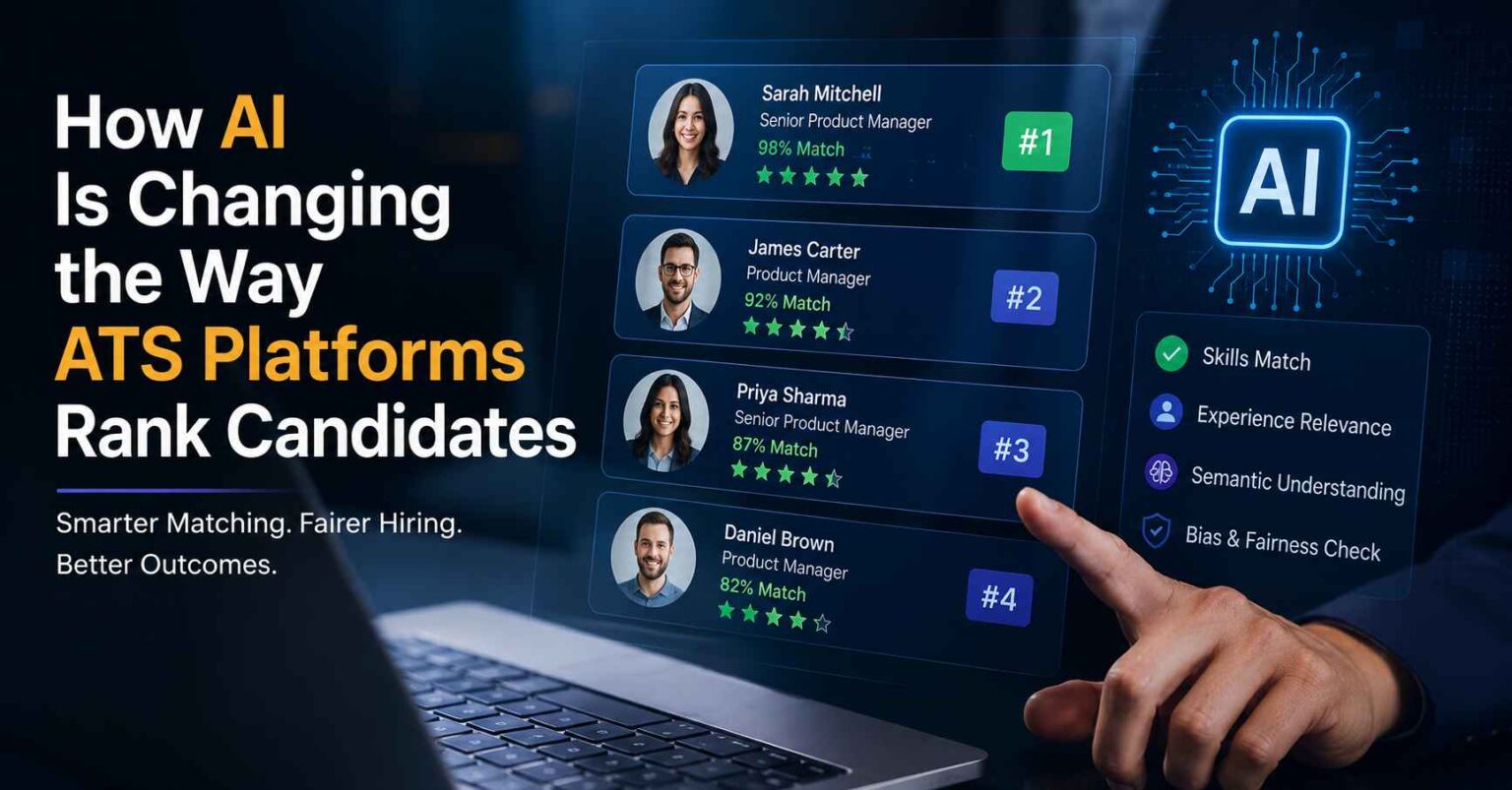
How AI Is Changing the Way ATS Platforms Rank Candidates
For a long time, applicant tracking systems ranked candidates with keyword matching. You posted a job, the system scanned each resume for the words in your description, and the resumes with the closest word overlap moved to the top. The weakness showed fast. A strong candidate who described the same work in different words slipped down the list, while a weaker one who happened to mirror your phrasing climbed it.
Many modern ATS and talent intelligence platforms supplement keyword matching with AI-based semantic matching. They use AI to read for meaning, so the ranking depends on what someone’s experience adds up to rather than whether two phrases line up. Whether you build these tools or buy one, the shift is worth understanding, because part of the logic deciding who a recruiter sees first may now sit inside a model.
Reading for meaning instead of matching words
The old method behaved like a basic search filter. Type “Python developer,” get back resumes containing that exact phrase. It had no way to tell that “built backend services in Django” implies real Python experience.
AI-based ranking reads the resume and the job description together and estimates how closely they relate in meaning. So a candidate who wrote about their Django and Flask work may surface for a Python role even without using the word “Python.” That change reduces one of the most common failures of the old approach. It also makes the output harder to predict, since small wording differences can move a candidate more than they once did, because the model is interpreting language rather than counting it.
What the model actually weighs
Beyond the words on the page, AI ranking tools often do two things worth knowing about. They infer related skills, so a resume listing Kubernetes might be credited with some Docker exposure even when Docker is never written down. And they judge how relevant past roles are to the open one, scoring a backend engineer higher for a backend job than for an unrelated role, based on the work described. This type of AI-powered candidate matching helps recruiters identify candidates whose skills and experience closely align with a role, even when their resumes don’t use the exact same terminology as the job description.
Both help. Both can also be wrong. A bad skill inference can move someone up or down the list, and you may never see why. That matters when you compare products, because two platforms can each claim “AI ranking” and weigh these signals in completely different ways. If you are weighing options, look closely at how each one scores people and what it shows the recruiter.
One detail that gets missed in discussions about AI ranking is that many ATS workflows filter candidates before the ranking model ever runs. Recruiters often set requirements around location, work authorization, certifications, salary expectations, or screening questions. Candidates who fail those checks may never reach the stage where AI compares their experience to the role. In practice, hiring platforms usually combine rule-based filtering with AI ranking rather than replacing one with the other.
The bias and compliance question
AI ranking carries a real risk. A model trained on a company’s past hiring learns the patterns inside that history, including the biased ones. If earlier hiring favored certain schools or backgrounds, the model can absorb that preference without anyone choosing it.
Regulators have started treating this as a legal matter. In New York City, Local Law 144 has required that, since July 5, 2023, employers and employment agencies that use a covered automated employment decision tool in New York City obtain an independent bias audit every year and publish a summary of the results. The U.S. EEOC published guidance in May 2022, noting that employers can be liable under the Americans with Disabilities Act when an AI hiring tool screens people out unfairly. The EU AI Act classifies AI systems used for recruitment and employment decisions as high-risk and imposes extensive compliance requirements that are being phased in over several years.
So ask any vendor how they test for bias and whether they will hand you the documentation. In some places, you now need that paperwork to operate legally.
AI has made ATS ranking better at finding good people who do not use the obvious keywords. It has also made the scoring harder to see into and pulled real legal duties into the picture. When you choose a platform, favor the ones that can explain how they rank and prove how they check for fairness. The rest are asking you to trust a closed box with one of the most consequential calls your company makes.
