
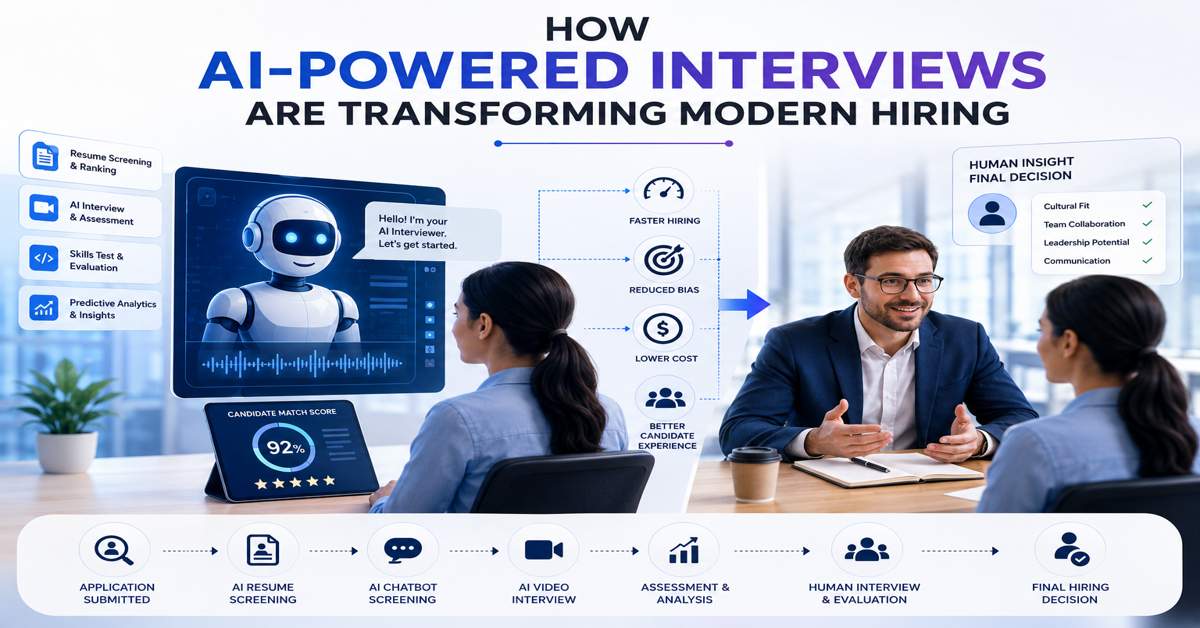
Hiring has always been slow, subjective, and expensive. A single open role can take weeks to fill, involve dozens of manual resume screens, and still end in a mismatch between candidate and job. Artificial intelligence is now rewriting that process from the ground up. AI-powered interviews, systems that use natural language processing, machine learning, and automated scheduling to screen, assess, and even converse with candidates, are becoming a standard part of recruitment at companies of every size.
This shift is not a minor upgrade to applicant tracking software. It is a structural change in how organizations identify talent, reduce bias, and shorten time to hire. Below is a detailed look at what AI-powered interviews actually are, why companies are adopting them so quickly, and what the future of hiring looks like as this technology matures.
What Are AI-Powered Interviews
An AI-powered interviews uses software, rather than a human recruiter alone, to conduct some or all stages of candidate evaluation. This can include automated video interviews with AI-driven question generation, chatbot-based screening conversations, resume parsing tools that rank candidates against job requirements, and real-time analysis of spoken or written responses for relevant skills and keywords.
Unlike older applicant tracking systems that simply filtered resumes by keyword matches, modern AI interview platforms can evaluate tone, coherence, technical accuracy, and even problem-solving approaches. Some tools go further and use predictive analytics to estimate how well a candidate might perform in a specific role based on patterns from previous successful hires.
The goal is not to remove humans from hiring entirely. Most companies use AI as a first-pass filter, letting recruiters spend their limited time on candidates who have already cleared a baseline of relevant qualifications.
Why Companies Are Adopting AI Interviews So Quickly
Speed and Scale
Traditional hiring cannot keep up with high-volume recruitment needs. A retail chain hiring for hundreds of seasonal positions, or a tech company sorting through thousands of applications for one role, simply cannot rely on manual screening alone. AI-powered interview tools can process large applicant pools in hours instead of weeks, flagging top candidates almost immediately after applications close.
Consistency in Evaluation
Human interviewers are inconsistent by nature. Two recruiters can interview the same candidate and reach very different conclusions, often influenced by fatigue, mood, or unconscious bias. AI systems apply the same evaluation criteria to every candidate, which creates a more standardized and, in theory, fairer comparison across applicants.
Cost Reduction
Recruiting is expensive. Job postings, recruiter salaries, interview scheduling, and the opportunity cost of unfilled roles all add up. Automating early-stage screening reduces the number of human hours spent on candidates who are unlikely to be a fit, which lowers the overall cost per hire.
Better Candidate Experience Through Faster Feedback
Contrary to what many assume, AI-powered interviews can actually improve the candidate experience. Automated scheduling removes the back-and-forth of finding interview times. Chatbot screening gives candidates instant answers to basic questions about the role. And faster overall timelines mean candidates are not left waiting for weeks without any communication.
Where AI Is Being Used in the Hiring Funnel
AI is not a single tool bolted onto the end of the hiring process. It touches nearly every stage.
Resume screening and ranking. Machine learning models compare resumes against job descriptions and historical hiring data to rank candidates by predicted fit.
Automated video interviews. Candidates record responses to pre-set questions, which are then analyzed for relevant keywords, communication clarity, and role-specific competencies.After those recordings are captured, Metaview, an interview intelligence platform, automatically turns each session into structured notes and shareable reports, so hiring managers walk into debriefs already aligned on what each candidate actually said.
Conversational AI screening. Chatbots conduct initial screening conversations, asking clarifying questions and collecting structured data that would otherwise require a live recruiter call.
Skills assessments and coding tests. For technical roles, AI-driven platforms evaluate code quality, problem-solving approach, and even how a candidate debugs under pressure.
Predictive analytics for retention. Some platforms go beyond the interview itself, using historical performance and retention data to predict which candidates are likely to stay in a role long term.
The Bias Question: Reducing It or Repeating It
One of the most debated aspects of AI-powered interviews is bias. Advocates argue that AI removes the inconsistency and unconscious bias that plague human interviewers, since a well-designed algorithm evaluates every candidate against the same fixed criteria.
Critics point out that AI models are trained on historical hiring data, and if that data reflects past discriminatory patterns, the algorithm can end up replicating and even amplifying those biases at scale. A model trained mostly on successful hires from a narrow demographic, for instance, could inadvertently penalize candidates who do not fit that pattern, even if they are equally or more qualified.
This is why regulation is catching up. Jurisdictions including New York City and the European Union have introduced rules requiring companies to audit AI hiring tools for bias and disclose when automated decision-making is used in recruitment. Responsible AI-powered interview platforms now build in regular bias audits, diverse training data, and human oversight checkpoints specifically to address this risk.
How Candidates Are Adapting
Job seekers are adjusting their approach as AI-powered interviews become more common. Many are learning to structure answers more clearly, since AI systems often score responses based on relevant keywords and logical structure rather than tone or charisma alone. Career coaches now routinely advise candidates to speak in complete, structured points during automated video interviews, since ambiguous or overly casual answers can be harder for natural language models to parse accurately.Using an AI interview assistant like ParakeetAI can help with this aspect. Candidates can now feel more confident during interviews as it’ll help with the live interview questions and their structured responses, making sure you give your best for the role.
There is also a growing awareness among candidates that automated systems are evaluating them, which has led to mixed feelings. Some appreciate the faster response times and reduced scheduling friction. Others express discomfort at being assessed by an algorithm before ever speaking to a human being, particularly for roles where interpersonal skills matter as much as technical ones.
What Recruiters and HR Teams Should Keep in Mind
Organizations adopting AI-powered interviews get the best results when they treat the technology as an assistant rather than a replacement for human judgment. A few practical principles stand out across companies that have implemented this well.
First, AI should handle repetitive, high-volume, and clearly measurable tasks, such as resume screening and initial skills verification. Final hiring decisions, especially for senior or highly relational roles, should still involve human interviewers.
Second, transparency matters. Candidates increasingly expect to know when they are interacting with an AI system versus a human recruiter, and being upfront about this builds trust rather than eroding it.
Third, regular auditing of the AI tools themselves is essential. Hiring algorithms should be tested periodically against outcomes data to check for unintended bias, and vendors should be able to explain how their models reach conclusions.
Finally, AI-powered interviews work best as part of a broader, well-designed hiring process, not as a standalone solution. Companies that pair automated screening with strong onboarding, clear job descriptions, and thoughtful final-round interviews tend to see the biggest improvements in both hiring speed and employee retention.
The Road Ahead
AI-powered interviews are moving from a competitive advantage to a baseline expectation, with many organizations also exploring solutions developed by an agentic AI development company as AI systems become more capable of handling complex, multi-step recruitment workflows. As natural language models become more sophisticated at understanding nuance, tone, and context, the gap between automated and human-led screening will continue to narrow. Expect to see more real-time feedback for candidates, deeper integration between AI screening tools and applicant tracking systems, and increasingly strict regulatory frameworks governing how these tools are built and audited.
For companies, the organizations that will benefit most are not necessarily the ones that adopt AI the fastest, but the ones that implement it thoughtfully, pairing automation with human oversight, transparency, and a genuine commitment to fair evaluation. Hiring will always involve judgment calls that go beyond what any algorithm can measure. The role of AI is not to make those calls, but to make sure the right candidates reach the humans who will.
