
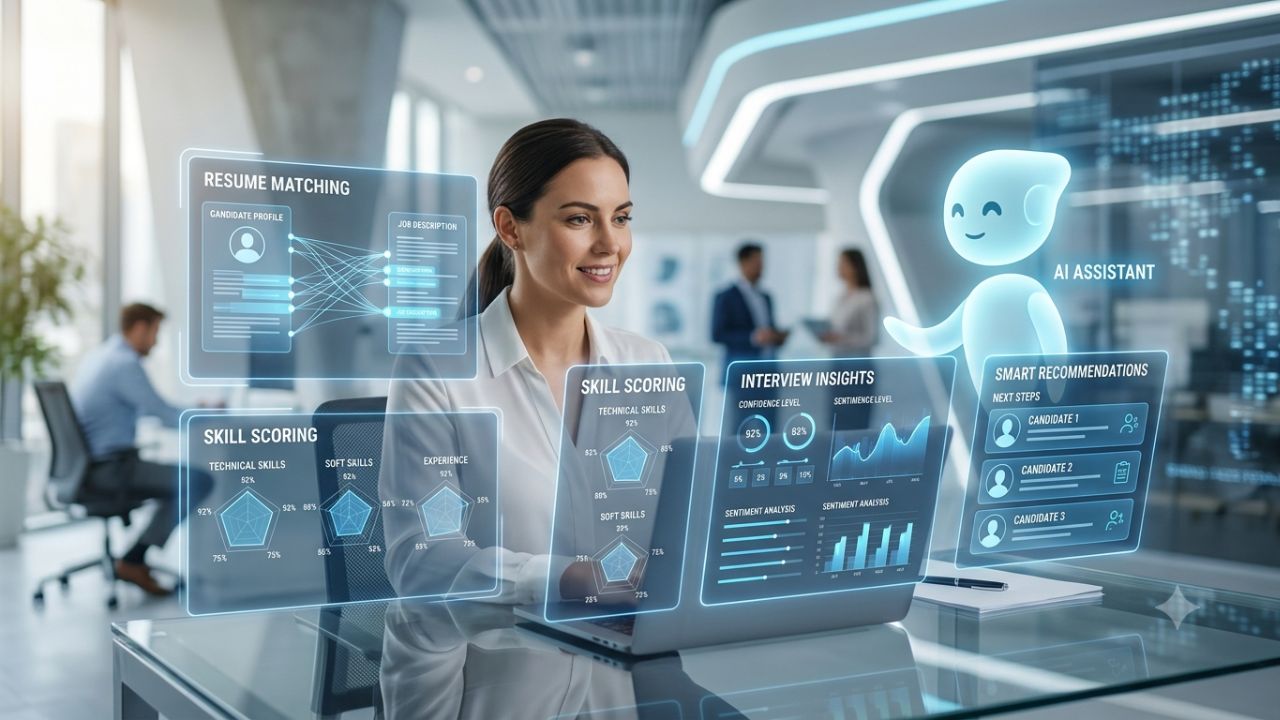
Hiring has never been about collecting the most resumes. It has always been about identifying the right people quickly while delivering a positive candidate experience.
The challenge is that hiring volumes continue to increase. Recruiters often spend hours reviewing applications, comparing resumes, scheduling interviews, and keeping candidates informed. These repetitive tasks consume valuable time that could be spent building relationships with candidates and advising hiring managers.
This is where AI in recruitment is changing the conversation.
Instead of replacing recruiters, modern AI helps automate time-consuming screening tasks while preserving the human judgment that ultimately leads to successful hires. Organizations that implement AI thoughtfully can reduce administrative work, improve consistency, and make faster hiring decisions without lowering hiring standards.
In this article, we’ll explore how AI is transforming candidate screening, where it delivers the most value, and what recruitment teams should keep in mind to maintain hiring quality.
Why Manual Candidate Screening Is No Longer Sustainable
Recruiters today manage significantly larger applicant pools than they did just a few years ago.
A single job posting can generate hundreds or even thousands of applications. Reviewing every resume manually requires substantial time and increases the likelihood of inconsistent evaluations.
Some of the biggest challenges include:
- Resume overload during high-volume hiring
- Human fatigue leading to overlooked qualified candidates
- Inconsistent screening criteria across recruiters
- Longer time-to-hire
- Delayed communication with applicants
These issues not only affect recruiter productivity but can also damage the candidate experience. Top candidates rarely stay available for long, and delays often result in losing qualified talent to competitors.
AI helps remove much of this operational burden while allowing recruiters to focus on high-value conversations.
What AI in Recruitment Actually Does During Screening
Many people assume AI makes hiring decisions independently. In reality, most recruitment platforms use AI to support recruiters rather than replace them.
During the screening stage, AI can help by:
Resume Parsing
AI automatically extracts information from resumes, including:
- Work history
- Skills
- Education
- Certifications
- Contact information
Instead of manually entering candidate data into an ATS, recruiters receive structured candidate profiles within seconds.
Skills Matching
Rather than relying only on keyword matching, modern AI evaluates how closely a candidate’s experience aligns with job requirements.
This allows recruiters to identify applicants whose transferable skills may make them strong candidates, even if their resumes are formatted differently.
Candidate Ranking
AI can organize applicants based on predefined hiring criteria, making it easier for recruiters to prioritize reviews.
Importantly, recruiters remain responsible for making final decisions.
Duplicate Detection
Large organizations often receive multiple applications from the same candidate.
AI helps identify duplicate profiles, reducing database clutter and preventing redundant reviews.
Automated Screening Questions
Many hiring teams use AI to evaluate responses to pre-screening questions before candidates move to the interview stage.
This allows recruiters to focus their attention on applicants who meet the essential qualifications.
Reducing Administrative Work Without Losing Human Judgment
One of the biggest misconceptions surrounding AI is that automation removes the human element from hiring.
The opposite is often true.
When recruiters spend less time reviewing resumes line by line, they gain more time to:
- Conduct meaningful interviews
- Build relationships with candidates
- Collaborate with hiring managers
- Improve employer branding
- Personalize communication
AI handles repetitive processes while recruiters focus on evaluating qualities that technology cannot reliably measure, including motivation, communication style, cultural contribution, and long-term potential.
Hiring quality improves because recruiters spend more time making thoughtful decisions instead of completing administrative work.
Faster Screening Creates Better Candidate Experiences
Candidates expect timely responses throughout the hiring process.
Long application review periods often lead to frustration and increased candidate drop-off.
AI contributes to a better experience by helping recruiters:
- Review applications faster
- Provide quicker updates
- Schedule interviews sooner
- Keep hiring processes moving consistently
Faster screening does not necessarily mean rushed hiring.
Instead, it removes unnecessary waiting periods that occur when recruiters become overwhelmed with administrative tasks.
This benefits both employers and candidates.
Consistency Matters More Than Speed
Speed alone does not improve hiring.
Consistency is equally important.
Different recruiters may naturally interpret resumes differently. One recruiter might prioritize years of experience, while another focuses on technical skills.
AI supports consistency by applying the same evaluation framework across every application.
When screening criteria remain standardized:
- Qualified candidates are less likely to be overlooked.
- Hiring managers receive more comparable candidate shortlists.
- Recruiters spend less time debating whether applicants meet minimum requirements.
Human review still plays a critical role, but AI helps establish a more consistent starting point.
Where Human Recruiters Still Make the Biggest Difference
Despite advances in automation, AI cannot replace the expertise recruiters bring to the hiring process.
Recruiters continue to lead decisions involving:
Relationship Building
Candidates often choose employers based on their interactions with recruiters.
Empathy, trust, and communication remain uniquely human strengths.
Assessing Soft Skills
Leadership potential, adaptability, emotional intelligence, and collaboration cannot be fully measured through automated screening.
Recruiters uncover these qualities through interviews and conversations.
Understanding Hiring Context
A hiring manager’s priorities may evolve during a search.
Experienced recruiters recognize when exceptional candidates deserve consideration even if they do not perfectly match every listed requirement.
Context matters, and humans provide that context.
Best Practices for Using AI Responsibly
Organizations achieve the best outcomes when AI supports recruiter expertise rather than replacing it.
Consider these best practices:
Define Clear Screening Criteria
AI performs best when recruiters establish transparent hiring requirements before screening begins.
Clearly identifying must-have qualifications helps produce more relevant candidate recommendations.
Regularly Review AI Recommendations
Recruiters should periodically audit AI-generated rankings to ensure qualified candidates are not being unintentionally overlooked.
Human oversight remains essential.
Minimize Bias Through Continuous Monitoring
AI systems learn from historical hiring data.
If past hiring practices included bias, organizations should regularly review outcomes and adjust screening criteria when necessary.
Responsible AI requires ongoing evaluation.
Keep Candidates Informed
Automation should improve communication, not eliminate it.
Personalized updates at key hiring stages continue to make candidates feel valued throughout the recruitment process.
Choosing the Right AI Recruitment Tools
Not all recruitment technology offers the same capabilities.
When evaluating AI recruitment software, organizations should look beyond automation alone.
Important features include:
- Resume parsing
- Intelligent candidate matching
- Workflow automation
- Candidate relationship management
- Interview scheduling
- Analytics and reporting
- Human review controls
- Bias monitoring capabilities
The goal is not to automate every hiring decision but to reduce repetitive work while giving recruiters better information for making informed choices. Metaview and a growing set of dedicated interview-intelligence platforms add another layer by turning every screen into structured notes that hiring managers can compare during debriefs.
Many modern recruitment platforms, including Recruit CRM, combine applicant tracking, CRM functionality, and AI-powered automation to help recruiters spend less time on administrative tasks and more time engaging with candidates throughout the hiring journey.
Common Misconceptions About AI Screening
Several myths continue to slow AI adoption across recruitment teams.
Myth 1: AI Replaces Recruiters
Reality: AI automates repetitive administrative work while recruiters remain responsible for hiring decisions.
Myth 2: AI Only Looks for Keywords
Reality: Many modern systems evaluate broader context, transferable skills, and candidate relevance rather than relying solely on exact keyword matches.
Myth 3: Faster Hiring Means Lower Quality
Reality: Removing repetitive work allows recruiters to spend more time evaluating qualified candidates, often improving hiring quality.
Myth 4: AI Eliminates Bias Completely
Reality: AI can help improve consistency, but organizations must continuously monitor hiring outcomes and maintain human oversight.
The Future of Candidate Screening
Recruitment continues to evolve alongside advances in AI.
Future hiring workflows will likely include even stronger candidate matching, predictive hiring insights, and smarter workflow automation.
However, one thing is unlikely to change.
Successful hiring will continue to rely on human judgment, relationship building, and thoughtful decision-making.
AI will increasingly serve as a powerful assistant that handles repetitive work while allowing recruiters to focus on the conversations and evaluations that truly determine hiring success.
Final Thoughts
Manual screening has become one of the most time-consuming aspects of recruitment. As application volumes continue to grow, relying solely on manual review is no longer practical for many organizations.
The greatest value of AI in recruitment is not that it replaces recruiters. It enables them to work more efficiently by automating repetitive screening tasks, organizing candidate information, and supporting more consistent evaluations.
When paired with experienced recruiters and clearly defined hiring processes, AI helps organizations reduce manual effort without compromising hiring quality. The result is a faster, more efficient recruitment process that benefits recruiters, hiring managers, and candidates alike.
