
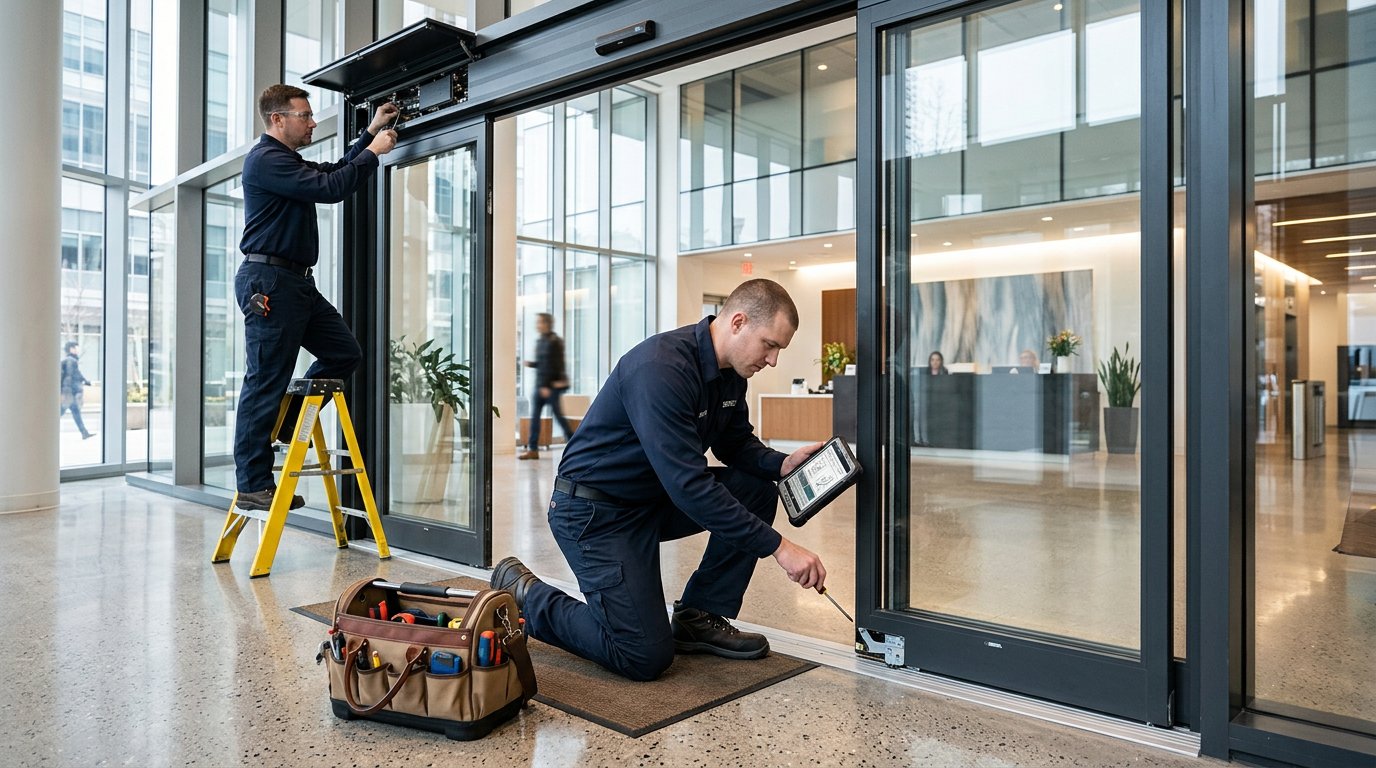
A commercial sliding door that hesitates, slams, drags, or stands wide open is never just a nuisance. It is a safety checkpoint, a security perimeter, and an accessibility promise all failing in public view. Automatic sliding door repair sits at the intersection of mechanics, electronics, and code compliance — and on high-traffic entrances, the difference between a band-aid fix and a proper repair shows up on next month’s maintenance log.
This guide on automatic sliding door repair is written for the people who answer for those doors — facility managers, property managers, building engineers, and business owners across New York and New Jersey. It covers what automatic sliding door repair actually involves, how professionals separate symptoms from root causes, the preventive maintenance that keeps doors off the emergency list, and how to schedule service with Door Automation Corp, a commercial door specialist based in Westbury serving the NY metro region.
Why sliding doors fail on busy entrances
Commercial entrances are among the most punished mechanical systems in any building. A retail or healthcare doorway can cycle thousands of times a day, and every cycle wears rollers, tracks, belts, guides, sensors, and operator components a fraction further. Debris grinds into tracks and thresholds, sensors drift out of position, control settings wander, and hardware loosens — usually slowly, then all at once.
The trap is treating the visible symptom as the problem. A door that reopens after closing may not need a new operator; it may need sensor adjustment. A door that drags may not need a motor; it may need track cleaning and roller alignment. Automatic sliding door repair done properly starts with diagnosis, not parts — because replacing components without fixing causes guarantees a callback.
What automatic sliding door repair actually covers
The scope is broader than most managers expect. Door Automation’s published repair scope for automatic sliding door repair includes operator troubleshooting, sensor adjustment, roller replacement, track repair, guide adjustment, panel alignment, lock service, breakout hardware checks, wiring review, control adjustments, and safety response testing.
The company handles mechanical, electrical, sensor, hardware, and operator-related problems across New York and New Jersey, with a stated goal that should be the industry standard: find the cause, correct it cleanly, confirm safe operation, and help the facility avoid the same failure next month.
The repair approach that stops repeat failures
Method is what separates professional automatic sliding door repair from parts-swapping. Door Automation describes a three-part approach worth holding any automatic sliding door repair vendor to:
- Inspect the full entrance system — panels, tracks, guides, header, operator, activation devices, safety sensors, locks, and the breakout function, because the failure rarely lives where the symptom appears.
- Separate symptoms from root causes — so the repair addresses why the door fails instead of chasing the most visible sign.
- Repair, adjust, and test — using practical field checks that confirm the door performs properly under normal use, not just once in front of the technician.
If an automatic sliding door repair call ends without that third step, the service is not finished. Testing under real traffic conditions is where marginal sensors and tired rollers reveal themselves.
Preventive maintenance that keeps doors off the emergency list
Most emergency automatic sliding door repair calls trace back to deferred maintenance. A sensible planned-maintenance checklist for commercial sliding doors includes:
- Track and threshold cleaning where debris affects smooth travel
- Roller, guide, and panel alignment checks
- Sensor positioning, activation pattern, and safety response checks
- Operator inspection, timing review, and control behavior evaluation
- Locking, breakout, signage, and hardware condition checks
- Repair recommendations for worn, loose, damaged, or obsolete components
Planned maintenance agreements convert that list into a schedule with priority response — and automatic sliding door repair becomes twice-a-year adjustments instead of midnight emergencies. For multi-entrance portfolios, structured automatic sliding door repair contracts are the most reliable way to protect uptime and budget predictably.
Door types and buildings that need the same standard
Sliding entrances are the workhorse, but the same discipline applies across commercial door types: swinging, balanced, revolving, folding, and manual doors. Different systems fail differently — swing doors drift out of alignment, sliding doors develop sensor, roller, and track problems — yet the automatic sliding door repair method of inspection and root cause stays constant.
Demand for automatic sliding door repair peaks in high-traffic, safety-critical environments: retail, healthcare, offices, education, hospitality, and mixed-use buildings. Healthcare and accessibility-focused entrances deserve special mention, because a degraded automatic sliding door repair standard there is not an inconvenience — it is a compliance exposure.
Compliance, safety, and AAADM inspections
Automatic entrances answer to safety standards, and ignoring them transfers risk straight to the building owner. Safety sensors, activation patterns, breakout hardware, signage, and force and timing settings all need periodic verification, not assumptions.
Door Automation provides AAADM inspections alongside repair and maintenance, and supports ADA automatic door compliance — the combination facility teams should expect from any automatic sliding door repair vendor touching a public entrance. When automatic sliding door repair concludes without documented safety testing, the liability remains open even if the door glides shut.
When automatic sliding door repair becomes an emergency
Some automatic sliding door repair failures cannot wait for a Monday appointment. A door stuck open is an open invitation to theft and weather. A door stuck closed can block egress and lock out accessibility. Sensor failures that let a door close on a pedestrian are immediate problems by definition.
Door Automation offers 24/7 emergency service for exactly these situations. The practical advice: when a commercial entrance fails in a way that touches safety or security, treat it as an emergency automatic sliding door repair call, not a work order — the cost difference is small next to the exposure of waiting.
Scheduling automatic sliding door repair with Door Automation
Door Automation Corp works from 2700 Shames Dr, Westbury, NY 11590, serving the New York metropolitan area — all five boroughs, Nassau and Suffolk counties on Long Island, Westchester, Rockland, and Putnam — plus Central and Northern New Jersey and Lower Connecticut.
Scheduling automatic sliding door repair is straightforward: call the NY line at 516-678-4440 or 800-371-2208, the NJ line at 800-344-9298, email info@doorautomation.com, or request a service quote through the website. Office hours run weekdays, with 24/7 emergency response outside them. Whether the need is a one-off automatic sliding door repair, a recurring maintenance contract, or a full inspection program, the first step is a service request describing the door type, the symptom, and how the entrance is behaving.
Conclusion
Automatic sliding door repair is one of those facilities disciplines that looks simple from the outside and proves unforgiving in practice. For automatic sliding door repair, the winning pattern stays consistent: inspect the whole entrance system, fix root causes instead of symptoms, test under real use, and prevent the next failure with planned maintenance and documented safety inspections.
For buildings across New York and New Jersey, Door Automation Corp brings that pattern to sliding, swinging, revolving, balanced, folding, and manual entrances alike — with 24/7 emergency response, AAADM inspections, ADA compliance support, and service contracts that keep high-traffic doors out of the failure cycle. If your entrance is hesitating, dragging, or dead, make the call while it is still a repair: reach the automatic sliding door repair team at 516-678-4440 for NY or 800-344-9298 for NJ.
Frequently Asked Questions
1. What does automatic sliding door repair include?
The full scope covers operator troubleshooting, sensor adjustment, roller replacement, track repair, guide adjustment, panel alignment, lock service, breakout hardware checks, wiring review, control adjustments, and safety response testing.
2. How often should commercial sliding doors be serviced?
High-traffic entrances benefit most from planned maintenance agreements with regular inspection visits — far cheaper than emergency automatic sliding door repair and the standard way to keep safety systems verified.
3. Is emergency automatic sliding door repair available?
Yes. Door Automation offers 24/7 emergency service across its coverage area for doors stuck open, stuck closed, or presenting any safety risk to pedestrians.
4. What areas does the service cover?
New York City including all five boroughs, Long Island (Nassau and Suffolk), Westchester, Rockland, and Putnam counties, Central and Northern New Jersey, and Lower Connecticut.
5. Can automatic sliding door repair problems be prevented?
Most can. Regular track cleaning, roller and panel alignment, sensor testing, operator review, and hardware checks catch wear before it fails — exactly what an automatic sliding door repair service contract schedules.
6. What should I check before calling for automatic sliding door repair?
Note whether power is on at the operator, look for debris or obstructions in the track, check for blocked sensors, and record exactly what the door does wrong — then describe those symptoms when you call; that one-minute checklist makes every automatic sliding door repair visit faster.
