
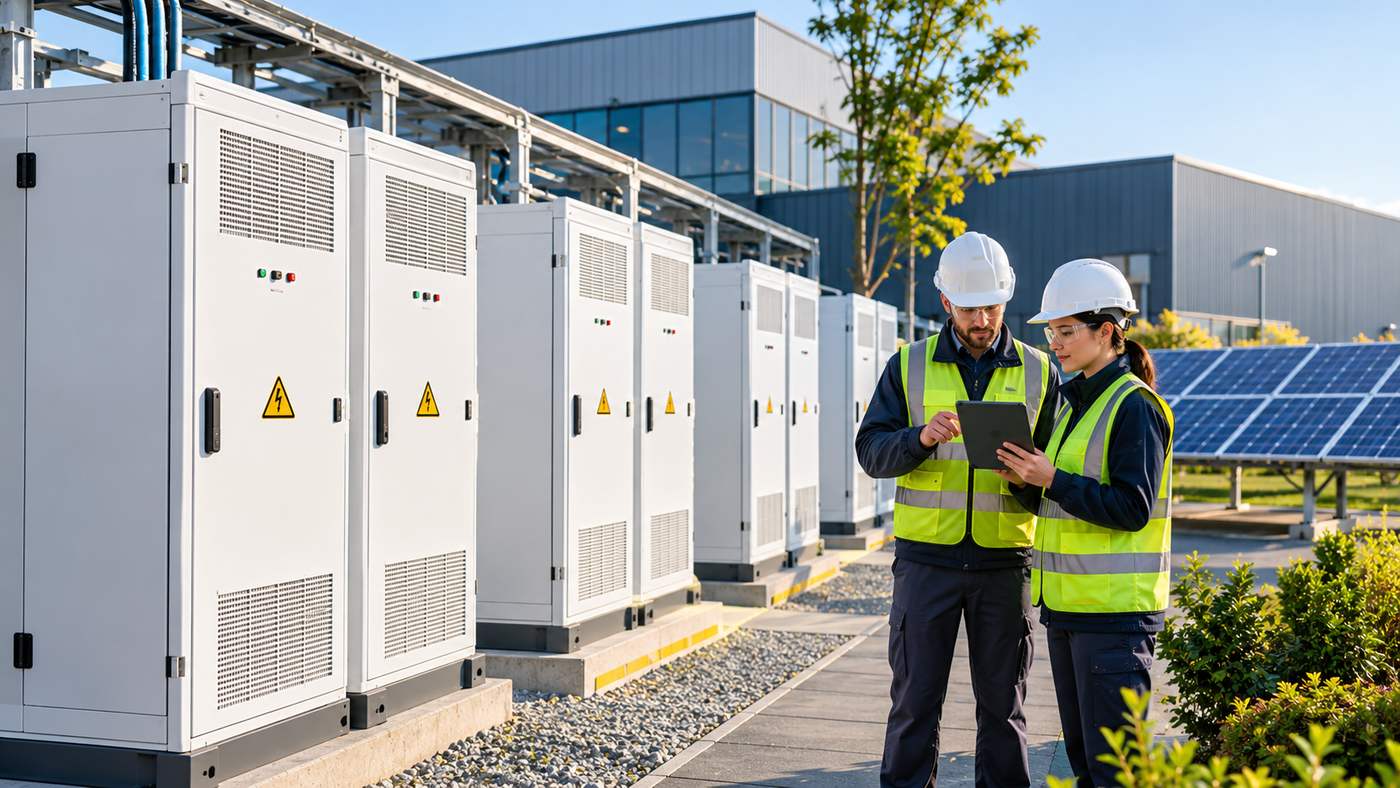
As businesses and industries search for more reliable and flexible ways to manage electricity, energy storage technology is becoming increasingly important. Rising electricity demand, fluctuating energy prices, renewable power generation, and the need for dependable operations are encouraging organisations to reconsider how they generate, purchase, store, and use electricity.
A battery energy storage system offers a practical way to store electrical energy for later use. Instead of consuming all available electricity immediately, businesses can charge batteries when suitable energy is available and discharge them when electricity is needed.
This capability can help commercial facilities manage peak demand, integrate solar energy, support critical operations, and improve overall energy flexibility.
However, installing battery storage involves more than purchasing rechargeable batteries. A complete system requires power conversion equipment, monitoring technology, electrical protection, thermal management, and suitable controls.
This guide explains how battery storage works, its essential components, major commercial benefits, installation costs, safety considerations, and practical applications across different industries.
What Is a Battery Energy Storage System?
A battery energy storage system, commonly abbreviated as BESS, is an integrated electrical installation designed to store energy in rechargeable batteries and release it when required.
Electricity can come from several sources, including solar panels, the electrical grid, or other compatible generation equipment.
Once stored, the energy can be supplied to connected loads or returned to the grid when the system is designed and authorised to do so.
BESS installations range from relatively small commercial systems to large industrial and utility-scale projects.
How Battery Storage Works
The basic operating process involves charging, storing, and discharging electricity.
During charging, electrical energy is converted into a form suitable for storage within the battery cells.
The battery management system monitors important operating conditions, including voltage, temperature, and other parameters.
When electricity is needed, the power conversion system manages the flow of energy from the batteries.
For most alternating-current applications, an inverter converts the battery’s direct-current electricity into alternating-current electricity compatible with the connected electrical system.
An energy management system coordinates these activities according to operating requirements.
Why Energy Storage Is Important
Electricity consumption and electricity generation do not always occur at the same time.
Solar panels, for example, generate electricity when suitable sunlight is available.
Commercial facilities may experience their highest demand at different times.
A battery energy storage system helps address this timing difference by making stored electricity available when needed.
Its practical value depends on the facility’s electricity consumption, tariff structure, generation capacity, and operational goals.
Understanding the Main Components of BESS
A commercial battery storage installation contains several connected technologies.
Each component contributes to the overall performance and safety of the system.
Battery Modules and Packs
Battery cells are the primary energy storage components.
Individual cells are assembled into modules and larger packs to achieve the required electrical capacity.
Many modern commercial systems use lithium-ion battery technology, including lithium iron phosphate chemistry.
The selected chemistry affects energy density, performance characteristics, operating temperature requirements, and other design considerations.
Battery Management System
The battery management system, or BMS, monitors and manages battery operating conditions.
It may track cell voltage, temperature, current, and state of charge.
The BMS also helps identify abnormal operating conditions and enforce appropriate protection limits.
A properly designed battery management system is essential for maintaining safe operation.
However, the BMS is only one part of the overall system safety strategy.
Power Conversion System
The power conversion system, commonly called PCS, controls energy conversion between the batteries and the connected electrical network.
A bidirectional PCS can support charging and discharging.
It converts electricity according to the requirements of the installation and coordinates with other control systems.
Equipment ratings must be selected according to the intended power requirements.
Energy Management System
An energy management system, or EMS, helps determine when batteries should charge or discharge.
For example, a commercial facility might configure its system to reduce electricity demand during expensive peak periods.
Another installation may prioritise stored energy for backup requirements.
The EMS uses operating information and configured control strategies to manage these decisions.
Thermal Management and Protection
Batteries generate heat during operation.
Thermal management equipment helps maintain appropriate operating conditions.
Commercial installations may use air cooling or liquid cooling, depending on system design.
Electrical protection, monitoring, emergency controls, and fire safety measures must also be considered.
Seven Powerful Benefits of Battery Energy Storage
Battery storage can provide several operational advantages when correctly designed for the intended application.
1. Reducing Peak Electricity Demand
Many commercial electricity tariffs include charges associated with the highest power demand during a billing period.
These charges can become substantial for facilities operating large electrical equipment.
A battery energy storage system may help reduce peak demand by supplying stored electricity during periods of unusually high consumption.
This practice is commonly called peak shaving.
For example, a manufacturing facility may experience a short demand increase when several machines operate simultaneously.
A suitably sized battery system can potentially reduce the amount of power drawn from the grid during that period.
The financial benefit depends on the electricity tariff, battery capacity, control strategy, and facility load profile.
2. Supporting Solar Energy Integration
Solar panels generate electricity during daylight hours.
However, businesses may not consume all the electricity at the moment it is produced.
Battery storage can capture suitable excess solar generation and make it available later.
This approach may improve the amount of locally generated solar electricity used by the facility.
It can also provide additional flexibility when grid export is limited or less financially attractive.
Actual savings depend on solar production, battery efficiency, electricity rates, and consumption patterns.
3. Improving Energy Resilience
Unexpected power interruptions can disrupt commercial operations.
Depending on the facility, an outage may interrupt production, affect refrigeration, or prevent essential equipment from operating.
A properly configured battery energy storage system can support selected loads during certain grid outages.
However, backup operation requires suitable electrical design, islanding controls, protection, and sufficient stored energy.
Not every grid-connected battery system automatically provides backup power.
Businesses should define which loads require support and for how long.
4. Enabling Time-of-Use Energy Management
Some electricity providers charge different rates depending on the time of day.
When tariff conditions make it worthwhile, batteries can charge during lower-cost periods and discharge during more expensive periods.
This strategy is known as energy arbitrage.
However, charging and discharging involve energy losses.
Battery wear, demand charges, fees, and other operating costs must also be considered.
A financial assessment should determine whether the expected tariff savings justify the investment.
5. Supporting Renewable Energy Adoption
Wind and solar generation fluctuate according to environmental conditions.
Energy storage can help manage part of that variability.
For businesses pursuing renewable energy objectives, batteries may provide a way to coordinate generation and consumption more effectively.
However, storage does not create additional electricity.
Its environmental impact depends on the electricity used for charging, battery manufacturing, lifetime performance, and end-of-life handling.
6. Providing Greater Operational Flexibility
Commercial facilities may have changing electricity requirements throughout the day.
Storage systems can respond to configured operating conditions and help manage power flows.
Some systems are designed to support microgrids or operate alongside generators and renewable energy sources.
This flexibility may be valuable at remote sites or facilities with demanding energy requirements.
The available operating modes depend on the selected equipment and system architecture.
7. Supporting Long-Term Energy Planning
Electricity needs can change as businesses expand.
Facilities may introduce electric vehicles, additional machinery, or new operating schedules.
A carefully planned battery energy storage system can become part of a broader energy management strategy.
However, future expansion should be considered during the original design.
Not every installation can be enlarged simply by adding battery modules.
Electrical ratings, system compatibility, space, protection, and regulatory requirements can limit expansion.
Exploring Commercial Energy Storage Solutions
Businesses evaluating storage equipment should consider the complete electrical architecture rather than focusing only on battery capacity.
Manufacturers offer different configurations for commercial, industrial, and renewable energy applications.
Organisations researching a battery energy storage system can explore the commercial and industrial energy storage products offered by ATESS.
ATESS provides solutions involving hybrid inverters, bidirectional battery inverters, battery equipment, solar charge controllers, bypass cabinets, and related power conversion technology.
Its published product portfolio addresses applications ranging from smaller commercial installations to larger industrial projects.
Hybrid Inverters
Hybrid inverters can coordinate electricity from compatible sources, including batteries and solar generation.
Depending on the model, these systems may support grid-connected and off-grid operating arrangements.
Hybrid designs can be useful where businesses want to combine solar production with storage and backup functionality.
The specific capabilities must be confirmed against the selected equipment documentation.
Bidirectional Battery Inverters
ATESS describes its bidirectional battery inverters as power conversion systems designed for energy storage applications.
These units manage the conversion between battery DC power and AC electrical systems.
Different models are intended for different power requirements.
System designers must select equipment compatible with the batteries, electrical network, and intended operating modes.
Battery Cabinet Solutions
ATESS also offers modular battery storage equipment.
Its published battery solutions describe battery management technology and configurations incorporating thermal management.
Certain products use liquid cooling to help control battery operating temperatures.
Product selection should account for site conditions, required capacity, equipment certification, and long-term maintenance.
All-in-One Storage Cabinets
An all-in-one storage system combines several major components within an integrated cabinet.
Depending on the model, these may include battery packs, power conversion equipment, energy management controls, thermal management, and fire protection components.
Integrated configurations can simplify some aspects of equipment coordination.
However, site design, installation, commissioning, and regulatory compliance remain necessary.
Commercial Applications of Battery Storage
Different industries use battery storage for different objectives.
Manufacturing Facilities
Manufacturers often operate equipment with substantial electrical demand.
Battery storage may help manage short demand peaks and support selected operational requirements.
The system should be designed using actual consumption data rather than general assumptions.
Warehouses and Logistics
Large warehouses may have significant electricity requirements for lighting, climate control, refrigeration, and equipment.
A battery installation may be considered alongside rooftop solar or other energy improvements.
Facilities with electric vehicle fleets may also evaluate storage as part of their charging infrastructure.
Shopping Centres and Retail Properties
Retail properties can experience changing demand associated with air conditioning, lighting, and customer activity.
Storage may help manage tariff-related costs where the local electricity pricing structure supports the business case.
Agricultural Operations
Farms and agricultural facilities may use electricity for irrigation, refrigeration, processing, and other essential activities.
Battery storage can sometimes support solar integration or selected backup requirements.
The appropriate capacity depends on seasonal loads and operational priorities.
Remote Industrial Sites
Certain facilities operate where grid access is limited or unreliable.
Battery storage can form part of a hybrid energy system incorporating solar generation, compatible generators, and appropriate control equipment.
Such installations require careful engineering to maintain stable power delivery.
How to Size a Battery Storage System
Correct sizing is one of the most important project decisions.
An undersized system may fail to meet operational goals.
An oversized installation may create unnecessary capital expenditure.
Understand Power and Energy
Battery systems are commonly described using kilowatts and kilowatt-hours.
Kilowatts, or kW, measure power.
Kilowatt-hours, or kWh, measure energy.
For example, a battery rated at 100 kWh has a nominal energy capacity of 100 kilowatt-hours.
If it supplies a constant 25 kW load, the theoretical duration would be four hours.
Actual usable duration may be shorter because of discharge limits, conversion losses, operating conditions, and reserve requirements.
Analyse Electricity Consumption
Businesses should collect relevant electricity consumption data.
Interval meter records can reveal daily and seasonal demand patterns.
A facility may have high power peaks but relatively modest total energy requirements.
Another may require sustained energy delivery over many hours.
These situations can require different system configurations.
Define the Main Objective
A peak-shaving project may need high discharge power for relatively short periods.
A backup installation may require sufficient energy capacity to operate essential equipment throughout a specified outage.
Solar self-consumption applications require analysis of both generation and demand.
The business objective should guide the system design.
What Affects Battery Storage System Costs?
Commercial energy storage costs depend on the complete installed system rather than battery modules alone.
Battery Capacity
Larger storage capacity generally requires more battery equipment.
However, costs do not increase in a perfectly linear relationship with capacity.
System configuration and scale can influence pricing.
Power Conversion Equipment
Inverters and related electrical equipment must match the required power output.
Higher power ratings may increase equipment and installation costs.
Installation and Electrical Infrastructure
Projects may require switchgear modifications, transformers, cabling, foundations, and other infrastructure.
Complex grid connections can increase engineering and commissioning requirements.
Safety and Compliance
Battery storage installations require appropriate safety engineering.
Relevant expenses may include monitoring systems, thermal controls, fire protection, emergency planning, and regulatory approval.
Operations and Maintenance
Long-term costs may include monitoring, inspections, software support, equipment servicing, and eventual component replacement.
A complete financial assessment should include lifecycle costs.
Understanding Battery Performance
Several technical measurements help explain the practical performance of a storage system.
Round-Trip Efficiency
Round-trip efficiency describes how much usable energy is recovered compared with the energy supplied during charging.
Some energy is lost through electrical conversion, internal battery processes, and auxiliary equipment.
Actual efficiency depends on system architecture and operating conditions.
Depth of Discharge
Depth of discharge indicates how much of the battery’s available capacity is used.
Operating limits depend on the selected battery chemistry and manufacturer’s requirements.
Discharge settings can influence usable capacity and battery ageing.
Cycle Life
A battery cycle generally refers to a charging and discharging sequence.
Manufacturers may specify performance expectations under defined testing conditions.
Real-world lifetime depends on temperature, discharge patterns, charging behaviour, and other factors.
Capacity Degradation
Battery capacity gradually changes with age and use.
Businesses should review warranty conditions, capacity retention guarantees, and the operating assumptions behind performance claims.
Safety and Installation Requirements
Battery storage installations must be engineered and operated with appropriate safety precautions.
Thermal Runaway Risk
Certain battery failures can lead to thermal runaway, a condition involving uncontrolled heat generation.
Risk management may require battery monitoring, thermal control, suitable separation, detection, and emergency procedures.
A well-designed system uses multiple layers of protection.
Fire and Electrical Standards
In the United States, NFPA 855 addresses the installation of stationary energy storage systems.
Other applicable standards, electrical codes, product certifications, and local requirements may also apply.
Requirements vary according to jurisdiction and system type.
Businesses should work with qualified designers, installers, and relevant authorities.
Appropriate Site Selection
Location influences installation safety and performance.
Designers should evaluate ventilation, environmental conditions, accessibility, structural suitability, and emergency response requirements.
Outdoor cabinets and indoor installations may involve different considerations.
Maintenance and Monitoring
Regular inspection and monitoring can help identify abnormal conditions.
Operators should follow manufacturer procedures and maintain suitable incident-response plans.
Battery storage equipment should not be modified or serviced by unqualified personnel.
Evaluating the Financial Return
A battery energy storage system should be considered as a long-term infrastructure investment.
The business case depends on how the system will be used.
Estimate Potential Savings
Begin with actual electricity tariffs and demand data.
Determine whether the system could reduce peak charges, shift energy consumption, or increase solar self-consumption.
Avoid relying exclusively on general savings claims.
Include Operating Costs
Financial models should account for conversion losses, maintenance, degradation, financing, and potential equipment replacement.
The project may also require insurance and compliance-related expenses.
Consider Backup Value
Some benefits are difficult to measure through electricity bills alone.
For certain facilities, avoiding operational interruption may have significant value.
However, these benefits should be estimated using realistic outage scenarios and verified backup capabilities.
Compare Multiple Scenarios
A useful project assessment considers different electricity prices, operating schedules, and battery performance outcomes.
Sensitivity analysis can help identify whether the investment remains viable if assumptions change.
The Future of Commercial Energy Storage
Energy storage technology continues to develop as renewable generation and electricity demand expand.
Manufacturers are improving battery integration, thermal management, power conversion, and monitoring capabilities.
Modular systems may also provide more flexible installation options for certain applications.
Businesses are increasingly considering storage alongside solar generation, electric vehicle charging, and facility energy management.
However, rapid technological development makes careful product evaluation essential.
Newer equipment should be assessed according to independently supported performance, appropriate certifications, warranty terms, and practical service availability.
The most suitable solution is not necessarily the newest or largest system.
It is the configuration that reliably meets the facility’s actual requirements.
Frequently Asked Questions
What is a battery energy storage system used for?
A battery energy storage system stores electricity for later use. Common applications include solar energy integration, peak demand management, selected backup power functions, and grid support.
How long can a commercial battery system provide power?
Runtime depends on usable battery capacity and the connected electrical load. A professional assessment is needed to account for efficiency losses, reserve requirements, and equipment limitations.
Can battery storage work with solar panels?
Yes. Many commercial storage systems can integrate with compatible solar equipment. The design may use different electrical configurations depending on the inverter and system architecture.
Is commercial battery storage safe?
Properly engineered systems incorporate monitoring, electrical protection, thermal management, and other safety measures. However, battery storage carries hazards and must comply with applicable installation, operation, and emergency-response requirements.
Conclusion
Battery energy storage technology is becoming an important part of modern commercial and industrial energy management.
A properly designed battery energy storage system can help businesses manage electricity demand, make better use of solar generation, support selected critical loads, and improve operational flexibility.
However, successful projects require more than selecting batteries with a large advertised capacity.
Power requirements, usable energy, system efficiency, safety standards, operating costs, and long-term maintenance all influence the final design.
Manufacturers such as ATESS provide equipment and integrated solutions for different commercial and industrial applications, but each installation must be evaluated according to its own technical and financial requirements.
By combining accurate energy analysis with qualified engineering and appropriate safety planning, organisations can make more informed investments in energy storage and build more flexible electricity infrastructure for the future.
