
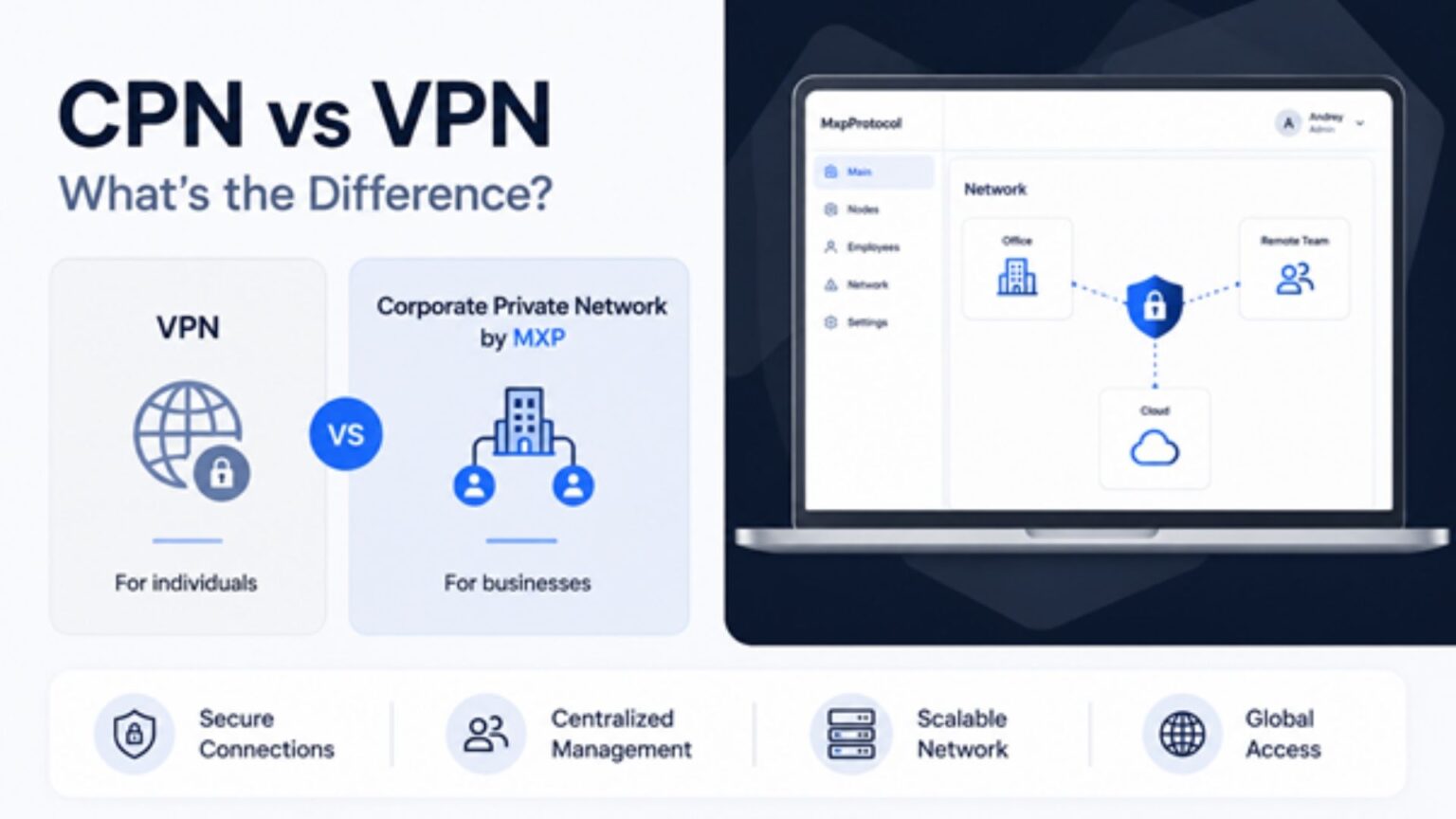
As hybrid work becomes the norm, organizations are looking for better ways to provide employees with secure access to internal resources. While Virtual Private Networks (VPNs) remain widely used, many businesses are also exploring Corporate Private Networks (CPNs) as a more scalable and business-focused solution.
Although both technologies help protect network traffic, they are designed for different use cases. This guide explains the differences, advantages, and when each approach makes the most sense.
What Is a Traditional VPN?
A Virtual Private Network (VPN) encrypts internet traffic between a user’s device and a remote server.
Its primary goals are to:
- encrypt data transmitted over the internet;
- protect users on public networks;
- mask public IP addresses;
- securely access remote services.
VPNs are commonly used by both individuals and businesses, particularly for remote work and secure browsing.
What Is a Corporate Private Network?
A Corporate Private Network is designed specifically for organizations that need secure communication between employees, offices, cloud infrastructure, and internal business applications.
Unlike consumer-focused VPN services, a Corporate Private Network is typically built around an organization’s own infrastructure, access policies, and identity management systems.
Typical use cases include:
- connecting remote employees to company resources;
- linking multiple office locations;
- securing cloud workloads;
- controlling access based on user roles;
- centralizing network management.
Key Differences
| Feature | Traditional VPN | Corporate Private Network |
| Primary users | Individuals & small teams | Businesses & enterprises |
| Main purpose | Secure internet access | Secure corporate connectivity |
| Access control | Basic user authentication | Centralized identity & policy management |
| Infrastructure | Shared VPN servers | Dedicated business network architecture |
| Scalability | Suitable for individuals | Designed for growing organizations |
When a VPN Is Enough
For freelancers, travelers, or small teams, a traditional VPN may be sufficient for:
- working from public Wi-Fi;
- securing internet traffic;
- accessing remote services;
- protecting sensitive communications.
These scenarios usually don’t require complex network management or enterprise-grade access controls.
When Businesses Need More
As organizations grow, their networking requirements become more complex.
Companies often need to:
- connect multiple offices;
- manage hundreds of employees;
- integrate cloud platforms;
- enforce security policies;
- monitor network activity;
- control access to internal systems.
In these environments, simply encrypting traffic is no longer enough. Businesses typically require centralized administration, granular permissions, and infrastructure designed specifically for enterprise operations.
Security Beyond Encryption
Encryption is only one component of network security.
Modern organizations also benefit from:
- identity-based authentication;
- device verification;
- network segmentation;
- centralized logging;
- role-based access control;
- continuous monitoring.
These capabilities help reduce the attack surface while making network administration easier for IT teams.
Choosing the Right Solution
The best option depends on your organization’s size and requirements.
If your primary goal is protecting internet traffic while working remotely, a standard VPN may be appropriate.
However, organizations managing distributed teams, multiple offices, or sensitive business systems often benefit from a solution built specifically for enterprise networking.
One example is Corporate Private Network by MXP, which focuses on secure corporate connectivity rather than consumer VPN use cases. Instead of simply routing internet traffic through external servers, it is designed to help businesses build private, managed network environments with centralized administration and secure access between employees, offices, and infrastructure.
Final Thoughts
Both traditional VPNs and Corporate Private Networks improve security, but they solve different problems.
A VPN is primarily intended to secure an individual’s internet connection, while a Corporate Private Network is designed to support secure communication across an entire organization.
As businesses continue adopting hybrid work models and cloud infrastructure, enterprise networking solutions that combine centralized management, secure connectivity, and scalable architecture are becoming an increasingly important part of modern IT environments.
