
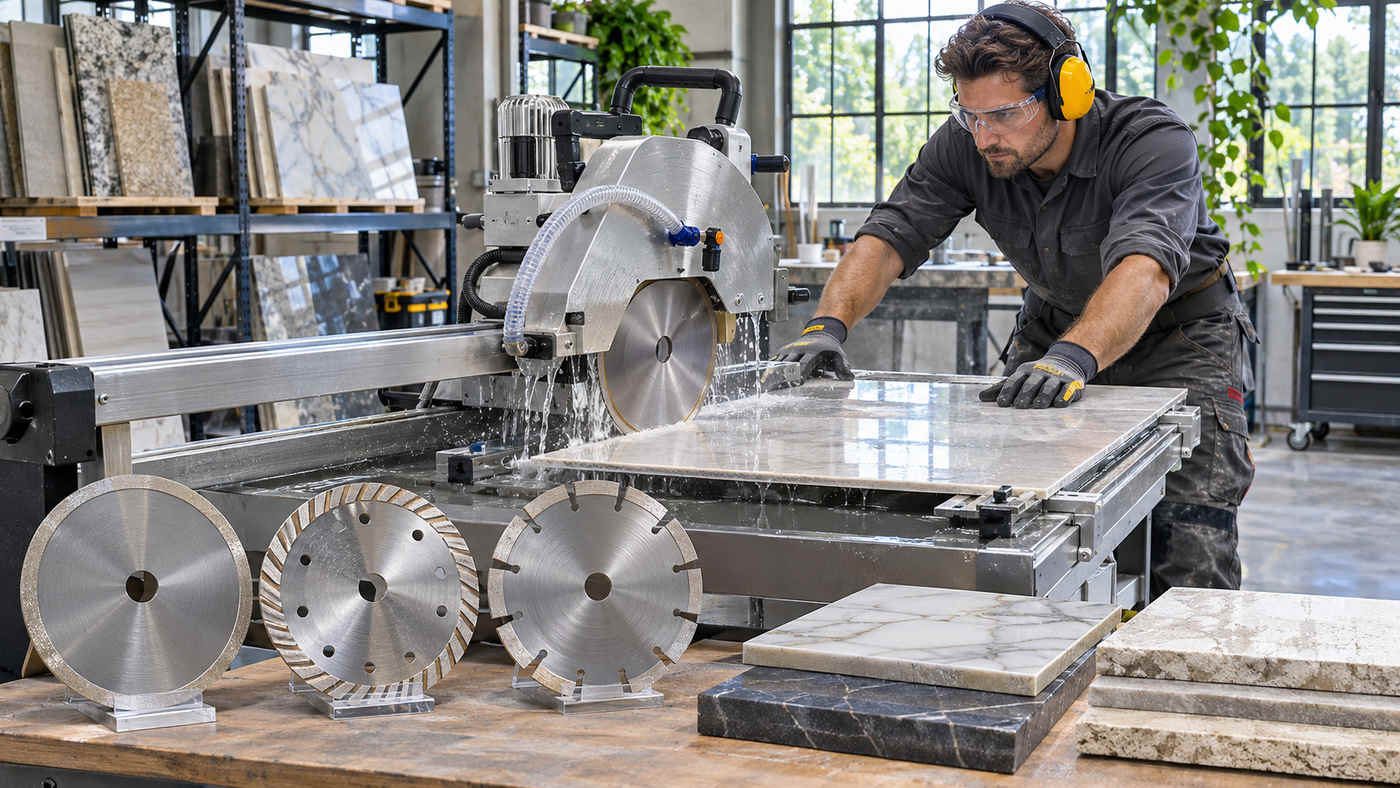
Choosing the right diamond blade is essential for achieving precise cuts in concrete, porcelain, ceramic tile, natural stone, brick, and other demanding construction materials. Whether you are a professional contractor, tile installer, masonry specialist, or home improvement enthusiast, blade selection directly affects cutting quality, working efficiency, equipment performance, and safety. Different materials require specific cutting characteristics, and an unsuitable blade can lead to excessive chipping, slow progress, overheating, or premature wear. Understanding blade construction, rim design, material compatibility, and proper operating practices helps you make informed purchasing decisions and achieve consistent results.
What Is a Diamond Blade and How Does It Work?
A diamond blade is a circular cutting tool that uses industrial diamond particles embedded in a specialized cutting edge to grind through hard or abrasive materials.
Unlike conventional toothed saw blades that remove material through mechanical cutting teeth, diamond cutting tools work primarily through abrasion.
The cutting edge contains synthetic diamond particles held within a bonding material. As the blade operates, exposed diamond particles grind away the surface being processed.
The bonding material gradually wears, allowing additional diamond particles to become exposed.
This process enables sustained cutting when the blade, saw, and material are correctly matched.
Understanding the Main Components
A typical diamond saw blade consists of a steel core and an abrasive cutting rim or a series of individual cutting segments.
The steel core provides structural support, while the diamond containing section performs the cutting.
Manufacturers may use sintering, brazing, or welding methods depending on the blade design and intended operating conditions.
High performance blades intended for demanding construction applications may use laser welded segments to improve attachment strength.
Why Synthetic Diamonds Are Used
Manufactured industrial diamonds offer controlled physical characteristics, including particle size, shape, and strength.
These properties help manufacturers develop cutting products for different materials.
However, diamond concentration alone does not determine overall quality.
Bond design, segment geometry, saw compatibility, cooling, and operating conditions also influence cutting performance.
1. Choose the Correct Diamond Blade Type
Understanding different rim configurations is one of the most important steps in blade selection.
Three commonly encountered designs are continuous rim, segmented rim, and turbo rim.
Each serves particular cutting requirements.
Continuous Rim Blades for Smooth Finishes
A continuous rim blade has an uninterrupted abrasive cutting edge.
This design is frequently associated with applications where clean edges and reduced chipping are important.
It is commonly used for ceramic tile, porcelain, and certain natural stone materials.
Continuous rim products are often designed for wet cutting, although specifications vary by manufacturer.
Because the cutting edge maintains consistent contact with the material, it can produce a refined finish under suitable conditions.
Ideal Applications for Continuous Rims
These blades are especially useful for decorative tile installations, bathroom renovations, kitchen projects, and precision stonework.
A continuous rim diamond blade can be a practical choice when the appearance of exposed edges matters more than maximum cutting speed.
Select a version explicitly rated for the material and saw being used.
Segmented Blades for Construction Materials
Segmented designs feature individual abrasive sections separated by spaces known as gullets.
These openings help remove debris and manage heat during cutting.
Segmented blades are widely used for concrete, masonry blocks, brick, and certain other construction materials.
Some designs support wet and dry cutting, but the manufacturer’s operating instructions determine what is permitted.
They are often selected for demanding work where cutting productivity is more important than producing a polished edge.
Turbo Rim Blades for Balanced Performance
Turbo rim designs use a patterned or corrugated cutting edge to combine relatively fast material removal with a controlled finish.
Depending on their specifications, they may be suitable for porcelain, granite, masonry, and other hard materials.
A turbo diamond blade can offer a useful compromise between aggressive cutting and edge quality.
However, turbo rims are not universally better than continuous or segmented alternatives.
Always prioritize the manufacturer’s stated material compatibility over general descriptions of blade style.
2. Match the Blade to the Material Being Cut
One of the most common purchasing mistakes is assuming that every diamond cutting wheel performs equally well on different surfaces.
Material hardness, abrasiveness, density, and internal structure influence how a blade behaves.
Diamond Blades for Concrete
Concrete contains cement, aggregates, and other constituents that affect cutting resistance.
The exact combination varies according to the concrete mix and its condition.
A blade intended for concrete should be selected according to the material, saw type, and cutting requirements.
Reinforced concrete presents additional challenges because the blade may encounter embedded steel.
Only use products specifically approved for reinforced concrete when this condition is expected.
Do not assume that every masonry blade can safely process steel reinforcement.
Diamond Blades for Porcelain and Ceramic Tile
Porcelain is generally dense and can be difficult to cut without damaging the visible surface.
A suitable continuous rim or specialized tile cutting blade can help achieve controlled edges.
Ceramic tile characteristics vary, so a product designed for one tile type may not provide the same finish on another.
For highly visible installations, prioritize cut quality and material compatibility rather than choosing solely by advertised speed.
Diamond Blades for Granite and Natural Stone
Granite, marble, sandstone, and other natural stones differ substantially in composition and abrasiveness.
A diamond blade suitable for dense granite may not perform efficiently on a softer but highly abrasive stone.
Some natural stones are prone to chipping along exposed or delicate edges.
Understand Hardness and Abrasiveness
Hardness describes resistance to surface deformation or scratching, while abrasiveness influences how aggressively a material wears the blade’s bonding system.
Both characteristics matter.
Manufacturers develop different bond formulations to maintain effective diamond exposure under specific conditions.
Selecting a blade designed for the actual material can improve cutting consistency and reduce unnecessary wear.
Brick, Block, and Pavers
Masonry products may contain aggregates or other constituents that create abrasive cutting conditions.
For repeated brick or block cutting, consider a blade designed specifically for masonry rather than assuming a general purpose model will deliver equivalent service life.
When cutting pavers, check whether the product is intended for concrete pavers, clay products, or natural stone.
Correct material identification is an essential part of choosing a reliable diamond blade.
3. Check Blade Diameter, Arbor Size, and Saw Compatibility
Blade compatibility is a safety requirement, not simply a matter of convenience.
A product may be suitable for the material but inappropriate for the equipment available.
Select the Correct Diameter
Diamond cutting blades are manufactured in different diameters to suit angle grinders, tile saws, masonry saws, and larger construction equipment.
The correct blade size depends on the machine manufacturer’s approved specifications.
Never install a larger diameter blade by removing or modifying the protective guard.
A larger blade can require different operating conditions and may create serious hazards when installed on unsuitable equipment.
Verify Arbor Compatibility
The arbor is the mounting opening that fits the saw spindle.
The blade must match the machine’s approved mounting dimensions and hardware.
A loose or incorrectly mounted blade can create excessive vibration and unsafe operating conditions.
Never force a blade onto an incompatible spindle.
Inspect Mounting Components
Before installation, examine the mounting flanges, spindle, and related components according to the equipment manual.
Damaged or contaminated mounting surfaces can prevent secure installation.
If an arbor adapter is permitted, it must be specifically approved for that blade and machine combination.
Understand Maximum RPM Ratings
Every rotating cutting blade has an operating speed limit.
The blade’s maximum permitted revolutions per minute must be compatible with the saw’s operating speed.
A diamond blade should never be operated above its marked maximum RPM.
Exceeding the rated speed can create severe mechanical hazards.
The operator should also check the manufacturer’s approved operating speed range rather than relying only on a maximum number.
Check Direction of Rotation
Some diamond cutting blades have directional markings.
These arrows identify the intended rotation direction.
Installing a directional blade incorrectly can interfere with the cutting behavior intended by its manufacturer.
Always follow the marked direction and the saw’s mounting instructions.
4. Understand Wet Cutting and Dry Cutting Methods
Wet and dry cutting are common approaches used with suitable diamond cutting equipment.
The correct method depends on the blade specifications, saw design, material, and workplace controls.
Benefits of Wet Cutting
Wet cutting uses an integrated water delivery system to supply water to the cutting area.
When correctly implemented, this can reduce airborne dust and help control heat.
Water may also help remove cutting debris from the contact area.
Wet cutting is commonly used with stationary tile saws, masonry saws, and other equipment specifically designed for water assisted operation.
A wet cutting diamond blade should receive the water flow required by its manufacturer.
Insufficient water can contribute to overheating, reduced performance, or blade damage.
When Dry Cutting Is Appropriate
Some blades are manufactured for approved dry cutting operations.
These applications may be useful where suitable equipment cannot employ water, but dry cutting creates additional thermal and dust management challenges.
Dry cutting permission does not eliminate the need for effective exposure controls.
Follow the saw and blade manufacturers’ operating limits, cooling requirements, and instructions.
Never assume that a blade marked for wet cutting can also be used dry.
Managing Heat During Cutting
Excessive heat can affect cutting efficiency and contribute to mechanical damage.
Causes may include inadequate cooling, inappropriate material selection, unsuitable operating conditions, or excessive cutting pressure.
Why Cooling Matters
A diamond blade is engineered to perform within specific operating limits.
Using the proper cooling method helps maintain the conditions for which the cutting tool was designed.
On equipment approved for wet operation, ensure the integrated water delivery system functions correctly.
Never introduce water to electrical equipment that is not designed and approved for wet cutting.
5. Improve Cutting Accuracy and Blade Performance
Even a suitable cutting blade can produce disappointing results if the surrounding equipment or workpiece is poorly prepared.
Accurate work depends on stable materials, correctly maintained machinery, and controlled operation.
Inspect the Workpiece
Before cutting, identify the material and assess its condition.
Check for embedded objects, cracks, movement, or other issues that may affect the operation.
For renovation projects, consider whether concealed services or structural elements could be present.
Do not cut into unknown building components until they have been appropriately assessed.
Use Proper Work Support
The material should be supported according to the equipment manufacturer’s instructions.
Uncontrolled movement can affect accuracy and create hazards.
For stationary tile saws, use the approved table, guides, and support accessories.
For handheld equipment, follow the manufacturer’s instructions regarding secure work positioning and safe handling.
Avoid Excessive Pressure
Forcing a diamond blade through material does not necessarily improve productivity.
Excessive pressure can contribute to blade deflection, overheating, poor edge quality, and premature wear.
A correctly matched blade should perform within the feed and load conditions specified for the saw.
Recognize Changes in Cutting Performance
Unexpected vibration, unusual noise, reduced cutting performance, burning smells, or visible blade damage may indicate a problem.
Stop the equipment safely and investigate before continuing.
Do not attempt adjustments while the blade is rotating.
If the cause is uncertain, consult a qualified technician or the manufacturer.
Protect Visible Edges
When cutting decorative tile or stone, consider how the finished edge will appear.
Appropriate blade selection, accurate positioning, and stable machine operation help reduce unnecessary chipping.
Some materials may also require manufacturer approved finishing methods after cutting.
A precision diamond blade is most effective when used as part of a complete and suitable cutting system.
6. Follow Essential Diamond Blade Safety Practices
Safety is particularly important when using high speed cutting equipment.
Diamond blades can create hazards involving rotating machinery, airborne dust, fragments, noise, and contact with damaged cutting components.
Inspect Blades Before Use
Check for cracks, missing segments, damaged mounting openings, unusual wear, and other visible defects.
Do not use a damaged blade.
Inspect the saw guard and confirm that the machine is suitable for the intended operation.
Follow the manufacturer’s mounting and inspection procedures before starting work.
Use Appropriate Personal Protective Equipment
Protective equipment should be selected based on the hazards identified for the task.
Depending on the operation, this may include suitable eye and face protection, hearing protection, safety footwear, and task appropriate protective clothing.
Respiratory protection may also be required under applicable exposure control rules.
Personal protective equipment must complement appropriate machine guarding and engineering controls rather than replace them.
Understand Silica Dust Hazards
Concrete, brick, stone, and other construction materials may contain crystalline silica.
Cutting these materials can release respirable crystalline silica particles that create serious long term health risks.
In the United States, OSHA’s construction silica standard addresses exposure control requirements for covered work.
For example, its specified control method for handheld power saws cutting silica containing materials uses integrated water delivery systems that continuously feed water to the blade.
The required respiratory protection depends on the task and work conditions.
Control Dust at Its Source
Use properly designed dust suppression or extraction methods appropriate to the equipment and applicable requirements.
Water delivery systems must be maintained and operated according to manufacturer instructions.
Additional ventilation may be necessary in enclosed spaces.
Never assume that cutting outdoors or wearing an ordinary disposable mask makes uncontrolled dust exposure safe.
Prevent Mechanical Accidents
Maintain machine guards and keep unauthorized people away from the cutting area.
Do not bypass safety mechanisms or operate damaged machinery.
Maintain the correct working position and follow the equipment’s handling instructions.
Disconnect or isolate power according to the manufacturer’s procedure before changing blades or performing maintenance.
A diamond blade must never be used for an application outside its approved design.
7. Evaluate Blade Durability, Maintenance, and Overall Value
The lowest purchase price does not always represent the most economical cutting solution.
A purchasing decision should account for the expected work, equipment compatibility, replacement requirements, and reliability.
Understand Blade Wear
As a diamond cutting blade works, its bond gradually wears and exposes additional abrasive particles.
This process is part of normal operation.
However, the wear rate depends on the material, blade design, cooling, cutting conditions, and maintenance.
A blade designed for dense stone may perform poorly on highly abrasive materials if its bonding system is unsuitable.
Recognize Glazing and Premature Wear
Glazing can occur when the cutting edge stops exposing effective diamond particles and the blade loses cutting efficiency.
Premature wear may result from incorrect material matching, unsuitable operation, or abrasive cutting conditions.
Do not attempt improvised sharpening procedures.
Follow the manufacturer approved maintenance or dressing guidance for the exact product.
When Should a Blade Be Replaced?
Replace the blade when it reaches the manufacturer’s wear limit or develops damage that makes further use unsafe.
Missing segments, cracks, distortion, or damaged mounting openings require immediate attention.
Do not rely exclusively on the apparent height of the cutting segments to determine remaining service life.
Calculate Cost per Cut
Professionals who regularly cut construction materials can evaluate operating value by comparing the approximate cost per completed cut.
Consider the purchase price, cutting productivity, expected blade life, and downtime associated with replacement.
A higher priced diamond blade may offer better value when it is properly matched to repeated work and delivers dependable service.
However, premium pricing alone does not prove superior performance.
Store Blades Correctly
Store cutting blades in a clean, dry, secure location according to their manufacturer’s guidance.
Avoid conditions that may damage the steel core or cutting segments.
Prevent impacts and improper stacking that could affect blade condition.
Before reusing a stored blade, inspect it and verify that it remains suitable for the intended machine and material.
How to Choose a Diamond Blade for Different Projects
The most effective buying process begins by identifying the material and the saw.
For porcelain tile installations, a suitable tile blade focused on clean edges may be appropriate.
For concrete construction, a properly rated concrete cutting blade is essential.
For granite or other natural stone, select a blade specifically recommended for that stone and equipment type.
Then confirm the required diameter, arbor size, operating speed, rim design, and wet or dry cutting approval.
Consider expected usage frequency.
An occasional home renovation may not justify the same equipment specification as continuous commercial cutting.
For regular professional work, durability, predictable performance, and replacement availability can become important economic factors.
Finally, review the technical product documentation rather than relying only on broad marketing descriptions.
A clearly documented diamond blade with appropriate compatibility ratings is generally a more informed choice than an unidentified product with limited specifications.
Common Diamond Blade Buying Mistakes
A frequent mistake is selecting a universal blade without checking whether it is suitable for the specific material.
Another is choosing based on diameter alone while ignoring arbor compatibility or maximum operating speed.
Buyers may also confuse a blade approved for wet cutting with one approved for dry operation.
Using an unsuitable cooling method can affect safety and cutting performance.
Overlooking silica dust controls is another serious issue, particularly during concrete and masonry work.
Finally, replacing blades without investigating the reason for premature wear can lead to repeated unnecessary expense.
Review material compatibility, operating conditions, maintenance, and equipment condition before assuming that a different brand will resolve the problem.
Frequently Asked Questions
What is a diamond blade used for?
A diamond blade is designed to cut or grind through materials such as concrete, porcelain, ceramic tile, stone, and masonry using an abrasive cutting edge containing industrial diamonds.
Which diamond blade is best for porcelain tile?
A continuous rim blade specifically rated for porcelain is often suitable when clean edges are a priority. Confirm the exact saw and material compatibility.
Can a diamond blade cut concrete and reinforced concrete?
Yes, appropriately specified diamond blades can cut concrete, and certain models are rated for reinforced concrete. Always verify suitability for embedded steel.
Is wet cutting better than dry cutting?
Wet cutting can help reduce airborne silica dust and manage heat when performed with approved equipment. The appropriate method depends on the material, blade, saw, and safety requirements.
How long does a diamond blade last?
Blade life varies with material abrasiveness, cutting conditions, bond design, cooling, equipment, and usage frequency. There is no reliable universal number of cuts.
Why does a diamond blade stop cutting efficiently?
Possible causes include glazing, unsuitable material compatibility, inadequate cooling, equipment problems, or blade wear. Stop safely and identify the cause before continuing.
Conclusion
Selecting the right diamond blade requires careful attention to material compatibility, rim design, saw specifications, and appropriate cutting methods. Understanding these factors helps improve cutting consistency, equipment efficiency, and the quality of finished work. Proper inspection, dust control, maintenance, and compliance with manufacturer instructions are essential for safe operation. By prioritizing technical suitability over price alone, both professionals and home improvement users can make more confident equipment decisions.
