
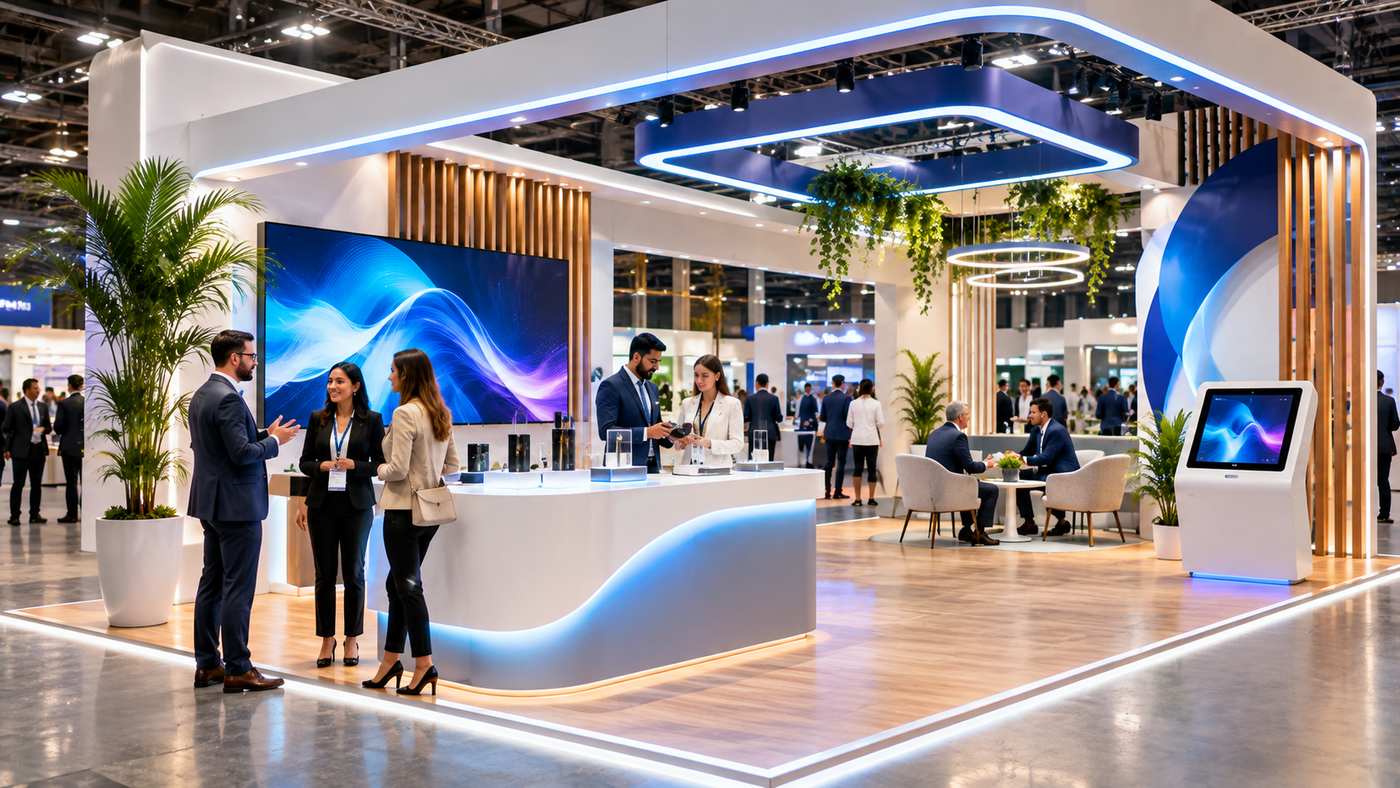
Exhibition booth design plays a major role in how businesses attract visitors, communicate their identity, and generate valuable connections at trade shows. In a busy exhibition hall filled with competing brands, a carefully designed booth can capture attention and encourage meaningful conversations. However, successful design requires more than attractive graphics and stylish furniture. Businesses must consider visitor movement, lighting, product displays, interactive experiences, accessibility, and marketing objectives. Whether you are preparing for a technology conference, international trade exhibition, or corporate event, a thoughtful booth can help transform a limited exhibition space into a memorable brand experience. This guide explores nine creative ideas and practical strategies for designing an effective exhibition presence in 2026.
What Is Exhibition Booth Design?
Exhibition booth design is the process of planning and creating a branded space where a business presents its products, services, or ideas during an exhibition or trade show.
The process combines architecture, interior design, marketing, graphic design, lighting, and visitor experience planning.
A booth may include product demonstrations, digital displays, meeting areas, branded graphics, promotional materials, and interactive installations.
The design should reflect the company’s identity while supporting specific business objectives.
For example, a technology company may prioritize demonstrations and interactive screens, while a furniture manufacturer may create a realistic showroom environment.
Successful exhibition booth design balances visual appeal with functionality, helping visitors understand what the business offers and encouraging them to engage with its representatives.
Why Exhibition Booth Design Matters for Businesses
Trade shows bring together companies, potential customers, industry professionals, and decision-makers.
A booth provides an opportunity to communicate directly with these audiences.
However, visitors often have limited time and numerous exhibits to explore.
An organized, welcoming display can help a brand make a stronger impression.
Creating a Memorable First Impression
Visitors frequently notice a booth’s colors, structure, lighting, and overall appearance before reading detailed product information.
A clear and professional presentation can encourage them to stop and learn more.
Improving Brand Recognition
Consistent use of brand colors, logos, imagery, and messaging helps visitors recognize the business.
A distinctive booth may also make the company easier to remember after the exhibition.
Supporting Product Demonstrations
A functional layout provides suitable space for demonstrating products or explaining services.
Visitors can experience relevant features rather than relying entirely on printed descriptions.
Generating Business Leads
A booth should make it easy for interested visitors to connect with representatives.
Effective layouts create natural opportunities for discussions, demonstrations, and follow-up arrangements.
Building Professional Relationships
Trade shows also provide opportunities to meet suppliers, distributors, investors, and potential partners.
Comfortable meeting areas can support these conversations.
9 Creative Exhibition Booth Design Ideas for 2026
Modern exhibitions emphasize memorable experiences, practical layouts, and meaningful interaction.
The following ideas can help businesses develop a distinctive presence.
1. Create an Open and Welcoming Booth Layout
An open layout makes a booth feel approachable.
Large counters, unnecessary partitions, and poorly positioned displays can discourage visitors from entering.
Instead, consider a design that provides clear access from the main aisle.
Position important displays where attendees can see them without blocking circulation.
An open arrangement is particularly valuable for smaller booths because it can make the available space feel more comfortable.
For example, a compact technology stand might place a product demonstration counter along one side while leaving the central area open.
The goal is to encourage natural movement without creating confusion or crowding.
2. Use Strategic Lighting to Highlight Important Features
Lighting influences how visitors perceive a display.
A well-lit booth can attract attention while making products and graphics easier to examine.
Different lighting techniques serve different purposes.
Spotlights may emphasize featured products, while concealed LED strips can define architectural elements.
Soft ambient lighting can create a comfortable environment for discussions.
Lighting should complement the brand’s personality.
A premium lifestyle company might prefer warm, elegant illumination, while a technology business may choose a cleaner contemporary appearance.
Avoid overly bright or flashing effects that distract visitors or interfere with neighboring exhibitors.
3. Incorporate Interactive Digital Displays
Digital technology can make exhibitions more engaging.
Touchscreens, product demonstrations, digital catalogs, and interactive presentations allow visitors to explore information at their own pace.
For example, a manufacturing business could use an interactive screen to explain its production process.
A real estate company might present a virtual walkthrough of a development.
Digital installations should have a clear purpose.
Adding technology merely because it looks impressive can increase costs without improving visitor engagement.
The most effective interactive features help attendees understand a product, solve a problem, or take a useful next step.
4. Design a Strong Visual Brand Identity
An exhibition stand should communicate the company’s identity quickly.
Use consistent colors, recognizable logos, and a clear visual hierarchy.
Important brand messages should remain visible from commonly used visitor approaches.
Large graphics can help visitors understand the business without requiring lengthy explanations.
For example, a renewable energy company might use nature-inspired colors and imagery to communicate its industry focus.
A luxury product brand may prefer minimalist displays with carefully selected materials.
Avoid overcrowding walls with excessive text.
A concise message supported by strong imagery is generally easier to understand in a busy exhibition environment.
5. Add Comfortable Meeting and Networking Areas
Not every visitor interaction should happen while standing in a crowded aisle.
Businesses offering complex products or professional services may benefit from dedicated conversation areas.
A small seating arrangement can provide space for more detailed discussions.
Larger booths may accommodate semi-private meeting rooms.
Furniture selection should reflect the booth’s overall design.
Comfortable chairs, appropriate table heights, and suitable lighting can make discussions more productive.
However, meeting furniture should not obstruct accessible routes or reduce the space needed for demonstrations.
6. Explore Modular and Reusable Booth Structures
Modular exhibition systems are designed around components that can be assembled, rearranged, and reused.
They can be useful for businesses attending multiple events with different booth dimensions.
Reusable frames, interchangeable graphics, and adaptable displays may reduce the need for entirely new structures at every exhibition.
Modular systems can also simplify storage and transport when designed appropriately.
However, reuse depends on product durability, transportation conditions, and compatibility with future exhibition requirements.
Businesses should evaluate long-term costs rather than focusing only on the initial purchase price.
7. Integrate Sustainable Design Elements
Sustainability is an increasingly important consideration in exhibition planning.
Temporary installations can involve significant material use, transportation, and disposal.
Businesses can explore reusable structures, rental furniture, efficient lighting, and materials selected with end-of-life handling in mind.
The German Sustainable Building Council introduced a sustainable trade fair stand framework in 2026 that emphasizes integrating environmental considerations early in planning and construction. DGNB
Exhibitors can also reduce unnecessary printed materials by providing digital product information.
Sustainable decisions should be evaluated realistically, including durability, transport requirements, and opportunities for reuse.
8. Create Dedicated Product Demonstration Zones
Live demonstrations can help visitors understand products more effectively than static displays.
A dedicated demonstration area should provide sufficient room for staff, equipment, and audience members.
For example, a kitchen equipment manufacturer might use a controlled demonstration counter.
A software company could provide individual stations where visitors explore the product.
Designers should consider electrical access, equipment safety, noise levels, and the number of people likely to gather.
Demonstrations should be visible enough to attract attention without blocking neighboring booths or public walkways.
9. Use Immersive Brand Storytelling
A memorable booth can communicate a story rather than simply display products.
The experience might guide visitors from understanding a common problem to discovering how the company’s solution works.
A healthcare technology business could organize its booth around the patient experience.
An environmentally focused company might demonstrate how its products support specific operational improvements.
Storytelling can use lighting, product displays, interactive demonstrations, and visual sequences.
The strongest experiences remain relevant to the brand and avoid unnecessary complexity.
How to Plan an Effective Exhibition Booth Layout
Before selecting colors or decorative features, businesses should establish how visitors will use the space.
A practical layout helps ensure that every design element supports a specific purpose.
Define the Main Objective
Start by identifying what the company wants to achieve.
Possible objectives include launching a product, generating qualified leads, meeting distributors, or strengthening brand awareness.
A booth designed for frequent demonstrations may require a different layout from one intended for private business meetings.
Study the Exhibition Floor Plan
Review the assigned location, neighboring booths, available entrances, and main visitor routes.
A corner booth may receive traffic from multiple directions.
An inline booth may need to emphasize its front-facing presentation.
The design should respond to these conditions rather than relying on a generic arrangement.
Organize the Space Into Functional Zones
Consider separating the booth into clear areas for welcoming visitors, demonstrating products, holding conversations, and storing supplies.
These zones can overlap in smaller spaces, but their functions should remain understandable.
Prioritize Accessibility
Visitors should be able to approach and interact with the booth comfortably.
Where required, provide accessible circulation, suitable interaction heights, and appropriate space for mobility devices.
Exhibitors must review the event’s technical rules and relevant local accessibility requirements. Accessibility guidance published for trade shows in 2026 emphasizes clear routes, reachable displays, and inclusive visitor experiences. ProExhibits
Custom Exhibition Booths vs. Modular Exhibition Stands
Businesses generally have several options when selecting an exhibition structure.
Custom booths are developed around specific brand requirements and event conditions.
They can support distinctive architectural shapes, specialized installations, and detailed visual presentations.
However, fully customized structures may involve higher design, fabrication, transportation, and installation expenses.
Modular stands use standardized components that can often be reconfigured.
They may be suitable for businesses attending multiple exhibitions or working within tighter budgets.
Neither option is universally superior.
A custom booth may be appropriate for a major product launch, while a reusable modular system may make more sense for frequent regional events.
The right choice depends on available space, intended reuse, visual requirements, and total project costs.
How to Choose a Professional Exhibition Booth Designer
Professional design support can be valuable when a project involves specialized fabrication, complex displays, or strict event requirements.
A suitable designer should understand both visual presentation and practical exhibition operations.
Review Relevant Project Experience
Examine completed projects involving similar industries, booth sizes, and event formats.
A designer experienced with corporate conferences may approach a large consumer exhibition differently from a specialist in elaborate product showcases.
Evaluate the Design Process
A structured process generally begins with a project brief, followed by concept development, layout planning, visualization, technical documentation, and production coordination.
The team should explain how design decisions support business objectives.
Discuss Fabrication and Installation
An attractive concept must also be practical to construct.
Confirm who will manage manufacturing, logistics, installation, dismantling, and on-site troubleshooting.
Explore Experienced Design Providers
Businesses seeking professional exhibition booth design services can explore Touch Concept, a Malaysia-based exhibition and brand activation company.
According to its website, Touch Concept provides services covering concept development, 3D design visualization, fabrication, installation, dismantling, and on-site coordination for exhibition projects. Touch Concept+1
When evaluating any design provider, request a detailed proposal that explains deliverables, responsibilities, schedules, and project costs.
Confirm Communication and Support
Exhibition preparation often involves deadlines and coordination among several parties.
Clear communication can help reduce misunderstandings during design, production, and installation.
How Much Does Exhibition Booth Design Cost?
Exhibition booth costs vary substantially according to size, location, materials, and complexity.
A compact modular display may require a relatively modest investment.
A large custom-built pavilion with specialized structures, multimedia installations, and extensive fabrication can cost considerably more.
Important budget categories include design services, structure fabrication or rental, graphics, lighting, furniture, audiovisual equipment, transportation, installation, and dismantling.
Other expenses may involve electricity, internet service, venue approvals, insurance, staffing, and storage.
For example, a company planning a 20-square-meter booth should request quotations based on an agreed specification rather than comparing unrelated price-per-square-meter estimates.
A useful project budget should also include contingency funds for approved changes and unexpected logistical expenses.
The most economical solution is not necessarily the cheapest initial quote.
Reusable components, efficient installation, and appropriate storage arrangements may influence total long-term value.
Common Exhibition Design Mistakes to Avoid
Several mistakes can reduce the effectiveness of an exhibition presence.
Overcrowding the Booth
Too many products, graphics, and decorative elements may make the space confusing.
Prioritize the most important information and provide room for visitor movement.
Ignoring Visitor Flow
A booth can look impressive in a rendering but function poorly when attendees arrive.
Review entry points, circulation, demonstration locations, and meeting areas before finalizing the layout.
Using Excessive Text
Visitors may not have time to read lengthy descriptions while walking through an exhibition hall.
Use short, clear messages supported by meaningful visuals.
Neglecting Storage
Staff often need space for promotional materials, personal belongings, packaging, and technical supplies.
Without suitable storage, these items may create clutter.
Forgetting Event Regulations
Every exhibition can impose different restrictions on booth height, electrical installations, fire safety, and structural approvals.
For example, the Inter BEE 2026 exhibitor manual contains detailed requirements affecting booth construction and operation. exb.jesa.or.jp
Always check the requirements for the specific event rather than assuming that a previous design can be reused without modification.
How to Make Your Exhibition Booth More Engaging
An attractive structure creates an opportunity, but visitor engagement depends on the experience inside the booth.
Train staff to welcome attendees without applying unnecessary pressure.
Prepare concise explanations of products and services.
Offer demonstrations that address common customer questions.
Use appropriate digital lead-capture methods with clear privacy information.
Consider providing useful educational materials rather than generic promotional items.
Most importantly, ensure that the visitor experience supports the company’s actual business goals.
A technically impressive installation is only valuable when it helps visitors understand the brand and creates meaningful opportunities for further engagement.
Measuring Exhibition Booth Performance and ROI
Businesses should evaluate exhibition results after the event.
The most useful measurements depend on the original objectives.
Qualified Leads
Record the number of visitors who express genuine interest and meet relevant customer criteria.
A smaller number of well-qualified leads may be more valuable than a large collection of unrelated contacts.
Product Demonstrations
Track meaningful demonstrations and the questions visitors ask.
This information can help marketing and sales teams improve future presentations.
Meetings and Partnerships
Document completed meetings, potential partnerships, and agreed follow-up actions.
Cost Per Qualified Lead
Divide the total eligible exhibition investment by the number of qualified leads generated.
This provides a useful performance indicator, although it does not capture every benefit of exhibiting.
Sales Pipeline Development
Monitor opportunities created through the event and their progression over time.
Avoid attributing every future sale to the exhibition without considering other marketing influences.
Future Trends in Exhibition Booth Design
The exhibition industry continues to develop in response to changing visitor expectations and business priorities.
Interactive Digital Experiences
Touchscreens, product visualization, and digital demonstrations can provide more detailed experiences without requiring excessive physical inventory.
Reusable Exhibition Systems
More businesses are considering structures that can be adapted for multiple events.
This approach can support cost management and reduce unnecessary material disposal.
Accessible and Inclusive Spaces
Greater attention to accessibility can make exhibitions more welcoming for a wider range of visitors.
Flexible Hybrid Layouts
Booths may increasingly combine product demonstrations, digital information, and comfortable conversation areas.
Experience-Focused Brand Presentation
Instead of displaying extensive product catalogs, businesses can create focused experiences that communicate a clear message.
These developments reinforce the importance of designing for real visitors rather than following visual trends without a practical objective.
Frequently Asked Questions
1. What is exhibition booth design?
Exhibition booth design is the process of planning and creating a branded display space for trade shows and events. It combines visual identity, layout, lighting, product presentation, and visitor engagement.
2. How can I make my exhibition booth stand out?
Use clear branding, strategic lighting, an open layout, relevant demonstrations, and meaningful interactive features. A focused message is often more effective than an overcrowded display.
3. How much does a custom exhibition booth cost?
Costs depend on booth size, materials, fabrication, customization, location, and installation requirements. Request an itemized quotation based on the specific project rather than relying on universal pricing estimates.
4. What is the difference between modular and custom exhibition stands?
Modular stands use reusable components that can be adapted to different spaces. Custom stands are developed around specific design requirements and may offer greater architectural flexibility.
5. How early should I plan an exhibition booth?
Planning should begin as early as practical, particularly for large custom projects. Allow time for design approval, fabrication, venue permissions, logistics, installation, and contingency planning.
6. How do I measure exhibition booth success?
Useful indicators include qualified leads, completed demonstrations, meetings, sales opportunities, customer feedback, and cost per qualified lead. Select performance metrics that match your original exhibition objectives.
Conclusion
Exhibition booth design is an important part of creating a memorable and productive trade show experience. A successful booth combines visual appeal, clear branding, practical visitor flow, accessible layouts, and engaging presentations. Businesses that plan their exhibition presence around measurable objectives can make better decisions about design, materials, technology, and budget. By focusing on meaningful visitor experiences rather than decoration alone, companies can build stronger connections and improve the value of their exhibition investments.
