
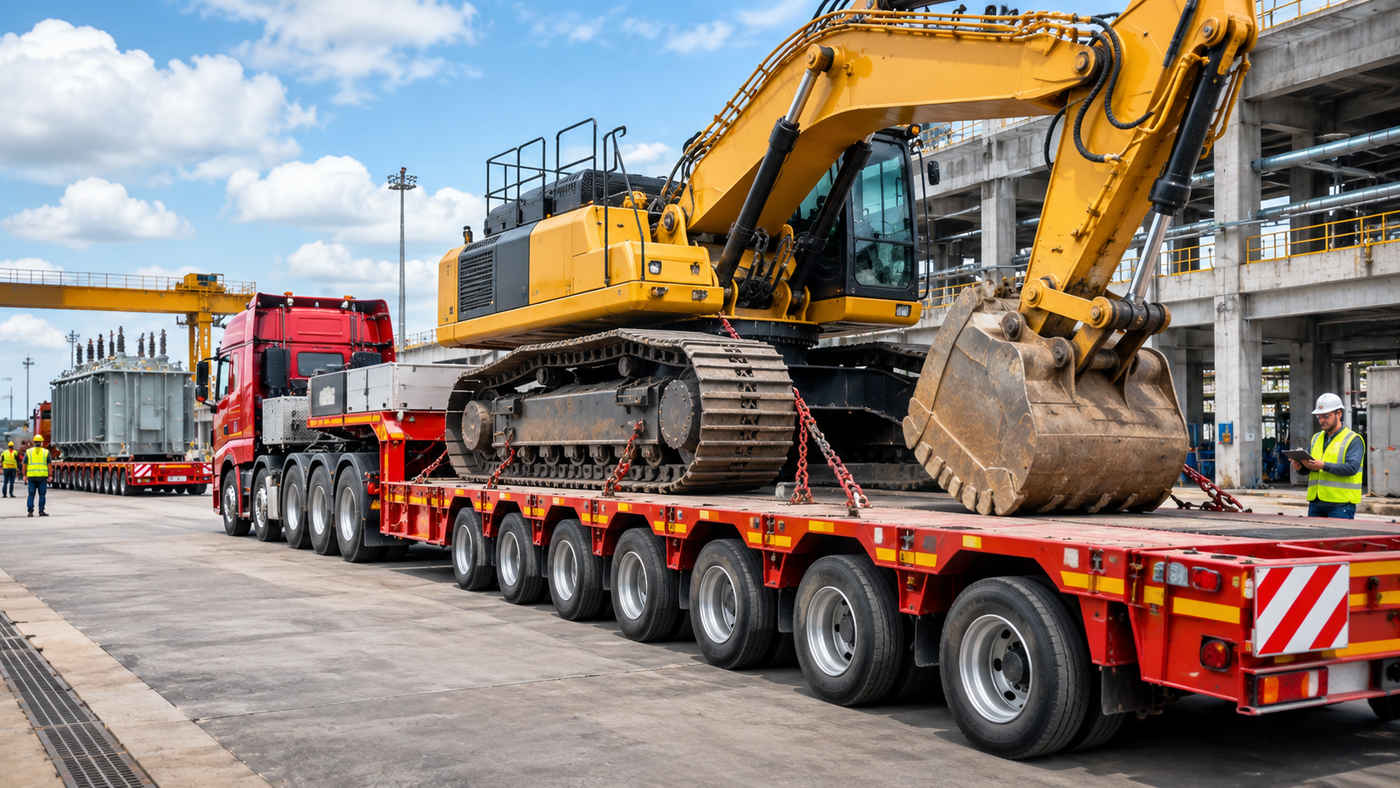
Transporting an excavator, transformer, crane component or wind turbine section requires more than finding a trailer with enough room on its deck. Faymonville heavy-haul trailers are part of a specialist product portfolio designed for loads that exceed conventional freight dimensions or handling requirements. The manufacturer offers lowbed, semi low loader, extendable flatbed and modular systems, each intended for different combinations of weight, height, length and route constraints. Selecting equipment responsibly means checking the complete vehicle configuration, not treating an advertised capacity as permission to travel on every road. This guide explains seven important decisions, the differences among major Faymonville models, and the practical questions that transport operators should resolve with engineers, manufacturers and permitting authorities before moving exceptional cargo.
What Makes Faymonville Trailers Different From Ordinary Flatbeds?
A conventional flatbed is suitable for many standard shipments, but unusually tall, heavy or long cargo creates additional problems. A low deck may be needed to stay beneath a bridge, extra axle lines may be needed to distribute weight, and steering may be required to navigate tight corners. Faymonville heavy-haul trailers address these challenges through specialised structures and configuration options rather than a single universal design.
Faymonville describes its own trailer range as covering payload classes from 20 to 500 tonnes, depending on the model and arrangement. That portfolio figure must not be interpreted as the legal carrying capacity of any individual trailer. Actual payload depends on vehicle tare mass, coupling, axle equipment, tyre ratings, structural limits, configuration and jurisdictional requirements.
Understand the Main Product Families
The manufacturer’s catalogue includes MultiMAX semi low loaders, MegaMAX and VarioMAX lowbeds, TeleMAX extendable flatbeds, and CombiMAX and ModulMAX modular solutions. Each family contains variants, so the model name alone is insufficient for ordering or operational approval.
Start With the Load and Route, Not the Branding
A useful specification begins with a measured load and a surveyed route. Only then can a transport specialist judge whether the deck, gooseneck, bogies and axle system fit the assignment.
1. Choose the Trailer Family for the Actual Cargo
The first decision when evaluating Faymonville heavy-haul trailers is identifying what must be transported and how it will be loaded. The MultiMAX is a versatile semi low loader family used for machinery, industrial components and other abnormal loads. Faymonville lists configurations with two to ten axles and telescopic versions that can extend up to 36 metres. Those figures describe the broader model range, not every individual MultiMAX unit.
MultiMAX for Versatile Machinery Transport
A suitable MultiMAX configuration may include equipment ramps, an excavator trough, wheel recesses or an extendable platform. These options make sense when a fleet transports various construction machines and needs a deck that can adapt. The MultiMAX Plus emphasises weight optimised configurations for certain lifting equipment, while the PA-X family uses low pendle axle technology for applications that benefit from a reduced loading height.
MegaMAX and VarioMAX for Lower Loading Heights
The MegaMAX features a removable gooseneck, lowbed and rear bogie. Faymonville describes versions with one to five rear axles and an optional dolly of one or two axles. A detachable neck can support front loading where the site, machine and procedure permit it. VarioMAX combines lowbed design with a removable front bogie that can add axle lines ahead of the low deck, and its configurations use hydraulic pendle axles.
CombiMAX, ModulMAX and TeleMAX for Special Cases
CombiMAX uses components that can be combined in multiple ways and is described by Faymonville as supporting configurations up to 250 tonnes of payload. ModulMAX is a modular system with two to six axle lines per module, available in trailer, assist propelled and self propelled modes. TeleMAX is different: it is an extendable flatbed for long freight, including wind turbine blades and structural beams. A WingMAX variant can reach a stated vehicle length of 74.65 metres. These are distinct engineering solutions, not interchangeable substitutes.
Match the Family to the Handling Method
For Faymonville heavy-haul trailers, a wheeled machine that can safely drive aboard presents a different loading requirement from a transformer lifted by crane. Confirm the loading process before deciding which deck design is most useful.
2. Calculate Payload, Axle Loads and Weight Distribution
The second decision concerns where the load’s mass acts on the vehicle. Faymonville heavy-haul trailers can provide additional axle arrangements, but more axles do not automatically create lawful capacity. Engineers must consider the load’s total mass, centre of gravity, support points, trailer dead weight, tractor limits and the reaction carried by every axle group.
Measure Dimensions and the Centre of Gravity
Record the actual length, width, height and mass of the cargo using suitable documentation or verified measurements. Identify the centre of gravity and any lifting or support restrictions provided by the equipment manufacturer. A concentrated industrial load can exert very different stresses from a similarly heavy but evenly distributed machine.
The trailer’s rated payload must be considered together with deck point load limits and permitted load positions. An apparently adequate gross capacity does not establish that the platform can support heavy pressure on a small contact area.
Understand the Gooseneck and Bogie Relationship
The gooseneck transfers part of the combination’s load to the tractor. The bogie carries another portion through its wheel sets. Different coupling arrangements and tractor axle groups change this distribution. Faymonville heavy-haul trailers should be specified with an appropriate tractor and any required dolly, rather than evaluated as a disconnected trailer alone.
Check the Complete Combination
Document the tractor, trailer, dolly, ballast, accessories and load as one system. Legal mass and bridge restrictions may apply to individual axles, axle groups, gross combination weight and spacing. A rated component is not necessarily authorised at that rating on public roads.
3. Evaluate Steering, Suspension and Manoeuvrability
A heavy load can fit on a deck and still be impossible to move through a particular junction. That is why steering geometry matters when selecting Faymonville heavy-haul trailers. The manufacturer’s options include friction steering, hydraulically forced steering, pendle axles and other systems across different products. Each design has a particular operating envelope, turning behaviour and maintenance requirement.
Why Pendle Axles Matter
For Faymonville heavy-haul trailers, hydraulic pendle axles can be relevant on routes involving uneven terrain, changes in level and demanding clearance conditions. They permit specific suspension travel and load sharing functions according to the selected configuration. Faymonville offers a low PA-X pendle axle arrangement intended for projects where reduced deck height is valuable.
However, an advertised steering angle or suspension stroke is not a substitute for a swept path study. The actual tractor length, trailer extension, load overhang and turning restrictions determine whether a move is feasible.
Plan for Tight Turns and Ground Clearance
With Faymonville heavy-haul trailers, transport planners should assess road junctions, roundabouts, depot gates, ramps and vertical breakover points where a long low platform could contact the ground. Faymonville heavy-haul trailers may be configured to improve manoeuvrability, but a route can still require temporary traffic measures or an alternative path.
Validate the Turning Envelope
Use the manufacturer’s dimensional drawings and a suitable route simulation or engineering assessment. Account for signs, street furniture, kerbs and roadside structures instead of relying on visual judgment from a passenger vehicle.
4. Choose Loading Geometry and Cargo Support Carefully
Loading is one of the highest risk stages of exceptional transport. Faymonville heavy-haul trailers offer different entry methods, including ramps and removable goosenecks, depending on the model. The correct method depends on whether cargo can be driven aboard, is lifted by crane or needs specialised supports.
Consider Ramps and Front Loading
On Faymonville heavy-haul trailers, a suitable ramp arrangement must support the equipment’s mass and contact pressure while accommodating track or wheel geometry. A steep approach can cause a low machine to ground, and poor alignment can lead to loss of control. A detachable gooseneck may create a lower front approach on an appropriately configured trailer, but loading remains a controlled operation requiring trained personnel and site planning.
Protect High or Irregular Cargo
Faymonville’s VarioMAX literature describes excavator troughs designed to accommodate a machine’s boom and help lower overall transport height. Other loads may need cradles, beams, timber packing or engineered supports compatible with the cargo and deck. Never assume that a support method suitable for one machine can be used for a transformer or vessel of the same mass.
For Faymonville heavy-haul trailers, assess the full loaded height, including tyres, suspension condition, securing hardware and any projections. The relevant clearance is the height of the actual travelling combination, not an empty trailer brochure dimension.
Approve a Written Loading Plan
The plan should define lifting points or driving directions, exclusion zones, personnel roles, ground bearing conditions, and confirmation that the load sits correctly before securing begins. Stop and reassess if the actual cargo differs from the approved dimensions.
5. Plan Permits, Route Restrictions and Load Securement
A technically suitable trailer can still be unusable for a particular road movement. Faymonville heavy-haul trailers frequently operate in special transport conditions that require attention to permit rules, bridge capacities, travel windows and escort arrangements. These differ by country, state, road authority and sometimes the exact route.
Survey the Whole Route
A responsible heavy transport plan checks dimensions, bridge restrictions, overhead utilities, roadworks, gradients, turning radii and access to the destination. It also identifies suitable stopping places and whether the load can pass without interfering with infrastructure. Do not assume that an approved route for one vehicle automatically works for a different trailer geometry.
Apply the Relevant Cargo Securement Standard
For example, United States federal rules in 49 CFR 393.130 address heavy vehicles, equipment and machinery operating on wheels or tracks when each item weighs at least 10,000 pounds. They generally require at least four tiedowns to restrain the item in multiple directions, along with securing appropriate attachments. Other cargo categories and jurisdictions can have different rules. An engineered load restraint plan should also account for anchor ratings, chain condition, load shape and potential movement.
Verify Permits Before Departure
The selection of Faymonville heavy-haul trailers should never be based solely on a nominal trailer capacity if the intended bridges or roads impose lower limits. Confirm the applicable permit, approved route and operating conditions before a movement begins. Specialist transport teams should coordinate with qualified engineers and relevant authorities for unusual loads.
Keep Safety Documents Available
Maintain the approved load plan, vehicle data, cargo measurements, securing inspection record and movement authorisations. These support consistent decisions among dispatchers, drivers, escort personnel and site crews.
6. Assess Maintenance, Inspection and Long Term Ownership
Purchase price is only one part of the cost of Faymonville heavy-haul trailers. Heavy transport equipment faces high stresses, demanding travel conditions, and periods when a fault can delay a valuable shipment. A useful ownership comparison considers inspection access, spare parts, hydraulic maintenance, tyre wear, corrosion protection and service support.
Inspect Critical Systems Consistently
A structured inspection programme should cover tyres, wheels, brakes, suspension, steering components, coupling points, deck supports and lashing equipment. Hydraulic systems require appropriate checks for leaks, damage and correct function. Follow the current maintenance manual and any required statutory inspection schedule rather than creating a universal service interval based on general advice.
Compare Configurations by Fleet Utilisation
A specialised trailer can be the right choice for repetitive transport of the same category of machinery. A modular system may offer better flexibility for a business whose assignments change significantly. With Faymonville heavy-haul trailers, however, optional equipment also adds complexity, mass and maintenance obligations. Select features that solve demonstrable problems, not simply the longest list of options.
Evaluate Dealer and Parts Availability
Before purchase, identify the service network available in the region where the equipment will operate. Ask how warranty work, technical support and critical replacement components are handled. A spare trailer waiting in the yard can be costly, but so can a primary trailer that cannot be repaired promptly.
Look at Total Cost Over the Service Life
Consider acquisition, financing, routine inspection, consumables, repairs, downtime, resale expectations and any training needed for operators. Reliable forecasting requires actual fleet data and quotations, not unsupported claims that one model always has the lowest operating cost.
7. Build a Specification Based on Real Transport Jobs
The final decision in choosing Faymonville heavy-haul trailers is turning technical options into a documented purchasing specification. Start with the types of freight the fleet genuinely moves, their frequency, and the most difficult routes. A company handling excavators every week will require a different balance of loading speed, ramps and deck length from an operator transporting very heavy industrial components occasionally.
Ask for Configuration Specific Data
Request an official drawing and the applicable technical sheet for the proposed vehicle, including tare weight, permitted support positions, deck dimensions, axle loads, coupling requirements and operating limitations. Verify whether quoted features are standard, optional or exclusive to a regional version. The broad Faymonville heavy-haul trailers catalogue includes products for different transport markets, so a specification should reference the actual vehicle offered.
Compare Alternatives on the Same Basis
Ask prospective suppliers to address an identical set of representative loads and routes. Compare loading methods, legal operating assumptions, available accessories, warranty terms and delivery support. Include training, storage and servicing needs in the assessment. A lower acquisition quote can be less attractive if the configuration requires additional equipment or fails to cover important assignments.
Confirm the Operating Plan Before Ordering
Have qualified transport personnel review tractor compatibility, turning geometry, intended cargo and regulatory constraints. If an equipment purchase depends on one unusually challenging project, verify that project independently before signing a contract.
Common Mistakes When Selecting Heavy Haul Equipment
When selecting Faymonville heavy-haul trailers, one mistake is assuming that a published maximum payload applies to every configuration and route. Another is concentrating on the trailer while ignoring the tractor, dolly and axle group constraints. A third is measuring the freight but overlooking its centre of gravity, support points or loading method.
Operators assessing Faymonville heavy-haul trailers should also avoid assuming that a telescopic deck will solve every long load challenge or that steering equipment guarantees passage through a tight junction. Route feasibility and regulatory approval remain separate tasks. Product illustrations are useful for understanding options, but the final decision requires current technical documentation and a suitable engineering assessment.
A Practical Selection Checklist
- Confirm cargo mass, dimensions, centre of gravity and support restrictions.
- Identify the appropriate trailer family and exact proposed configuration.
- Check deck loading limits, axle group reactions and tractor compatibility.
- Review steering geometry, road clearance and site access.
- Prepare a loading and securement plan using relevant standards.
- Confirm permits, route conditions and any required escorts.
- Compare service support, maintenance obligations and long term ownership costs.
Frequently Asked Questions
What are Faymonville heavy-haul trailers used for?
They are specialised transport vehicles for large or heavy machinery, industrial cargo, construction equipment and exceptional loads. The correct model depends on the freight and route.
What is the difference between MultiMAX and MegaMAX?
MultiMAX is a versatile semi low loader range, while MegaMAX is a lowbed system with a removable gooseneck. Available axle and deck options vary by configuration.
Can Faymonville trailers transport wind turbine components?
Yes. The manufacturer’s portfolio includes extendable TeleMAX flatbeds and other equipment used in wind energy logistics. Exact suitability depends on the component and route.
How much weight can a Faymonville trailer carry?
Capacity varies significantly by model and configuration. Legal payload must also account for axle limits, vehicle weight, tractor selection, roads and permits.
Why are hydraulic pendle axles used on heavy trailers?
They offer suspension and handling characteristics suited to demanding terrain and specialised load arrangements. The benefit depends on the selected axle system and route.
What should buyers verify before choosing a heavy haul trailer?
Confirm cargo dimensions, engineered loading limits, axle distribution, route feasibility, securing rules, service support and current model specific specifications.
Conclusion
Faymonville heavy-haul trailers offer multiple ways to handle unusual freight, from versatile semi low loaders to lowbeds and modular transport systems. The most important choice is not the largest advertised capacity, but a configuration that matches the cargo, tractor, route and loading plan. Accurate engineering, documented securement and regulatory checks remain essential on every exceptional move. Comparing those factors alongside service support and ownership costs leads to a more defensible investment.
