
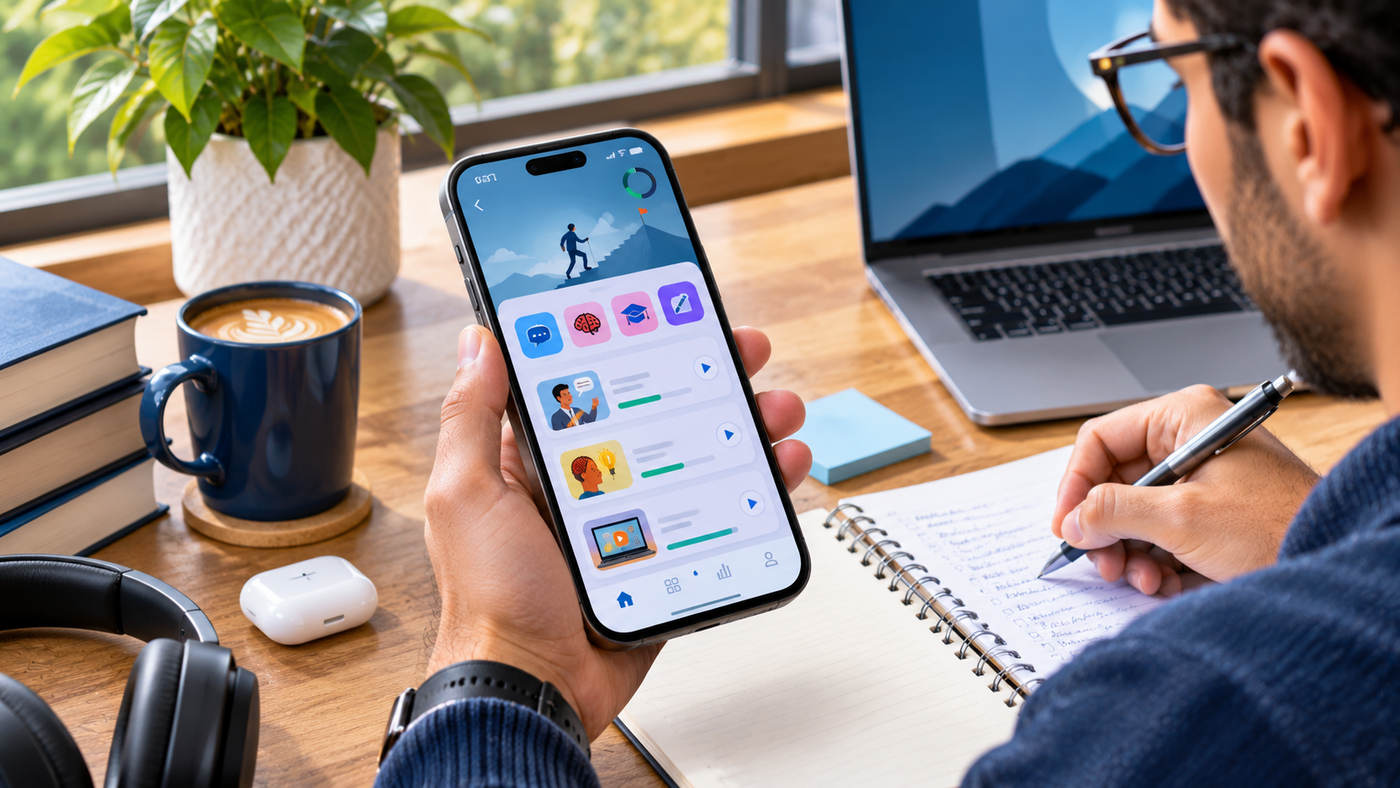
Personal growth advice is everywhere, yet finding time to practise a useful skill can be harder than finding another inspiring video. RiseGuide is a mobile self-improvement platform that organises learning into short, goal-oriented lessons and activities. Its published programme areas include communication, cognitive skills, and content creation, with additional knowledge-search and practice tools. The idea is appealing to people who want structure rather than an endless feed of unrelated tips. However, downloading an app does not automatically change habits; outcomes depend on the quality of the material, the user’s participation, and whether new behaviours transfer into ordinary life.
This guide explains how the platform works, seven decisions worth making before or during a subscription, and the practical limits of app-based personal development. It separates the features the company describes from results that individual learners would still need to demonstrate through experience.
What Is RiseGuide?
RiseGuide is an educational mobile application built around short courses, guided learning journeys, and exercises for self-development. According to its published product information, lessons draw on ideas and frameworks from authors, researchers, leaders, and other recognised figures. Learners can choose pathways aligned with a goal and work through text, video, and practice activities at their own pace. Its app listings identify availability for Android and iOS, although device compatibility and content access should always be checked before purchase.
The platform describes its goal as turning passive screen time into more active learning. That can make sense for someone who opens a phone during short breaks but struggles to commit to long courses. Whether the approach is effective depends on a realistic schedule and tasks relevant to the learner’s needs.
What Does Expert-Powered Mean?
The term describes educational content inspired by expert work, not necessarily classes personally taught or approved by every expert mentioned. RiseGuide states that it is an independent platform and that references to public figures do not by themselves mean partnership, sponsorship, or endorsement. Readers should therefore distinguish a summary of someone’s published ideas from direct instruction by that person.
Is It a Course Library or a Coaching Service?
Its core offering consists of prepared digital learning materials rather than scheduled one-to-one coaching. The company’s FAQ describes text summaries, videos, templates, checklists, self-assessments, and tools. Someone seeking personalised clinical support, professional counselling, or a formal credential should look for an appropriately qualified service instead.
A Useful Way to Evaluate the Promise
Ask whether the lessons teach a clearly defined skill and provide a chance to practise it. Motivating content can be enjoyable, but a repeatable action with feedback is more useful for changing behaviour.
7 Smart Ways to Use RiseGuide for Meaningful Progress
1. Pick One Skill Instead of Trying Everything
A new learner may be interested in better conversations, sharper memory, public speaking, and social media growth all at once. Dividing attention across too many goals makes it difficult to notice improvement. Begin with one practical challenge, such as speaking more confidently during meetings or remembering information from reading.
RiseGuide presents structured journeys rather than a single undifferentiated content feed. Its prominent current tracks include Communication Mastery, Intelligence Training, and Content Creation. Choose the track that most closely matches a real situation you encounter each week. A person who rarely creates online content may gain less from creator lessons than someone actively building an audience.
Define success in observable terms. For example, aim to ask two thoughtful follow-up questions in a conversation, summarize an article from memory, or create one improved video introduction. These measures are more useful than a vague ambition to become successful.
Establish a Baseline
Before beginning RiseGuide, write down what currently feels difficult and collect a simple example of your performance. Revisit it later. A baseline provides a more meaningful comparison than a streak counter alone.
2. Build a Short Routine That Fits Real Life
The company promotes bite-sized learning, with lessons designed for relatively brief daily sessions. Short sessions can make starting easier, but consistency matters more than a perfect number of minutes. Set aside a repeatable time when interruptions are limited, perhaps after breakfast or during a scheduled break.
For RiseGuide to support a habit, treat lessons as a starting point rather than the whole task. Spend some time understanding the concept, then reserve a few minutes to apply it. If a module teaches better listening, test one idea in your next conversation. If it concerns memory techniques, practise recalling information without immediately rereading it.
Avoid turning the routine into a punishment when a day gets busy. Resume at the next practical opportunity rather than trying to compensate by rushing through several lessons. Long-term participation is more likely when the routine is manageable.
Design a Trigger and a Next Action
Connect learning to an existing habit, such as opening the app after a morning coffee. Finish each session by recording one small action for the day. This makes the transition from consuming information to using it deliberate.
3. Explore Communication and Confidence Skills
Communication lessons are among the platform’s highlighted offerings. RiseGuide describes topics such as speaking, storytelling, first impressions, voice control, body language, and social intelligence. These skills can be useful at work and in everyday relationships, but progress requires practising with real people rather than only reading about effective behaviour.
A practical exercise might involve explaining an idea in sixty seconds, replacing filler words with intentional pauses, or checking whether the listener understood the main point. For difficult conversations, write down the outcome you want and prepare one respectful question before speaking. Observe how others respond without treating every interaction as a test of personal worth.
RiseGuide can provide prompts and frameworks for this kind of practice. It cannot guarantee that people will respond positively or that a single technique works equally well in every culture and situation. Good communication depends on listening, respect, context, and adaptability.
Practise With Appropriate Feedback
Ask a trusted colleague or friend what came across clearly and what was confusing. Specific feedback helps improve a skill more effectively than self-rating confidence alone.
4. Use Memory and Thinking Lessons Actively
Its Intelligence Training journey describes material about memory, learning, critical thinking, decision-making, and problem-solving. These are broad abilities, so it is important not to confuse completing a quiz with a proven improvement in general intelligence. Training on one exercise may improve performance on that exercise without transferring equally to unrelated tasks.
When using RiseGuide for cognitive skills, connect the lesson to something meaningful. For memory, practise active recall of names, concepts, or information you genuinely need. For decision-making, write down the options, the information available, the uncertainty, and the tradeoffs before choosing. Then review whether your prediction was reasonable.
Critical thinking can be practised by asking what evidence supports a claim, whether an alternative explanation is possible, and what would change your mind. A well-designed exercise helps you examine your own reasoning instead of simply memorising an appealing conclusion.
Keep Expectations Evidence-Based
Memory or cognitive training content is educational, not a diagnosis or treatment for medical conditions. Seek a qualified clinician if you experience concerning changes in memory, concentration, or daily functioning.
5. Apply Content-Creation Lessons to Real Projects
RiseGuide also promotes a Content Creation journey covering niches, hooks, engagement frameworks, and the ways online content is distributed. This track may appeal to freelancers, entrepreneurs, and creators who want more structure for planning and evaluating their work.
Rather than copying a purported viral formula, use the material to form testable hypotheses. Identify a clear audience need, choose one format, and prepare a small set of examples. Track meaningful indicators such as qualified enquiries, audience retention, useful comments, and whether viewers find the promised information. Large impression counts alone do not establish that a message serves the business or audience.
A platform algorithm can change, so advice about distribution should be treated as a working framework rather than a guaranteed formula for visibility. Ethical content creation also requires accurate claims, respect for copyright, transparent sponsorships, and protection of personal information.
Turn Frameworks Into Experiments
Use RiseGuide to organise one content experiment at a time. Change a headline or opening approach, document the result, and compare it with a reasonable baseline before drawing conclusions.
6. Use SEEK for Questions, but Verify Important Answers
One of the platform’s distinctive features is SEEK, described as a search-based tool for expert knowledge. Its support materials say users can open the Ask Experts area, submit a question, and receive an answer drawn from a curated collection of sources and insights. This offers a different entry point from following a predetermined course sequence.
To get more useful results from RiseGuide, ask specific questions. Instead of asking how to become better at everything, ask for an approach to remembering the key points from a work presentation or preparing a structured introduction for a networking event. A focused question can produce advice that is easier to assess and apply.
However, a curated or AI-assisted answer is not infallible. The company describes SEEK as grounded in selected knowledge, but that does not eliminate possible omissions, outdated information, or errors of interpretation. Verify consequential claims using original trustworthy material and qualified professionals where appropriate.
Separate Learning Help From Professional Advice
RiseGuide states in its terms that its educational content is not a substitute for medical, psychological, financial, legal, or other professional advice. Do not use the tool as the sole basis for high-stakes decisions.
7. Review Subscription Terms Before Paying
A useful learning platform is still a financial commitment. RiseGuide describes fixed-term subscriptions that are paid upfront and renew automatically unless cancelled. The precise plan length, price, and promotional offer may vary by purchase route and region. Its FAQ advises cancelling at least twenty-four hours before the renewal date to avoid the next charge.
Before buying RiseGuide, inspect the checkout screen for the full amount charged today, the date and amount of renewal, whether a trial is involved, and the applicable refund rules. Keep the confirmation and record where the subscription is managed. The company’s published guidance describes cancellation through the app’s profile and subscription settings, with support available for assistance. App-store purchases can involve additional store-specific management procedures.
The website also describes some one-time guide purchases, which should not be confused with the ongoing subscription. Customer reviews include both positive learning experiences and complaints about billing or expectations; consider those reports alongside the actual terms rather than treating individual reviews as proof of every transaction’s outcome.
Decide on Value Before the Renewal Date
Set a calendar reminder well before the next billing date. Ask whether you used the material, applied the exercises, and gained enough practical value to justify another term.
What Features Are Included in the Learning Experience?
RiseGuide describes a mix of text and video learning, practice exercises, quizzes, templates, and downloadable resources. The combination matters because different parts serve different purposes. A summary can explain a concept quickly, while a worksheet encourages the learner to make a decision or record an action. Repeated practice can reveal whether the idea remains useful outside the app.
Personalized Learning Journeys
The onboarding and pathway model is intended to align course content with user goals. That offers direction to someone who would otherwise browse unrelated videos. Yet personalization should not be assumed to mean an individual human coach evaluates every response. Review what the specific plan actually adapts and what remains the same for all learners.
On-Demand Knowledge and Practice Tools
The platform’s support materials describe tools such as an introduction builder, small-talk simulator, memory trainer, and thought organizer, alongside SEEK. Availability and features can evolve, so learners should check the current app version and subscribed course. When practising a social skill with a simulator, use it as preparation for real interactions rather than proof that a conversation will follow a script.
Languages, Devices, and Internet Access
RiseGuide says its courses can be accessed on Android and iOS, including via the mobile app or website. Its FAQ lists several supported text languages but describes video lessons as English-language content. It also states that lessons currently require an internet connection rather than offline viewing. These details matter for learners who travel or rely on limited data connectivity.
Who Is RiseGuide Best Suited For?
The platform may be useful for adults who appreciate structured self-paced learning, prefer short sessions, and want concrete exercises for communication, thinking, or creative work. Someone who struggles with the open-ended nature of social media tutorials may benefit from following a defined sequence. A learner already comfortable taking notes and practising independently may find its resources easier to use effectively.
RiseGuide is less likely to meet the needs of someone seeking accredited formal education, individually supervised therapy, or a guaranteed career outcome. People who need live teaching, extensive offline materials, or specialised coaching should compare those requirements with the actual product before subscribing.
Does Microlearning Really Help?
Short lessons can make information easier to approach and review, particularly when paired with active retrieval and practice. Yet the effectiveness of microlearning depends on content quality, difficulty, motivation, and opportunities for real-world application. Learning science does not support the claim that every skill can be mastered in a few minutes a day regardless of complexity.
A realistic goal is cumulative improvement through repeated effort. Use short lessons to begin or reinforce learning, and schedule longer practice when the skill requires it. Public speaking, for example, benefits from actual presentations and feedback, not just reading speaking tips.
How to Build a Practical 30-Day Learning Plan
A simple month-long experiment can help determine whether RiseGuide fits your routine. During the first week, select one topic, establish a baseline, and complete a small number of lessons with an associated action. Keep the time commitment manageable and record what you actually practise.
In week two, repeat relevant exercises in authentic situations. If studying communication, apply one question technique in a real conversation. If studying memory, test recall a day later rather than immediately after reading. In week three, review mistakes and ask for specific feedback. Adjust the goal if it was too broad or unrealistic.
During week four, compare your new performance with the baseline. Consider whether improvement is visible outside the learning interface. RiseGuide can serve as the source of lessons and prompts, but your own examples provide better evidence of practical progress than the number of modules completed.
Metrics Worth Tracking
Choose two or three useful indicators: completion of planned practice, a specific demonstrated skill, and feedback from an appropriate real-world situation. Avoid obsessing over arbitrary streaks. Rest and adjustments are part of a sustainable learning process.
Privacy and Trust Considerations
RiseGuide publishes a privacy policy describing categories of information it may collect, including registration details, device identifiers, usage information, and other information supplied by users. The policy also discusses third-party service providers and rights that may be available depending on applicable law. Before sharing sensitive details in a profile or question, review the settings and relevant privacy terms.
The platform’s educational claims should also be assessed with care. It draws on publicly available expert ideas and does not imply every named person endorses the app. This distinction protects readers from mistaking educational summaries for direct mentorship. If a particular framework is important, investigate its original context and limitations.
Common Mistakes to Avoid
Mistakes include starting too many tracks, treating a motivational insight as proof of change, relying on knowledge-search answers without verification, and overlooking automatic renewal. Another is expecting an app to replace professional care or live interpersonal practice. The best approach is to use its tools intentionally, test improvements in everyday situations, and review whether the subscription remains worthwhile.
Frequently Asked Questions
1. What is RiseGuide used for?
RiseGuide is a self-improvement learning app offering guided lessons and practice tools for communication, memory, thinking skills, and content creation. It is intended for self-paced educational use.
2. Is RiseGuide available on Android and iPhone?
Yes. The provider lists access through Android and iOS apps, with web-based access described in its support materials. Check current device requirements before installing.
3. Are the lessons taught directly by famous experts?
Not necessarily. The app says its materials are inspired by expert publications and ideas and that references do not automatically indicate partnership or endorsement.
4. Is RiseGuide free or paid?
The app can be downloaded, but access to core programmes is associated with paid subscription offers. Prices, trial terms, and one-time purchases depend on the selected offer.
5. Can a subscription be cancelled before renewal?
The provider says subscriptions renew automatically and advises cancelling at least twenty-four hours before the next billing date. Review the exact checkout and account-management terms.
6. Can RiseGuide replace coaching or mental healthcare?
No. It is an educational product, not a substitute for qualified clinical care, professional counselling, or a specialist’s advice on important personal decisions.
Conclusion
RiseGuide offers a structured alternative to unplanned scrolling by combining short lessons, goal-based pathways, and interactive practice. Its communication, thinking, and content-creation resources may be useful when learners set specific goals and apply ideas outside the app. However, claims of expertise, personalized learning, and potential results should be evaluated alongside product limits, privacy practices, and subscription terms. The most meaningful measure of value is whether the experience supports sustained, observable improvement in everyday life.
