
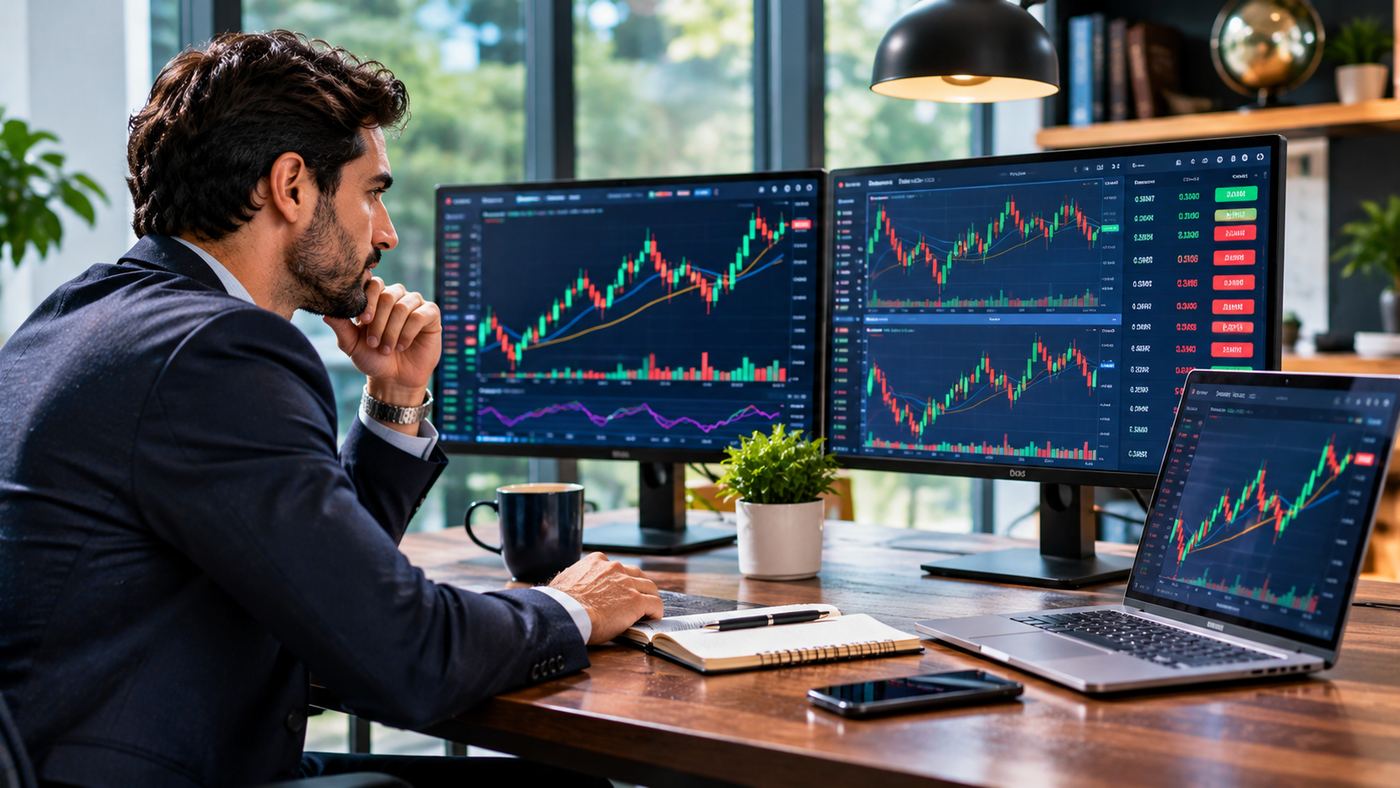
The global foreign exchange market provides opportunities to trade currencies through constantly changing exchange rates. Whether someone is learning about currency markets or already has trading experience, choosing a suitable Forex trading platform is an important part of understanding market access, trade execution, transaction costs, and financial risk.
Modern online trading platforms offer charting systems, technical indicators, market analysis, and order-management features that make it possible to monitor currency markets from computers and smartphones. However, not every platform delivers the same functionality, pricing transparency, regulatory protections, or trading conditions.
The growing availability of online brokers has also made it essential for traders to distinguish useful technology from exaggerated promises of easy profits.
This comprehensive guide explains how forex trading platforms work, what features to compare, how MetaTrader 4 and MetaTrader 5 differ, and why security and responsible risk management deserve careful consideration.
What Is a Forex Trading Platform?
A Forex trading platform is software that enables users to access foreign exchange market information and place currency-related trades through a broker.
The platform typically displays currency prices, charts, available instruments, account information, and trading controls.
Depending on the broker and product, traders may access spot foreign exchange transactions or derivatives such as contracts for difference (CFDs).
These instruments are not identical.
For example, forex CFDs generally allow traders to speculate on currency price movements without taking delivery of the underlying currencies.
Such products frequently involve leverage and carry substantial financial risk.
How Does Online Forex Trading Work?
Foreign exchange trading involves the relationship between two currencies.
A currency pair shows how much of one currency is required to purchase another.
For example, EUR/USD represents the exchange rate between the euro and the US dollar.
If EUR/USD is quoted at 1.1000, this indicates that one euro is valued at approximately 1.10 US dollars.
A trader expecting the euro to strengthen against the dollar might consider a long position. Someone expecting the euro to weaken might consider a short position.
Both predictions can be wrong, and leverage can significantly increase losses.
The trading platform provides the interface for entering and managing these positions, while the broker determines important aspects of execution and available trading conditions.
Why Choosing the Right Forex Trading Platform Matters
The quality of a trading platform can influence how effectively users analyze market conditions and manage orders.
A reliable interface should provide accurate information, clear order controls, and transparent access to account details.
However, platform quality alone does not guarantee profitable trading.
Access to Currency Markets
A suitable platform may provide access to major, minor, and selected exotic currency pairs.
Major currency pairs typically include combinations involving heavily traded currencies, such as EUR/USD, GBP/USD, and USD/JPY.
Minor pairs generally combine major currencies without the US dollar, while exotic pairs involve currencies from smaller or emerging markets.
Available instruments differ between brokers.
Trade Execution and Order Management
Trading software allows users to submit orders and monitor positions.
Execution quality depends on the broker, market conditions, liquidity, connectivity, and order type.
During periods of high volatility, the execution price may differ from the price visible when an order was submitted.
This difference is commonly known as slippage.
Market Analysis
Modern platforms include technical charts, historical price information, and indicators.
These tools help traders examine past price behavior and formulate trading scenarios.
Nevertheless, historical patterns do not reliably predict future market movements.
Risk Management
Many trading platforms offer stop-loss and take-profit orders.
These tools can help organize trade exits, although they do not eliminate financial risk.
Under fast-moving market conditions, some orders may execute at prices different from the requested levels.
Essential Features of a Forex Trading Platform
Before opening an account, it is worth comparing the features that affect day-to-day trading activities.
1. Clear and Responsive Interface
A trading platform should make it easy to locate currency pairs, view charts, check account balances, and manage open positions.
Complicated navigation can increase the likelihood of mistakes, particularly when markets are moving quickly.
Beginners may prefer a straightforward interface, while experienced traders may value extensive customization.
2. Real-Time Market Data
Currency markets move continuously during their regular trading week.
Access to updated prices allows traders to monitor developments and evaluate current conditions.
However, quote frequency, latency, and available data may vary across providers.
3. Advanced Charting Tools
Charts are among the most frequently used features of forex trading software.
Common chart types include:
- Candlestick charts
- Line charts
- Bar charts
- Multiple timeframe views
- Historical price charts
Technical indicators may include moving averages, the Relative Strength Index, Bollinger Bands, and the Moving Average Convergence Divergence indicator.
These tools describe selected characteristics of price movements rather than guaranteeing future results.
4. Multiple Order Types
Order flexibility is useful when planning transactions.
Common order types include market orders, limit orders, stop orders, stop-loss orders, and take-profit orders.
Their exact behavior depends on the platform, broker agreement, and market conditions.
Traders should understand how each order works before using real funds.
5. Mobile Trading Support
Mobile applications allow users to monitor positions, receive notifications, and access account information while away from a desktop computer.
A suitable mobile interface should provide clear account details and essential risk controls.
However, mobile convenience should not encourage impulsive decisions or excessive trading.
6. Demo Account Availability
A demo account offers a simulated environment for exploring platform functions.
It can help beginners practice placing orders, reading charts, and understanding trading terminology.
Demo results do not establish how a strategy will perform with real money, where emotional pressure, execution conditions, and costs may differ.
7. Transparent Costs
A useful comparison should include spreads, commissions, overnight financing charges, currency conversion costs, and potential administrative fees.
Low advertised spreads do not necessarily mean that total trading costs are low.
Understanding MetaTrader 4 and MetaTrader 5
MetaTrader 4 and MetaTrader 5 are established trading platforms used through participating brokers.
Both provide charting, technical analysis, order-management features, and support for automated trading.
However, they are separate software platforms with differences in functionality.
MetaTrader 4 (MT4)
MT4 is widely associated with retail forex trading.
Its features include technical charts, indicators, customizable workspaces, and support for Expert Advisors.
Expert Advisors are programs that can analyze markets or perform trading actions according to coded instructions.
Automated trading introduces additional risks, including programming errors and unexpected market behavior.
MT4 may suit users who prefer an established forex-focused interface.
MetaTrader 5 (MT5)
MT5 provides a broader collection of analytical and trading features.
Depending on the broker, it may support multiple financial instruments, additional order-management capabilities, and expanded technical analysis.
MT5 also uses a different programming environment for automated strategies.
Which Platform Is Better?
Neither platform is universally better for every trader.
MT4 may appeal to people who already use its tools and automated systems.
MT5 may be attractive to users seeking additional functionality or broader instrument access.
When choosing between them, consider broker support, available instruments, order types, personal familiarity, and compatibility with any existing trading tools.
Exploring Online Forex Trading Through Orbex
Traders researching brokers may encounter Orbex while comparing software, currency-pair access, and trading conditions.
Orbex provides access to forex CFD trading and supports established trading technologies, including MetaTrader 4 and MetaTrader 5.
Readers evaluating a Forex trading platform can examine Orbex’s published information about available currency pairs, trading software, execution arrangements, and account conditions.
The company advertises competitive spreads and an average execution speed of 0.03 seconds on its website.
Such figures represent the provider’s published claims rather than guarantees that every order will execute at that speed or price.
Actual conditions can vary with market liquidity, volatility, connection quality, and instrument characteristics.
What Should Traders Verify?
Before considering any broker, prospective customers should confirm:
- The legal entity providing the trading account
- Applicable regulatory authorization
- Whether services are available in their country
- Account fees and minimum funding requirements
- Spreads and commissions
- Leverage and margin requirements
- Deposit and withdrawal conditions
- Customer support availability
- Negative balance protection, where applicable
Orbex states that its services are not available to residents of certain jurisdictions, including the United States.
Availability, legal entities, and regulatory protections must be checked for the customer’s actual location.
Understanding Forex Trading Costs
Trading costs can influence financial outcomes, especially when traders place frequent orders.
Even a strategy that appears profitable before costs can produce losses after spreads, commissions, and financing expenses.
Spreads
The spread is the difference between the buy and sell prices quoted for an instrument.
A narrower spread generally reduces the initial transaction cost, all else being equal.
However, spreads can widen during periods of market uncertainty or reduced liquidity.
Trading Commissions
Some brokers charge a separate commission for opening or closing positions.
Others incorporate more of their compensation into the quoted spread.
Compare the combined cost rather than treating a zero-commission advertisement as automatically cheaper.
Overnight Financing
Leveraged forex CFD positions held beyond a particular time may incur overnight financing charges or adjustments.
The treatment depends on the product, position direction, and broker terms.
These costs can accumulate when positions remain open for extended periods.
Currency Conversion Fees
Accounts funded in a currency different from the trading account’s base currency may incur conversion expenses.
Check conversion terms when depositing, withdrawing, or holding positions denominated in other currencies.
Inactivity and Withdrawal Fees
Some brokers charge administrative fees under specific circumstances.
Review the full fee schedule before opening an account.
The Importance of Broker Regulation and Security
Trading software should never be evaluated separately from the financial company operating the account.
Broker regulation can influence operational standards, disclosures, client money arrangements, and dispute resolution procedures.
Verify the Legal Entity
International brokerage brands may operate through multiple legal entities.
Different entities can be subject to different regulations and customer protections.
Verify the precise contracting entity and its authorization through the relevant regulator’s official register.
Do not assume that every customer of an international brand receives identical protections.
Understand Client Fund Arrangements
Review how the broker describes the handling of customer funds.
Where applicable, regulatory rules may require specific segregation or safeguarding arrangements.
The existence of such arrangements does not eliminate all financial or counterparty risks.
Protect Your Account
Use strong, unique passwords and enable additional account security features where supported.
Avoid entering credentials through unfamiliar links or unsolicited messages.
Download trading applications from legitimate sources.
Review Withdrawal Terms
Withdrawal accessibility is a practical consideration.
Before depositing funds, examine processing requirements, identity verification procedures, potential fees, and accepted payment methods.
Forex Leverage and Margin Explained
Leverage allows a trader to control a larger market exposure with a comparatively smaller amount of deposited capital.
For example, with leverage of 1:20, a $1,000 margin allocation could provide exposure to a position worth $20,000, subject to the product’s margin rules.
This increases both potential gains and potential losses.
A 1% unfavorable price movement on a $20,000 position represents approximately $200 of market loss before fees and other adjustments.
That would be equivalent to 20% of the original $1,000 margin allocation.
This simplified example illustrates why leveraged trading can cause substantial losses even when the underlying exchange rate changes by a relatively small percentage.
Higher leverage is not automatically beneficial.
Risk exposure, account equity, margin requirements, and the possibility of forced liquidation all need careful consideration.
Risk Management Tools Every Trader Should Understand
No trading platform can remove market uncertainty.
However, understanding risk controls may help traders evaluate and limit certain exposures.
Stop-Loss Orders
A stop-loss order is designed to close or trigger an exit when the market reaches a specified level.
It is not always a guaranteed execution price.
Market gaps, volatility, and liquidity conditions can cause slippage.
Take-Profit Orders
A take-profit order is designed to close a position when a specified favorable price level is reached.
It can help automate part of a planned exit strategy.
However, price movements may not reach the selected level.
Position Sizing
Position size determines the amount of market exposure created by a trade.
Excessively large positions can produce substantial losses relative to account size.
Understanding position size is essential before using leverage.
Margin Monitoring
Traders should monitor available margin, account equity, and broker liquidation policies.
Margin requirements may change, and adverse price movements can lead to forced position closures.
Avoiding Emotional Decisions
Rapid market movements can encourage impulsive trading.
Documenting assumptions and reviewing outcomes may help identify mistakes, but no trading plan guarantees profits.
Technical Analysis on Forex Trading Platforms
Technical analysis involves examining market information, often including historical prices and trading patterns.
Traders use these tools to evaluate possible scenarios.
Moving Averages
Moving averages smooth price data over a selected period.
They can help illustrate historical trends, although they respond to past information and may lag changing conditions.
Relative Strength Index
The Relative Strength Index, commonly called RSI, measures aspects of recent price momentum.
Traders sometimes use it to identify potentially extended price movements.
Such readings are not reliable standalone predictions of reversals.
Support and Resistance
Support and resistance refer to price areas that traders consider potentially significant based on historical market behavior.
These levels can fail, particularly during major news events.
Economic Calendars
Economic calendars identify scheduled announcements such as employment reports, inflation data, and central bank decisions.
These events may affect exchange rates and market volatility.
An economic calendar provides context but does not determine how markets will respond.
Fundamental Analysis in Currency Trading
Fundamental analysis examines economic, monetary, and political developments that may influence exchange rates.
Interest Rates
Central bank policy can influence borrowing costs, capital flows, and currency valuations.
However, exchange rates also depend on market expectations and many other factors.
Inflation
Inflation affects purchasing power and may influence monetary policy.
Currency markets often respond to how inflation data compares with expectations rather than to the figures alone.
Economic Growth
Indicators such as gross domestic product, employment data, and business activity can provide information about economic conditions.
Geopolitical Developments
Political instability, trade policy, conflicts, and international economic developments can increase uncertainty and market volatility.
No single indicator consistently predicts currency movements.
Mobile Forex Trading vs. Desktop Trading
Both mobile and desktop platforms offer practical advantages.
Desktop Platforms
Desktop trading software generally provides more screen space for detailed charts, simultaneous instruments, and research workflows.
Users who rely on complex analysis may prefer this environment.
Mobile Platforms
Mobile applications make it convenient to monitor open positions and receive alerts.
They can be useful for account oversight while traveling.
However, smaller screens may make detailed analysis less comfortable, and mobile connectivity can be interrupted.
Web-Based Trading
Some brokers offer browser-based access without requiring a dedicated desktop installation.
This can be convenient on supported devices, but available functions vary by platform.
Choose an environment that suits your workflow rather than assuming that more screens or faster access will improve financial returns.
How to Evaluate a Forex Trading Platform Before Opening an Account
Comparing trading services systematically helps identify important differences.
Step 1: Confirm Local Availability
Start by determining whether the broker legally serves residents of your jurisdiction.
Avoid attempting to bypass geographic eligibility restrictions.
Step 2: Verify Regulation
Identify the operating legal entity and independently confirm any regulatory claims.
Step 3: Explore the Demo Environment
Use a simulated account to understand navigation, charts, order entry, and account reporting.
Step 4: Compare Complete Trading Costs
Review spreads, commissions, overnight financing, conversion charges, and administrative fees.
Step 5: Check Platform Compatibility
Confirm whether your preferred computer, browser, or mobile device supports the trading software.
Step 6: Review Risk Disclosures
Read the broker’s risk statement and product documents.
Pay particular attention to leverage, margin rules, negative balance arrangements, and the circumstances under which positions may be closed.
Step 7: Evaluate Customer Service
Review available communication channels, language support, and published service arrangements.
Support quality can be difficult to assess from marketing materials alone.
Common Mistakes Beginners Make in Forex Trading
New traders can encounter significant challenges when learning about currency markets.
One common mistake is focusing on potential returns while underestimating the possibility of losses.
Another is selecting a broker based exclusively on advertised leverage or low spreads.
Some beginners also rely too heavily on technical indicators without understanding broader economic influences.
Other mistakes include:
- Trading without understanding margin requirements
- Using excessive position sizes
- Assuming a demo account guarantees live success
- Ignoring overnight financing costs
- Depending on unrealistic profit predictions
- Failing to verify broker licensing
- Following unverified trading signals
- Using money needed for essential living expenses
Learning about these risks before depositing funds is more valuable than relying on promotional claims.
Automated Forex Trading and Expert Advisors
Automated trading software can execute predetermined rules without requiring manual intervention for every action.
MetaTrader platforms support automated systems, commonly called Expert Advisors.
Such programs may monitor indicators, evaluate market conditions, and submit orders according to their programming.
However, automated trading systems can malfunction, respond poorly to unexpected market conditions, or amplify losses.
Backtesting also has limitations.
Historical simulations may not accurately reflect live execution, changing spreads, slippage, or shifts in market behavior.
Traders should not interpret impressive historical performance as evidence of future profitability.
How to Identify Forex Trading Scams
Online currency trading attracts fraudulent marketing because financial markets can appear complex to inexperienced users.
Warning signs may include:
- Guaranteed investment returns
- Claims of risk-free trading
- Pressure to deposit immediately
- Requests to transfer funds to personal accounts
- Unverifiable regulatory credentials
- Unexpected demands for additional withdrawal fees
- Promises that automated software cannot lose money
A legitimate trading provider should clearly disclose financial risks and the contractual terms governing customer accounts.
Anyone uncertain about a provider should independently verify its credentials before transferring money.
The Future of Online Forex Trading Technology
Forex software continues to evolve through improvements in analytics, mobile interfaces, automation, and financial data processing.
Artificial intelligence may assist with research summaries, pattern detection, and the organization of market information.
However, AI-generated market predictions can be inaccurate.
Automated analysis cannot eliminate unexpected economic events or guarantee successful trading outcomes.
As platforms become more sophisticated, users will continue to need sound judgment, appropriate security practices, and realistic expectations.
The most valuable technology is often technology that makes relevant information clearer rather than promising effortless profits.
Frequently Asked Questions
What is a Forex trading platform?
A Forex trading platform is software used to view currency prices, analyze market information, and submit trading orders through a broker. Its features depend on the provider and available financial instruments.
Which is better for forex trading, MT4 or MT5?
MT4 offers an established forex-focused environment, while MT5 provides expanded capabilities and potential access to additional instruments. The better choice depends on broker support, required tools, and personal preferences.
Can beginners use a Forex trading platform?
Beginners can learn platform functions through demo accounts and educational resources. However, live forex trading, particularly leveraged CFDs, carries substantial risks and may not be appropriate for inexperienced individuals.
Are forex trading platforms free to use?
Many brokers provide trading software without a separate platform subscription. Nevertheless, trading can involve spreads, commissions, financing charges, and other expenses.
What is leverage in forex trading?
Leverage allows traders to create market exposure greater than their margin allocation. It magnifies both gains and losses and can result in rapid account depletion.
Is online forex trading safe?
Online forex trading involves market, leverage, operational, and counterparty risks. Regulatory oversight, account security, and responsible position management may address certain risks but cannot eliminate the possibility of financial loss.
Does Orbex offer MetaTrader platforms?
Orbex advertises access to MetaTrader 4 and MetaTrader 5. Available services and account conditions depend on the relevant legal entity and jurisdiction.
How do I choose a reliable forex broker?
Verify the broker’s legal entity, regulatory authorization, local availability, fee structure, withdrawal terms, customer support, and product risk disclosures before considering an account.
Conclusion
Choosing an appropriate Forex trading platform requires evaluating more than charts, execution claims, or promotional trading conditions. Platform usability, broker regulation, transparent costs, order-management tools, and risk disclosures are all important considerations.
MetaTrader 4, MetaTrader 5, and other online trading technologies provide useful ways to monitor currency markets, but no platform can guarantee profitable outcomes. Prospective traders should prioritize education, verify broker eligibility and regulation, and fully understand leveraged trading risks before committing capital.
