
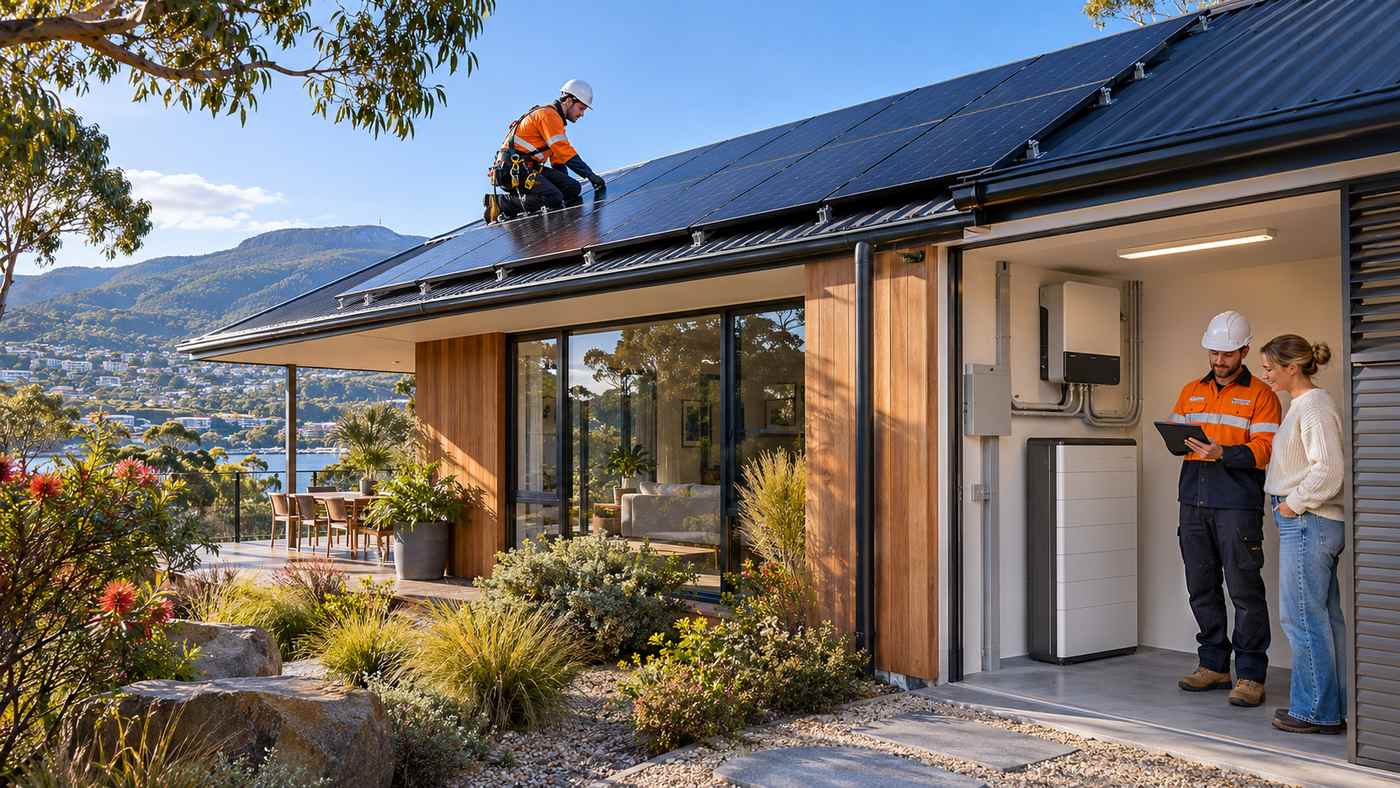
Installing rooftop solar and home storage is a significant household decision, especially in a city with distinct seasonal daylight and variable heating needs. Hobart solar panels and batteries can help households use more of the electricity they generate, reduce dependence on purchased grid power, and plan for some electrical outages when the system includes appropriate backup equipment. The benefits of Hobart solar panels and batteries depend on roof conditions, consumption patterns, network approvals, equipment specifications, and electricity tariffs rather than on a single advertised savings figure.
For homeowners considering an installation in southern Tasmania, good planning begins with understanding what solar can generate through summer and winter and how a battery changes that energy flow. This guide explains seven practical choices, current Australian incentives, Tasmanian feed in arrangements, installation safeguards, and questions to ask before accepting a quotation.
What Are Hobart Solar Panels and Batteries?
A rooftop photovoltaic system converts sunlight into direct current electricity. An inverter converts that output into alternating current suitable for household appliances and, when permitted, export to the electricity network. When solar generation exceeds immediate demand, the excess may be exported or stored in a compatible battery for later use.
A typical arrangement includes roof mounted panels, an inverter, electrical protection, a monitoring system, and optional storage. Batteries have a usable energy capacity measured in kilowatt hours and a power output measured in kilowatts. These describe different limits: how much energy can be stored and how rapidly the battery can deliver it.
Solar Only Versus Solar With Battery Storage
Solar only systems can reduce electricity purchases during daylight hours. Adding storage can shift some surplus generation into evening or early morning use, although charging and discharging involve losses. A battery is not automatically financially worthwhile for every household, particularly when solar export credits are relatively valuable.
Hobart solar panels and batteries should be sized together with the household’s load profile, not chosen independently from a sales brochure. If most electricity is already consumed during the day, a large battery may cycle infrequently and deliver limited additional savings.
Why Hobart Needs Location Specific Planning
Hobart’s shorter winter days and lower seasonal sun angles mean generation changes considerably over the year. Roof direction, slope, shade, and nearby buildings also influence production. Solar panels still work during cooler weather, but lower winter sunlight cannot be ignored when calculating annual benefits.
Understand Solar Exposure Before Purchasing
In the southern hemisphere, a north facing roof often provides strong annual solar exposure, while east and west orientations can better distribute generation across morning and afternoon. A site assessment should model the actual roof rather than treating one orientation as suitable for every home.
7 Proven Tips for Choosing a Solar and Battery System
1. Analyse Your Electricity Use Before Selecting Capacity
Start with at least twelve months of electricity bills, where available, to identify total consumption and seasonal differences. Look at daily usage, electric heating, hot water, cooking, and whether anyone works from home. Interval meter data can offer a clearer picture than quarterly bills because it shows when energy is used.
When evaluating Hobart solar panels and batteries, ask the installer to separate estimated solar generation from household consumption, exported energy, and battery charging. A home with high evening heating demand has a different profile from one using most electricity during daylight hours. Even an accurately sized solar array will not meet all loads during every winter day.
Plan for Future Household Changes
An electric vehicle, heat pump, induction cooking, or additional occupants may change demand. Include realistic future plans, but avoid buying excessive capacity for equipment that may never be installed. Request a modeled scenario for both present and anticipated use.
2. Assess Roof Strength, Shade, and Panel Placement
Choosing Hobart solar panels and batteries begins with a roof suitable for long term mounting. A qualified professional should consider roof condition, available area, structural capacity, orientation, pitch, and safe access. Shading from chimneys, trees, hills, or neighboring properties can reduce production at particular times.
For Hobart solar panels and batteries, discuss a site specific layout that accounts for usable roof space and potential obstructions. Do not schedule panel installation over deteriorated roofing that is likely to need replacement soon. Roof repair after installation can require removing and reinstalling the array.
Good design also considers fire access, cable routes, waterproof penetrations, and appropriate mounting equipment for local wind and weather conditions. These details should be explained before installation rather than discovered on the day.
3. Match Solar Capacity to Realistic Generation and Export Limits
System capacity is commonly expressed in kilowatts of panels, while an inverter has its own rated output. A larger panel array does not always mean that an equivalent amount of power can be exported to the grid. Network limits, inverter configuration, and local consumption all affect the practical outcome.
Hobart solar panels and batteries connected to the Tasmanian network require appropriate connection approval through TasNetworks. The installer generally submits the application before the work proceeds. Export conditions may depend on network capability and the particular connection, so a proposal should not promise unrestricted exports without approval.
Compare Annual Output and Seasonal Forecasts
Ask for modeled monthly generation, not only a high annual total. A monthly breakdown makes winter limitations clearer and helps explain whether the solar array is likely to charge a battery reliably through different seasons. Review any assumptions about roof shading, panel degradation, and expected system losses.
4. Choose Battery Capacity and Backup Features Carefully
For Hobart solar panels and batteries, storage size should reflect how much surplus solar energy is usually available and how much electricity the household wants to use after sunset. A large battery that rarely fills may not be good value, while one that is too small may provide limited evening coverage. Understand the distinction between nominal capacity and usable capacity, and compare the warranty’s capacity retention terms.
For Hobart solar panels and batteries, confirm whether the system provides outage backup and exactly which circuits it can supply. Ordinary grid connected solar systems generally shut down when the network fails to protect workers and equipment. A battery also needs suitable backup capable inverter and switching arrangements to provide electricity during an outage.
Some backup systems power only selected circuits such as refrigeration, lighting, and communications. High demand appliances may require more output than the system can deliver. Ask for written descriptions of backup limits, switchover behavior, and whether the panels can continue charging the battery during a blackout.
Review Battery Installation Safety
A qualified installer must choose a location that complies with applicable Australian standards, electrical rules, access needs, and manufacturer instructions. Battery units must not be placed wherever there is spare wall space. Appropriate separation, protection, and placement depend on the installation and battery technology.
5. Understand Incentives and the Actual Financial Return
Australian rooftop solar can qualify for Small-scale Technology Certificates under the Small-scale Renewable Energy Scheme when the products and installation meet eligibility rules. These certificates commonly appear as an upfront discount on an installer quotation. Check how the discount is calculated rather than assuming an advertised package price includes every available benefit.
The federal Cheaper Home Batteries Program supports eligible systems with nominal capacities from 5 to 100 kilowatt hours, with certificate support applied to the first 50 kilowatt hours of usable capacity. From May 2026, the calculation uses capacity tiers and the incentive declines over time. The commonly advertised discount of around 30 percent is a program objective, not a guaranteed percentage for every quotation.
Hobart solar panels and batteries may qualify for both rooftop solar and eligible battery incentives, but the conditions are separate. For supported battery installations, check approved product listings and relevant Solar Accreditation Australia accreditation. Grid connected eligible batteries must be technically capable of joining a virtual power plant, but customers do not have to enrol in one.
Do Not Assume Older Tasmania Schemes Are Still Open
Some articles still describe Tasmania’s Energy Saver Loan Scheme as an available incentive. That scheme closed to new applications in September 2025. Before relying on any advertised grant or loan, verify its current status and eligibility through an official program administrator. A sound investment assessment should also remain viable if an expected incentive cannot be claimed.
6. Compare Feed In Tariffs With Self Consumption Savings
When comparing Hobart solar panels and batteries, remember that for the period from July 2026 to June 2027, Tasmania’s regulated minimum feed in tariff is 9.276 cents per kilowatt hour for eligible exports. Retailers may offer different plans, and the household’s import rate and fixed supply charge also matter. A high export credit is not necessarily the best deal if the electricity bought from the grid costs more.
Hobart solar panels and batteries create two different financial benefits. Solar electricity used immediately can avoid buying that amount from the retailer. Exported electricity earns the applicable feed in credit. When stored solar is used later, the benefit must account for the export credit forgone and losses during battery charging and discharging.
For illustration, imagine an imported kilowatt hour costs 28 cents while a solar export earns about 9.3 cents. Using solar immediately can avoid more variable electricity cost than exporting it, but storing it for later is not worth a full 28 cents of additional savings because the household gives up the export payment and loses some energy in storage. Real tariffs and system efficiency must be used for a genuine calculation.
Check the Entire Retail Electricity Plan
Compare usage rates, time of use periods, daily supply charges, export credits, and any special battery conditions. Review the payback analysis under reasonable future tariff assumptions rather than assuming today’s rates will remain unchanged throughout the equipment’s life.
7. Select Accredited Installers and Demand a Complete Quote
The design and installation should be carried out by appropriately accredited professionals, with electrical work performed by licensed practitioners under Tasmanian requirements. Solar Accreditation Australia is the current national accreditation scheme for eligible solar and battery installers. Eligible equipment must also meet relevant approved product and safety requirements.
When seeking quotations for Hobart solar panels and batteries, compare several designs prepared for the same property and electricity use. Ask for panel and inverter models, battery usable capacity, forecast monthly generation, mounting details, network application responsibility, warranties, monitoring options, and estimated savings assumptions.
Confirm Commissioning and Documentation
A complete handover should include operating instructions, electrical compliance documentation, system diagrams, warranty records, emergency shutdown instructions, and a demonstration of monitoring. Confirm who provides support if equipment reports a fault and who is responsible for warranty labour. Avoid a contractor who cannot explain installation supervision or local after sales service.
How Much Do Hobart Solar Panels and Batteries Cost?
There is no reliable single price for Hobart solar panels and batteries across every household. Cost depends on the array size, roof complexity, panel and inverter selection, battery capacity, switchboard condition, installation access, and any electrical or structural upgrades. A retrofit battery may require additional compatibility work compared with a storage system planned alongside new solar.
Hobart solar panels and batteries should be compared on an itemized basis after applicable incentive assumptions have been shown. Ask the installer to separate the gross equipment cost, labor, network and metering arrangements, claimed discounts, and total amount payable. Warranty length matters, but review what is actually covered and which exclusions apply.
How to Estimate Financial Payback
For Hobart solar panels and batteries, a basic payback estimate divides the net initial cost by expected annual net savings. A more meaningful model also considers maintenance, battery capacity degradation, inverter replacement risk, financing cost, export value, and future electricity prices. Solar panels and batteries may have different financial payback periods because storage adds cost as well as flexibility.
Never accept a fixed payback claim without seeing the assumed electricity consumption, tariff, export amount, and expected battery cycling.
Installing Solar and Storage in Hobart
TasNetworks connection approval is an important step for grid connected solar. The installer generally manages the application and provides technical documentation. After installation, the relevant compliance, inspection, and metering processes must be completed before normal operation. The timing depends on whether network changes or upgrades are required.
For Hobart solar panels and batteries, clarify these responsibilities before paying a deposit. A battery addition to existing solar may need its own compatibility assessment and connection documentation. Changes to a roof, heritage property, or unusual mounting arrangement can also require council or building advice depending on the site.
What Happens During Installation?
A normal installation involves safe roof mounting, electrical cabling, inverter and protective equipment installation, commissioning, and owner instruction. Battery work introduces additional siting and electrical safety requirements. Occupants should never attempt to modify high voltage DC connections or open battery equipment themselves.
How to Maintain and Monitor a Solar Battery System
Solar systems generally need less routine attention than equipment with many moving parts, but they are not maintenance free. Monitor production, inverter alerts, and changes in output. Arrange professional checks when there are unexpected shutdowns, storm damage, water ingress, or damaged wiring.
Hobart solar panels and batteries should be maintained according to the equipment manufacturer’s instructions and the installer’s documentation. Avoid climbing onto the roof to clean panels. If cleaning is necessary, use a competent service provider and appropriate methods. Battery owners should keep the unit accessible for professional inspection and follow instructions about ventilation, temperature, and emergency response.
Recognize the Warning Signs
Unexpected reductions in solar production, recurring inverter faults, unusual battery alarms, and visible damage warrant investigation. Do not assume reduced winter generation is a malfunction without comparing it against expected seasonal output and weather conditions. Contact an appropriately qualified professional for electrical concerns.
Common Mistakes to Avoid With Home Solar Storage
Oversizing equipment without reviewing consumption, accepting optimistic winter generation forecasts, and relying on a headline rebate can distort the budget. Another mistake is assuming that every battery provides whole house backup during an outage. An installer should explain technical limits before purchase.
Homeowners comparing Hobart solar panels and batteries should also avoid overlooking roof repairs, network export conditions, and product support. A slightly cheaper system can become inconvenient if spare parts are unavailable or the warranty process is unclear. Base the decision on suitable performance, safety, and total ownership costs.
Frequently Asked Questions
1. Are Hobart solar panels and batteries worth installing?
They can reduce grid electricity purchases and improve use of household solar generation. Value depends on roof exposure, consumption timing, system sizing, tariffs, installed costs, and battery cycling.
2. Do solar panels generate electricity in Hobart during winter?
Yes. Solar panels can generate during winter daylight, but output is generally lower due to shorter days and seasonal sun angles. A realistic quotation should show monthly forecasts.
3. Can home batteries keep a house running during a blackout?
Only if the installation has appropriate backup capable equipment and wiring. Backup may cover selected circuits rather than the entire house, and available power and stored energy are limited.
4. Are federal battery discounts available in Tasmania in 2026?
Eligible batteries may qualify under the Cheaper Home Batteries Program, subject to capacity, approved equipment, accreditation, and other requirements. The amount depends on the installation date and capacity.
5. What is Tasmania’s minimum solar feed in tariff for 2026 to 2027?
The regulated minimum for eligible systems is 9.276 cents per kilowatt hour from 1 July 2026 to 30 June 2027. Retailers can offer other rates and plan conditions.
6. How do I choose an installer for Hobart solar panels and batteries?
Verify relevant Solar Accreditation Australia accreditation and Tasmanian electrical licensing, compare itemized quotes, and confirm equipment approvals, network responsibilities, warranties, and after sales support.
Conclusion
Hobart solar panels and batteries can provide useful energy flexibility when the system is built around actual household demand and the realities of Tasmania’s seasons. A strong decision compares roof suitability, monthly generation, storage needs, export rates, incentives, and installation safety rather than trusting broad savings promises. Carefully selected accredited professionals and transparent documentation help protect the investment. With realistic forecasts and ongoing monitoring, homeowners can make their solar and battery system a dependable part of everyday energy planning.
