
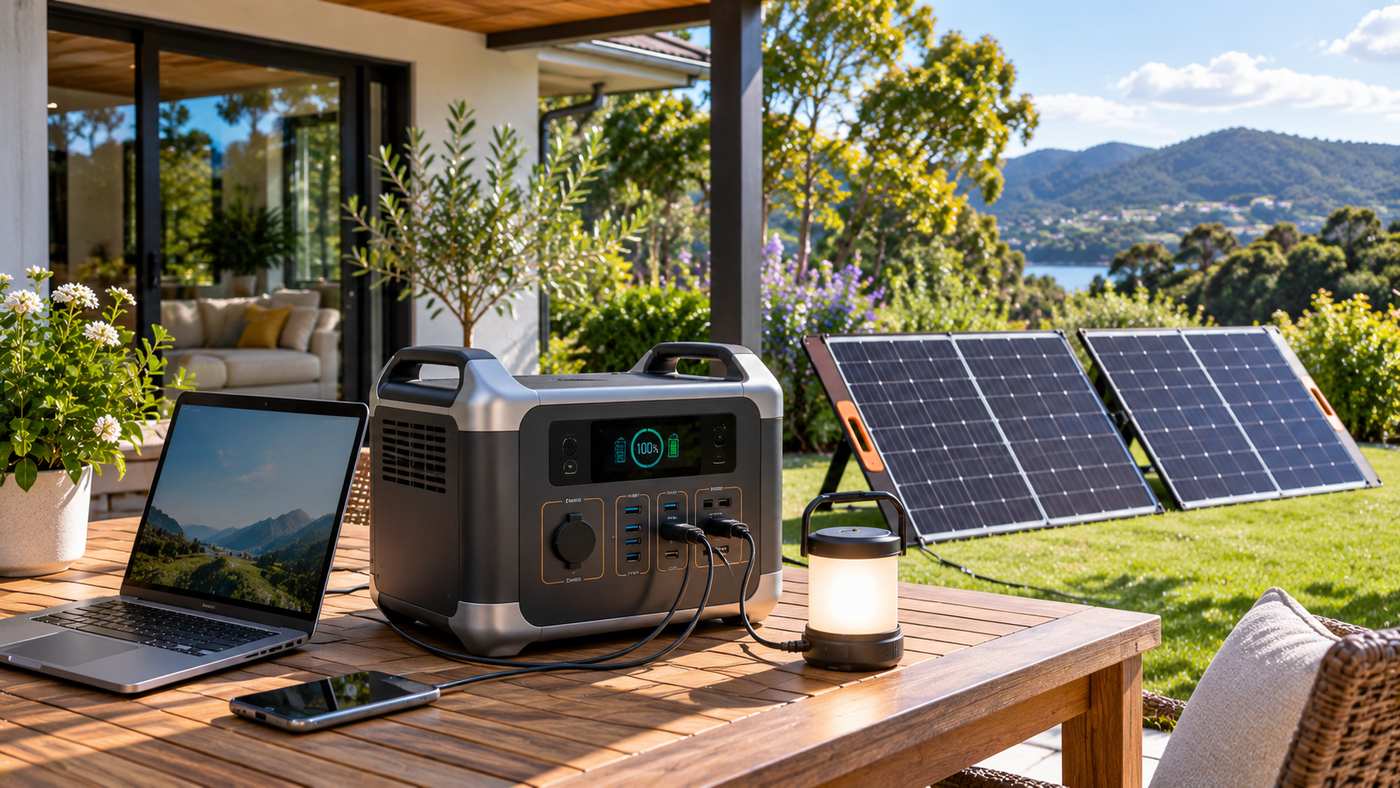
A solar generator can provide stored electricity when a wall outlet is unavailable, making it useful for camping, temporary workspaces, and selected household needs during an outage. Despite the name, most consumer models do not generate electricity on their own. They combine a rechargeable power station with compatible solar panels, purchased together or separately. Choosing a dependable setup requires understanding battery capacity, appliance power requirements, charging conditions, and electrical safety rather than comparing advertising claims alone. This guide explains seven decisions that help buyers select an appropriate system, estimate realistic runtime, and use portable power responsibly. It also clarifies the difference between a convenient battery backup and a professionally installed system designed to supply household circuits.
What Is a Solar Generator and How Does It Work?
A solar generator is generally a battery power station that accepts electricity from photovoltaic panels. The panels convert sunlight into direct current electricity. A charge controller manages the incoming energy, the battery stores it, and an inverter supplies alternating current for compatible household devices. Many units also provide USB connections or direct current outputs that avoid the need to use the AC inverter for certain electronics.
Names and bundles vary. Some stations are advertised without panels, so confirm what comes in the box.
Portable Power Versus a Home Solar Installation
A portable station normally provides electricity through its own outlets. A rooftop solar and stationary battery installation can serve selected building circuits through appropriately designed electrical equipment. They have different installation and safety requirements.
Understand the Main Components
The panels, charge controller, battery, inverter, and protective electronics must work together. A large battery is less useful if its inverter cannot start your appliance.
1. Calculate Battery Capacity Before Buying
Battery energy capacity is commonly expressed in watt hours, abbreviated Wh. A 1,000 Wh battery nominally stores one kilowatt hour of energy. That number is not the same as the amount available at the AC outlets because the inverter, internal electronics, and battery management system consume some energy. Real usable capacity also depends on temperature, battery condition, output demand, and the manufacturer’s operating limits.
Begin a solar generator comparison by listing the essential devices, their rated power, and the hours you expect to operate them. A device drawing 50 watts for four hours uses approximately 200 Wh. A device drawing 100 watts for three hours uses 300 Wh. Add the loads, then allow for conversion losses and a reasonable reserve. Do not assume that every device consumes its labelled maximum power continuously.
Estimate Runtime With Realistic Expectations
Suppose an illustrative station has 1,000 Wh of nominal capacity and 85 percent of that energy is available at its AC output under the chosen conditions. It could provide about 850 Wh. At an average 100 watt load, that suggests roughly 8.5 hours, not a guaranteed outcome. At higher loads, actual runtime can differ because of efficiency and battery limitations.
For a refrigerator, measure consumption where possible; its compressor cycles and may require a starting surge. Medical equipment needs a separate reliability plan.
Prioritise What Must Stay Powered
If the solar generator is intended for outages, create separate lists for essential and optional devices. Lighting, communication, and modest electronics are easier to support than electric heaters, large cooking appliances, or whole house air conditioning. Reducing demand often costs less than buying a much larger station.
2. Match Inverter Power to the Appliances
Battery capacity tells you approximately how long energy might last; inverter output determines what the station can run at one time. Output is stated in watts, with continuous and sometimes short duration surge ratings. Both matter for motors.
A solar generator with a high watt hour figure may still be unable to run a kettle or power tool if the appliance exceeds its supported output. Similarly, two moderate loads connected simultaneously may exceed the continuous rating even when either one works alone. Compare actual appliance specifications with the device’s AC output, voltage, frequency, and any relevant start up requirements.
Consider Pure Sine Wave Output
Many modern stations advertise pure sine wave inverters, designed to produce an AC waveform similar to conventional mains power. This can be important for equipment sensitive to poor power quality. However, a pure sine wave label does not guarantee compatibility with every device or make a product suitable for direct connection to a building’s electrical system.
Check Peak Load and Port Limits
Check surge duration and individual port limits. For unusually high startup currents, ask the equipment supplier.
3. Assess Solar Panels and Charging Performance
Solar charging is a defining reason to consider a solar generator, but panel wattage is a rating measured under controlled conditions. Actual output varies with time of day, season, clouds, shade, panel orientation, temperature, and dirt on the surface. A panel rated at 200 watts does not necessarily deliver 200 watts for every hour it is outside.
Start by examining the station’s supported solar input voltage and current range, connector requirements, and maximum charging power. A compatible panel must stay within those limits under all expected conditions, including lower temperatures that can increase panel voltage. Do not connect a larger or improvised array merely because a cable fits.
Estimate Solar Charging Without Guessing
As an illustration, a 200 watt array receiving the equivalent of four hours of full rated sunshine has a theoretical daily output of 800 Wh before real system losses. Actual energy reaching the battery may be lower. Weather and shading can reduce production further. Treat the result as a planning example, not a local forecast or promise that a depleted battery will recharge in four hours.
A solar generator with a maximum solar input of 100 watts cannot accept the full rated output of a 400 watt array through that input, even in excellent sunlight. Its internal controller and operating conditions determine what it can use.
Folding Panels Versus Fixed Panels
Folding panels suit travel; compatible rigid panels may suit stationary setups. Compare dimensions, weight, weather ratings, connectors, and warranty terms.
Position Panels Safely
Place panels in appropriate sunlight without blocking entrances, damaging cables, or exposing an indoor rated station to rain. Keep connectors clean and dry as instructed. Secure panels against wind and allow safe ventilation around charging equipment.
4. Review Battery Chemistry and Service Life
Many newer portable stations use lithium iron phosphate cells, also called LFP or LiFePO4. This chemistry is valued for relatively long cycle life and thermal stability compared with some other lithium ion chemistries. Other designs use different lithium batteries that may offer a weight or size advantage. The correct choice depends on the complete product, not chemistry alone.
A solar generator manufacturer’s cycle life statement commonly refers to a defined number of charge cycles before the battery declines to a specified percentage of its original capacity. It does not mean that the device suddenly stops working at that count. The definition of a cycle, testing temperature, depth of discharge, and battery management all affect how meaningful the claim is.
Check the Warranty and Repair Options
Compare warranty exclusions, battery replacement policies, and authorised service. Never dismantle the battery enclosure or attempt improvised repairs.
Follow the Correct Storage Instructions
If the solar generator will sit unused for months, follow the maker’s recommended state of charge and inspection interval. Avoid extreme heat, moisture, and temperatures outside the specified range. Never assume one generic storage percentage applies to every battery chemistry or product.
5. Select Outputs and Features That Match Real Use
The best solar generator is one with usable connections for the devices you already own. Many offer AC outlets, USB A, USB C, and regulated DC outputs, but the available power can vary across ports. Check whether a USB C port supports the charging protocol and wattage needed by your laptop, and whether the supplied AC outlets match your region’s plug and voltage requirements.
A useful display reports charge, incoming and outgoing power, and warnings. Apps and expandable modules add convenience but cannot replace reliable basic operation.
Examine Pass Through and Backup Switching
Some stations can charge while supplying connected devices. Others offer an uninterruptible power supply style mode or rapid switching when grid electricity fails. Transfer time, operating restrictions, and certification vary widely. A device described as having UPS functionality is not automatically suitable for a computer server, life sustaining medical equipment, or every appliance needing uninterrupted operation.
Keep Portability in Perspective
A solar generator described as portable may be heavy enough to need wheels or a second person. Compare weight, handles, size, and the distance it must be carried. A lighter station may suit occasional travel better.
6. Make Electrical and Battery Safety Nonnegotiable
A battery based solar generator operates without fuel combustion or engine exhaust at the point of use, but it still stores significant electrical energy. It can present risks from damaged batteries, unsuitable charging equipment, water exposure, overloaded cables, and poor ventilation. Read the product instructions before operation, and keep the unit away from flammable clutter or conditions beyond its weather rating.
For portable power packs, certification to an applicable safety standard such as UL 2743 may be relevant in markets that use that standard. Check the exact model and the scope of its certification, not just a logo in an advertisement. Certification of a portable unit does not automatically qualify it as a permanently installed home energy storage system.
Never Backfeed Household Wiring
Do not plug a solar generator into a wall outlet to energise home circuits. Such improvised backfeeding can create dangerous electrical conditions. Supplying building circuits requires equipment specifically approved for that use and installed according to applicable regulations by a qualified electrician. A larger portable battery is not an exception to this requirement.
Handle Damage and Charging Carefully
Use approved chargers, cables, and expansion batteries. Stop using the station if it swells, leaks, emits an unusual smell, overheats abnormally, or shows other signs of battery failure. Seek manufacturer guidance and appropriate emergency assistance. Damaged lithium batteries should not be handled or discarded as ordinary household rubbish.
Separate Portable Backup From Medical Backup
If equipment is essential to breathing, treatment, or another critical medical function, work with the equipment manufacturer and clinical team on a suitable backup plan. Verify operating time and alarms under appropriate guidance, and have an alternative for prolonged outages. Do not base safety on a general runtime calculator.
7. Compare Value for Camping, Travel, and Home Emergencies
A solar generator can be useful for charging phones and cameras on a trip, operating suitable portable lighting, and supporting selected appliances during a short power interruption. Larger stations may support refrigeration or more demanding electronics when their output and capacity are adequate. Actual suitability depends on the equipment load, the duration required, and access to recharge power.
Think in Terms of Total Ownership Cost
Include panels, cables, expansion batteries, and servicing in the price comparison. A cheap station without panels or local support may be poor value; unused capacity may be too.
A solar generator has no engine fuel consumption while operating from stored battery energy, but it is not a source of unlimited free electricity. Solar panels, batteries, manufacturing, replacement, and charging arrangements all have costs and environmental impacts. Avoid claims of guaranteed bill savings without a location specific analysis.
Consider Each Use Case Separately
Camping favours portability; outages demand reserves and dependable charging; remote work depends on compatible ports and output.
Build in a Weather Contingency
If the solar generator relies on sunlight during a trip or an outage, plan for several low production days. Recharge from an approved wall outlet beforehand when possible, and keep alternative arrangements for needs that cannot wait for the sun.
How to Plan a Practical Solar Generator Setup
Start by writing down the devices you need to power and their actual consumption. Multiply average watts by operating hours to estimate daily energy, then add realistic allowances for conversion losses. Identify the highest simultaneous wattage and the largest expected startup surge. Use these figures to establish a minimum battery capacity and inverter rating.
Next, decide how the solar generator will recharge. If solar panels are the main source, check local sunlight patterns and the station’s allowable input rather than dividing battery capacity by panel wattage as though ideal output were constant. If you also have wall or vehicle charging, read the limits and safety instructions for each method.
A Small Illustrative Outage Plan
Imagine a 15 watt router running for eight hours, two 8 watt lights running for five hours each, and a 60 watt laptop charging for two hours. The estimated energy use would be 120 Wh, 80 Wh, and 120 Wh, respectively, for a combined 320 Wh before conversion losses. That example helps illustrate the calculation, but real device power and operating patterns should be measured where practical.
Recheck the Setup Before You Need It
Charge and inspect the station periodically according to its manual. Confirm the correct cables are available, essential devices can connect, and the battery indicator works. A solar generator stored for emergencies deserves occasional supervised testing, not indefinite neglect.
Common Mistakes to Avoid When Shopping
Avoid choosing a solar generator on battery capacity alone, assuming the pictured panel is included, or treating the printed panel rating as guaranteed charging power. Do not mistake a brief surge rating for continuous output or assume every station can run heavy heating equipment. Other costly errors include ignoring weight, warranty support, local outlet compatibility, and safe storage requirements.
Ask for capacity, output, input limits, weather ratings, and a full list of included equipment, not broad marketing slogans.
Frequently Asked Questions
What is a solar generator?
It is usually a rechargeable portable power station designed to accept solar panel input. The panels generate electricity, while the battery stores energy for later use.
Can a solar generator power a refrigerator?
Some can, if their inverter handles the refrigerator’s startup surge and their battery has sufficient usable capacity. Check the appliance’s real consumption and the station’s specifications.
Does a solar generator work at night?
Yes, it can supply electricity from its charged battery at night. Solar panels do not provide meaningful charging without sunlight, so runtime depends on stored energy.
How long does solar charging take?
Charging time depends on battery state, panel output, sunlight, input limits, and losses. A panel’s advertised wattage alone cannot guarantee a particular recharge time.
Is a solar generator safe to use indoors?
Many battery power stations are designed for indoor use and produce no combustion exhaust, but users must follow the model’s ventilation, temperature, charging, and safety instructions.
Can I connect a solar generator directly to my home’s wiring?
No. Never backfeed a wall outlet. Supplying home circuits requires approved compatible equipment and professional installation that meets applicable electrical rules.
Conclusion
A solar generator can make portable electricity more convenient when its battery, inverter, solar input, and safety features match the job. Compare real energy requirements with usable capacity, not just headline wattage, and prepare for variable sunlight. Pay close attention to electrical compatibility, certified equipment, and maintenance instructions before relying on a system. The strongest purchase is the one that supports your essential tasks safely and predictably.
