
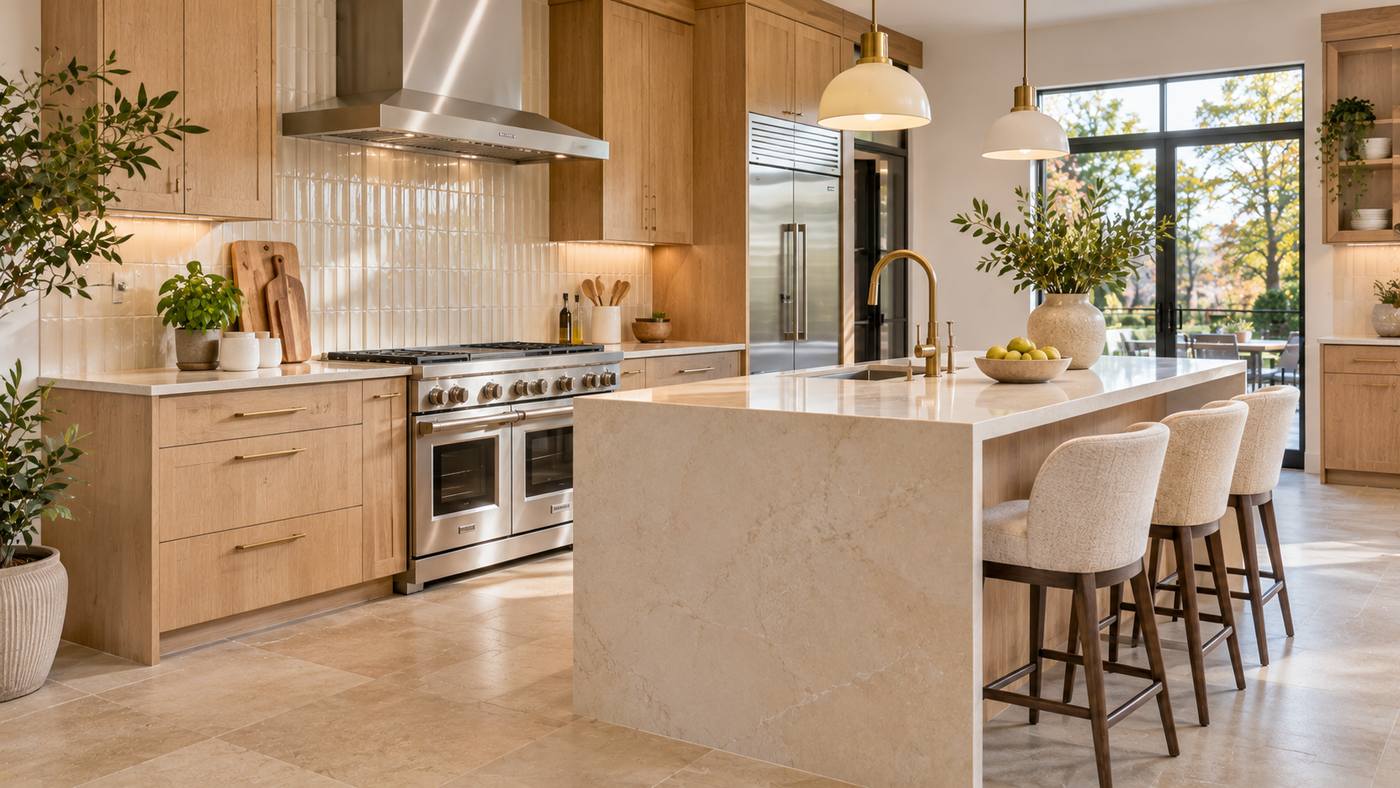
A kitchen must handle cooking spills, frequent cleaning, changing temperatures, and constant movement without losing its inviting appearance. Choosing Kitchen tiles carefully can help balance those practical demands with a style that suits the rest of the home. The right surface depends on more than colour or a photograph of a finished renovation. Material composition, slip characteristics, room proportions, installation quality, and maintenance needs all influence whether a tile remains a satisfying choice years after the project is complete.
For many homeowners, the challenge is deciding where to spend money and which design features will make a meaningful difference. A backsplash is exposed to splashes and grease, while a floor carries people, appliances, and furniture. The products that perform well in these locations are not always interchangeable. This guide explains seven essential decisions, compares common materials, and shows how to plan attractive, practical finishes without overlooking safety or construction details.
What Are Kitchen Tiles and Where Are They Used?
Kitchen tiles are individual units installed as a durable covering over prepared wall or floor surfaces. Common products include glazed ceramic, porcelain, natural stone, glass, and specialty decorative materials. Each has different characteristics, and products within the same category can vary considerably in suitability.
Kitchen Floor Tiles Versus Backsplash Tiles
The most important distinction is intended use. Some wall tiles are not designed for floors because they lack the necessary strength, wear performance, or suitable surface grip.
Check the manufacturer’s application recommendations rather than assuming that any attractive tile is suitable everywhere. A glossy decorative wall tile may be ideal above a countertop but an unsuitable choice for an area where people walk with wet shoes.
Why Surface Performance Matters
Kitchen tiles are exposed to grease, food residue, water, and cleaning products. A surface that resists staining or is easy to wipe may simplify everyday maintenance, but the grout joints and substrate must be considered too. Water resistant tile is not equivalent to a waterproof wall or floor assembly.
Recognise the Limits of Product Labels
Terms such as premium, luxury, or commercial quality do not automatically establish technical suitability. Look for published dimensions, intended applications, absorption characteristics, care instructions, and any applicable performance classifications.
7 Smart Decisions for Choosing Kitchen Tiles
1. Select the Material for the Job
Ceramic and porcelain are popular choices, but they should not be treated as identical. Both are made from fired ceramic materials. Porcelain is generally classified by very low water absorption, commonly 0.5 percent or less under established standards. This characteristic can be useful for demanding applications, although finish, wear resistance, and installation remain important.
Glazed ceramic wall tiles offer many colours, shapes, and decorative finishes. They can be suitable for backsplashes when specified for that use. Porcelain products cover a broad range of appearances, including stone effect, concrete effect, and wood look designs. The best kitchen tiles depend on the exact product and its intended location, not just whether the label says ceramic or porcelain.
Natural stone introduces genuine variation in veining and texture. Marble, limestone, slate, and granite have different maintenance considerations. Some stones are sensitive to acidic foods such as lemon juice or vinegar. A material that looks beautiful in a showroom may require more daily care than a homeowner expects.
Ask for a Technical Product Sheet
Check suitability for wall or floor installation, surface finish, thickness, size tolerance, and cleaning guidance. For natural stone, ask about sealing recommendations and expected variation between pieces. For glass or handmade tile, verify the recommended adhesive and installation method.
2. Choose Floor Finishes With Slip Risk in Mind
Kitchen floors are sometimes wet, greasy, or dusty, and a polished surface may be difficult to walk on safely under those conditions. Slip performance should therefore be part of tile selection, especially for households with children, older occupants, or people with mobility challenges.
In North America, product classifications under ANSI A326.3 use dynamic coefficient of friction measurements for certain applications, including level interior areas expected to be wet. A commonly referenced wet DCOF value is 0.42, but this number is not a universal promise of slip resistance. Actual safety depends on contamination, footwear, slope, cleaning, and the intended environment. Other regions use different testing and classification systems.
When comparing kitchen tiles, ask for the manufacturer’s declared suitability for the actual floor conditions. A matt or textured finish may be practical, but texture alone does not guarantee a safe floor. Test a sample and consider whether its surface is difficult to clean when cooking residue accumulates.
Balance Grip With Cleaning Needs
Deeply textured products can trap dirt, while very smooth finishes may become slippery under certain conditions. Choose a tested surface suitable for domestic kitchens and maintain it according to the maker’s guidance. Remove spills promptly, regardless of the selected finish.
3. Match Tile Size and Layout to Room Proportions
Large tiles can create a relatively continuous visual appearance because they usually require fewer grout joints across the same area. Smaller tiles offer opportunities for detailed patterns and can adapt to certain complex layouts. Neither format is automatically better for a small kitchen.
Kitchen tiles should be assessed against cabinet dimensions, countertop edges, doorways, and the widths of visible floor sections. A very large format may create awkward narrow cuts around an island or require a particularly flat substrate. Small mosaics may produce more joints that need regular attention.
For backsplashes, options range from familiar rectangular subway formats to squares, slim vertical rectangles, and shaped mosaics. Horizontal arrangements can emphasize width, while vertical layouts can draw attention to height.
Plan Cuts Before Ordering
Ask the installer to dry lay or digitally plan critical sections before cutting. Symmetry around a range hood, socket, or focal wall can be more noticeable than the alignment at a concealed edge. Include realistic grout joints and allow for manufacturer specified movement joints rather than forcing tiles tightly against adjoining surfaces.
4. Build a Coherent Colour and Texture Palette
A kitchen contains several large visual surfaces, including cabinets, countertops, floors, and walls. Selecting each independently can create a busy appearance. Choose a primary material, a supporting neutral, and a limited number of accents before finalising the decorative details.
For example, warm white cabinets may work with soft stone coloured floor tiles and a subdued backsplash. Dark cabinetry can provide contrast against pale surfaces, while timber accents soften cooler grey or blue tones.
Kitchen tiles can act as a quiet background or become the primary decorative feature. If the countertop already contains dramatic veining, a simpler backsplash may keep the overall design balanced. If cabinet fronts are plain, a carefully selected geometric or handmade look tile can add character without overwhelming the room.
Test Samples Under Real Lighting
Natural light, warm artificial lamps, and under cabinet lighting can change how colours appear. Review several samples beside the actual cabinet and countertop finishes at different times of day. A product’s online photograph may not accurately represent its undertone or sheen.
5. Choose Grout and Edge Details Deliberately
Grout is part of the design and part of the installation system. Its colour influences whether individual tiles stand out or blend into a larger surface. Matching grout creates a quieter result, while contrasting joints can emphasize geometry. The practical considerations include joint width, product suitability, stain resistance, and cleaning requirements.
Cement based and epoxy grout products have different handling and maintenance characteristics. Epoxy options may provide useful stain resistance in certain applications, but they can be more demanding to install and are not automatically necessary in every domestic kitchen. Use the type recommended for the tile, substrate, and intended service conditions.
Kitchen tiles should have neat transitions at exposed edges, cabinet ends, and floor thresholds. Agree on the location of movement joints and transitions before the work begins.
Understand Why Grout Cannot Stop All Water
Grout and tile are not substitutes for waterproofing where a waterproof assembly is required. Sealants, movement accommodation, and substrate preparation serve different purposes. Ask the installer how vulnerable junctions around sinks or other wet areas will be detailed.
6. Plan the Installation Around the Existing Surface
Even high quality kitchen tiles can fail when the base is unstable, uneven, contaminated, or poorly prepared. Floors need an appropriate substrate that can support the chosen tile and installation method. Walls must be sound enough for the tile’s weight, especially when large or heavy formats are proposed.
An installer should check for movement, damaged boards, existing coatings, moisture issues, and flatness limitations. If old tiles remain in place, suitability for an overlay must be assessed rather than assumed. Adding another layer can change floor height, appliance clearances, door movement, and transitions to adjoining rooms.
The correct adhesive, mortar, trowel method, grout, and curing conditions depend on the specific product and assembly. Large format tile may require specialized flatness preparation and appropriate coverage. A kitchen renovation should not proceed directly to decoration when the underlying surface needs repair.
Check the Complete Work Scope
Request a written description of substrate preparation, removal and disposal, waterproofing where needed, tile layout, edge details, grout, cleanup, and curing guidance. Clarify which work is included and how unexpected damage will be handled before the installer begins.
7. Calculate Full Project Cost and Long Term Care
Additional costs may include removing existing coverings, repairing substrates, preparing surfaces, buying adhesive and grout, creating detailed cuts, and labour. Intricate patterns or unusually large tiles can affect installation time and material waste.
Compare quotations based on the same scope rather than assuming that a low tile price delivers the lowest completed cost. Ask how many spare tiles should be retained for future repairs and whether the product could be difficult to match later. It is also sensible to budget for a small amount of material waste, with the exact allowance determined by layout complexity and the installer’s estimate.
Consider cleaning frequency and surface maintenance when deciding between materials. A low maintenance porcelain finish may be preferable in a busy family kitchen, while someone who enjoys natural stone may accept its additional care requirements.
Keep Records for Future Repairs
Store the product name, shade or batch details, grout colour, installation documents, and a few spare tiles in a safe place. These records can be valuable if a pipe leak, appliance replacement, or later renovation requires localized repair.
Comparing Popular Types of Kitchen Tiles
Understanding the general strengths and limitations of each material can narrow the shortlist without creating unrealistic expectations.
Porcelain and Glazed Ceramic
Porcelain is valued for its low absorption and the range of designs offered. Glazed ceramic is often used on walls and backsplashes because it comes in many decorative finishes. Porcelain can be difficult to cut cleanly without suitable tools, while a wall tile designed only for decoration may be unsuitable underfoot.
Natural Stone and Decorative Glass
Natural stone offers colour and veining variation that factory printed products may imitate but not reproduce exactly. Its suitability and care depend on mineral composition, porosity, and surface finish. Glass tiles reflect light and can be effective as a backsplash feature, although adhesive colour, transparency, and edge finishing require attention.
Handmade Look and Patterned Tiles
Zellige inspired, encaustic look, and patterned ceramic products create strong visual character. The terms describe different designs and production methods, so confirm the actual material. Handcrafted products can have intentional irregularities that affect joint appearance and layout. Decorative tiles with a cement body may require particular sealing and cleaning practices.
How to Design Kitchen Backsplashes That Remain Practical
A backsplash should be easy to maintain and compatible with surrounding cabinetry, worktops, and electrical fittings. Kitchen tiles installed near a sink may encounter splashes, while areas behind cooking equipment can accumulate grease. Choose a finish that tolerates the expected cleaning routine and follow guidance concerning heat exposure and clearance around appliances.
The location of the tile termination matters. A backsplash that stops abruptly beside open shelving or a tall cabinet can look unfinished. Plan the height and side edges as part of the overall elevation. If the tile extends to the ceiling, check how it will meet the cornice, ventilation hood, and other fixtures.
Classic Versus Statement Backsplashes
A restrained rectangular layout can sit comfortably in kitchens with colourful cabinets or patterned worktops. A more expressive shape or colour may work well when the surrounding surfaces are simple. The strongest design is not necessarily the most fashionable one; it is the arrangement that complements the actual room.
Kitchen Floor Tiles for Busy Households
A kitchen floor must cope with repeated foot traffic, chair movement, cooking spills, and cleaning. Kitchen tiles intended for flooring should have suitable wear characteristics, safe surface performance, and a finish the household can maintain consistently.
Consider how the tile meets adjoining rooms and whether abrupt level changes could create a trip hazard.
Comfort, Noise, and Underfloor Heating
Hard tile surfaces can feel firm underfoot and may reflect sound more than some resilient floor coverings. Where underfloor heating is planned, verify the compatibility of the tile, adhesive, substrate, and heating system before installation.
Cleaning and Maintaining Kitchen Tiles
Routine care is simpler when it matches the material. Sweep or vacuum grit before wiping floors, then use a cleaner appropriate for the tile and grout. For many glazed ceramic and porcelain surfaces, manufacturer approved mild cleaning products are sufficient. Avoid abrasive tools or harsh chemicals that could damage a delicate finish or joint.
Natural stone requires particular attention. Calcareous stones such as marble and limestone can be etched by acidic cleaners, including vinegar based products. Sealers may improve resistance to certain stains, but they do not make every stone stain proof. Ask the stone supplier which products and maintenance intervals are appropriate.
What to Do When Grout Becomes Discoloured
First identify whether the problem is surface dirt, a cleaning residue, moisture, or deterioration of the grout itself. Use compatible cleaning methods and allow the surface to dry. Replacing grout may be necessary when joints are cracked or failing, but covering a persistent moisture problem with new material is not a durable solution.
Common Mistakes to Avoid During Tile Selection
One mistake is selecting kitchen tiles solely by colour without checking their intended application. Another is choosing a highly polished floor finish without considering spill conditions and manufacturer guidance. A third is overlooking grout, edge profiles, and substrate work when calculating the budget.
A sample reviewed in the real kitchen is more informative than a promotional image viewed on a phone.
For a complex renovation, a qualified tile installer can help resolve layout, movement, waterproofing, and material compatibility questions before the work becomes expensive to change.
Frequently Asked Questions
1. What are the best kitchen tiles for flooring?
Porcelain and appropriately floor rated ceramic tiles are common options. Choose products with suitable wear performance, manufacturer declared slip suitability, and care requirements that match the household.
2. Are porcelain tiles better than ceramic tiles for kitchens?
Porcelain has very low water absorption and can suit many demanding applications, but a suitable glazed ceramic product may be excellent for backsplashes or some floors. Compare individual specifications.
3. Are glossy kitchen tiles difficult to maintain?
Glossy tiles can be easy to wipe on walls, but polished floors may show water marks and have different slip characteristics. Use only products suitable for the intended location.
4. What grout colour works best with kitchen tiles?
Matching grout creates a quieter look, while contrasting grout highlights the pattern. Consider cleaning, staining, tile edge variation, and the overall design before choosing.
5. Do kitchen tiles need sealing?
Many glazed ceramic and porcelain surfaces do not require routine tile sealing, while some natural stones or grout products may benefit from it. Follow the specific manufacturer’s recommendations.
6. How long do kitchen tiles last?
Service life varies with material quality, substrate, installation, traffic, and maintenance. Durable tiles can perform for many years when properly specified and installed, but no fixed lifespan applies to every kitchen.
Conclusion
Kitchen tiles can bring lasting character to a home when material performance and everyday use guide the design. The most successful projects balance suitable floor grip, manageable cleaning, thoughtful pattern placement, and careful installation. Reviewing real samples and complete quotations helps homeowners avoid decisions based only on appearance or a low upfront price. With sensible preparation and ongoing care, a tiled kitchen can remain functional, comfortable, and visually cohesive for years.
