
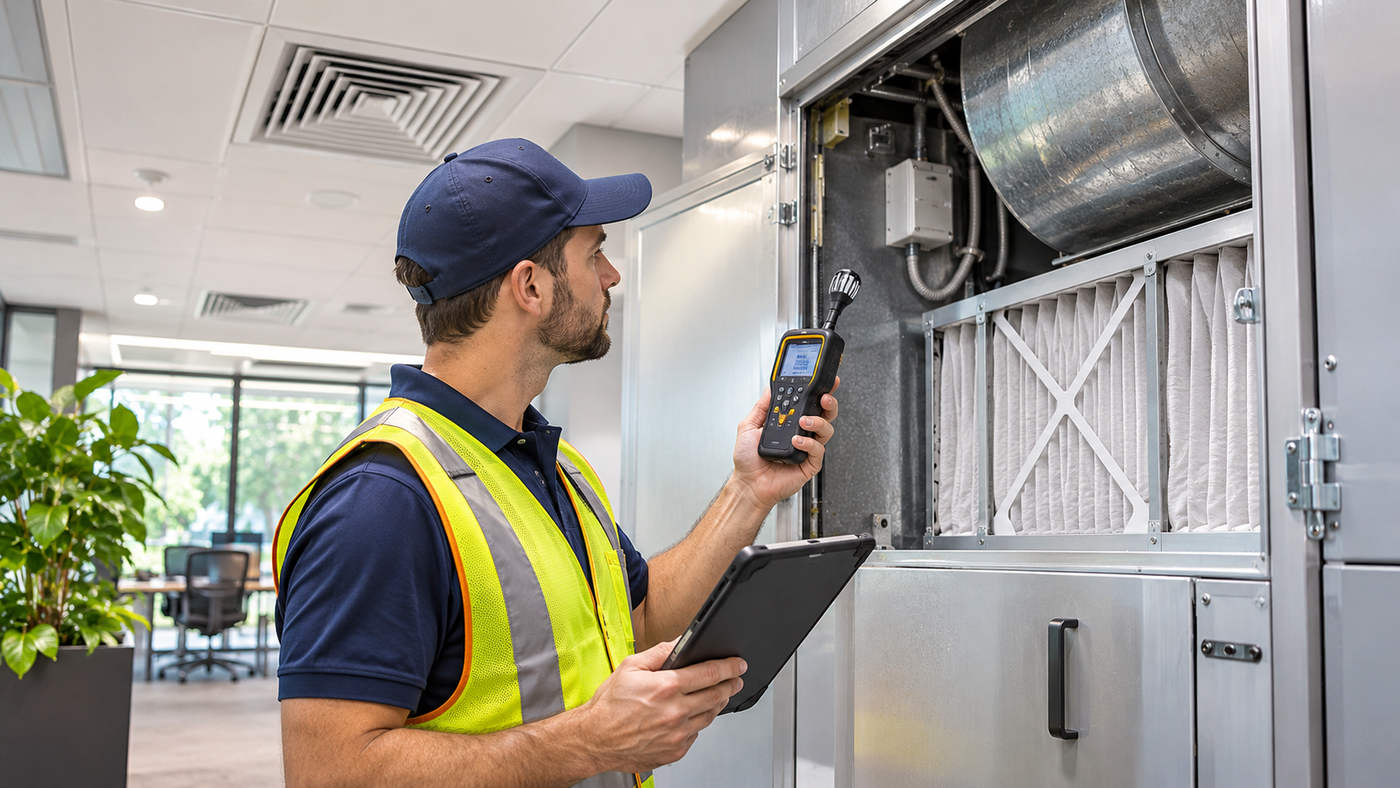
An effective indoor air quality procedure for commercial HVAC helps building owners and facility teams identify ventilation problems, control indoor pollutants, maintain equipment, and document corrective work. Rather than relying on a single air-quality reading, it combines building inspections, airflow verification, filter maintenance, moisture control, occupant feedback, and follow-up testing. The result is a repeatable management process that can support more comfortable workplaces and reduce avoidable operating problems.
Offices, shops, hotels, schools, and mixed-use buildings face different sources of indoor contamination. Outdoor traffic pollution, cleaning chemicals, damp insulation, crowded meeting rooms, and malfunctioning air-handling units can each influence indoor conditions. The right response depends on the source, the occupants, and the HVAC design. An air purifier alone cannot correct a leaking roof or a closed outdoor-air damper.
This guide presents a practical inspection and maintenance framework, explains the relevant ASHRAE standards, and shows how to investigate complaints without making unsupported claims about a building being completely safe or contaminant-free.
What Is an Indoor Air Quality Procedure for Commercial HVAC?
An indoor air quality procedure for commercial HVAC is a documented sequence used to assess and manage the environmental conditions influenced by a building’s heating, ventilation, and air conditioning system. It should define who is responsible, what equipment is inspected, which measurements are meaningful, when action is needed, and how results are recorded.
The procedure typically covers outdoor-air supply, distribution to occupied rooms, exhaust, filtration, temperature, humidity, equipment hygiene, and potential pollutant sources. It also addresses how complaints are received and escalated. A documented procedure makes it easier to spot changes over time, especially when different contractors maintain the same building.
Why Commercial Buildings Need a Consistent Process
Commercial spaces change regularly. Furniture gets rearranged, meeting rooms become more crowded, tenant activities change, and building automation schedules are adjusted. Any of these changes can affect ventilation performance. A system that worked as designed when a building opened may no longer provide appropriate conditions for current occupancy.
Indoor Air Quality Is Not Just an HVAC Problem
Ventilation and filtration are important, but they work alongside source control and moisture management. Pollutants can enter from outdoors or originate in carpeting, products, deliveries, renovation work, printers, and cleaning activities. Solving the source of a problem can be more effective than simply increasing airflow.
Who Should Own the Procedure?
Assign a facility manager or designated indoor-air-quality representative to coordinate reports and maintenance records. Qualified HVAC technicians should complete mechanical inspections, and specialist hygienists or engineers should investigate unusual hazards. Staff should have an accessible way to report recurring odors, discomfort, or visible water damage.
Which Commercial HVAC Standards and Guidelines Matter?
A useful indoor air quality procedure for commercial HVAC should be based on applicable codes, design documents, equipment instructions, and relevant technical standards. No single generic checklist establishes compliance for every building.
ASHRAE Standard 62.1 for Ventilation
ANSI/ASHRAE Standard 62.1-2025 addresses ventilation and acceptable indoor air quality for many nonresidential spaces. It covers ventilation design, air cleaning, construction and startup, and system operation and maintenance. The edition adopted into local building regulations may differ from the latest published edition, so an engineer should verify the governing requirements for a particular facility.
Ventilation Rate Procedure Versus Indoor Air Quality Procedure
ASHRAE uses the term Indoor Air Quality Procedure, or IAQP, for a specific performance-based ventilation design method. It evaluates contaminants of concern, design limits, air cleaning, and other factors. That formal design method is not identical to a day-to-day facility maintenance checklist. The more familiar Ventilation Rate Procedure calculates outdoor-air requirements based on space use, occupancy, floor area, and system factors. Qualified designers should select the appropriate approach rather than assuming that a few sensor readings can establish compliance.
ASHRAE Standard 241 and Infection-Risk Planning
ASHRAE Standard 241 provides a framework for reducing exposure to infectious aerosols, including an infection risk management mode when applicable. Its equivalent clean-airflow concepts may inform enhanced ventilation and filtration plans, but they do not replace routine source control, moisture management, or the normal ventilation requirements that apply to the building.
EPA, OSHA, and NIOSH Guidance
EPA’s commercial building guidance emphasizes source control, ventilation, maintenance, and complaint investigation. OSHA and NIOSH also provide resources on indoor-air complaints and HVAC inspections. These documents help organize good practice, but general guidance should not be presented as a universal legal threshold for every pollutant or building type.
A 12-Step Indoor Air Quality Procedure for Commercial HVAC
The following framework can be adapted into a facility operating procedure. Each step should have an assigned owner, completion date, and documented outcome. Use this indoor air quality procedure for commercial HVAC as a starting framework, then tailor each action to the building design.
Step 1: Define the Building, Zones, and Occupancy
Create a current inventory of air-handling units, rooftop units, fan-coil systems, exhaust fans, outdoor-air intakes, and served rooms. Note operating hours and expected occupancy for offices, conference rooms, kitchens, restrooms, storage spaces, and any specialized work areas. Your indoor air quality procedure for commercial HVAC should recognize that a crowded training room has different ventilation demands from a lightly occupied corridor.
Step 2: Review Drawings and Previous Performance Records
Collect available design ventilation calculations, commissioning documents, test-and-balance reports, filter specifications, maintenance logs, complaints, and building automation trends. Compare the original design assumptions with current use. Missing records are a reason to establish a new baseline, not to assume the system is functioning correctly.
Step 3: Walk Through Occupied Spaces
Inspect for persistent odors, blocked diffusers, damaged ceiling materials, visible condensation, leaks, dust buildup, and changes in how rooms are used. Ask occupants when problems occur and whether they are limited to a location or time. A systematic walkthrough often identifies issues that an isolated sensor cannot explain.
Step 4: Assess Outdoor-Air Intakes and Exhaust
Check that outdoor-air intakes are unobstructed and appropriately separated from potential pollution sources such as loading bays, vehicle exhaust, and waste areas. Verify that dampers and actuators move as intended. Review exhaust fan operation and whether undesirable pressure relationships are pulling contaminants between spaces. If outdoor air is polluted by smoke or other events, use a building-specific response plan.
Step 5: Verify Airflow and Ventilation Controls
A qualified technician should measure or validate appropriate outdoor-air rates and supply, return, and exhaust performance using suitable instruments and methods. Review demand-control ventilation sensors, occupied schedules, economizers, and overrides. A normal-looking temperature reading does not prove that the required outdoor air is reaching occupied rooms. Document deficiencies and arrange balancing or control repairs as needed.
Do Not Adjust Dampers by Guesswork
Changing an outdoor-air setting affects comfort, energy use, pressure balance, and possibly code compliance. Significant adjustments should follow an engineer’s or qualified technician’s assessment rather than a blanket instruction to open every damper fully.
Step 6: Inspect and Maintain Filtration
Record filter type, efficiency, dimensions, condition, installation fit, and differential pressure where available. Filters must seal appropriately so air does not bypass them. A MERV 13 or higher filter can improve particle removal when compatible with the equipment, but fan capability and airflow must be checked before upgrading. The indoor air quality procedure for commercial HVAC should use a replacement schedule based on manufacturer guidance, loading conditions, and inspection rather than a universal calendar alone.
Step 7: Inspect Cooling Coils and Drain Pans
Check coils, condensate pans, traps, and drains for dirt, standing water, blockage, or evidence of unwanted microbial growth. Condensate must drain correctly. Wet insulation or recurring moisture warrants investigation. Cleaning techniques and protective measures should match the equipment and contamination; workers must not improvise chemical treatment inside occupied systems.
Step 8: Monitor Temperature and Humidity
Measure temperature and relative humidity in representative zones and compare patterns with occupant feedback and building requirements. Unusually high humidity can support condensation and mould growth, while excessively dry air may cause discomfort. There is no single setting appropriate to every climate or use; the building’s design, activities, and moisture sources matter.
Step 9: Use Air-Quality Measurements for Specific Questions
An indoor air quality procedure for commercial HVAC may include CO2, particulate matter, carbon monoxide, or other measurements when they address a plausible issue. CO2 can help reveal changes in ventilation relative to occupancy, but it is not a universal measure of air safety. A single number cannot rule out chemical pollutants, mould, or poor local airflow. Select calibrated instruments and interpret readings against occupancy, outdoor conditions, and the purpose of the test.
Step 10: Control Pollutants at Their Source
Review cleaning products, renovation activities, printers, food preparation, deliveries, and any processes that generate fumes or particles. Replace or isolate problematic products where feasible, and use appropriate local exhaust. Source control should come before assuming that extra filtration will solve every concern. Tell contractors how work that creates dust or fumes must be scheduled and contained.
Step 11: Investigate Complaints and Correct Root Causes
Create a written log with the location, time, description, building conditions, initial assessment, actions taken, and follow-up. If a complaint coincides with rain, a cleaning shift, or an equipment schedule, that pattern can guide investigation. Escalate suspected carbon monoxide, significant chemical releases, sewage contamination, or widespread water damage immediately under the facility’s safety procedures.
Step 12: Verify Results and Update the Plan
After repairs, repeat the relevant observations or measurements. Confirm that airflow adjustments, filtration work, moisture repairs, or source-control changes have addressed the identified issue. Share a clear outcome with affected occupants without disclosing private information. Update the indoor air quality procedure for commercial HVAC when equipment, tenant use, occupancy, or applicable requirements change.
What Should an HVAC Indoor Air Quality Inspection Checklist Include?
An inspection sheet should be practical enough for repeated use while allowing technical notes. At minimum, include equipment identification, location, date, inspector, current conditions, findings, corrective actions, and completion status. Keep readings with their units and measurement conditions. A documented indoor air quality procedure for commercial HVAC also identifies which observations require immediate escalation.
Air Handling and Distribution Checks
Inspect outdoor-air dampers and control sequences, fans and belts, filters and seals, return paths, supply diffusers, exhaust connections, and the condition of accessible ducts. Identify disconnected sections or blocked grilles. Schedule work that requires opening equipment or entering restricted areas with appropriately trained staff. These routine checks give the indoor air quality procedure for commercial HVAC a consistent mechanical baseline.
Moisture and Hygiene Checks
Look for condensate leakage, blocked drains, wet insulation, roof or plumbing leaks, and water staining around HVAC equipment. Document where moisture appears and investigate its source. A damp surface should not be treated merely by wiping away visible growth and returning the system to normal operation.
Controls and Occupant Feedback
Review occupied and unoccupied schedules, overrides, sensor calibration, setpoints, alarms, and trends from the building automation system. Compare these with complaint records. A sensor fault or programming change can explain problems that appear to be mechanical failures.
How Often Should Commercial HVAC Air Quality Checks Be Done?
A useful indoor air quality procedure for commercial HVAC has several maintenance intervals rather than one fixed inspection date. Some checks occur daily through automation, some during routine site rounds, and others during planned professional service visits. Manufacturer instructions, operating conditions, local rules, and system risk should determine the final schedule.
Daily or Weekly Operational Reviews
Facility teams can review alarms, unusual temperatures, humidity trends, occupant reports, and critical exhaust or ventilation status. Investigate significant deviations promptly instead of waiting for scheduled preventive maintenance.
Monthly or Seasonal Inspections
Inspect filters according to actual loading and differential pressure, check drain pans and accessible moisture-prone components, and review ventilation controls. Seasonal transitions may require economizer or humidity-control checks. High-use environments or dusty sites may need more frequent attention.
Annual and Change-Triggered Assessments
Arrange a more comprehensive review of airflow, control sequences, equipment performance, and the current occupancy plan at an interval appropriate for the building. Repeat key assessments after renovations, major equipment changes, new tenants, recurring complaints, or a change in space use. These events can matter more than the calendar alone. The indoor air quality procedure for commercial HVAC should explicitly identify these change-triggered reviews.
How to Interpret CO2, Particles, and Humidity Without False Confidence
Monitoring tools support decisions, but each measures only a narrow part of indoor conditions. For example, a CO2 monitor does not identify formaldehyde, ozone, carbon monoxide, or every source of particles. An indoor air quality procedure for commercial HVAC should document why each parameter is measured and what action the result could trigger.
CO2 as a Ventilation Indicator
Indoor CO2 changes with occupancy, outdoor concentration, and ventilation. Elevated readings can prompt a review of outdoor-air delivery, but there is no universally reliable CO2 number proving a commercial room is safe or unsafe. Compare readings under similar occupancy and use calibrated equipment.
PM2.5 and Other Particle Measurements
Fine-particle monitors can reveal spikes associated with outdoor pollution, cooking, nearby construction, or internal activities. Consumer sensors differ in accuracy and may be affected by humidity. If high-stakes decisions depend on results, use suitable professional methods and interpret indoor readings alongside outdoor data. Record the method and device so the indoor air quality procedure for commercial HVAC can support meaningful future comparisons.
Humidity, Mould, and Water Damage
Repeated high humidity, condensation, and water intrusion should trigger source investigation. Measuring relative humidity alone cannot confirm whether mould exists inside a wall. If contamination affects HVAC components or porous materials, qualified remediation specialists may be needed before normal operation resumes.
Balancing Indoor Air Quality and Energy Efficiency
Commercial HVAC teams must control indoor contaminants while managing equipment capacity and energy demand. Increasing outdoor air without considering heating, cooling, or humidity loads can create new problems. A carefully planned indoor air quality procedure for commercial HVAC uses source control first, verifies required ventilation, and considers compatible filtration or supplementary air cleaning when justified.
Filtration Upgrades Must Preserve Airflow
Higher-efficiency filters may increase resistance across the filter bank. Technicians should check the unit’s capability, filter fit, and pressure drop. A filter upgrade that severely reduces airflow can undermine performance even when the filter material itself is efficient.
Portable HEPA Cleaning as a Supplement
Well-selected portable HEPA air cleaners can provide additional particle removal in specific rooms, particularly when central ventilation improvements are difficult. They do not replace required outdoor air, source control, or repairs. Avoid ozone-generating devices in occupied areas, and evaluate any advanced air-cleaning technology for effectiveness and potential byproducts.
Demand-Control Ventilation Needs Review
Occupancy-based ventilation controls can reduce unnecessary conditioning of outdoor air, but they depend on accurate sensors and appropriate programming. A space converted from low occupancy to intensive group use should prompt a review of design assumptions and controls. Energy savings should not come from compromising applicable ventilation requirements.
Handling Indoor Air Quality Complaints in Commercial Buildings
A complaint is useful evidence, not a diagnosis. Document what the person noticed, where it occurred, whether other occupants experienced it, and when it began. Review recent maintenance, construction, cleaning activities, and weather events. Take reports seriously without making medical conclusions about exposure. The indoor air quality procedure for commercial HVAC should connect every complaint to a review and a documented response.
Prioritize Urgent Safety Risks
Suspected carbon monoxide, a major chemical release, or another acute hazard calls for the building’s emergency response procedures and qualified assessment. Do not use a routine indoor air quality procedure for commercial HVAC as a substitute for evacuation rules, emergency services, or hazardous-material response.
Escalate Unresolved or Complex Problems
If a routine inspection does not identify the cause, consider a qualified industrial hygienist, mechanical engineer, or environmental specialist. Sampling should answer a specific question and use an appropriate method. Broad testing packages sold without a clear reason can generate numbers without explaining how to solve the problem.
Documentation That Makes an IAQ Procedure Auditable
Useful records include a system inventory, design and balancing reports, filter history, sensor calibration, maintenance tickets, water-damage records, complaint logs, and evidence that corrective work was completed. Keep documents accessible to authorized staff and contractors. Trend data can help identify repeating faults that a single visit misses.
Assign Responsibility and Close Every Action
Each issue needs an owner, a due date, and a verification step. Note when a contractor recommends a further investigation or an engineering change. An indoor air quality procedure for commercial HVAC becomes more reliable when the facility team closes the loop rather than treating an inspection report as the end of the task.
Provide Staff With a Simple Reporting Route
Occupants should know who to contact when they notice unusual odors, blocked vents, standing water, or persistent discomfort. A short reporting form is useful if it captures location, timing, and observations without asking staff to diagnose contaminants themselves.
Common Mistakes in Commercial HVAC IAQ Management
A common mistake is treating filter replacement as the entire air-quality program. Another is making major damper adjustments without measuring resulting ventilation. Buildings may also ignore moisture damage until a smell becomes persistent or interpret a single CO2 reading as proof that all pollutants are controlled.
Some operators invest in expensive sensors but fail to maintain them, review their trends, or respond to alarms. Others use a one-time report long after tenants, operating schedules, or equipment have changed. The most useful indoor air quality procedure for commercial HVAC is one that can be repeated and improved with real observations.
Frequently Asked Questions
1. What is an indoor air quality procedure for commercial HVAC?
It is a documented process covering ventilation checks, filtration, moisture inspection, relevant measurements, pollutant source control, complaints, corrective work, and verification.
2. Which ASHRAE standard applies to commercial ventilation?
ASHRAE Standard 62.1 is a key reference for many commercial buildings. Verify the edition adopted locally and any specific requirements for the building’s use.
3. Is a MERV 13 filter required in every commercial HVAC system?
Not universally. MERV 13 or higher can improve particle capture when compatible with the system, but applicable requirements and equipment capacity must be evaluated.
4. Does a low CO2 reading prove indoor air is healthy?
No. CO2 can inform ventilation assessment, but it does not measure all pollutants or rule out moisture, chemical, and particulate hazards.
5. How often should commercial HVAC indoor air quality be inspected?
Use routine operational checks, scheduled maintenance, and comprehensive reassessments after system changes, renovations, occupancy changes, or recurring complaints.
6. Can an indoor air quality procedure for commercial HVAC reduce energy costs?
It can help identify inefficient operation, but energy improvements must preserve adequate ventilation, humidity management, and appropriate filtration.
Conclusion
An effective indoor air quality procedure for commercial HVAC starts with knowing the building, verifying ventilation, controlling pollutant sources, and keeping equipment dry and well maintained. Reliable inspections, relevant measurements, and a clear complaint process help facility teams identify problems without relying on simplistic air-quality claims. The procedure should also distinguish everyday maintenance from formal engineering compliance and emergency response. With assigned responsibility and documented follow-up, commercial buildings can manage indoor conditions more consistently over time.
