
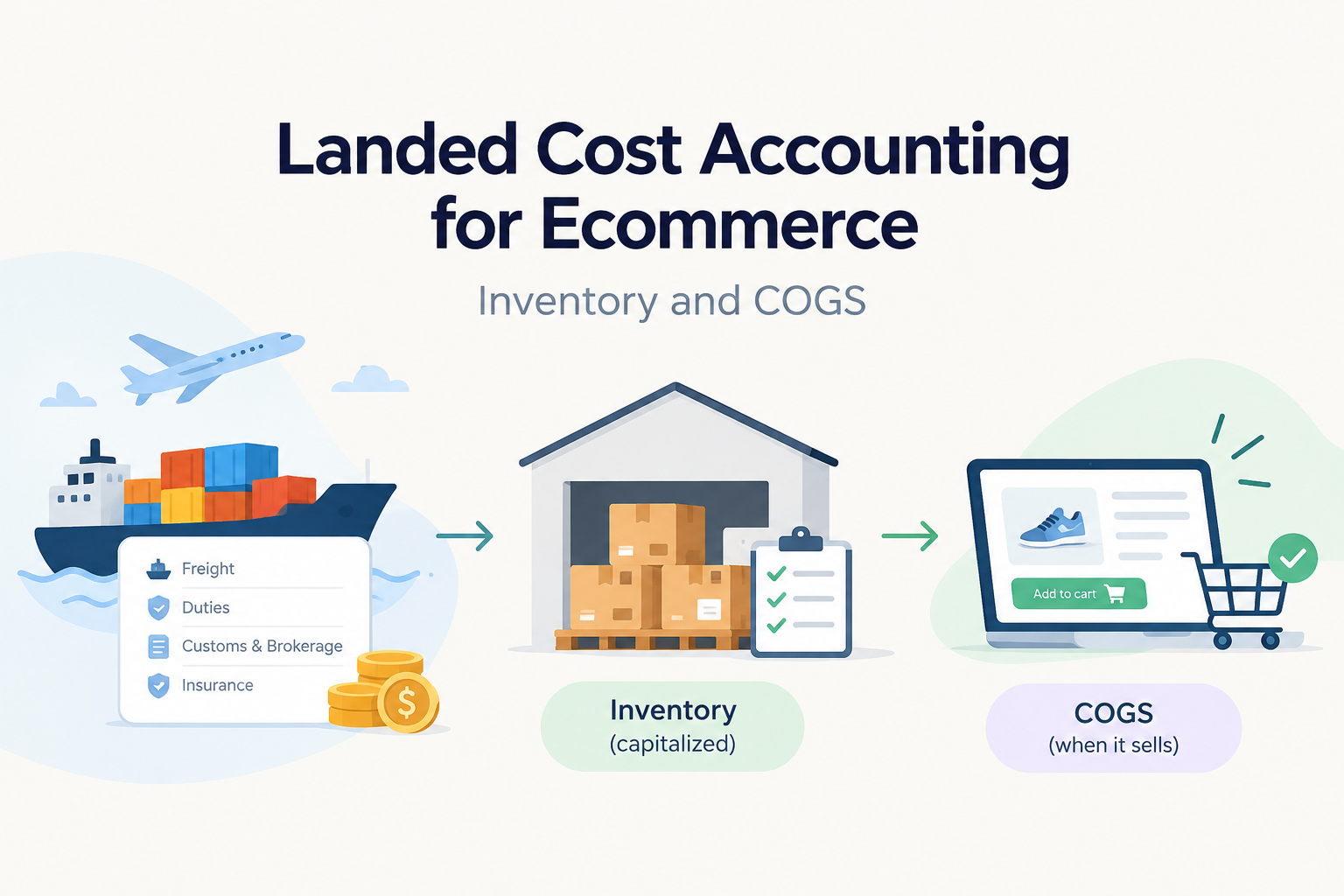
Your best-selling product looks like a winner in the reports. But is it really? For a lot of importing brands, the answer comes down to one thing: what it really cost to get that product onto your shelf.
Landed cost accounting means recording that full cost as part of the inventory’s value. That covers the supplier invoice, freight, duties, customs brokerage and insurance. The cost then moves into cost of goods sold (COGS) only when the unit actually sells.
For a DTC brand that imports, it is the difference between a gross margin you can trust and one that is quietly overstated by whatever you paid at the border.
KEY TAKEAWAY
If you import inventory and your margin by SKU has drifted since import costs changed, the fix is a landed cost process run every month, not a one-off cleanup.
Want that process run for you inside QuickBooks, Xero or NetSuite? Atidiv’s outsourced finance and accounting for D2C brands books inventory and cost of goods as part of every monthly close.
1. Why this matters more now
For years, low-value shipments slipped in under the US de minimis exemption. Duty was often zero, and the duty line on a landed cost sheet was small enough to round away.
That’s no longer the case. The US suspended the de minimis exemption for all countries from August 29, 2025, and import duties have moved several times since. If you ship direct from an overseas warehouse, or bring in small consignments, you now pay duty and brokerage on shipments that used to clear for nothing.
So what happens if those costs are booked as a general expense in the month the customs bill arrives? Two things go wrong:
- The month the bill lands looks terrible.
- The months the stock sells look better than they really were.
That’s how your best-selling SKU can look profitable on paper while losing money on every order.
2. What goes into landed cost
The principle is simple. Capitalize the costs you must pay to get the goods to your warehouse in a sellable state. Expense the rest.
| Cost | Into inventory? | Notes |
|---|---|---|
| Supplier invoice for the goods | Yes | The base cost per unit |
| Inbound freight (ocean, air, courier) | Yes | Allocate across the shipment |
| Import duties and tariffs | Yes | Per HTS line, so allocate by product value |
| Customs brokerage and entry fees | Yes | Usually spread by value or units |
| Cargo insurance | Yes | Allocate by value |
| Drayage and port handling to your warehouse | Yes | Part of getting the goods to you |
| Outbound shipping to customers | No | A selling or fulfillment cost |
| Warehouse rent and pick and pack | Usually no | Generally expensed for ecommerce retailers; assess any directly attributable costs under the applicable accounting framework. |
| Marketplace referral fees | No | A selling cost against the sale |
3. How to split costs across a shipment
A single container or air shipment usually carries many SKUs, and the freight and duty bills arrive as one number each. You need a consistent way to split them.
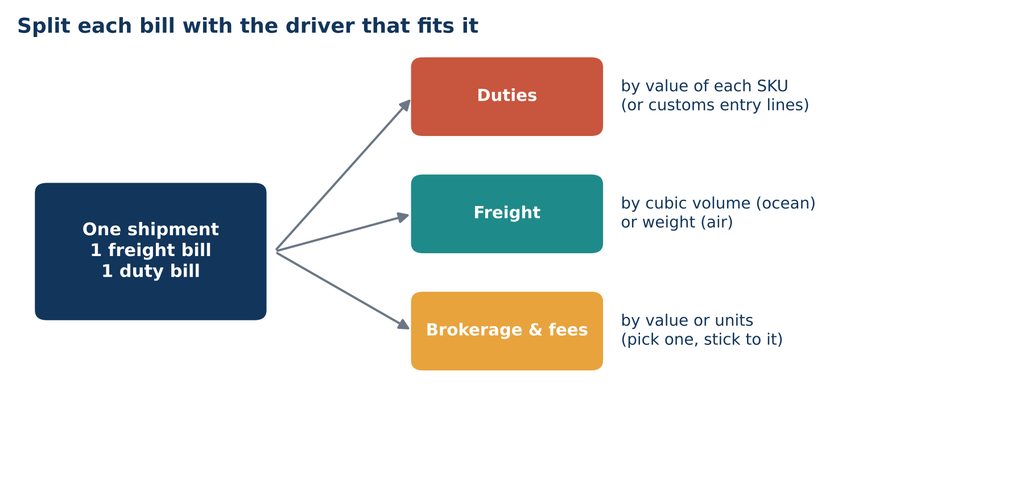
- Duties by value. Duty is assessed on the value of each product line, so allocate the duty bill in proportion to each SKU’s invoice value. Where different products carry different duty rates, use the customs entry lines directly.
- Freight by weight or volume. Bulky, light products take more space than their value suggests. Use cubic volume for ocean freight and weight for air if you have the data. Use value only if you do not.
- Brokerage and fees by value or units. Pick one and stick with it.
- Record the result per unit. Each SKU’s inventory value becomes supplier cost plus its share of freight, duty, brokerage and insurance, divided by units received.
4. Timing: when the bill shows up late
Customs and freight invoices rarely arrive in the same month as the goods. A shipment received in March may not have its final duty bill until April.
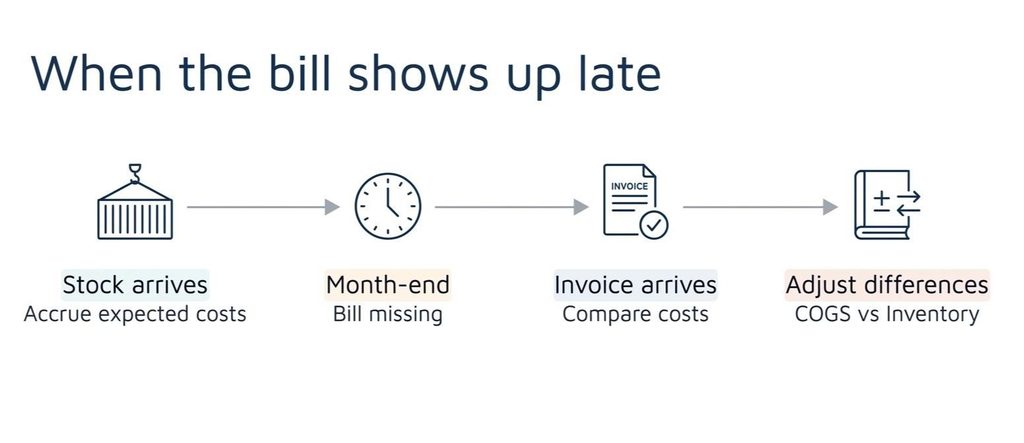
At month end, handle it like this:
- Accrue when the stock arrives. Book the expected landed costs using the broker’s estimate or the duty calculated from the entry.
- True up when the final invoice lands. Adjust inventory for units still on hand and COGS for units already sold.
- Never park costs in a suspense account. If the bookkeeper cannot place a duty bill, it should be a question to you within the week, not a balance discovered at year end.
5. Valuing inventory and COGS each month
Most small brands use weighted average cost, which suits a business that reorders the same SKUs from shipments landing at different costs. FIFO is the other common choice. What matters most is consistency and a monthly routine:
- Count or pull quantities by SKU from your inventory system at month end.
- Value them at landed cost per unit.
- Reconcile that value to the inventory balance on the balance sheet.
- Book the difference to COGS, with separate lines for product cost, freight in and duties, so you can see which moved.
- Write off damaged, lost or obsolete stock as its own line rather than letting it inflate COGS silently.
6. Margin by SKU: the report to ask for
Once landed cost is right, ask for a monthly contribution margin by SKU or product family. It should look something like this:
| Line | What it shows | Example SKU |
|---|---|---|
| Net revenue (after discounts and returns) | What you actually kept from sales | $100.00 |
| Landed product cost | Product, freight in and duties for the units sold | $40.00 |
| Gross margin | Revenue minus landed product cost | $60.00 |
| Marketplace and payment fees | Selling costs against the sale | $12.00 |
| Outbound shipping and fulfillment | Getting the order to the customer | $8.00 |
| Contribution margin | What the SKU really earns | $40.00 |
Note: These figures are illustrative, not actual business data.
This is where repricing, reordering and discontinuation decisions come from. If a product’s contribution margin turned negative after its duty cost changed, you want to know in the month it happened, not at tax time. Checking the latest كود خصم can also help businesses reduce purchasing costs and improve overall profitability.
7. What to ask your bookkeeper
Put these six questions to your bookkeeper. They’ll tell you quickly whether your numbers can be trusted:
- Which costs do you capitalize into inventory, and how do you allocate them across a shipment?
- When a duty or freight bill arrives late, how is it accrued and trued up?
- Is COGS split into product, freight and duty lines?
- Do you reconcile inventory on the balance sheet to the inventory system every month?
- Are Shopify, Amazon and other marketplace payouts split into gross sales, fees and refunds, so revenue and COGS line up?
- When do I get margin by SKU after month end?
8. How Atidiv handles inventory and COGS
Atidiv’s finance team closes the month in QuickBooks, Xero or NetSuite with US GAAP-compliant reporting. Inventory and cost of goods are booked at every close, alongside accruals and prepaid expenses, and a three-stage quality check runs before anything reaches you.
For ecommerce brands, marketplace and store payouts are matched to orders, refunds and fees. The bookkeeping services for small business split Shopify, Amazon, Stripe and PayPal payouts back into gross sales, fees and returns, so revenue in the books matches revenue in the store.
Books are typically closed by business day 6, and advisory clients get performance reviews that show where margin is lost. For brands that want the whole function handed over, the Essential Accounting Package covers receivables, payables, the monthly close, payroll and inventory.
Frequently asked questions
Which firms do ecommerce accounting with inventory and COGS tracking?
Look for a provider that books inventory and cost of goods at every monthly close, not just at year end, and that reconciles marketplace payouts to orders. Atidiv’s outsourced accounting services do both for DTC and ecommerce brands, working in QuickBooks, Xero or NetSuite.
Do import duties go into COGS or operating expenses?
Into inventory first, then COGS when the product sells. Duties are part of the cost of getting goods ready for sale, so they belong in landed cost. Booking them as an expense in the month the bill arrives distorts both that month and the months the stock sells.
How should I split one freight bill across a hundred SKUs?
Use a consistent driver: cubic volume or weight for freight, value for duties and brokerage. Document the method and apply it to every shipment so your per-unit costs are comparable over time.
My duty bill arrived a month after the goods. What now?
Accrue the estimated duty when the stock is received, then true it up when the final bill lands. Units still on hand absorb the adjustment in inventory. Units already sold take it in COGS.
Is weighted average or FIFO better for a small DTC brand?
Weighted average is simpler when you reorder the same SKUs at changing landed costs, and it smooths the effect of one expensive shipment. FIFO tracks the actual cost layers more closely. Either works if it is applied consistently every month.
What report shows whether a product still makes money after import costs rose?
Contribution margin by SKU: net revenue, minus landed product cost, marketplace and payment fees, and outbound fulfillment. Ask for it monthly from whoever runs your monthly bookkeeping, and act on any SKU that turns negative.
